
Does Medicare Cover Back Surgery — Complete Guide 2026
Does Medicare cover back surgery in 2026? Back pain is one of the most common medical complaints among Medicare beneficiaries — and back surgery is one of the most frequently performed procedures in the Medicare population. The good news is that yes — Medicare does cover back surgery in 2026 when it is medically necessary. In this complete guide we explain exactly what Medicare covers for back surgery in 2026 — what types of back surgery are covered, who qualifies for Medicare back surgery coverage, how much back surgery costs with Medicare, what rehabilitation is covered after back surgery, and how Medicare Advantage handles back surgery coverage. All information is sourced from Medicare.gov and CMS.gov.
Also Read —
- When to Enroll in Medicare — Complete Timeline 2026
- Medicare Advantage vs Medigap — Which is Better in 2026?
- Medicare Part D Drug Coverage Explained Simply 2026
What You Will Learn — Does Medicare Cover Back Surgery
- Does Medicare cover back surgery in 2026
- What types of back surgery Medicare covers
- Who qualifies for Medicare back surgery coverage
- Which part of Medicare covers back surgery
- How much does back surgery cost with Medicare
- Does Medicare cover spinal fusion surgery
- Does Medicare cover minimally invasive back surgery
- Does Medicare cover back surgery rehabilitation
- Does Medicare Advantage cover back surgery
- Frequently asked questions about Medicare back surgery coverage 2026
Does Medicare Cover Back Surgery in 2026?
Yes — Medicare does cover back surgery in 2026 when it is medically necessary. Back surgery is covered by Medicare as a medically necessary procedure for patients whose back pain, nerve compression, or spinal instability has not responded adequately to conservative treatment and who meet the clinical criteria for surgical intervention.
Medicare back surgery coverage in 2026 applies to a wide range of spinal procedures including discectomy for herniated discs, laminectomy for spinal stenosis, spinal fusion for instability, vertebroplasty and kyphoplasty for compression fractures, and many other surgical procedures designed to address structural spinal problems causing significant pain and functional impairment.
Medicare does not automatically cover every back surgery request — your doctor must document medical necessity showing that your condition meets Medicare’s clinical criteria and that conservative treatments have been tried without adequate relief. The standard of medical necessity is central to Medicare back surgery coverage.
What Types of Back Surgery Does Medicare Cover?
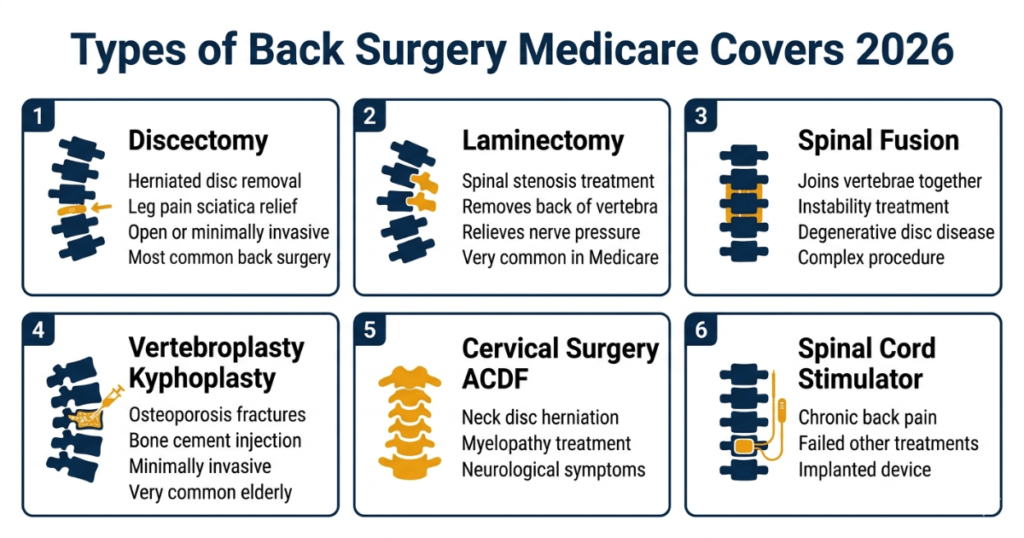
Medicare covers a comprehensive range of back surgery procedures in 2026 when medically necessary. Here are the most common types of back surgery Medicare covers:
Discectomy — Herniated Disc Surgery
Medicare covers discectomy — surgical removal of all or part of a herniated intervertebral disc — when the herniated disc is causing significant nerve compression with documented neurological symptoms such as leg pain (sciatica), numbness, weakness, or bowel and bladder dysfunction. Medicare covers both traditional open discectomy and minimally invasive microdiscectomy.
Laminectomy — Spinal Stenosis Surgery
Medicare covers laminectomy — removal of the lamina (the back part of the vertebra) to relieve pressure on the spinal cord or nerve roots caused by spinal stenosis. Spinal stenosis is extremely common among Medicare beneficiaries and laminectomy is one of the most commonly performed back surgeries in the Medicare population. Medicare covers laminectomy when stenosis is causing significant symptoms that have failed to improve with conservative treatment.
Spinal Fusion Surgery
Medicare covers spinal fusion — surgically joining two or more vertebrae together to eliminate painful motion and stabilize the spine. Spinal fusion is covered when medically necessary for conditions including:
- Degenerative disc disease with spinal instability
- Spondylolisthesis — slippage of one vertebra over another
- Spinal deformity including scoliosis and kyphosis
- Failed prior spinal surgery requiring revision
Vertebroplasty and Kyphoplasty — Compression Fracture Surgery
Medicare covers vertebroplasty and kyphoplasty — minimally invasive procedures to treat painful vertebral compression fractures typically caused by osteoporosis. These procedures involve injecting bone cement into fractured vertebrae to stabilize them and relieve pain. Vertebral compression fractures are very common among elderly Medicare beneficiaries with osteoporosis.
Cervical Spine Surgery
Medicare covers surgery on the cervical spine — the neck portion of the spine — including anterior cervical discectomy and fusion (ACDF) and cervical laminoplasty when medically necessary for herniated cervical discs, cervical stenosis, or cervical myelopathy causing neurological symptoms.
Minimally Invasive Spine Surgery
Medicare covers minimally invasive spine surgery techniques including minimally invasive discectomy, minimally invasive laminectomy, and minimally invasive spinal fusion. The type of surgical approach — open versus minimally invasive — does not affect Medicare coverage as long as the procedure itself is medically necessary.
Spinal Cord Stimulator Implantation
Medicare covers spinal cord stimulator implantation for chronic back and leg pain in carefully selected patients who have failed other treatments. This involves implanting a device that delivers electrical impulses to interrupt pain signals.
Who Qualifies for Medicare Back Surgery Coverage?
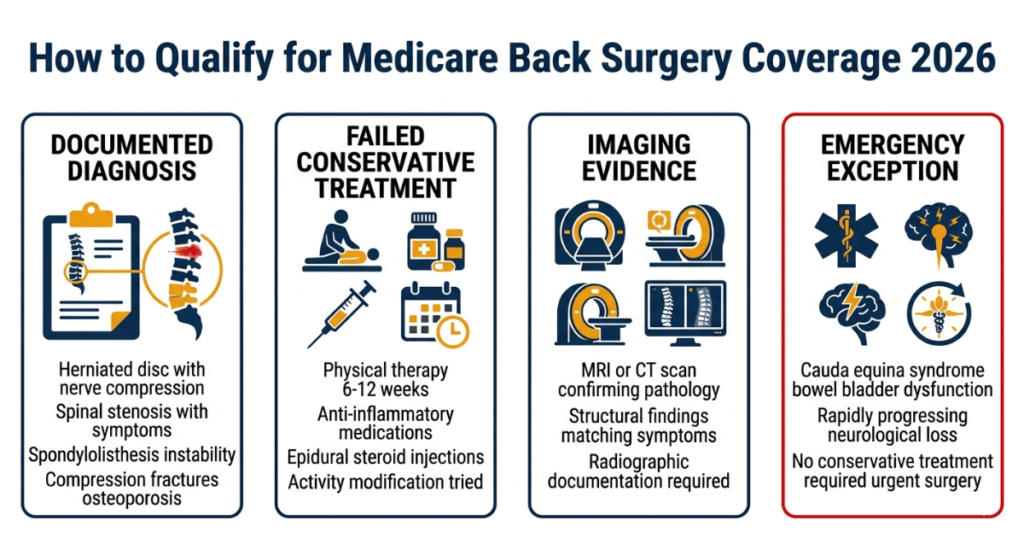
For Medicare to cover back surgery in 2026 you must meet specific medical necessity criteria. Here is what Medicare requires:
Documented Diagnosis
You must have a documented diagnosis of a spinal condition causing significant pain and functional impairment. Common qualifying diagnoses include:
- Lumbar disc herniation with nerve compression
- Lumbar spinal stenosis
- Cervical disc herniation with myelopathy or radiculopathy
- Degenerative disc disease with spinal instability
- Spondylolisthesis — vertebral slippage
- Vertebral compression fractures
- Spinal deformity causing pain or neurological compromise
Failed Conservative Treatment
Medicare generally requires documentation that conservative treatment has been tried without adequate relief before approving elective back surgery. Conservative treatments that should be documented include:
- Physical therapy — typically 6 to 12 weeks of documented treatment
- Anti-inflammatory medications and pain management
- Epidural steroid injections
- Activity modification and lifestyle changes
- Chiropractic treatment in some cases
Exception for Neurological Emergencies
When back surgery is required as a neurological emergency — cauda equina syndrome with bowel or bladder dysfunction, rapidly progressive neurological deficits, or other urgent conditions — Medicare covers emergency back surgery without requiring prior failed conservative treatment.
Imaging Evidence
Medicare requires radiographic evidence — MRI, CT scan, or X-rays — demonstrating structural spinal pathology consistent with the symptoms and surgical indication. Documentation of imaging findings is essential for establishing medical necessity.
Surgical Candidacy
Your physician and surgeon must determine that you are medically fit for surgery and that the expected benefits outweigh the surgical risks given your overall health status.
Which Part of Medicare Covers Back Surgery?
Medicare Part A — Inpatient Back Surgery
Most complex back surgeries — particularly spinal fusion, laminectomy, and cervical spine procedures — are performed as inpatient procedures requiring a hospital stay. Medicare Part A covers the hospital facility costs for inpatient back surgery.
Medicare Part A inpatient back surgery costs:
- Part A deductible — $1,676 per benefit period
- Hospital days 1 to 60 — $0 after deductible
- Hospital days 61 to 90 — $419 per day coinsurance
Medicare Part B — Outpatient Back Surgery and Surgeon Fee
Minimally invasive back surgery procedures are increasingly performed on an outpatient basis — same-day surgery where patients go home the same day. When performed outpatient Medicare Part B covers 80% of the Medicare-approved amount after the $257 annual Part B deductible.
Regardless of inpatient or outpatient setting Medicare Part B always covers the surgeon’s professional fee at 80% after the Part B deductible.
How Much Does Back Surgery Cost with Medicare in 2026?
Inpatient Back Surgery with Original Medicare
Part A costs:
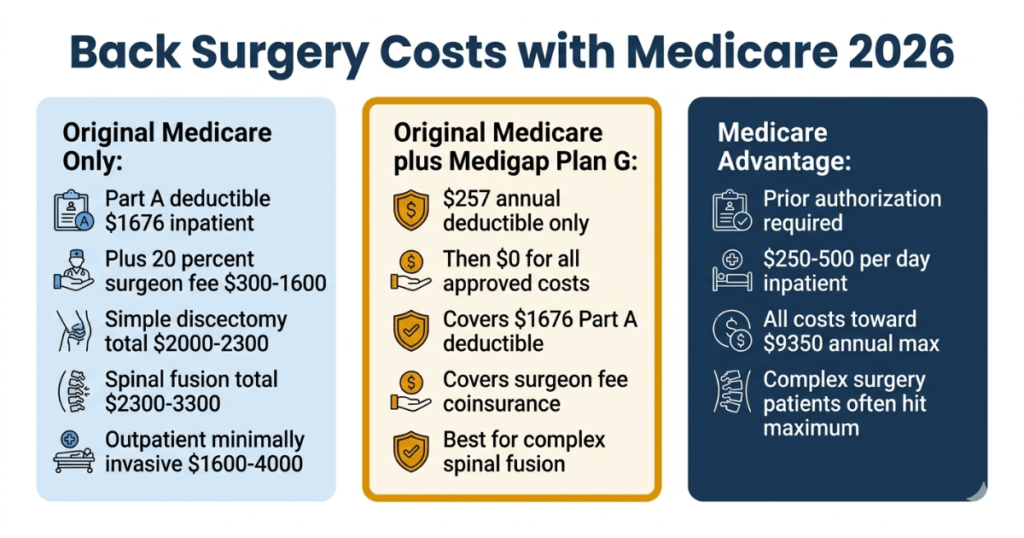
- Part A deductible — $1,676 per benefit period
- Hospital days 1 to 60 — $0 after deductible
Part B costs for surgeon fee:
- 20% coinsurance on Medicare-approved surgeon fee
- Surgeon fee varies significantly by procedure
- Simple discectomy surgeon fee — approximately $1,500 to $3,000 approved — your 20% is $300 to $600
- Complex spinal fusion surgeon fee — approximately $3,000 to $8,000 approved — your 20% is $600 to $1,600
Total approximate out-of-pocket for inpatient back surgery with Original Medicare:
- Simple discectomy or laminectomy — approximately $2,000 to $2,300
- Complex spinal fusion — approximately $2,300 to $3,300
Outpatient Back Surgery with Original Medicare
Part B costs:
- $257 annual Part B deductible
- 20% coinsurance on total Medicare-approved amount — surgeon plus facility
- Outpatient minimally invasive discectomy Medicare-approved total — approximately $8,000 to $20,000
- Your 20% coinsurance — approximately $1,600 to $4,000
With Medigap Plan G
Medigap Plan G provides the most comprehensive financial protection for back surgery. After your $257 annual Part B deductible Plan G covers 100% of Medicare-approved cost-sharing for both inpatient and outpatient back surgery. Your effective cost with Plan G after the annual deductible is $0 for all Medicare-approved costs.
For complex spinal fusion surgery where inpatient costs alone can approach $3,000 out of pocket under Original Medicare Medigap Plan G provides substantial financial protection.
With Medicare Advantage
Medicare Advantage plans cover back surgery with their own cost-sharing:
- Prior authorization required for elective back surgery
- Inpatient back surgery — typically $250 to $500 per day for first few days
- Outpatient back surgery — copay or coinsurance
- All costs count toward $9,350 annual out-of-pocket maximum
Does Medicare Cover Spinal Fusion Surgery?
Does Medicare cover spinal fusion surgery in 2026? Yes — Medicare covers spinal fusion surgery when it is medically necessary. Spinal fusion is covered for conditions including degenerative disc disease with instability, spondylolisthesis, spinal deformity, and failed prior surgery requiring revision.
Spinal fusion is one of the more complex and expensive back surgeries — and Medicare’s coverage is comprehensive for medically necessary procedures. However the medical necessity criteria are strictly applied — Medicare requires strong documentation of the clinical indication and failed conservative treatment before covering spinal fusion.
The cost of spinal fusion is significant — even with Medicare coverage your out-of-pocket cost without a supplement can be substantial. Medigap Plan G eliminates these costs after the annual deductible making it the most financially protective option for patients undergoing spinal fusion.
Does Medicare Cover Back Surgery Rehabilitation?
Does Medicare cover back surgery rehabilitation in 2026? Yes — Medicare covers comprehensive rehabilitation following back surgery through multiple pathways.
Skilled Nursing Facility Rehabilitation
Medicare Part A covers skilled nursing facility care following a qualifying 3-day inpatient hospital stay — up to 100 days per benefit period. SNF coverage provides days 1 to 20 at $0 and days 21 to 100 at $209.50 per day coinsurance.
Home Health Physical Therapy
For homebound patients after back surgery Medicare covers home health physical therapy at 100% — no cost to you — when ordered by your physician. Home health is particularly valuable for patients recovering from complex spinal surgery who cannot yet travel to outpatient physical therapy.
Outpatient Physical Therapy
Medicare Part B covers outpatient physical therapy rehabilitation at 80% after the $257 annual Part B deductible with no hard session limit. Most back surgery patients require 8 to 16 weeks of outpatient physical therapy. Your 20% coinsurance is approximately $16 to $35 per session.
Inpatient Rehabilitation Facility
For patients needing intensive post-surgical rehabilitation Medicare Part A covers inpatient rehabilitation facility care following a qualifying hospital stay when the patient requires and can tolerate at least 3 hours per day of therapy.
Does Medicare Advantage Cover Back Surgery?
Does Medicare Advantage cover back surgery in 2026? Yes — all Medicare Advantage plans must cover back surgery as a Medicare-covered service. Important Medicare Advantage considerations for back surgery include:
Prior authorization — virtually all Medicare Advantage plans require prior authorization for elective back surgery. Your surgeon’s office typically handles this process but ensure authorization is obtained before your surgery date. Some plans require second surgical opinions before authorizing complex procedures like spinal fusion.
Network requirements — confirm your spine surgeon and the hospital or surgery center are in your plan’s network before scheduling surgery. For complex spinal surgery you may want access to a specialized spine center — verify these facilities are in-network.
Post-surgical care network — confirm your preferred rehabilitation facility or home health agency is in-network before surgery.
Out-of-pocket maximum — all back surgery and rehabilitation costs count toward your $9,350 annual out-of-pocket maximum. Complex spinal fusion patients often reach this maximum during their hospitalization.
Frequently Asked Questions — Does Medicare Cover Back Surgery
Does Medicare cover back surgery in 2026?
Yes — Medicare covers back surgery in 2026 when medically necessary. Covered procedures include discectomy for herniated discs, laminectomy for spinal stenosis, spinal fusion for instability, and many other procedures. You must have a documented diagnosis, evidence of failed conservative treatment, and imaging confirming structural pathology.
Does Medicare cover spinal fusion surgery?
Yes — Medicare covers spinal fusion when medically necessary for conditions including degenerative disc disease with instability, spondylolisthesis, spinal deformity, and revision surgery. Medical necessity documentation is strictly reviewed — your surgeon must clearly document the clinical indication and failed conservative treatment.
How much does back surgery cost with Medicare?
With Original Medicare inpatient back surgery costs approximately $2,000 to $3,300 out of pocket depending on complexity. Outpatient minimally invasive surgery can cost $1,600 to $4,000. With Medigap Plan G your effective cost after the $257 annual deductible is $0 for all Medicare-approved costs. Medicare Advantage limits costs to the $9,350 annual maximum.
Does Medicare require prior authorization for back surgery?
Original Medicare does not require prior authorization for back surgery — medical necessity is determined by your doctor’s documentation. Medicare Advantage plans virtually always require prior authorization for elective back surgery. Emergency back surgery — such as cauda equina syndrome — does not require prior authorization under any plan type.
Does Medicare cover minimally invasive back surgery?
Yes — Medicare covers minimally invasive back surgery when the procedure itself is medically necessary. The surgical approach — open versus minimally invasive — does not affect Medicare coverage. Minimally invasive procedures are covered at the same rates as traditional open procedures.
Does Medicare cover back surgery rehabilitation?
Yes — Medicare covers comprehensive back surgery rehabilitation including skilled nursing facility care, home health physical therapy at 100%, and outpatient physical therapy at 80% after deductible with no session limit.
Summary — Does Medicare Cover Back Surgery 2026
Does Medicare cover back surgery in 2026? Yes — Medicare provides comprehensive coverage for medically necessary back surgery including discectomy, laminectomy, spinal fusion, vertebroplasty, and many other procedures. Medical necessity documentation is essential — your surgeon must clearly document your diagnosis, failed conservative treatment, and imaging findings.
Medigap Plan G provides the most comprehensive financial protection for back surgery — eliminating all Medicare-approved cost-sharing after the $257 annual deductible. For complex procedures like spinal fusion where out-of-pocket costs can reach thousands of dollars without a supplement Plan G provides substantial financial protection.
For free help understanding your Medicare back surgery coverage contact your State Health Insurance Assistance Program (SHIP) at shiphelp.org or call Medicare free at 1-800-633-4227.
This guide is for informational purposes only and is not medical advice. Always consult your spine surgeon and verify current Medicare coverage at Medicare.gov before making surgical decisions.
Sources: Medicare.gov | CMS.gov | SSA.gov | AARP.org
Last updated: April 2026 | Author: James Carter, Independent Medicare Research Analyst