Does Medicare Cover Eye Exams — Complete Guide 2026
Does Medicare cover eye exams in 2026? This is one of the most commonly asked Medicare coverage questions — and the answer is more nuanced than most people expect. The short answer is that Original Medicare does not cover routine eye exams for glasses or contact lenses, but Medicare does cover medically necessary eye exams for specific eye conditions and diseases. Understanding exactly what Medicare covers for eye care helps you avoid unexpected bills and make smart decisions about your Medicare coverage. In this complete guide we explain exactly what Medicare covers for eye exams in 2026 — what is covered, what is not covered, when eye exams are medically necessary, how much eye exams cost with Medicare, and how Medicare Advantage handles vision coverage. All information is sourced from Medicare.gov and CMS.gov.
Also Read —
- How to Switch Medicare Plans 2026 — Complete Guide
- Does Medicare Cover Dental and Vision 2026
- Medicare Advantage vs Original Medicare 2026
What You Will Learn — Does Medicare Cover Eye Exams
- Does Medicare cover eye exams in 2026
- What types of eye exams Medicare covers
- Does Medicare cover routine vision exams for glasses
- Does Medicare cover glaucoma testing
- Does Medicare cover diabetic eye exams
- How much does an eye exam cost with Medicare
- Does Medicare cover glasses or contact lenses
- Does Medicare Advantage cover eye exams
- How to get eye exam coverage as a Medicare beneficiary
- Frequently asked questions about Medicare eye exam coverage 2026
Does Medicare Cover Eye Exams in 2026?
Medicare coverage for eye exams in 2026 depends entirely on the purpose of the exam. Original Medicare has two very different approaches to eye care — one for routine vision exams and one for medically necessary eye care.
Original Medicare does not cover routine eye exams — exams performed to check your vision and update your glasses or contact lens prescription. This exclusion is one of the most significant gaps in Original Medicare coverage and affects millions of seniors who need annual vision checks.
However Original Medicare does cover eye exams that are medically necessary — meaning exams to diagnose, treat, or monitor specific eye diseases and conditions. When an eye exam is ordered to evaluate glaucoma, diabetic retinopathy, macular degeneration, or other medical eye conditions Medicare Part B covers it as a medically necessary service.
This distinction between routine vision exams and medically necessary eye care is the foundation of Medicare eye exam coverage in 2026. Understanding which category your exam falls into determines whether Medicare will pay.
What Types of Eye Exams Does Medicare Cover?
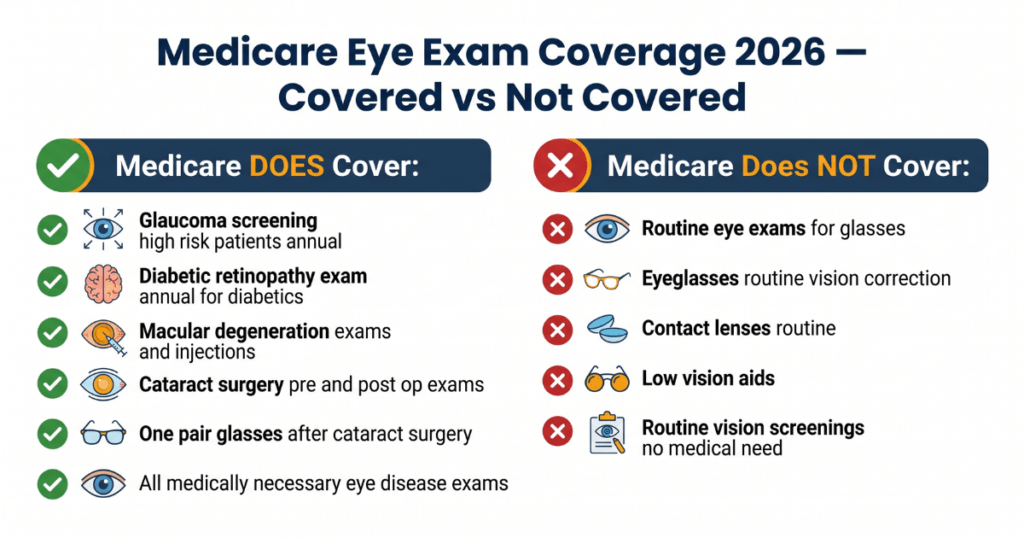
Glaucoma Testing — Covered by Medicare
Medicare Part B covers annual glaucoma screening exams for beneficiaries who are at high risk for glaucoma. Medicare covers glaucoma testing for:
- People with diabetes
- People with a family history of glaucoma
- African Americans aged 50 and older
- Hispanic Americans aged 65 and older
The Medicare-covered glaucoma test includes a dilated eye examination and intraocular pressure measurement. Medicare covers this screening at 80% after the annual Part B deductible of $257. Your 20% coinsurance applies.
Diabetic Retinopathy Eye Exams — Covered by Medicare
Medicare Part B covers annual dilated eye exams for people with diabetes to detect and monitor diabetic retinopathy — damage to the blood vessels in the retina caused by diabetes. This is one of the most important covered eye exams because diabetic retinopathy is a leading cause of blindness among Medicare beneficiaries.
The Medicare-covered diabetic eye exam must be performed by an eye doctor — either an ophthalmologist or optometrist — and ordered as a medically necessary service related to your diabetes management. Medicare covers this exam at 80% after the Part B deductible.
Macular Degeneration Exams and Treatment — Covered
Medicare Part B covers eye exams, diagnostic testing, and treatment for age-related macular degeneration — including injections of anti-VEGF medications such as ranibizumab (Lucentis), bevacizumab (Avastin), and aflibercept (Eylea). Macular degeneration is the leading cause of vision loss in Americans over 60 and Medicare’s coverage of these exams and treatments is critically important for affected beneficiaries.
Cataract Surgery and Related Exams — Covered
Medicare Part B covers pre-operative eye exams before cataract surgery, the surgery itself, and post-operative follow-up exams. Cataract surgery is one of the most commonly performed procedures among Medicare beneficiaries. Medicare also covers one pair of standard eyeglasses or contact lenses after cataract surgery involving implantation of an intraocular lens — one of the rare cases where Medicare provides eyeglass coverage.
Medically Necessary Eye Exams — Covered
Beyond the specific conditions listed above Medicare covers any eye exam that is medically necessary to diagnose or treat a specific eye disease or condition. Examples include:
- Eye exams to diagnose and monitor uveitis
- Exams related to eye injuries
- Exams for retinal detachment evaluation
- Optic nerve disease assessment
- Corneal disease evaluation
For any eye exam to be covered by Medicare it must be ordered by a physician or qualified healthcare provider and documented as medically necessary for a specific condition.
Does Medicare Cover Routine Eye Exams for Glasses?
Does Medicare cover routine eye exams for glasses or contact lenses in 2026? No — this is one of the clearest coverage exclusions in Original Medicare. Medicare does not cover:
- Routine eye exams to check your vision and update your eyeglass prescription
- Eyeglasses (with the one exception after cataract surgery)
- Contact lenses (with the same exception after cataract surgery)
- Low vision aids
- Routine vision screenings without a specific medical indication
This gap in Original Medicare coverage surprises many seniors who assume their Medicare covers annual vision care. The exclusion of routine vision coverage was part of Medicare’s original design in 1965 and has remained unchanged despite numerous calls for expansion.
For routine vision coverage Medicare beneficiaries have these options:
- Medicare Advantage plans which commonly include routine vision benefits
- Standalone vision insurance plans
- Discount vision programs
How Much Does an Eye Exam Cost with Medicare in 2026?
Medically Necessary Eye Exams with Original Medicare
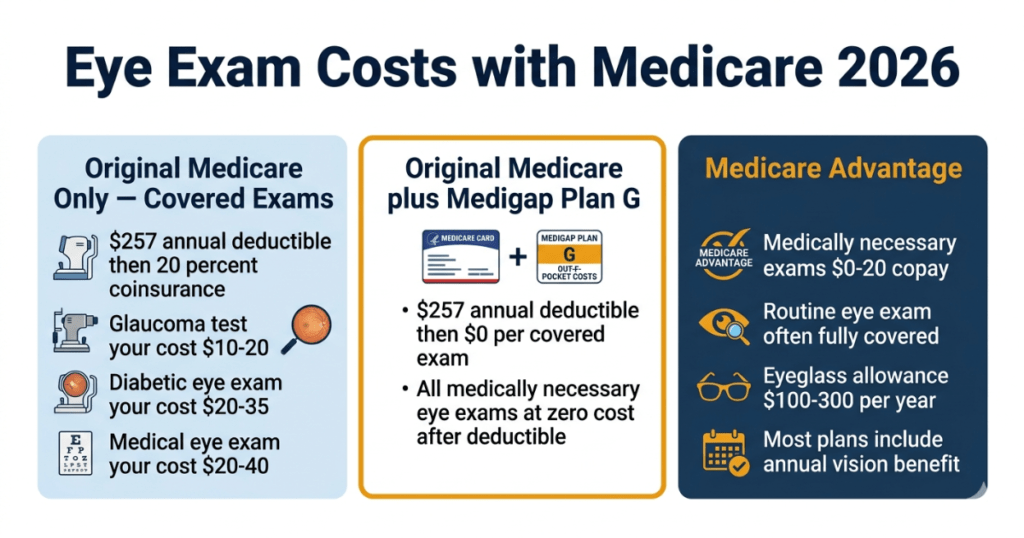
For covered medically necessary eye exams your costs with Original Medicare are:
- Annual Part B deductible — $257 per year
- After deductible — Medicare pays 80% of the Medicare-approved amount
- Your cost — 20% coinsurance
Typical Medicare-approved amounts for covered eye exams in 2026:
- Glaucoma screening — approximately $50 to $100 Medicare-approved — your 20% is $10 to $20
- Diabetic eye exam — approximately $100 to $175 Medicare-approved — your 20% is $20 to $35
- Comprehensive medical eye exam — approximately $100 to $200 Medicare-approved — your 20% is $20 to $40
With Medigap Plan G
If you have Medigap Plan G your 20% coinsurance for covered medically necessary eye exams is paid by Plan G after your $257 annual deductible. Your effective cost for covered Medicare eye exams with Plan G is $0 after the annual deductible.
Routine Eye Exams Without Medicare Coverage
For routine eye exams not covered by Medicare the out-of-pocket cost in 2026:
- Basic routine eye exam — $100 to $250
- Comprehensive exam with dilation — $150 to $300
- Contact lens fitting exam — $150 to $350
These costs are entirely your responsibility under Original Medicare since routine vision exams are not a covered benefit.
Does Medicare Cover Glasses or Contact Lenses?
Does Medicare cover glasses or contact lenses in 2026? Generally no — with one important exception.
Original Medicare does not cover eyeglasses, contact lenses, or other corrective lenses for routine vision correction. This exclusion applies regardless of how severe your vision impairment is.
The Cataract Surgery Exception
Medicare does cover one pair of eyeglasses or one set of contact lenses following cataract surgery that involves implanting an intraocular lens. This is the only situation where Medicare covers corrective eyewear. The coverage applies to:
- One pair of standard frames and lenses after cataract surgery
- Or one set of contact lenses instead of glasses
Medicare does not cover premium frames, progressive lenses beyond basic bifocal coverage, or upgrades to standard eyewear after cataract surgery. The coverage is specifically for basic corrective lenses following intraocular lens implantation.
Does Medicare Advantage Cover Eye Exams?
Does Medicare Advantage cover eye exams in 2026? Yes — most Medicare Advantage plans include vision benefits that cover routine eye exams that Original Medicare excludes. This is one of the primary reasons many Medicare beneficiaries choose Medicare Advantage over Original Medicare.
Medicare Advantage vision coverage typically includes:
- One routine eye exam per year — fully covered on most plans
- Eyeglass frames and lenses allowance — typically $100 to $300 per year
- Contact lens allowance instead of glasses
- Discounts at major optical retailers
Medicare Advantage plans also cover all the medically necessary eye exams that Original Medicare covers — glaucoma testing, diabetic eye exams, macular degeneration treatment — at the plan’s standard cost-sharing rates.
When comparing Medicare Advantage plans for vision coverage check:
- How often routine exams are covered — annually or every two years
- Eyeglass allowance amount — $100 vs $200 vs $300 makes a significant difference
- In-network optical providers — are your preferred eye doctors and optical stores in-network?
- Whether contact lenses are covered as an alternative to glasses
How to Get Eye Exam Coverage as a Medicare Beneficiary
If you need routine vision coverage beyond what Original Medicare provides here are your options:
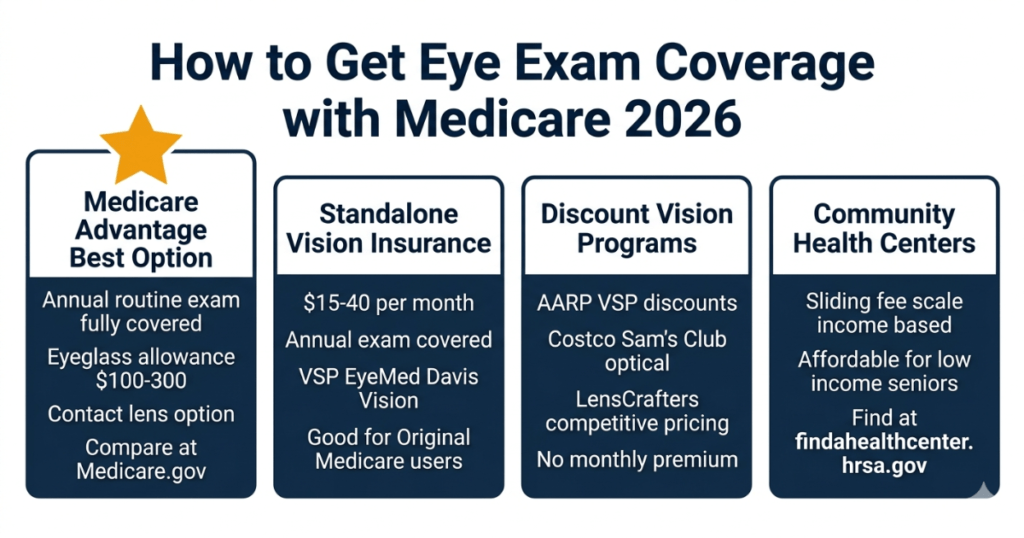
Option 1 — Enroll in Medicare Advantage
The most comprehensive way to get routine eye exam coverage as a Medicare beneficiary is to enroll in a Medicare Advantage plan with vision benefits. Most Medicare Advantage plans cover annual eye exams and provide eyeglass or contact lens allowances. Use Medicare Open Enrollment from October 15 to December 7 to compare plans and find one with strong vision benefits in your area.
Option 2 — Purchase Standalone Vision Insurance
If you prefer to keep Original Medicare you can purchase standalone vision insurance. Standalone vision plans for seniors typically cost $15 to $40 per month and cover:
- One annual routine eye exam
- Eyeglass frames and lens allowance
- Contact lens allowance
Popular standalone vision insurance providers include VSP, EyeMed, and Davis Vision. These plans are not Medicare plans — they are private insurance purchased separately.
Option 3 — Use Discount Vision Programs
Several discount vision programs offer reduced-cost eye exams and eyewear without monthly premiums. AARP has vision discounts through VSP for AARP members. Many optical retail chains like Costco, Sam’s Club, and LensCrafters offer competitive self-pay pricing for routine eye exams.
Option 4 — Community Health Centers
Federally Qualified Health Centers offer eye exams and vision services on a sliding fee scale based on income. This can be an affordable option for lower-income Medicare beneficiaries who need routine eye care.
Frequently Asked Questions — Does Medicare Cover Eye Exams
Does Medicare cover eye exams in 2026?
Original Medicare covers medically necessary eye exams — including glaucoma screening for high-risk patients, diabetic retinopathy exams for people with diabetes, macular degeneration treatment, and cataract surgery with related exams. Medicare does not cover routine eye exams for glasses or contact lenses. Medicare Advantage plans commonly include routine vision coverage that Original Medicare does not provide.
Does Medicare cover glaucoma testing?
Yes — Medicare Part B covers annual glaucoma screening for high-risk beneficiaries including people with diabetes, those with a family history of glaucoma, African Americans aged 50 and older, and Hispanic Americans aged 65 and older. The exam is covered at 80% after the $257 annual Part B deductible.
Does Medicare cover diabetic eye exams?
Yes — Medicare Part B covers annual dilated eye exams for Medicare beneficiaries with diabetes to screen for and monitor diabetic retinopathy. This is a critically important covered benefit because diabetic retinopathy is a leading cause of vision loss among seniors. The exam is covered at 80% after the Part B deductible.
Does Medicare cover glasses?
Generally no — Medicare does not cover eyeglasses for routine vision correction. The one exception is one pair of standard eyeglasses or contact lenses following cataract surgery involving an intraocular lens implant. Medicare Advantage plans commonly provide eyeglass allowances of $100 to $300 per year as part of their vision benefits.
How much does a Medicare-covered eye exam cost?
For covered medically necessary eye exams Medicare pays 80% of the approved amount after your $257 annual Part B deductible. Your 20% coinsurance is approximately $10 to $40 per exam depending on the type. With Medigap Plan G your effective cost after the annual deductible is $0. Medicare Advantage plans typically cover medically necessary eye exams at $0 to $20 copay.
Does Medicare Advantage cover routine eye exams?
Yes — most Medicare Advantage plans include annual routine eye exam coverage as part of their vision benefits. Coverage typically includes one exam per year with an eyeglass or contact lens allowance of $100 to $300. This is one of the most popular extra benefits that Medicare Advantage offers over Original Medicare.
Summary — Does Medicare Cover Eye Exams 2026
Does Medicare cover eye exams in 2026? Original Medicare covers medically necessary eye exams for glaucoma screening in high-risk patients, diabetic retinopathy monitoring, macular degeneration treatment, cataract surgery care, and other diagnosed eye conditions. Original Medicare does not cover routine eye exams for glasses or contact lenses — a significant gap for many seniors.
For comprehensive vision coverage including routine eye exams Medicare Advantage plans are the most accessible solution — most plans include annual eye exams and eyeglass allowances as standard extra benefits. Standalone vision insurance is also available for beneficiaries who prefer Original Medicare.
For free help understanding your Medicare vision coverage options contact your State Health Insurance Assistance Program (SHIP) at shiphelp.org or call Medicare free at 1-800-633-4227.
This guide is for informational purposes only and is not medical advice. Always verify current Medicare eye care coverage at Medicare.gov before scheduling eye care appointments.
Sources: Medicare.gov | CMS.gov | SSA.gov | AARP.org
Last updated: April 2026 | Author: James Carter, Independent Medicare Research Analyst