
Does Medicare Cover Botox — Complete Guide 2026
Does Medicare cover Botox in 2026? This is a question that surprises many Medicare beneficiaries — most people associate Botox with cosmetic procedures but Botox has significant medical applications that Medicare does cover. The key distinction is between cosmetic Botox — which Medicare never covers — and therapeutic Botox prescribed by a physician to treat a specific medical condition — which Medicare does cover in many situations. In this complete guide we explain exactly what Medicare covers for Botox in 2026 — what medical conditions qualify for coverage, what cosmetic uses are excluded, how much Botox costs with Medicare, and how Medicare Advantage handles Botox coverage. All information is sourced from Medicare.gov and CMS.gov.
Also Read —
- Does Medicare Cover Physical Therapy 2026
- Does Medicare Cover Mental Health 2026
- Medicare Advantage vs Original Medicare 2026
What You Will Learn — Does Medicare Cover Botox
- Does Medicare cover Botox in 2026
- What medical conditions qualify for Medicare Botox coverage
- Does Medicare cover Botox for migraines
- Does Medicare cover Botox for overactive bladder
- Does Medicare cover Botox for cervical dystonia and spasticity
- What cosmetic Botox uses Medicare excludes
- How much does Botox cost with Medicare
- Does Medicare Advantage cover Botox
- How to get Botox covered by Medicare
- Frequently asked questions about Medicare Botox coverage 2026
Does Medicare Cover Botox in 2026?
Medicare does cover Botox in 2026 — but only for medically necessary therapeutic uses. This distinction is critical and it is the most important thing to understand about Medicare Botox coverage.
Medicare covers therapeutic Botox — onabotulinumtoxinA (Botox) injections administered by a physician to treat specific medical conditions that have been FDA-approved for Botox treatment. When Botox is prescribed and administered as medical treatment for a covered condition Medicare Part B covers it as a physician-administered drug under the medical benefit.
Medicare does not cover cosmetic Botox — injections performed for aesthetic purposes such as reducing facial wrinkles, fine lines, or other cosmetic concerns. Cosmetic procedures are explicitly excluded from Medicare coverage regardless of cost or patient request.
The same active ingredient — onabotulinumtoxinA — is used in both cosmetic and therapeutic Botox. The difference in Medicare coverage is entirely based on the medical indication — the condition being treated — not the drug itself.
What Medical Conditions Qualify for Medicare Botox Coverage?
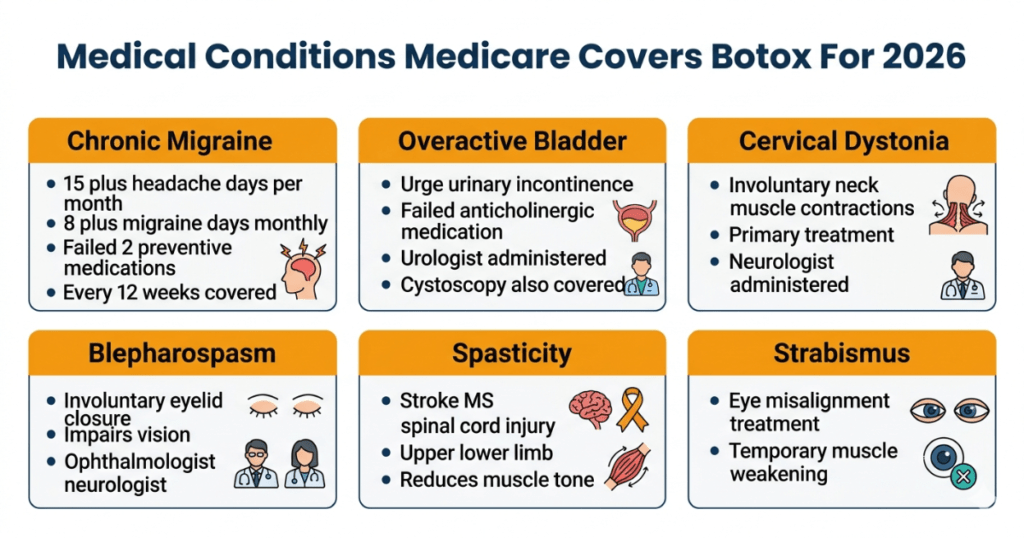
Medicare covers Botox for several FDA-approved medical conditions in 2026. Here are the conditions that qualify for Medicare Botox coverage:
Chronic Migraine — Covered
Medicare Part B covers Botox injections for the treatment of chronic migraine — defined as 15 or more headache days per month with at least 8 of those days meeting migraine criteria. Botox is FDA-approved for chronic migraine prevention and Medicare covers it when:
- Your neurologist or headache specialist diagnoses chronic migraine meeting the criteria
- You have tried and failed at least two preventive migraine medications
- A qualified physician administers the Botox injections
- Injections are performed every 12 weeks as indicated
Botox for chronic migraine involves 31 injections at 7 specific muscle areas in the head and neck — administered every 12 weeks. Medicare covers this treatment at 80% after the Part B deductible when properly documented and billed.
Overactive Bladder — Covered
Medicare Part B covers Botox injections for overactive bladder — urinary urgency incontinence — when administered by a urologist or urogynecologist. Medicare covers Botox for overactive bladder when:
- You have been diagnosed with overactive bladder with urge urinary incontinence
- You have tried and had inadequate response to at least one anticholinergic medication
- A urologist or other qualified specialist administers the injections
- Injections are administered at the appropriate medical dosage
Botox for overactive bladder is injected directly into the bladder wall via cystoscopy — a procedure performed by a urologist. Medicare covers both the Botox medication and the cystoscopy procedure.
Neurogenic Detrusor Overactivity — Covered
Medicare covers Botox for neurogenic detrusor overactivity — bladder dysfunction caused by neurological conditions such as spinal cord injury or multiple sclerosis. This condition involves involuntary bladder contractions due to neurological damage.
Cervical Dystonia — Covered
Medicare Part B covers Botox injections for cervical dystonia — a painful condition causing involuntary neck muscle contractions that force the head into abnormal positions. Botox is the primary treatment for cervical dystonia and Medicare covers it when administered by a neurologist or movement disorder specialist.
Blepharospasm — Covered
Medicare covers Botox for blepharospasm — involuntary, forceful closure of the eyelids that can significantly impair vision. Blepharospasm is a recognized medical condition treated with Botox injections administered by an ophthalmologist or neurologist. Medicare covers this treatment as medically necessary.
Strabismus — Covered
Medicare covers Botox for strabismus — misalignment of the eyes commonly called crossed eyes — when used as a therapeutic treatment. Botox can temporarily weaken specific eye muscles to help align the eyes.
Spasticity — Covered
Medicare Part B covers Botox for upper and lower limb spasticity — abnormal muscle stiffness and involuntary contractions caused by neurological conditions including stroke, multiple sclerosis, cerebral palsy, and spinal cord injury. Botox injections into spastic muscles help reduce muscle tone and improve function.
Hyperhidrosis — Sometimes Covered
Medicare may cover Botox for severe primary axillary hyperhidrosis — excessive underarm sweating — when it significantly affects daily activities and has not responded to topical treatments. Coverage for hyperhidrosis is less consistent than for the other conditions listed and requires strong medical documentation.
Does Medicare Cover Botox for Migraines?
Does Medicare cover Botox for migraines in 2026? Yes — Medicare Part B covers Botox for chronic migraine prevention. This is one of the most commonly covered therapeutic Botox uses in the Medicare population and one of the most important Medicare Botox benefits.
To qualify for Medicare Botox coverage for chronic migraine you must meet these criteria:
- Diagnosis of chronic migraine — 15 or more headache days per month with at least 8 migraine days per month
- Documented inadequate response to at least two preventive migraine medications
- Treatment administered by a qualified physician — neurologist, headache specialist, or other qualified provider
- Injections performed every 12 weeks as clinically indicated
Medicare covers the Botox medication itself under Part B as a physician-administered drug. The drug is covered at 80% of the Medicare-approved amount after the Part B deductible. Botox for chronic migraine is typically billed at approximately $1,500 to $2,000 per treatment session — your 20% coinsurance would be approximately $300 to $400 per session without a supplement.
With Medigap Plan G your 20% coinsurance for Medicare-covered Botox migraine treatment is covered after the annual Part B deductible — reducing your effective cost to $0 per session after meeting the annual deductible.
Does Medicare Cover Botox for Overactive Bladder?
Does Medicare cover Botox for overactive bladder in 2026? Yes — Medicare Part B covers Botox injections for overactive bladder when you meet the clinical criteria. Overactive bladder affects millions of Medicare beneficiaries and Botox is an important treatment option for those who have not responded adequately to oral medications.
To qualify for Medicare Botox coverage for overactive bladder:
- Documented diagnosis of overactive bladder with urge urinary incontinence
- Trial of at least one anticholinergic medication without adequate benefit
- Treatment administered by a urologist or other qualified specialist
- Injections performed at the appropriate dose — typically 100 units
The cystoscopy procedure used to administer Botox for overactive bladder is also covered by Medicare Part B at 80% after the deductible. Your 20% coinsurance applies to both the Botox medication and the procedure.
Does Medicare Cover Botox for Spasticity?
Does Medicare cover Botox for spasticity in 2026? Yes — Medicare covers Botox for upper and lower limb spasticity caused by neurological conditions including stroke, multiple sclerosis, spinal cord injury, and other conditions causing abnormal muscle tone.
Spasticity is a significant problem for many Medicare beneficiaries recovering from stroke or living with neurological conditions. Botox injections into spastic muscles help reduce muscle tone, improve range of motion, reduce pain, and facilitate physical therapy.
Medicare covers Botox for spasticity at 80% of the Medicare-approved amount after the Part B deductible. The amount covered depends on the dosage required which varies based on the severity and extent of spasticity being treated.
What Cosmetic Botox Uses Does Medicare Exclude?
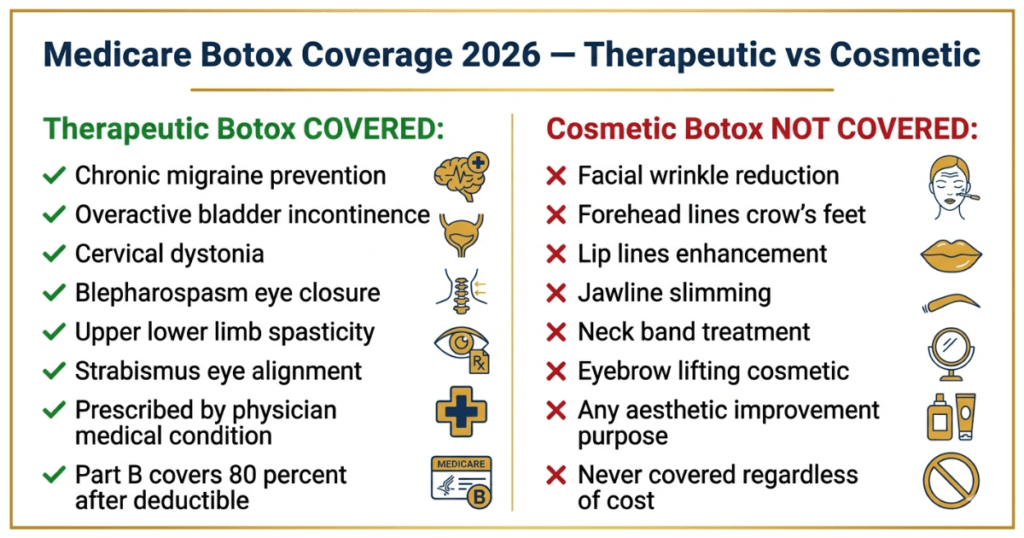
Medicare explicitly excludes cosmetic Botox in 2026. Cosmetic Botox uses that Medicare never covers include:
- Facial wrinkle reduction — forehead lines, crow’s feet, frown lines
- Lip enhancement and lip lines treatment
- Jawline slimming — masseter muscle reduction
- Neck banding treatment — platysmal bands
- Eyebrow lifting for cosmetic purposes
- Any other use of Botox for aesthetic improvement rather than medical treatment of a specific condition
Even if you feel strongly that your cosmetic Botox has medical benefits — reducing headaches from muscle tension for example — Medicare will not cover it unless the clinical indication meets the documented medical necessity criteria for one of the approved therapeutic uses.
How Much Does Botox Cost with Medicare in 2026?
Therapeutic Botox with Original Medicare
For covered therapeutic Botox treatments your costs with Original Medicare are:
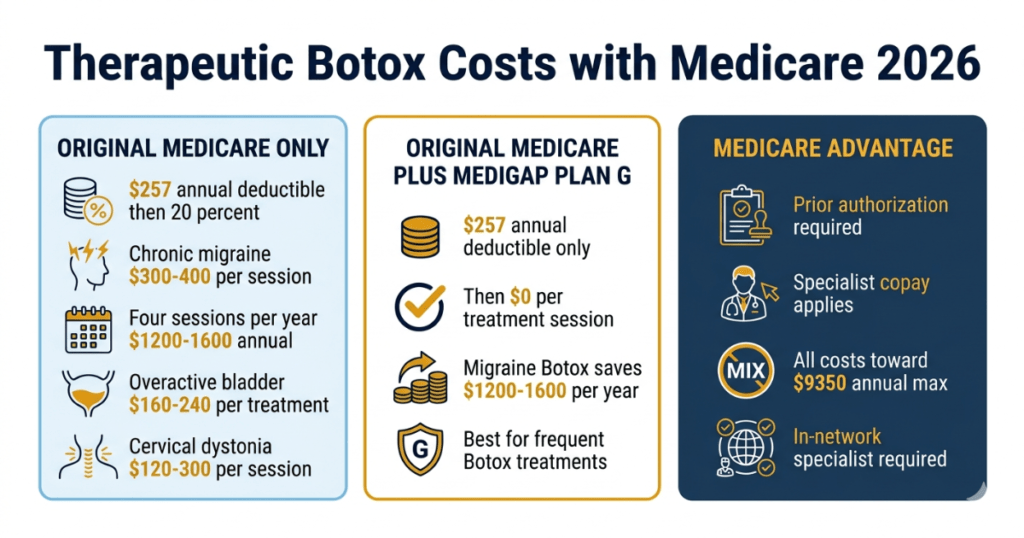
- Annual Part B deductible — $257 per year
- After deductible — Medicare pays 80% of the Medicare-approved amount
- Your cost — 20% coinsurance
Typical costs for Medicare-covered Botox treatments in 2026:
Chronic migraine Botox — approximately $1,500 to $2,000 Medicare-approved per session every 12 weeks — your 20% is approximately $300 to $400 per session — annual cost approximately $1,200 to $1,600 without a supplement
Overactive bladder Botox — approximately $800 to $1,200 Medicare-approved per treatment — your 20% is approximately $160 to $240 per treatment
Cervical dystonia Botox — approximately $600 to $1,500 Medicare-approved per treatment — your 20% is approximately $120 to $300 per treatment
Spasticity Botox — varies significantly based on dosage — $500 to $2,000 Medicare-approved — your 20% is $100 to $400 per treatment
With Medigap Plan G
If you have Medigap Plan G your 20% coinsurance for all covered therapeutic Botox treatments is covered after your $257 annual Part B deductible. Your effective cost for Medicare-covered Botox with Plan G after the annual deductible is $0.
For chronic migraine patients receiving Botox every 12 weeks Plan G saves approximately $1,200 to $1,600 per year in Botox coinsurance alone — a significant financial benefit.
With Medicare Advantage
Medicare Advantage plans cover therapeutic Botox with their own cost-sharing. Typical costs include specialist visit copays for the physician administering the Botox and drug administration fees. Prior authorization is commonly required for Botox treatments under Medicare Advantage.
How to Get Botox Covered by Medicare
If you have a condition that may qualify for Medicare Botox coverage here is how to pursue coverage:
Step 1 — See the Right Specialist
Botox for medical conditions must be administered by a physician who specializes in treating your condition. For migraines see a neurologist or headache specialist. For overactive bladder see a urologist. For cervical dystonia see a movement disorder neurologist. For spasticity see a physiatrist or neurologist.
Step 2 — Document Your Diagnosis and Failed Treatments
Medicare requires thorough documentation of your diagnosis and failed conservative treatments. Make sure your medical records clearly document your diagnosis, the severity of your symptoms, and the treatments you have tried without adequate benefit.
Step 3 — Obtain Prior Authorization if Required
If you have Medicare Advantage contact your plan before your Botox treatment to obtain prior authorization. Original Medicare does not require prior authorization for Botox but Medicare Advantage plans almost always require it.
Step 4 — Confirm Medicare Billing
Confirm that your physician bills Medicare for the Botox medication and administration under the correct billing codes for your specific condition. Botox for different conditions is billed under different codes — ensure your provider uses the appropriate code for your diagnosis.
Does Medicare Advantage Cover Botox?
Does Medicare Advantage cover Botox in 2026? Yes — all Medicare Advantage plans must cover therapeutic Botox for Medicare-covered medical conditions. However Medicare Advantage Botox coverage has important differences from Original Medicare.
Prior authorization — most Medicare Advantage plans require prior authorization before therapeutic Botox injections. Your physician’s office typically handles this process but authorization must be obtained before treatment to ensure coverage.
Network providers — Medicare Advantage plans require you to use in-network physicians for Botox treatments at the lowest cost. Confirm your neurologist, urologist, or other specialist is in your plan’s network before scheduling treatment.
Step therapy requirements — some Medicare Advantage plans require documented failure of specific medications before approving Botox. Ensure your medical records document your treatment history thoroughly.
Frequently Asked Questions — Does Medicare Cover Botox
Does Medicare cover Botox in 2026?
Medicare covers therapeutic Botox — Botox injections for medically necessary treatment of specific conditions including chronic migraine, overactive bladder, cervical dystonia, blepharospasm, spasticity, and strabismus. Medicare does not cover cosmetic Botox for aesthetic purposes. Covered Botox is billed through Medicare Part B at 80% after the $257 annual deductible.
Does Medicare cover Botox for migraines?
Yes — Medicare covers Botox for chronic migraine — 15 or more headache days per month with at least 8 migraine days. You must have tried and failed at least two preventive migraine medications. Botox is administered every 12 weeks. Medicare pays 80% after the Part B deductible — your 20% coinsurance is approximately $300 to $400 per session without a supplement.
Does Medicare cover Botox for overactive bladder?
Yes — Medicare covers Botox for overactive bladder when you have tried and had inadequate response to at least one anticholinergic medication. The Botox is injected into the bladder wall via cystoscopy by a urologist. Medicare covers both the Botox medication and the cystoscopy procedure at 80% after the deductible.
How much does Botox cost with Medicare?
Your 20% coinsurance for therapeutic Botox varies by condition — approximately $300 to $400 per migraine treatment session, $160 to $240 per overactive bladder treatment, and $120 to $400 per spasticity or dystonia treatment. With Medigap Plan G your effective cost after the $257 annual deductible is $0 for all Medicare-covered Botox treatments.
Does Medicare cover cosmetic Botox?
No — Medicare never covers cosmetic Botox for aesthetic purposes including wrinkle reduction, lip enhancement, or any other use for appearance improvement. Only therapeutic Botox prescribed by a physician for a specific medical condition is covered by Medicare.
Does Medicare Advantage cover Botox?
Yes — Medicare Advantage plans must cover therapeutic Botox for Medicare-covered medical conditions. Most plans require prior authorization. Always confirm authorization is obtained before treatment and verify your specialist is in-network.
Summary — Does Medicare Cover Botox 2026
Does Medicare cover Botox in 2026? Yes — Medicare covers therapeutic Botox for medically necessary treatment of specific conditions including chronic migraine, overactive bladder, cervical dystonia, blepharospasm, spasticity, and strabismus. Medicare never covers cosmetic Botox for aesthetic purposes.
For Medicare beneficiaries who receive Botox for chronic migraine or other covered conditions Medigap Plan G provides significant financial protection — covering your 20% coinsurance after the annual deductible and making your effective cost $0 per treatment session. For chronic migraine patients receiving quarterly Botox this can save $1,200 to $1,600 or more annually.
For free help understanding your Medicare Botox coverage contact your State Health Insurance Assistance Program (SHIP) at shiphelp.org or call Medicare free at 1-800-633-4227.
This guide is for informational purposes only and is not medical advice. Always consult your physician and verify current Medicare Botox coverage at Medicare.gov before beginning treatment.
Sources: Medicare.gov | CMS.gov | SSA.gov | AARP.org
Last updated: April 2026 | Author: James Carter, Independent Medicare Research Analyst