Medicare Part D Drug Coverage Explained Simply 2026
Medicare Part D drug coverage — what is it, how does it work, and how much does it cost in 2026? If you have Original Medicare you already know it does not cover most prescription drugs. Medicare Part D drug coverage fills this critical gap by providing prescription drug benefits through private insurance plans approved by Medicare. In this complete 2026 guide we explain everything you need to know about Medicare Part D drug coverage — how Medicare Part D works, what Medicare Part D covers, how much Medicare Part D costs, and how to choose the best Medicare Part D drug coverage plan for your specific medications. All information is sourced from Medicare.gov and CMS.gov.
Also Read- Best Medicare Supplement Plans 2026 — Complete Guide (Ranked) Also Read- Does Medicare Cover CPAP Machines — Complete Guide 2026
What You Will Learn — Medicare Part D Drug Coverage
- What Medicare Part D drug coverage is and how it works
- Who needs Medicare Part D drug coverage in 2026
- What Medicare Part D drug coverage covers in 2026
- How much Medicare Part D drug coverage costs in 2026
- How Medicare Part D drug coverage tiers work
- The Medicare Part D drug coverage deductible in 2026
- The Medicare Part D drug coverage out-of-pocket maximum in 2026
- How to choose the best Medicare Part D drug coverage plan
- Medicare Part D drug coverage late enrollment penalty
- Frequently asked questions about Medicare Part D drug coverage
What Is Medicare Part D Drug Coverage?
Medicare Part D drug coverage is the prescription drug benefit program within Medicare. Medicare Part D drug coverage was created by Congress in 2003 and became available to beneficiaries in 2006. Today Medicare Part D drug coverage is used by more than 50 million Americans to help pay for their prescription medications.
Medicare Part D drug coverage is offered exclusively through private insurance companies that are approved and regulated by Medicare. Unlike Medicare Parts A and B which are administered directly by the federal government Medicare Part D drug coverage is always delivered through a private plan. This means the specific drugs covered, the costs you pay, and the pharmacies you can use all depend on which Medicare Part D drug coverage plan you choose.
There are two main ways to get Medicare Part D drug coverage in 2026:
Standalone Medicare Part D drug coverage plans — also called PDPs. These are separate drug plans you add to your Original Medicare coverage. If you have Original Medicare Parts A and B and a Medigap supplement plan you will add a standalone Medicare Part D drug coverage plan to get prescription drug benefits.
Medicare Advantage Prescription Drug plans — also called MAPDs. If you choose Medicare Advantage (Part C) instead of Original Medicare your drug coverage is usually already included in your Medicare Advantage plan. Most Medicare Advantage plans include Medicare Part D drug coverage at no additional premium.
Who Needs Medicare Part D Drug Coverage?
Understanding who needs Medicare Part D drug coverage helps you decide whether to enroll. Here is who needs Medicare Part D drug coverage in 2026:
You need Medicare Part D drug coverage if you have Original Medicare (Parts A and B) and take any prescription medications regularly. Without Medicare Part D drug coverage you pay 100% of all outpatient prescription drug costs out of pocket.
You do not need a separate Medicare Part D drug coverage plan if you are enrolled in a Medicare Advantage plan that already includes drug coverage. Check your Medicare Advantage plan documents to confirm whether Medicare Part D drug coverage is included.
You may be able to delay Medicare Part D drug coverage enrollment without penalty if you have other qualifying drug coverage such as coverage from a current employer or union health plan. However you must enroll in Medicare Part D drug coverage within 63 days of losing your other qualifying coverage to avoid the late enrollment penalty.
Even if you currently take no prescription medications most Medicare experts recommend enrolling in a low-cost Medicare Part D drug coverage plan when you first become eligible. This protects you from the late enrollment penalty and ensures you have coverage immediately if you need medications in the future. A basic Medicare Part D drug coverage plan can cost as little as $5 to $15 per month.
What Does Medicare Part D Drug Coverage Cover in 2026?
Medicare Part D drug coverage covers a wide range of prescription medications including brand-name drugs, generic drugs, and some specialty medications. However Medicare Part D drug coverage does not cover every drug — each plan has its own formulary which is a list of covered medications.
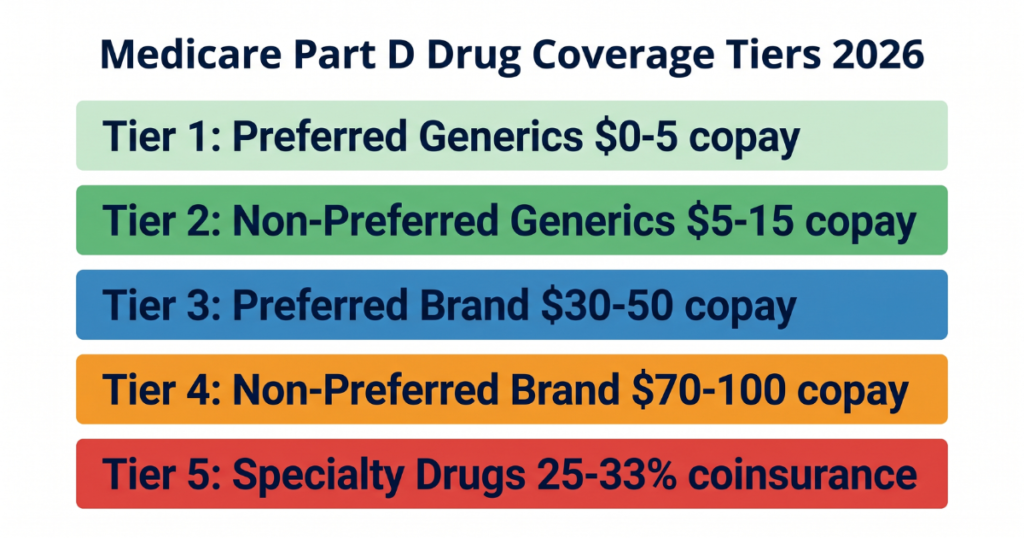
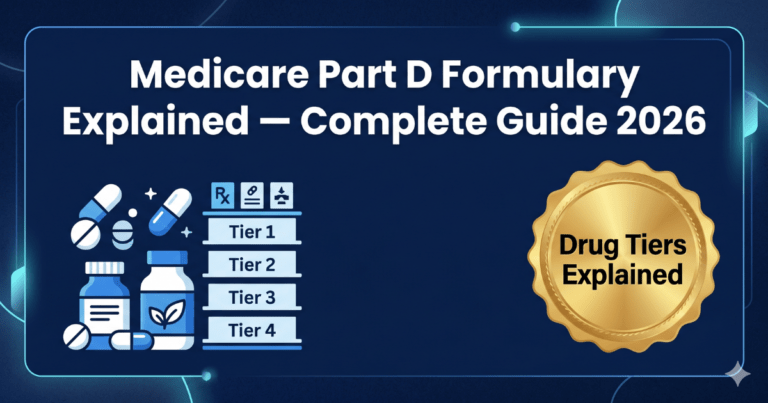
Medicare Part D drug coverage formularies are organized into tiers. Each tier has different cost-sharing requirements. Most Medicare Part D drug coverage plans use a 5-tier formulary structure in 2026:
Medicare Part D drug coverage Tier 1 — Preferred generic drugs. These are the lowest cost drugs on Medicare Part D drug coverage plans. Your copay is typically $0 to $5 per prescription. Medicare Part D drug coverage plans always prefer generic versions of medications when available.
Medicare Part D drug coverage Tier 2 — Non-preferred generic drugs. These are generic drugs that are not on the preferred list. Your copay under Medicare Part D drug coverage is typically $5 to $15 per prescription.
Medicare Part D drug coverage Tier 3 — Preferred brand-name drugs. These are brand-name drugs that the plan prefers over alternatives. Your Medicare Part D drug coverage copay is typically $30 to $50 per prescription.
Medicare Part D drug coverage Tier 4 — Non-preferred brand-name drugs. These brand-name drugs are covered by Medicare Part D drug coverage but at a higher cost. Your copay is typically $70 to $100 per prescription.
Medicare Part D drug coverage Tier 5 — Specialty drugs. These are high-cost specialty medications for complex conditions. Medicare Part D drug coverage typically charges 25% to 33% coinsurance for specialty tier drugs. These are often the most expensive medications on any Medicare Part D drug coverage plan.
Drugs that Medicare Part D drug coverage does NOT cover include over-the-counter medications, drugs used for weight loss or gain, drugs used to promote fertility, drugs used for cosmetic purposes, vitamins and supplements, and drugs covered under Medicare Part A or Part B.
Always check whether your specific medications are covered under a Medicare Part D drug coverage plan’s formulary before enrolling. You can check formularies using the Medicare plan finder tool at Medicare.gov.
How Much Does Medicare Part D Drug Coverage Cost in 2026?
Understanding the costs of Medicare Part D drug coverage is essential for choosing the right plan. Medicare Part D drug coverage has several layers of costs in 2026:
Medicare Part D Drug Coverage Premium 2026
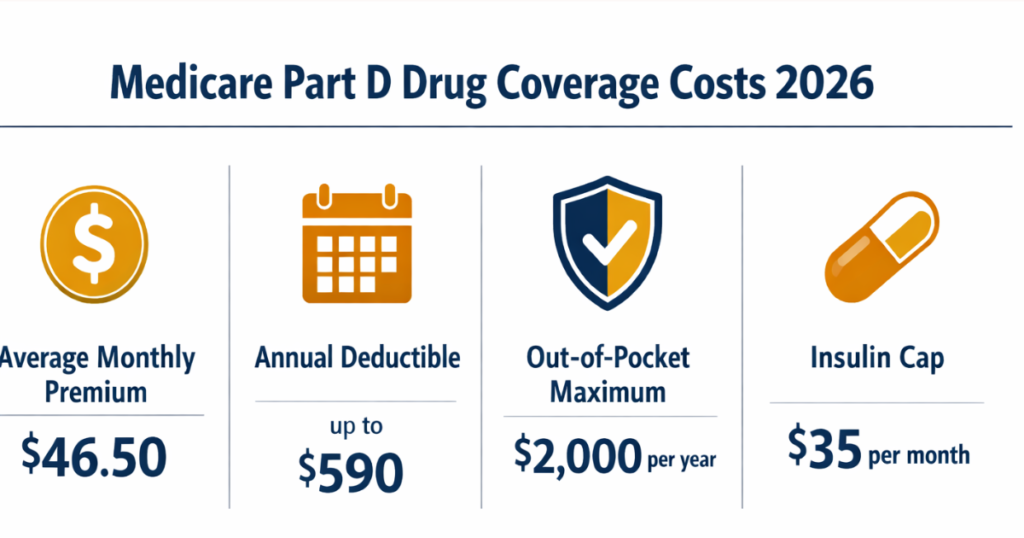
The average Medicare Part D drug coverage premium in 2026 is $46.50 per month. However Medicare Part D drug coverage premiums vary widely by plan and location — ranging from as low as $5 per month for basic Medicare Part D drug coverage plans to $150 or more per month for comprehensive plans with low copays.
Higher income seniors pay more for Medicare Part D drug coverage through IRMAA surcharges. The 2026 Medicare Part D drug coverage IRMAA surcharges are:
- Individual income up to $106,000 — standard Medicare Part D drug coverage premium only
- Individual $106,001 to $133,000 — add $13.70 per month
- Individual $133,001 to $167,000 — add $35.30 per month
- Individual $167,001 to $200,000 — add $57.00 per month
- Individual $200,001 to $500,000 — add $78.60 per month
- Individual above $500,000 — add $85.80 per month
Medicare Part D Drug Coverage Deductible 2026
The maximum Medicare Part D drug coverage deductible in 2026 is $590. This is the amount you pay out of pocket for covered drugs before your Medicare Part D drug coverage plan starts paying. Some Medicare Part D drug coverage plans have lower deductibles or no deductible at all — particularly for lower tier generic drugs.
Medicare Part D Drug Coverage Out-of-Pocket Maximum 2026
One of the most important improvements to Medicare Part D drug coverage in recent years is the $2,000 annual out-of-pocket maximum introduced in 2025 and continuing in 2026. Before this change there was no cap on what you could spend on Medicare Part D drug coverage in a year — leading to catastrophic drug costs for some seniors.
With the new $2,000 Medicare Part D drug coverage out-of-pocket maximum you will never pay more than $2,000 per year for covered drugs under any Medicare Part D drug coverage plan in 2026. Once you reach $2,000 in out-of-pocket drug costs your Medicare Part D drug coverage plan pays 100% of covered drug costs for the rest of the year.
Medicare Part D Drug Coverage Prescription Payment Plan 2026
Another major improvement to Medicare Part D drug coverage is the Medicare Prescription Payment Plan — also called the smoothing program. This allows Medicare Part D drug coverage beneficiaries to spread their drug costs evenly across monthly installments throughout the year instead of paying large amounts at the start of the year when deductibles reset.
For example if your Medicare Part D drug coverage out-of-pocket drug costs are projected to be $1,800 for the year instead of paying most of that in January and February when your deductible resets you can choose to pay $150 per month evenly throughout the year under the Medicare Part D drug coverage Prescription Payment Plan.
How Medicare Part D Drug Coverage Phases Work in 2026
Medicare Part D drug coverage operates in phases in 2026. Understanding these phases helps you understand your costs throughout the year:
Medicare Part D Drug Coverage Phase 1 — Deductible Phase
In the deductible phase you pay 100% of covered drug costs until you meet your Medicare Part D drug coverage deductible of up to $590. Some plans waive the deductible for lower tier generic drugs so you pay copays immediately for those medications.
Medicare Part D Drug Coverage Phase 2 — Initial Coverage Phase
After meeting your Medicare Part D drug coverage deductible you enter the initial coverage phase. During this phase you pay your plan’s standard copays or coinsurance for covered drugs. For example you might pay $5 for generic drugs and $45 for preferred brand drugs under your Medicare Part D drug coverage plan.
Medicare Part D Drug Coverage Phase 3 — Catastrophic Coverage Phase
Once your total out-of-pocket Medicare Part D drug coverage costs reach $2,000 in 2026 you enter the catastrophic coverage phase. In this phase your Medicare Part D drug coverage plan pays 100% of covered drug costs for the remainder of the calendar year. This is a massive improvement for seniors who take expensive specialty medications.
How to Choose the Best Medicare Part D Drug Coverage Plan
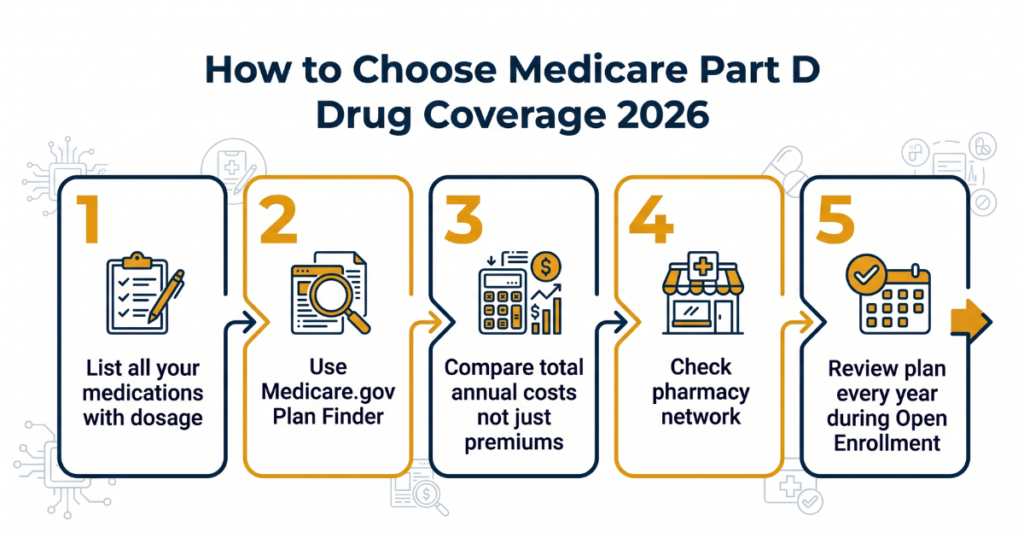
Choosing the best Medicare Part D drug coverage plan requires comparing plans based on your specific medications. Here is exactly how to choose the best Medicare Part D drug coverage plan in 2026:
Step 1 — Make a list of all your medications
Write down every prescription medication you take including the drug name, dosage, and how often you take it. This list is essential for comparing Medicare Part D drug coverage plans accurately.
Step 2 — Use the Medicare Plan Finder
Go to Medicare.gov plan finder. Enter your zip code and your medication list. The tool will show you all Medicare Part D drug coverage plans available in your area and calculate your estimated annual cost for each plan based on your specific drugs.
Step 3 — Compare total annual costs not just premiums
The biggest mistake seniors make when choosing Medicare Part D drug coverage is focusing only on the monthly premium. A plan with a $10 monthly premium may cost you more overall than a plan with a $50 monthly premium if the cheaper plan has higher copays for your specific medications. Always compare total annual costs including Medicare Part D drug coverage premiums, deductibles, and copays.
Step 4 — Check your pharmacy network
Medicare Part D drug coverage plans have preferred pharmacy networks. Using a preferred pharmacy can significantly reduce your Medicare Part D drug coverage costs. Check whether your preferred pharmacy is in the plan’s preferred network before enrolling.
Step 5 — Check the formulary
Confirm that all your medications are covered on the Medicare Part D drug coverage plan’s formulary before enrolling. If a medication you take is not on the formulary you may need to pay full price or request an exception from the plan.
Step 6 — Review the plan annually
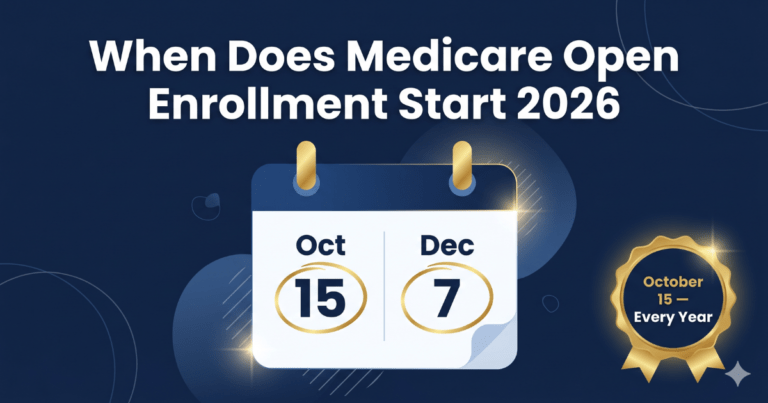
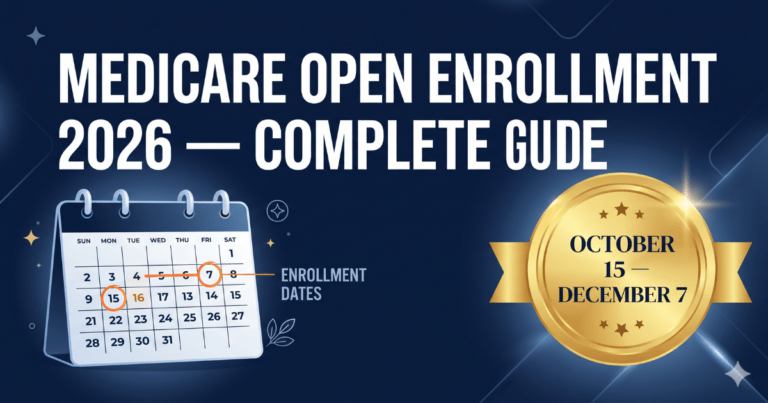
Medicare Part D drug coverage plans change their premiums, formularies, and pharmacy networks every year. Always review your Medicare Part D drug coverage plan during Open Enrollment (October 15 to December 7) to ensure it still offers the best value for your medications.
Medicare Part D Drug Coverage Late Enrollment Penalty
Missing your Medicare Part D drug coverage enrollment window can result in a permanent late enrollment penalty. The Medicare Part D drug coverage late enrollment penalty is calculated as 1% of the national base beneficiary premium multiplied by the number of months you went without qualifying drug coverage.
In 2026 the national base beneficiary premium for Medicare Part D drug coverage is $36.78. So for every month you delay enrolling in Medicare Part D drug coverage without other qualifying coverage you owe an additional $0.37 per month — forever.
For example if you delay Medicare Part D drug coverage enrollment for 24 months your penalty is 24% of $36.78 = $8.83 per month added to your Medicare Part D drug coverage premium for life.
The Medicare Part D drug coverage late enrollment penalty never goes away — it follows you for as long as you have Medicare Part D drug coverage. Always enroll in Medicare Part D drug coverage during your Initial Enrollment Period when you first become eligible for Medicare.
Extra Help with Medicare Part D Drug Coverage Costs
If you have limited income and resources you may qualify for Extra Help — a federal program that helps pay Medicare Part D drug coverage costs. Extra Help is also called the Low Income Subsidy (LIS).
With Extra Help your Medicare Part D drug coverage costs in 2026 may be reduced to:
- Medicare Part D drug coverage premium — $0 or very low
- Medicare Part D drug coverage deductible — $0
- Copays for generic drugs — $1.55 to $4.60
- Copays for brand-name drugs — $4.60 to $11.20
To apply for Extra Help with Medicare Part D drug coverage contact the Social Security Administration at SSA.gov or call 1-800-772-1213. You can also apply online at SSA.gov.
Medicare Part D Drug Coverage vs Medicare Advantage Drug Coverage
One important comparison in Medicare Part D drug coverage is standalone Part D plans versus Medicare Advantage drug coverage. Here are the key differences:
Standalone Medicare Part D drug coverage plans work alongside Original Medicare. You keep your freedom to see any Medicare-accepting doctor and hospital while adding prescription drug coverage separately.
Medicare Advantage drug coverage combines your Part A, Part B, and drug coverage in one plan from a private insurer. Medicare Advantage drug coverage is convenient and often has a $0 additional premium but restricts you to a network of local doctors.
For seniors with Original Medicare and a Medigap supplement a standalone Medicare Part D drug coverage plan is the right choice. For seniors with Medicare Advantage Medicare Part D drug coverage is usually already included — check your plan documents to confirm.
Frequently Asked Questions — Medicare Part D Drug Coverage
What is Medicare Part D drug coverage?
Medicare Part D drug coverage is the prescription drug benefit program within Medicare. Medicare Part D drug coverage is offered through private insurance companies approved by Medicare and helps pay for outpatient prescription medications. Medicare Part D drug coverage is available as a standalone plan added to Original Medicare or as part of a Medicare Advantage Prescription Drug plan.
Is Medicare Part D drug coverage mandatory?
Medicare Part D drug coverage is not mandatory. However if you do not enroll in Medicare Part D drug coverage when first eligible and do not have other qualifying drug coverage you will face a permanent late enrollment penalty when you do enroll. Most Medicare experts recommend enrolling in at least a low-cost Medicare Part D drug coverage plan when you first become eligible even if you currently take no medications.
How much does Medicare Part D drug coverage cost per month in 2026?
The average Medicare Part D drug coverage premium in 2026 is $46.50 per month. However Medicare Part D drug coverage premiums range from as low as $5 per month to $150 or more depending on the plan and your location. Higher income seniors pay IRMAA surcharges on top of their Medicare Part D drug coverage premium.
What is the Medicare Part D drug coverage deductible in 2026?
The maximum Medicare Part D drug coverage deductible in 2026 is $590. Some Medicare Part D drug coverage plans have lower deductibles or no deductible for certain tiers. You pay the deductible before your Medicare Part D drug coverage plan starts covering your drug costs.
What is the Medicare Part D drug coverage out-of-pocket maximum in 2026?
The Medicare Part D drug coverage out-of-pocket maximum in 2026 is $2,000. Once you spend $2,000 out of pocket on covered drugs your Medicare Part D drug coverage plan pays 100% of covered drug costs for the rest of the year. This cap was introduced in 2025 and provides important financial protection for seniors who take expensive medications.
When can I enroll in Medicare Part D drug coverage?
You can enroll in Medicare Part D drug coverage during your Initial Enrollment Period (the 7-month window around your 65th birthday), during the Annual Open Enrollment Period (October 15 to December 7), or during a Special Enrollment Period if you lose other qualifying drug coverage.
Can I change my Medicare Part D drug coverage plan?
Yes. You can change your Medicare Part D drug coverage plan during the Annual Open Enrollment Period (October 15 to December 7) each year. Changes take effect January 1 of the following year. Always review your Medicare Part D drug coverage plan annually during Open Enrollment because plans change their premiums, formularies, and pharmacy networks every year.
Does Medicare Part D drug coverage cover insulin?
Yes. Medicare Part D drug coverage covers insulin. Under the Inflation Reduction Act of 2022 the cost of covered insulin under Medicare Part D drug coverage is capped at $35 per month per insulin product regardless of which Medicare Part D drug coverage plan you have. This cap applies to all Medicare Part D drug coverage plans in 2026.
Summary — Medicare Part D Drug Coverage 2026
Medicare Part D drug coverage is an essential component of comprehensive Medicare coverage for most seniors. Without Medicare Part D drug coverage you pay 100% of prescription drug costs out of pocket — which can be extremely expensive for seniors who take multiple medications.
The key facts about Medicare Part D drug coverage in 2026 are an average premium of $46.50 per month, a maximum deductible of $590, and a $2,000 annual out-of-pocket maximum that protects you from catastrophic drug costs. Medicare Part D drug coverage plans are available through private insurers and vary significantly in premiums, formularies, and pharmacy networks.
Always use the free Medicare plan finder at Medicare.gov to compare Medicare Part D drug coverage plans based on your specific medications. Review your Medicare Part D drug coverage plan every year during Open Enrollment to ensure you have the best coverage at the best price.
For free personalized help with Medicare Part D drug coverage contact your State Health Insurance Assistance Program (SHIP) counselor at shiphelp.org or call Medicare free at 1-800-633-4227.
This guide is for informational purposes only and is not medical or financial advice. Always verify current Medicare Part D drug coverage details at Medicare.gov before making enrollment decisions.
Sources: Medicare.gov | CMS.gov | SSA.gov | AARP.org | KFF.org
Last updated: April 2026 | Author: James Carter, Independent Medicare Research Analyst
Also Read- Best Medicare Plans in New York 2026 — Complete Guide
8 Comments