Does Medicare Cover Hearing Tests — Complete Guide 2026
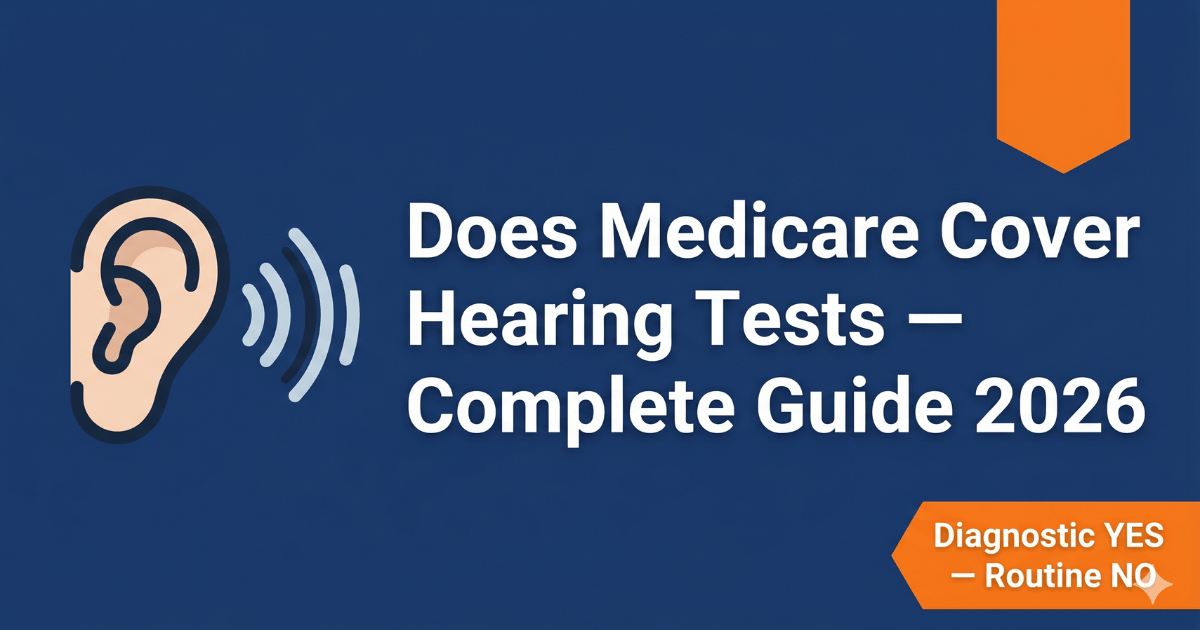
Does Medicare cover hearing tests in 2026? Hearing loss affects millions of Medicare beneficiaries — making this one of the most important Medicare coverage questions seniors ask. The answer follows the same pattern as vision and podiatry — Original Medicare covers medically necessary hearing tests but does not cover routine hearing exams for the purpose of fitting hearing aids. In this complete guide we explain exactly what Medicare covers for hearing tests in 2026 — what is covered, what is not covered, when hearing tests become medically necessary, how much hearing tests cost with Medicare, and how Medicare Advantage handles hearing coverage. All information is sourced from Medicare.gov and CMS.gov.
Also Read —
- Medicare Part D Drug Coverage Explained Simply 2026
- Does Medicare Cover Eye Exams 2026
- When to Enroll in Medicare — Complete Timeline 2026
What You Will Learn — Does Medicare Cover Hearing Tests
- Does Medicare cover hearing tests in 2026
- What types of hearing tests Medicare covers
- Does Medicare cover routine hearing exams
- When does a hearing test become medically necessary
- Does Medicare cover audiologist visits
- How much does a hearing test cost with Medicare
- Does Medicare cover balance testing and vestibular exams
- Does Medicare cover tinnitus treatment
- Does Medicare Advantage cover hearing tests
- Frequently asked questions about Medicare hearing test coverage 2026
Does Medicare Cover Hearing Tests in 2026?
Medicare does cover hearing tests in 2026 — but only when they are medically necessary. This is the most important thing to understand about Medicare hearing test coverage and the same principle applies here as with vision and podiatry.
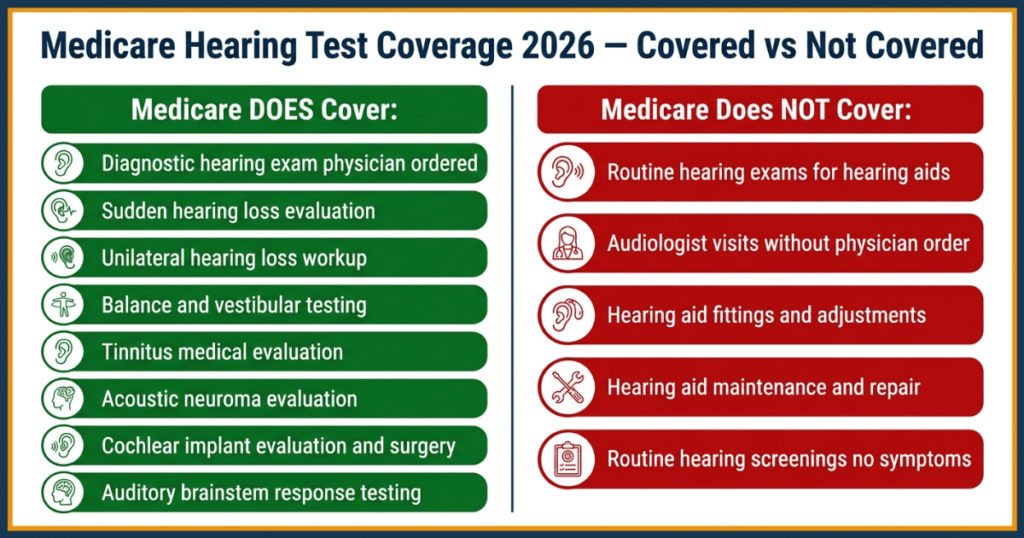
Original Medicare Part B covers diagnostic hearing and balance exams when a physician orders them to evaluate a medical condition or symptom. If your doctor orders a hearing test to investigate specific symptoms — sudden hearing loss, dizziness, balance problems, tinnitus, or suspected acoustic neuroma — Medicare covers the exam as medically necessary.
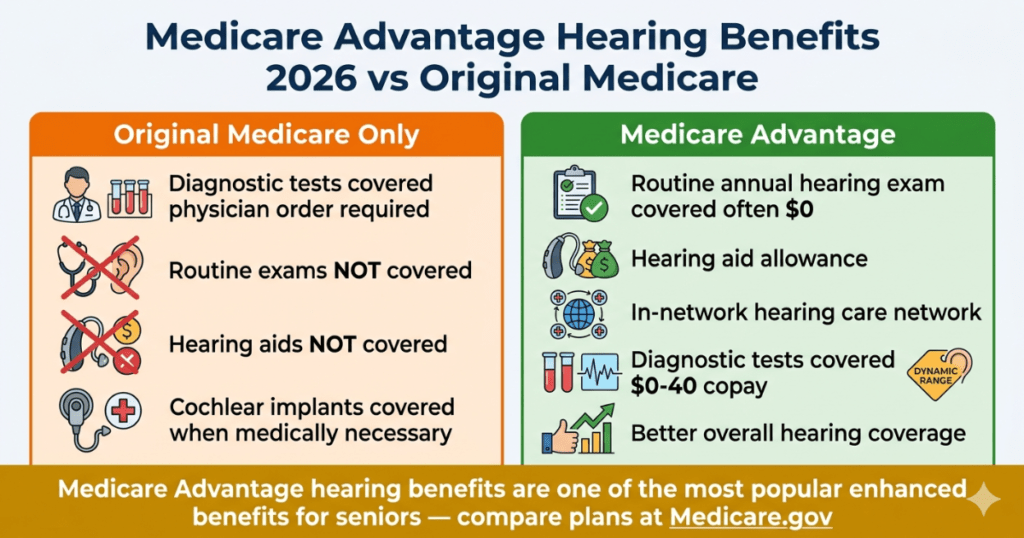
Original Medicare does not cover routine hearing exams performed solely to determine whether you need a hearing aid or to fit a hearing aid. This routine hearing exam exclusion is one of the most significant gaps in Original Medicare coverage for seniors — as routine hearing exams are a normal part of healthy aging for millions of Medicare beneficiaries.
The distinction between a diagnostic hearing test ordered by a physician to evaluate a medical condition and a routine hearing exam ordered for hearing aid fitting is the foundation of Medicare hearing test coverage in 2026.
What Types of Hearing Tests Does Medicare Cover?
Diagnostic Hearing Exams Ordered by a Physician — Covered
Medicare Part B covers diagnostic hearing exams when ordered by a physician to evaluate specific medical symptoms or conditions. Covered diagnostic hearing exams include:
Pure tone audiometry — a test measuring your ability to hear sounds at different frequencies and volumes. When ordered to investigate symptoms like sudden hearing loss, unilateral hearing loss, or hearing loss associated with other medical conditions this test is covered by Medicare.
Speech audiometry — testing your ability to understand spoken words. Covered when ordered to evaluate a specific medical condition or symptom.
Auditory brainstem response testing — an objective test measuring brain wave activity in response to sound. Covered when ordered to evaluate neurological conditions affecting hearing.
Tympanometry and acoustic reflex testing — testing middle ear function and the stapedius muscle reflex. Covered when ordered to evaluate ear conditions such as otitis media, Eustachian tube dysfunction, or suspected ossicular chain problems.
Balance Testing — Covered
Medicare Part B covers vestibular and balance testing when ordered by a physician to evaluate dizziness, vertigo, or balance disorders. Covered balance tests include:
Electronystagmography and videonystagmography — tests measuring eye movements to evaluate vestibular function. Covered when evaluating vertigo or balance problems.
Vestibular evoked myogenic potential testing — testing vestibular organ function. Covered for medically necessary evaluation.
Platform posturography — evaluating balance through computerized movement analysis. Covered when medically ordered.
Audiology Services in Connection with Medical Treatment — Covered
When audiology services are provided as part of treating a diagnosed medical condition they are covered by Medicare. For example audiology services provided during evaluation and treatment of Meniere’s disease, acoustic neuroma, or other diagnosed ear conditions are covered.
Does Medicare Cover Routine Hearing Exams?
Does Medicare cover routine hearing exams in 2026? No — Original Medicare does not cover routine hearing exams performed to determine whether you need a hearing aid or to fit and adjust hearing aids. This is one of the clearest exclusions in Original Medicare coverage.
Medicare does not cover:
- Routine hearing screenings without specific medical symptoms
- Hearing exams performed solely for hearing aid evaluation or fitting
- Audiologist visits for hearing aid selection consultation without a physician order for medical evaluation
- Follow-up hearing exams solely for hearing aid adjustment
This exclusion affects millions of Medicare beneficiaries who need annual or periodic hearing evaluations as a normal part of aging. The lack of routine hearing coverage under Original Medicare is a significant gap that many seniors address through Medicare Advantage plans which commonly include routine hearing benefits.
When Does a Hearing Test Become Medically Necessary?
Understanding when a hearing test crosses from routine to medically necessary is critical for Medicare hearing test coverage. A hearing test becomes medically necessary under Medicare when:
Sudden Hearing Loss
Sudden sensorineural hearing loss — rapid loss of hearing in one or both ears — is a medical emergency requiring immediate evaluation. Medicare covers diagnostic hearing testing ordered to evaluate sudden hearing loss because rapid assessment is necessary to identify and treat potentially reversible causes.
Unilateral Hearing Loss
Hearing loss in only one ear — particularly asymmetric hearing loss where one ear is significantly worse than the other — requires medical investigation to rule out acoustic neuroma and other serious conditions. Medicare covers diagnostic hearing testing ordered to evaluate unilateral hearing loss.
Dizziness and Vertigo
Dizziness and vertigo are common medical complaints among Medicare beneficiaries and often have an inner ear origin. Medicare covers hearing and balance testing ordered by a physician to evaluate dizziness, vertigo, and balance disorders.
Tinnitus Evaluation
Tinnitus — ringing, buzzing, or other sounds in the ears — can be a symptom of underlying medical conditions. When a physician orders audiological evaluation to investigate tinnitus as part of a comprehensive medical workup Medicare may cover the associated hearing tests.
Neurological Conditions
Neurological conditions affecting hearing — including acoustic neuromas, multiple sclerosis, stroke, and other conditions — require audiological evaluation. Medicare covers hearing tests ordered to evaluate neurological conditions.
Pre-Surgical Evaluation
Hearing tests ordered as pre-surgical evaluation for ear surgery or cochlear implant evaluation are covered by Medicare when the surgery itself is medically necessary.
Does Medicare Cover Audiologist Visits?
Does Medicare cover audiologist visits in 2026? Medicare Part B covers audiology services — but only when ordered by a physician for diagnostic purposes.
Specifically Medicare covers audiologist services when:
- A physician orders a diagnostic hearing or balance evaluation
- The audiologist provides services to treat a covered medical condition
- The services are medically necessary and appropriately documented
Medicare does not cover audiologist visits for:
- Routine hearing evaluations without a physician order for medical evaluation
- Hearing aid consultations or fittings
- Hearing aid maintenance and repair
- Cerumen management as a standalone routine service
The requirement for a physician order is important — before seeing an audiologist for a Medicare-covered hearing test you should have a physician order the test for a specific medical reason. Without a physician order the audiology visit is not covered under Medicare Part B.
How Much Does a Hearing Test Cost with Medicare in 2026?
Diagnostic Hearing Tests with Original Medicare
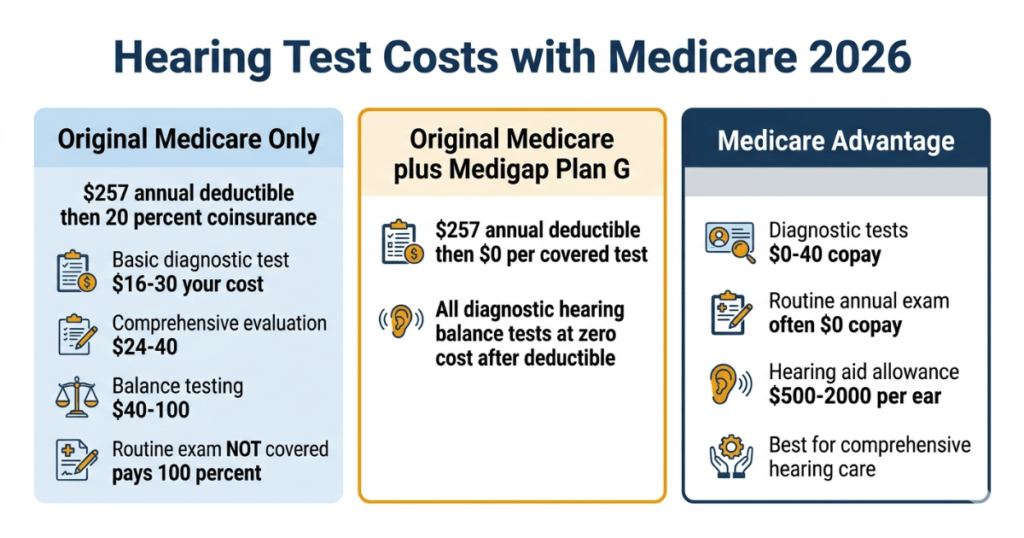
For covered medically necessary hearing tests your costs with Original Medicare are:
- Annual Part B deductible — $257 per year
- After deductible — Medicare pays 80% of the Medicare-approved amount
- Your cost — 20% coinsurance
Typical Medicare-approved amounts for covered hearing tests in 2026:
- Basic diagnostic audiological evaluation — approximately $80 to $150 Medicare-approved — your 20% is $16 to $30
- Comprehensive audiological evaluation — approximately $120 to $200 Medicare-approved — your 20% is $24 to $40
- Vestibular function testing — approximately $200 to $500 Medicare-approved — your 20% is $40 to $100
With Medigap Plan G
If you have Medigap Plan G your 20% coinsurance for covered diagnostic hearing tests is paid after your $257 annual Part B deductible. Your effective cost for Medicare-covered hearing tests with Plan G after meeting the annual deductible is $0.
Routine Hearing Exams Without Coverage
For routine hearing exams not covered by Medicare the out-of-pocket cost in 2026:
- Basic hearing screening — $0 to $50 at many hearing aid retailers
- Comprehensive audiological evaluation — $100 to $300 at audiology offices
- Complete hearing evaluation at hearing aid center — often free as a loss leader for hearing aid sales
With Medicare Advantage
Medicare Advantage plans typically cover both medically necessary hearing tests at the standard plan copay and routine hearing exams as part of enhanced hearing benefits. Most Medicare Advantage plans cover:
- One routine hearing exam per year — often at $0 copay
- Medically necessary hearing tests — $0 to $40 copay
Does Medicare Cover Balance Testing?
Does Medicare cover balance testing in 2026? Yes — Medicare Part B covers vestibular and balance testing when ordered by a physician to evaluate dizziness, vertigo, or balance disorders. Balance testing is medically necessary when a physician needs to determine the cause of a patient’s dizziness or balance problems.
Medicare-covered balance tests include electronystagmography, videonystagmography, vestibular evoked myogenic potential testing, and computerized dynamic posturography. These tests are performed by audiologists or otolaryngologists and are covered at 80% after the Part B deductible when medically ordered.
Balance disorders are common among seniors — falls are a leading cause of injury and death among Medicare beneficiaries — making proper vestibular evaluation an important safety benefit for aging seniors.
Does Medicare Cover Tinnitus Treatment?
Does Medicare cover tinnitus treatment in 2026? The answer depends on the type of treatment.
Diagnostic evaluation for tinnitus — when a physician orders audiological testing to evaluate tinnitus as part of a comprehensive medical workup — may be covered by Medicare as a medically necessary service.
Medical or surgical treatment of tinnitus caused by a specific medical condition — such as acoustic neuroma or Meniere’s disease — is covered by Medicare when the underlying condition itself is covered.
However tinnitus retraining therapy, sound therapy, and other interventions designed specifically to manage tinnitus symptoms rather than treat an underlying medical condition are generally not covered by Original Medicare.
Medicare Advantage plans may provide additional tinnitus-related benefits depending on the specific plan.
Does Medicare Cover Cochlear Implants?
Does Medicare cover cochlear implants in 2026? Yes — Medicare Part A and Part B cover cochlear implant surgery and related services when medically necessary. Cochlear implants are covered for Medicare beneficiaries who meet specific audiological criteria for severe to profound hearing loss that cannot be adequately treated with hearing aids.
Medicare coverage for cochlear implants includes:
- Pre-implant audiological evaluation — covered under Part B
- Cochlear implant surgery — covered under Part A as inpatient or Part B as outpatient
- The cochlear implant device itself — covered as part of the surgical procedure
- Post-implant auditory rehabilitation — covered when medically necessary
Cochlear implants are one of the most important Medicare hearing coverage benefits — representing a significant exception to Medicare’s general exclusion of hearing aids and routine hearing care.
Does Medicare Advantage Cover Hearing Tests?
Does Medicare Advantage cover hearing tests in 2026? Yes — Medicare Advantage plans must cover all medically necessary hearing tests that Original Medicare covers. Additionally most Medicare Advantage plans provide enhanced hearing benefits including:
Routine hearing exams — most Medicare Advantage plans cover one routine hearing examination per year at $0 or low copay. This routine exam coverage is not available under Original Medicare.
Hearing aid allowance — most Medicare Advantage plans provide an annual or biennial hearing aid benefit — typically $500 to $2,000 per ear — toward the purchase of hearing aids. This is a significant benefit given that hearing aids typically cost $1,000 to $4,000 per ear.
In-network hearing providers — Medicare Advantage plans work with hearing care networks to provide discounted hearing exams and hearing aids to members.
When comparing Medicare Advantage plans for hearing coverage look for:
- Whether routine hearing exams are covered annually or every two years
- The hearing aid benefit amount — $500 vs $1,000 vs $2,000 makes a significant difference
- In-network audiologists and hearing centers in your area
- Whether over-the-counter hearing aids are covered by the plan allowance
Frequently Asked Questions — Does Medicare Cover Hearing Tests
Does Medicare cover hearing tests in 2026?
Medicare Part B covers diagnostic hearing tests ordered by a physician to evaluate specific medical symptoms or conditions — including sudden hearing loss, balance disorders, tinnitus evaluation, and neurological conditions affecting hearing. Medicare does not cover routine hearing exams performed solely to determine whether you need a hearing aid. Medicare Advantage plans commonly include routine hearing exam coverage as an enhanced benefit.
Does Medicare cover audiologist visits?
Medicare covers audiologist visits when a physician orders diagnostic hearing or balance testing for medical evaluation. Without a physician order for a specific medical evaluation audiologist visits are not covered by Original Medicare. Medicare Advantage plans commonly cover audiologist visits for both diagnostic and routine hearing evaluation.
How much does a Medicare-covered hearing test cost?
For covered diagnostic hearing tests Medicare pays 80% of the approved amount after your $257 annual Part B deductible. Your 20% coinsurance is approximately $16 to $40 per test depending on the type. With Medigap Plan G your effective cost after the annual deductible is $0. Medicare Advantage typically charges $0 to $40 copay for covered hearing tests.
Does Medicare cover balance testing?
Yes — Medicare covers vestibular and balance testing when ordered by a physician to evaluate dizziness, vertigo, or balance disorders. Covered tests include electronystagmography, videonystagmography, and computerized posturography. Balance disorders are medically important for senior safety and fall prevention.
Does Medicare Advantage cover routine hearing exams?
Yes — most Medicare Advantage plans include annual routine hearing exam coverage as part of their enhanced hearing benefits. Coverage typically includes one exam per year with a hearing aid allowance of $500 to $2,000. This routine hearing coverage is one of the primary advantages Medicare Advantage offers over Original Medicare for hearing care.
Does Medicare cover cochlear implants?
Yes — Medicare covers cochlear implant surgery and related services for Medicare beneficiaries who meet the audiological criteria for severe to profound hearing loss. Coverage includes pre-implant evaluation, the surgery, the device, and post-implant rehabilitation.
Summary — Does Medicare Cover Hearing Tests 2026
Does Medicare cover hearing tests in 2026? Original Medicare covers medically necessary diagnostic hearing and balance tests ordered by a physician to evaluate specific medical conditions — including sudden hearing loss, vestibular disorders, tinnitus evaluation, and neurological conditions affecting hearing. Original Medicare does not cover routine hearing exams for hearing aid evaluation.
For comprehensive hearing coverage including routine exams and hearing aid benefits Medicare Advantage plans are the most accessible solution — most plans include annual hearing exams and hearing aid allowances as standard extra benefits. Cochlear implants represent an important exception where Medicare provides coverage for this major hearing intervention when medically necessary.
For free help understanding your Medicare hearing coverage contact your State Health Insurance Assistance Program (SHIP) at shiphelp.org or call Medicare free at 1-800-633-4227.
This guide is for informational purposes only and is not medical advice. Always verify current Medicare hearing coverage at Medicare.gov before scheduling hearing care appointments.
Sources: Medicare.gov | CMS.gov | SSA.gov | AARP.org
Last updated: April 2026 | Author: James Carter, Independent Medicare Research Analyst