Does Medicare Cover Nursing Home Care — Complete Guide 2026
Does Medicare cover nursing home care in 2026? If you or a loved one needs nursing home care this is one of the most important and most misunderstood Medicare coverage questions. The answer is complex — Medicare does cover nursing home care but only in very specific circumstances and only for a limited time. Medicare does not cover long-term custodial nursing home care — the kind of ongoing care most people think of when they imagine a nursing home. In this complete guide we explain exactly what Medicare covers for nursing home care in 2026 — what is covered, what is not covered, how many days Medicare covers, what nursing home care costs with Medicare, the critical difference between skilled nursing and custodial care, and how to pay for long-term nursing home care when Medicare ends. All information is sourced from Medicare.gov and CMS.gov.
Also Read —
- Does Medicare Cover Home Health Care 2026
- Does Medicare Cover Physical Therapy 2026
- Medicare Advantage vs Original Medicare 2026
What You Will Learn — Does Medicare Cover Nursing Home Care
- Does Medicare cover nursing home care in 2026
- The critical difference between skilled nursing and custodial care
- How many days does Medicare cover in a nursing home
- What Medicare covers in a skilled nursing facility
- How much does nursing home care cost with Medicare
- What happens when Medicare nursing home coverage ends
- Does Medicare cover memory care and dementia care
- Does Medicaid cover nursing home care
- Does Medicare Advantage cover nursing home care
- Frequently asked questions about Medicare nursing home coverage 2026
Does Medicare Cover Nursing Home Care in 2026?
Medicare does cover nursing home care in 2026 — but with critical limitations that every Medicare beneficiary and their family must understand. Medicare covers skilled nursing facility (SNF) care — not long-term custodial nursing home care.
This distinction between skilled nursing care and custodial care is the most important concept in understanding Medicare nursing home coverage:
Skilled nursing care — Medicare covers this. Skilled nursing care involves medically necessary services that can only be performed by or under the supervision of licensed medical professionals. Examples include wound care, IV medications, physical therapy, occupational therapy, speech therapy, and other complex medical treatments following an illness, injury, or surgery.
Custodial care — Medicare does NOT cover this. Custodial care involves assistance with activities of daily living — bathing, dressing, eating, using the toilet, moving around. When a person needs help primarily with daily activities rather than skilled medical treatment Medicare does not cover the nursing home cost regardless of how much care the person needs.
This distinction is devastating news for millions of Americans who assume Medicare will cover their nursing home care when they can no longer care for themselves. The reality is that Medicare provides short-term coverage for skilled nursing care after a hospitalization — not the long-term care that most people associate with nursing homes.
The Critical Difference Between Skilled Nursing and Custodial Care
Understanding the difference between skilled nursing care and custodial care is essential for understanding Medicare nursing home coverage in 2026.
Skilled Nursing Care — What Medicare Covers
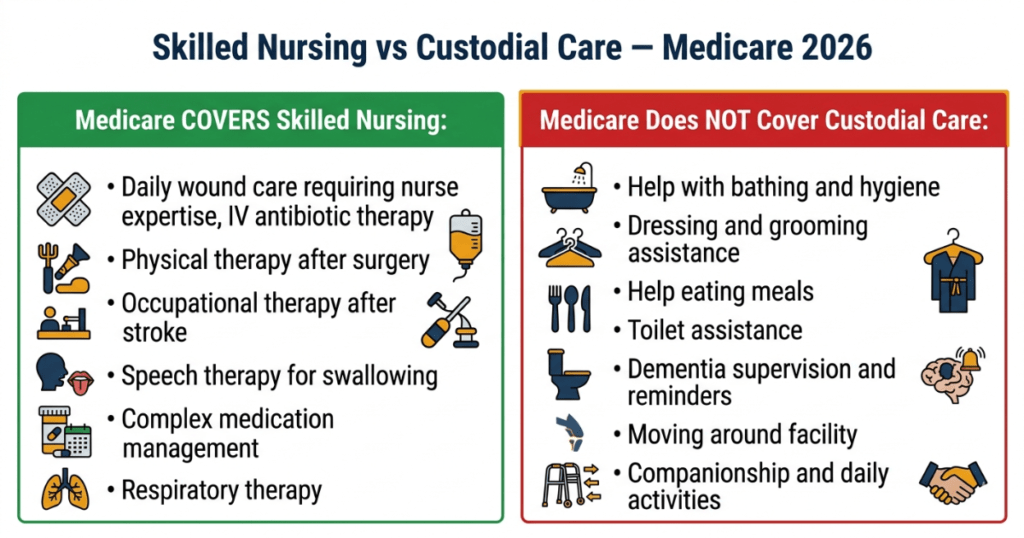
Skilled nursing care requires the expertise of licensed medical professionals and is medically necessary to treat a specific condition. Medicare covers skilled nursing care in a skilled nursing facility when:
- You need daily skilled nursing care — wound care, IV therapy, complex medication management
- You need physical therapy, occupational therapy, or speech therapy to improve or maintain your condition
- The care can only be provided safely by or under the supervision of licensed nurses or therapists
- The care is expected to improve your condition or maintain your current level of function
Examples of skilled nursing care Medicare covers:
- Daily wound dressing changes that require nursing expertise
- IV antibiotic therapy administered by nurses
- Physical therapy to regain walking ability after hip replacement
- Occupational therapy to relearn daily activities after stroke
- Speech therapy to improve swallowing after surgery
- Complex medication management requiring nursing monitoring
- Respiratory therapy and oxygen management
Custodial Care — What Medicare Does NOT Cover
Custodial care provides assistance with activities of daily living and supervision but does not require the expertise of licensed medical professionals. Medicare does not cover custodial care even when it is provided in a skilled nursing facility.
Examples of custodial care Medicare does NOT cover:
- Help with bathing and personal hygiene
- Assistance with dressing and grooming
- Help eating meals
- Assistance using the toilet
- Supervision and reminders for people with dementia
- Help moving around the facility
- Companionship and social activities
The challenge is that most people who need nursing home care primarily need custodial care — help with daily activities — rather than skilled nursing care. And Medicare does not cover custodial care regardless of how severe the person’s disabilities are.
How Many Days Does Medicare Cover in a Nursing Home?
How many days does Medicare cover in a nursing home in 2026? Medicare covers skilled nursing facility care for up to 100 days per benefit period — but with important daily coinsurance costs starting on day 21.
The 3-Day Qualifying Hospital Stay Requirement
Before Medicare will cover any skilled nursing facility care you must first have a qualifying inpatient hospital stay of at least 3 consecutive days — not counting the day of discharge. This is called the 3-day rule and it is one of the most important and most frequently misunderstood requirements in Medicare nursing home coverage.
Important notes about the 3-day rule:
- Observation status does not count — if you were in the hospital under observation status rather than admitted as an inpatient those days do not count toward the 3-day requirement even if you slept there for multiple nights
- The 3 days must be consecutive inpatient days
- You must be admitted to a Medicare-certified skilled nursing facility within 30 days of your qualifying hospital stay
Medicare Skilled Nursing Facility Coverage — Days and Costs in 2026
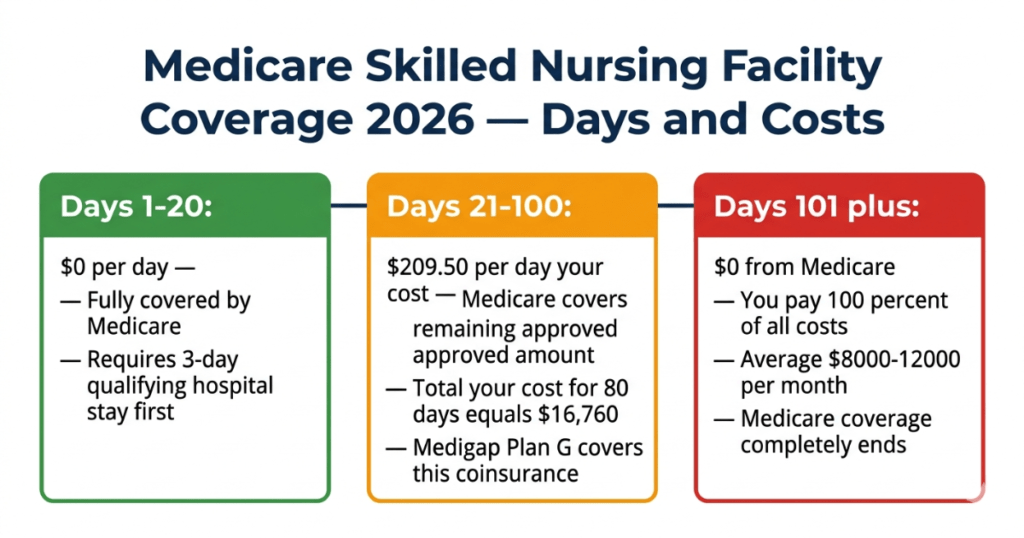
Days 1 to 20 — $0 per day — Medicare covers 100% of approved SNF costs for the first 20 days. This is the most valuable part of Medicare SNF coverage.
Days 21 to 100 — $209.50 per day coinsurance — Medicare covers the remaining approved costs but you pay $209.50 per day. Over 80 days this amounts to $16,760 out of pocket.
Days 101 and beyond — $0 from Medicare — Medicare stops covering SNF care after day 100. You pay 100% of all costs.
The Benefit Period Reset
Medicare SNF coverage resets with each new benefit period. A new benefit period begins when you have been out of the hospital and SNF for at least 60 consecutive days. If you are discharged from the SNF have 60 days without hospital or SNF admission and then are hospitalized again you start a new benefit period with new SNF coverage including the 20 days at $0.
What Does Medicare Cover in a Skilled Nursing Facility?
When Medicare does cover skilled nursing facility care what does it include? Medicare-covered SNF services in 2026 include:
Medical Services
- Semi-private room in the SNF
- Meals and nutritional services
- Skilled nursing care 24 hours per day
- Physical therapy
- Occupational therapy
- Speech-language pathology services
- Medical social services
- Medications and pharmaceutical services
- Medical supplies and equipment used in the facility
- Ambulance transportation to the nearest appropriate medical facility when required
What Medicare Does NOT Cover in a SNF
- Private room — unless medically necessary
- Personal convenience items — telephone, television
- Personal care items beyond what the facility provides
- Most dental care
- Most vision care
- Custodial care once skilled needs are no longer present
How Much Does Nursing Home Care Cost with Medicare in 2026?
Understanding the full cost of nursing home care with Medicare helps you plan for this significant potential expense.
With Original Medicare Only
Days 1 to 20 — $0 — Medicare covers 100%
Days 21 to 100 — $209.50 per day — your cost
- 10 additional days = $2,095
- 30 additional days = $6,285
- 80 additional days (full benefit period) = $16,760
Days 101 and beyond — 100% your cost
- Average nursing home cost in the United States in 2026 — $8,000 to $12,000 per month
- Annually — $96,000 to $144,000
With Medigap Plan G
Medigap Plan G covers the $209.50 per day SNF coinsurance for days 21 to 100. With Plan G your effective cost for Medicare-covered SNF days is $0 — providing significant financial protection for the up to 80 days of coinsurance that would otherwise cost $16,760.
However Plan G does not cover SNF care beyond day 100 — after Medicare’s coverage ends Plan G provides no additional protection for long-term nursing home costs.
With Medicare Advantage
Medicare Advantage plans must cover the same SNF benefits as Original Medicare but with their own cost-sharing structure. Most Medicare Advantage plans charge:
- Days 1 to 20 — $0 per day
- Days 21 to 100 — $0 to $300 per day depending on plan
- All costs count toward $9,350 annual out-of-pocket maximum
Some Medicare Advantage plans have more generous SNF benefits than Original Medicare — covering more days or lower daily coinsurance. Others have less generous terms. Always check your specific plan’s SNF benefit before a hospitalization if possible.
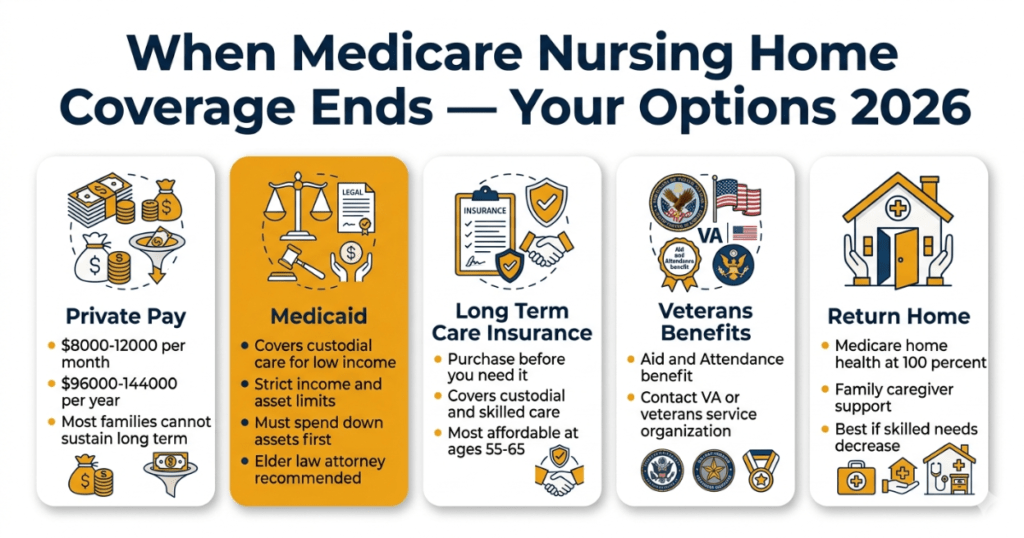
What Happens When Medicare Nursing Home Coverage Ends?
When Medicare stops covering nursing home care — after day 100 or when skilled care is no longer needed — patients and families face difficult decisions. Here are the options:
Option 1 — Pay Out of Pocket
Private pay nursing home care in 2026 costs $8,000 to $12,000 per month — $96,000 to $144,000 per year. Few families can sustain this expense for extended periods.
Option 2 — Medicaid
Medicaid — not Medicare — is the primary payer for long-term nursing home care in the United States. Medicaid covers custodial nursing home care for qualifying low-income individuals. To qualify for Medicaid nursing home coverage you must meet strict income and asset limits — requirements vary by state.
Many people spend down their assets paying for nursing home care until they qualify for Medicaid. Medicaid planning with an elder law attorney can help families legally protect assets while qualifying for Medicaid nursing home coverage.
Option 3 — Long-Term Care Insurance
Long-term care insurance purchased before you need nursing home care can cover custodial nursing home costs that Medicare does not. Long-term care insurance policies typically pay a daily benefit for nursing home care custodial or skilled for a specified number of years. Policies are most affordable when purchased at ages 55 to 65 before health problems develop.
Option 4 — Veterans Benefits
Veterans who served during wartime may qualify for VA benefits including the Aid and Attendance benefit that can help pay for nursing home care. Contact your local VA office or a veterans service organization for information.
Option 5 — Return Home with Home Health Care
Some patients can return home with Medicare-covered home health care and family caregiver support rather than remaining in a nursing home. Medicare covers home health physical therapy, skilled nursing, and other services at 100% for homebound patients — potentially enabling a return home when skilled nursing needs decrease.
Does Medicare Cover Memory Care and Dementia Care?
Does Medicare cover memory care and dementia care in a nursing home in 2026? This is one of the most common and most heartbreaking questions families face when a loved one develops Alzheimer’s disease or other dementia.
The answer is that Medicare covers skilled nursing care for dementia patients — but not custodial memory care. If a person with dementia requires skilled medical treatment — for example antibiotic therapy for a urinary tract infection, wound care, or physical therapy after a fall — Medicare covers those skilled services in a skilled nursing facility.
However the long-term supervision, personal care, behavioral management, and custodial care that dementia patients primarily need is not covered by Medicare. Memory care units in assisted living facilities or nursing homes are custodial in nature and Medicare does not cover these costs.
The primary payers for long-term memory care are private pay, long-term care insurance, and eventually Medicaid when assets are depleted. This financial reality makes long-term care planning and potentially long-term care insurance critically important for seniors at risk of dementia.
Does Medicaid Cover Nursing Home Care?
Does Medicaid cover nursing home care in 2026? Yes — Medicaid is the largest payer for long-term nursing home care in the United States covering over 60% of all nursing home residents nationally.
Medicaid covers custodial nursing home care — the daily assistance with activities of daily living that Medicare does not cover — for qualifying low-income individuals. Medicaid nursing home coverage includes room and board, personal care, meals, and basic medical services.
To qualify for Medicaid nursing home coverage you must meet your state’s income and asset limits. Requirements vary significantly by state but generally:
- Income limits — typically at or below a state-specific threshold
- Asset limits — typically $2,000 to $4,000 in countable assets for single individuals
- Certain assets are exempt — primary home with intent to return, one vehicle, personal belongings
Medicaid planning with an elder law attorney can help families navigate the complex Medicaid qualification rules and legally protect assets while qualifying for coverage. Medicaid look-back rules require 5-year look-back periods for asset transfers — planning must begin well before nursing home care is needed.
Does Medicare Advantage Cover Nursing Home Care?
Does Medicare Advantage cover nursing home care in 2026? All Medicare Advantage plans must cover skilled nursing facility care — the same as Original Medicare. However there are important differences in how Medicare Advantage plans handle SNF coverage.
Prior authorization — most Medicare Advantage plans require prior authorization for SNF admission and periodic recertification during the stay. Your doctor and the SNF typically handle this process but delays in authorization can affect placement.
Network SNF facilities — Medicare Advantage plans require you to use in-network SNFs for covered rates. Going to an out-of-network SNF can result in significantly higher costs or no coverage on HMO plans. Always verify SNF network status before admission if possible.
Benefit enhancements — some Medicare Advantage plans offer enhanced SNF benefits beyond the standard 100 days. Certain plans offer extended SNF coverage or lower daily coinsurance. Check your specific plan’s SNF benefit details.
Frequently Asked Questions — Does Medicare Cover Nursing Home Care
Does Medicare cover nursing home care in 2026?
Medicare covers skilled nursing facility care — not long-term custodial nursing home care. Medicare covers up to 100 days per benefit period in a skilled nursing facility following a qualifying 3-day inpatient hospital stay. Days 1 to 20 are covered at $0. Days 21 to 100 require $209.50 per day coinsurance. Medicare does not cover custodial care — help with daily activities — regardless of how much care the person needs.
How many days does Medicare cover in a nursing home?
Medicare covers up to 100 days per benefit period in a skilled nursing facility. The first 20 days are covered at $0. Days 21 to 100 require $209.50 per day coinsurance. After day 100 Medicare provides no coverage. Medicare SNF coverage resets with a new benefit period after 60 consecutive days outside the hospital and SNF.
What is the 3-day rule for Medicare nursing home coverage?
Before Medicare will cover skilled nursing facility care you must have a qualifying inpatient hospital stay of at least 3 consecutive days — not counting the day of discharge. Observation status does not count toward the 3-day requirement. This is one of the most important and frequently misunderstood requirements in Medicare nursing home coverage.
Does Medicare cover long-term nursing home care?
No — Medicare does not cover long-term custodial nursing home care. Medicare only covers skilled nursing care for a limited time following a qualifying hospitalization. Long-term custodial care is primarily covered by Medicaid for qualifying low-income individuals, long-term care insurance, or paid out of pocket.
Does Medicare cover memory care for Alzheimer’s patients?
Medicare covers skilled medical care for dementia patients — such as treatment for infections, wound care, or therapy after falls. Medicare does not cover the custodial supervision and personal care that memory care facilities primarily provide. Long-term memory care costs are paid privately, through long-term care insurance, or eventually through Medicaid.
What is the difference between Medicare and Medicaid for nursing home care?
Medicare covers short-term skilled nursing care following hospitalization — up to 100 days with daily coinsurance after day 20. Medicaid covers long-term custodial nursing home care for qualifying low-income individuals — with no time limit as long as you continue to qualify. Most people who need long-term nursing home care eventually transition from Medicare to Medicaid as their assets are depleted.
Summary — Does Medicare Cover Nursing Home Care 2026
Does Medicare cover nursing home care in 2026? Medicare covers skilled nursing facility care for up to 100 days per benefit period following a qualifying 3-day hospital stay — with the first 20 days at $0 and days 21 to 100 requiring $209.50 per day coinsurance. Medicare does not cover long-term custodial nursing home care — the care most people think of when they imagine a nursing home.
Understanding this critical limitation is essential for retirement planning. Long-term nursing home care costs $96,000 to $144,000 per year and Medicare will not pay for it. Planning ahead with long-term care insurance, Medicaid planning with an elder law attorney, or other strategies is critical for protecting your retirement assets.
For free help understanding your Medicare nursing home coverage contact your State Health Insurance Assistance Program (SHIP) counselor at shiphelp.org or call Medicare free at 1-800-633-4227.
This guide is for informational purposes only and is not legal or financial advice. Always consult an elder law attorney for Medicaid planning and verify current Medicare coverage at Medicare.gov.
Sources: Medicare.gov | CMS.gov | SSA.gov | AARP.org
Last updated: April 2026 | Author: James Carter, Independent Medicare Research Analyst