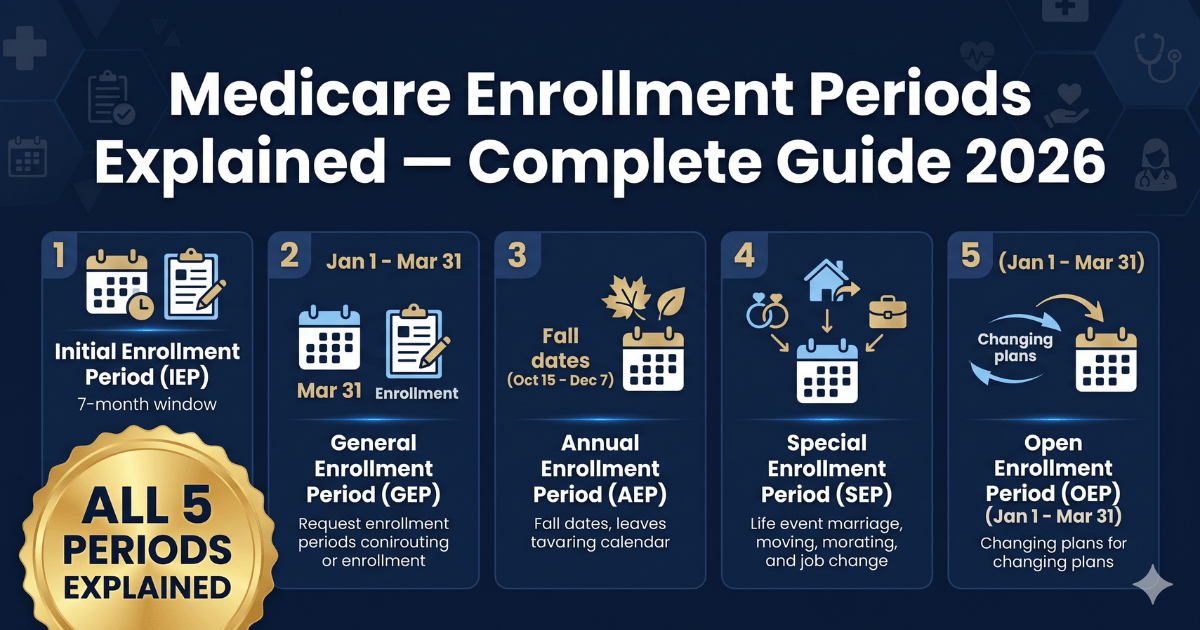
Medicare Enrollment Periods Explained — Complete Guide 2026
Understanding Medicare enrollment periods is one of the most critical aspects of Medicare planning — and making a mistake with enrollment timing can result in costly late enrollment penalties that last for life. In 2026 there are multiple Medicare enrollment periods — each with specific rules about who can use them, what changes can be made, and what happens if you miss them. In this complete guide we explain every Medicare enrollment period in 2026 — the Initial Enrollment Period, General Enrollment Period, Annual Election Period, Medicare Advantage Open Enrollment Period, and Special Enrollment Periods — so you can make the right Medicare decisions at the right time. All information is sourced from Medicare.gov and SSA.gov.
Also Read —
- When to Enroll in Medicare — Complete Timeline 2026
- Medicare Late Enrollment Penalty 2026
- Medicare Open Enrollment 2026 Complete Guide
What You Will Learn — Medicare Enrollment Periods Explained
- All Medicare enrollment periods explained for 2026
- The Initial Enrollment Period — when you first become eligible
- The General Enrollment Period — for those who missed initial enrollment
- The Annual Election Period — the main plan switching window
- The Medicare Advantage Open Enrollment Period
- Special Enrollment Periods — qualifying life events
- Medigap enrollment periods and rules
- Late enrollment penalties for missing enrollment windows
- Frequently asked questions about Medicare enrollment periods 2026
Why Medicare Enrollment Periods Matter
Medicare enrollment periods are among the most consequential timing decisions in healthcare. Missing an enrollment window can result in:
- Permanent lifetime late enrollment penalties added to your monthly premium — 10% per year for Part B and 1% per month for Part D
- Gaps in healthcare coverage that leave you uninsured
- Being locked out of changing Medicare plans until the next enrollment window
- Losing access to Medigap coverage without medical underwriting
Understanding every Medicare enrollment period — what it covers, when it occurs, and who qualifies — is essential for every Medicare beneficiary and everyone approaching age 65. The right enrollment decision at the right time can save thousands of dollars and prevent years of higher premiums.
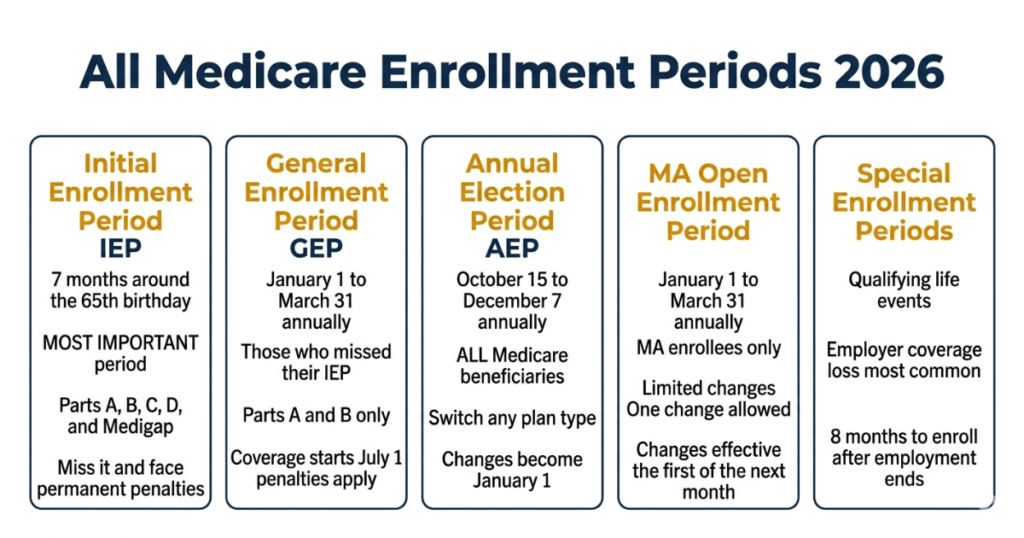
Enrollment Period 1 — Initial Enrollment Period (IEP)
The Initial Enrollment Period is the first and most important Medicare enrollment window — the window during which you first become eligible for Medicare and enroll in your coverage.
When Is the Initial Enrollment Period?
The Initial Enrollment Period lasts 7 months:
- 3 months before the month you turn 65
- The month you turn 65
- 3 months after the month you turn 65
Example — if you turn 65 on July 15 your Initial Enrollment Period runs from April 1 through October 31.
What Can You Do During the IEP?
During the Initial Enrollment Period you can:
- Enroll in Medicare Part A (hospital insurance)
- Enroll in Medicare Part B (medical insurance)
- Enroll in a Medicare Advantage plan (Part C)
- Enroll in a Medicare Part D prescription drug plan
- Purchase a Medigap supplement plan without medical underwriting
When Does Coverage Start?
Coverage start date depends on when during the IEP you enroll:
- If you enroll in the 3 months before your birthday month — coverage begins the first day of your birthday month
- If you enroll during your birthday month — coverage begins the first day of the following month
- If you enroll in months 1, 2, or 3 after your birthday month — coverage begins 1, 2, or 3 months after enrollment respectively
Enrolling early in your IEP — during the 3 months before your birthday — ensures coverage starts on the first day of your birthday month with no gap.
What Happens If You Miss the IEP?
If you miss your Initial Enrollment Period without a qualifying reason you may face:
- Late enrollment penalties — permanent increases to your monthly Medicare premiums
- A gap in coverage until the next enrollment opportunity
- Limited options until the General Enrollment Period
Many people are automatically enrolled in Medicare Part A at age 65 if they are already receiving Social Security benefits — but Part B enrollment still requires action. Always confirm your enrollment status before your IEP ends.
Enrollment Period 2 — General Enrollment Period (GEP)
The General Enrollment Period is the annual enrollment window for people who missed their Initial Enrollment Period and do not have a qualifying Special Enrollment Period.
When Is the General Enrollment Period?
The General Enrollment Period runs January 1 to March 31 every year.
What Can You Do During the GEP?
During the General Enrollment Period you can:
- Enroll in Medicare Part A if you missed your IEP and do not qualify for premium-free Part A
- Enroll in Medicare Part B if you missed your IEP
You cannot enroll in Medicare Advantage or Part D during the GEP — you need to enroll in Parts A and B first, then use other enrollment periods for supplemental coverage.
When Does Coverage Start?
Coverage for Part A and Part B enrolled during the General Enrollment Period begins July 1 of the enrollment year.
This means if you enroll in the GEP in January through March your coverage does not start until July 1 — potentially leaving you with a gap in coverage from January through June.
Late Enrollment Penalties Apply
Enrolling through the GEP rather than the IEP typically triggers late enrollment penalties:
Part B late enrollment penalty — 10% added to your monthly Part B premium for each full 12-month period you were eligible but not enrolled. This penalty is permanent and lasts as long as you have Medicare.
Example — if you were eligible at 65 and did not enroll until age 68 — 3 full years — your Part B premium would be 30% higher than the standard premium permanently.
Enrollment Period 3 — Annual Election Period (AEP)
The Annual Election Period is the main Medicare plan switching window — the period most people refer to when they talk about Medicare Open Enrollment.
When Is the Annual Election Period?
The Annual Election Period runs October 15 to December 7 every year.
What Can You Do During the AEP?
During the Annual Election Period all Medicare beneficiaries can:
- Switch from Original Medicare to a Medicare Advantage plan
- Switch from Medicare Advantage to Original Medicare
- Switch from one Medicare Advantage plan to a different plan
- Add a Medicare Part D drug plan
- Switch from one Part D plan to a different plan
- Drop a Medicare Part D plan
When Do Changes Take Effect?
All plan changes made during the Annual Election Period take effect January 1 of the following year.
What You Cannot Do During the AEP:
- Add or change a Medigap supplement plan
- Enroll in Medicare Parts A or B for the first time
- Use the AEP if you are not already enrolled in Medicare
The Annual Election Period is specifically for changing Medicare plan coverage — not for initial Medicare enrollment. If you need to enroll in Medicare for the first time use the Initial Enrollment Period or Special Enrollment Period.
Enrollment Period 4 — Medicare Advantage Open Enrollment Period (MA OEP)
The Medicare Advantage Open Enrollment Period provides a second annual opportunity for Medicare Advantage enrollees to make limited plan changes early in the coverage year.
When Is the MA Open Enrollment Period?
The MA Open Enrollment Period runs January 1 to March 31 every year.
Who Can Use the MA OEP?
Only current Medicare Advantage enrollees can use the MA Open Enrollment Period. If you have Original Medicare you cannot use this period to enroll in Medicare Advantage.
What Can You Do During the MA OEP?
During the Medicare Advantage Open Enrollment Period you can:
- Switch from your current Medicare Advantage plan to a different Medicare Advantage plan
- Switch from Medicare Advantage to Original Medicare and add a standalone Part D plan
You can only make one change during the MA OEP.
What You Cannot Do During the MA OEP:
- Switch from Original Medicare to Medicare Advantage
- Change a standalone Part D plan if staying in Medicare Advantage
- Make more than one plan change
When Do Changes Take Effect?
Changes made during the MA OEP take effect the first day of the month after your enrollment is processed.
Enrollment Period 5 — Special Enrollment Periods (SEPs)
Special Enrollment Periods allow Medicare beneficiaries to make Medicare enrollment changes outside of the standard enrollment windows when specific qualifying life events occur.
Common Qualifying Events for Special Enrollment Periods:
Losing employer or union coverage
If you or your spouse was covered by an employer or union group health plan and lose that coverage you qualify for a Special Enrollment Period. You have 8 months from the date you lose coverage to enroll in Medicare Part B without penalty.
This is one of the most important SEPs — millions of Americans delay Medicare enrollment because they have employer coverage past age 65. When that coverage ends you must enroll promptly to avoid penalties.
Moving out of your plan’s service area
If you move to an area where your current Medicare Advantage or Part D plan does not operate you qualify for a SEP to enroll in a new plan.
Plan losing Medicare certification
If your Medicare Advantage or Part D plan loses its Medicare contract you qualify for a SEP to enroll in a new plan.
Qualifying for or losing Medicaid or Extra Help
Changes in Medicaid eligibility or Extra Help status qualify you for special enrollment windows.
Leaving a skilled nursing facility or institutional care
Patients leaving skilled nursing facilities or other institutional care qualify for a SEP to make Medicare plan changes.
Other qualifying events
Medicare recognizes many other qualifying events — including being released from incarceration, receiving a plan termination notice, and others. Contact Medicare at 1-800-633-4227 to determine if your specific situation qualifies for a SEP.
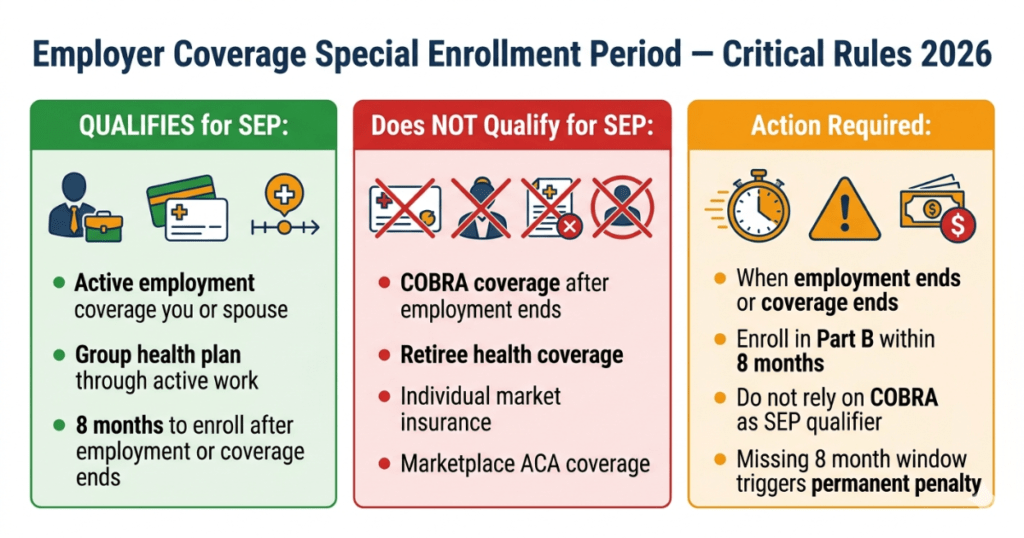
The Employer Coverage SEP — Critical Details
The employer coverage Special Enrollment Period is by far the most commonly used SEP and has specific important rules:
You can delay Medicare Part B enrollment past age 65 without penalty IF:
- You are actively employed (or your spouse is actively employed)
- You are covered by a group health plan through that active employment
Once the active employment ends or the group health coverage ends you have 8 months to enroll in Part B without penalty.
COBRA coverage does NOT qualify for the employer coverage SEP — once you are on COBRA you should enroll in Medicare Part B promptly as COBRA does not protect you from the late enrollment penalty.
Retiree coverage also does NOT qualify for the employer coverage SEP — once you retire and transition to retiree health coverage rather than active employment coverage you should enroll in Medicare Part B.
Medigap Enrollment Periods
Medigap supplement plans have their own enrollment rules that are separate from the Medicare Part A and B enrollment periods.
Medigap Open Enrollment Period
The Medigap Open Enrollment Period lasts 6 months — starting on the first day of the month you are both:
- Age 65 or older
- Enrolled in Medicare Part B
During this 6-month window you can purchase any Medigap plan offered in your state without medical underwriting — regardless of your health status. Insurance companies must accept you at standard rates during this window.
This is the most important Medigap enrollment window — and it happens only once. After the initial 6-month Medigap Open Enrollment Period you have Medigap guaranteed issue rights only in specific circumstances in most states.
After the Medigap Open Enrollment Period
After the initial 6-month window ends insurance companies in most states can use medical underwriting for Medigap — meaning they can deny you coverage or charge higher premiums based on your health conditions. This is why it is critically important to enroll in the Medigap plan you want during the initial open enrollment window.
States with Special Medigap Protections
Several states provide additional Medigap guaranteed issue protections beyond the federal standard:
Year-round guaranteed issue — New York, Massachusetts, and Connecticut allow Medicare beneficiaries to purchase or switch Medigap plans at any time without underwriting.
Birthday rules — California, Oregon, Washington, and a few other states allow annual Medigap shopping without underwriting during a 30-day window around your birthday.
Medigap Guaranteed Issue Rights
Even outside the initial open enrollment period certain qualifying events give you guaranteed issue rights for Medigap regardless of state:
- When your Medicare Advantage plan leaves your area or you move out of the service area
- When you leave a Medicare Advantage plan within the first year of joining (trial right)
- When your Medigap insurer goes bankrupt or your plan is discontinued
- Other qualifying circumstances
Late Enrollment Penalties for Missing Enrollment Windows
Missing Medicare enrollment windows can result in permanent lifetime penalties. Here is a complete summary:
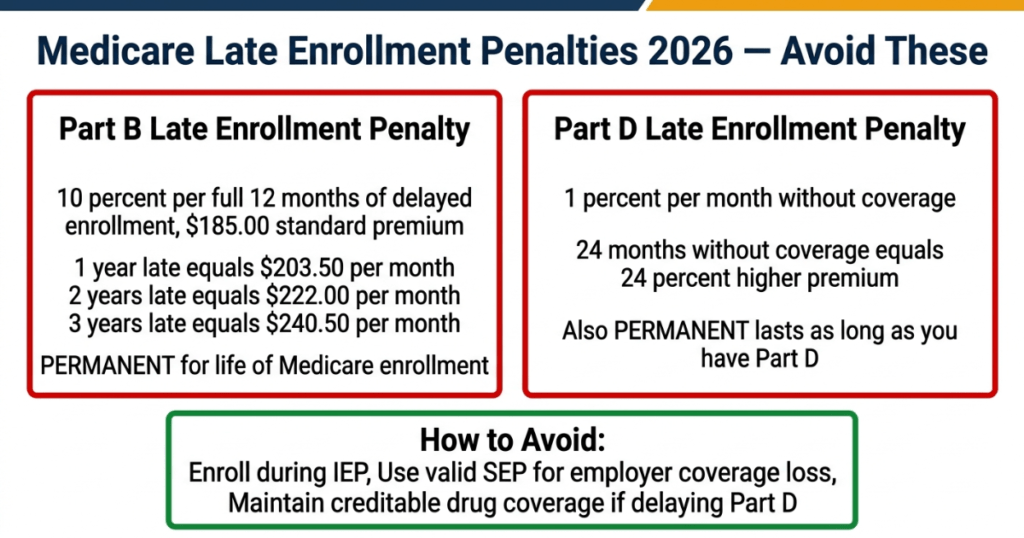
Part B Late Enrollment Penalty
For each full 12-month period you were eligible for Medicare Part B but did not enroll — without a qualifying Special Enrollment Period — your monthly Part B premium increases by 10%.
Example — 2 years of delayed enrollment = 20% higher Part B premium permanently $185.00 standard premium + 20% = $222.00 per month permanently
This penalty lasts as long as you have Medicare Part B.
Part D Late Enrollment Penalty
For each month you were eligible for Medicare Part D but did not enroll — without creditable drug coverage — your monthly Part D premium increases by 1% per month of non-enrollment.
Example — 24 months without coverage = 24% higher Part D premium permanently
This penalty also lasts as long as you have Medicare Part D.
Avoiding Penalties
You can avoid Medicare late enrollment penalties by:
- Enrolling during your Initial Enrollment Period
- Maintaining creditable employer drug coverage if delaying Part D
- Using a qualifying Special Enrollment Period when appropriate
- Understanding the difference between COBRA and active employer coverage
Frequently Asked Questions — Medicare Enrollment Periods
What are all the Medicare enrollment periods in 2026?
There are five main Medicare enrollment periods in 2026 — the Initial Enrollment Period (7 months around age 65), the General Enrollment Period (January 1 to March 31 for those who missed IEP), the Annual Election Period (October 15 to December 7 for plan changes), the Medicare Advantage Open Enrollment Period (January 1 to March 31 for MA members), and Special Enrollment Periods for qualifying life events.
What is the most important Medicare enrollment period?
The Initial Enrollment Period — the 7-month window around your 65th birthday — is the most important Medicare enrollment period. Missing the IEP without a qualifying SEP results in permanent late enrollment penalties. The Medigap Open Enrollment Period — the 6-month window when you first have Medicare Part B — is the second most important because it is your only guaranteed chance to buy Medigap without medical underwriting in most states.
What happens if I miss my Medicare enrollment period?
Missing the Initial Enrollment Period without a qualifying Special Enrollment Period results in late enrollment penalties — 10% per year for Part B and 1% per month for Part D — that are permanent. You must wait for the General Enrollment Period (January 1 to March 31) to enroll in Parts A and B with coverage starting July 1.
Can I enroll in Medicare at any time?
No — Medicare enrollment is limited to specific enrollment windows. The main exception is if you qualify for a Special Enrollment Period due to a qualifying life event. Understanding which enrollment period applies to your situation prevents penalties and coverage gaps.
What is the difference between the Annual Election Period and the MA Open Enrollment Period?
The Annual Election Period (October 15 to December 7) allows all Medicare beneficiaries to make any type of Medicare plan change. The MA Open Enrollment Period (January 1 to March 31) is only available to current Medicare Advantage enrollees and allows limited changes — switching between MA plans or returning to Original Medicare. Changes effective dates also differ — AEP changes take effect January 1 while MA OEP changes take effect the first of the following month.
Summary — Medicare Enrollment Periods Explained 2026
Understanding all Medicare enrollment periods is essential for making the right Medicare decisions at the right time and avoiding costly permanent penalties. The five main enrollment windows — Initial Enrollment Period, General Enrollment Period, Annual Election Period, Medicare Advantage Open Enrollment Period, and Special Enrollment Periods — each serve different purposes with different rules and different eligible populations.
The most critical enrollment timing decisions are enrolling in Medicare Parts A and B during your Initial Enrollment Period — or through a valid employer coverage SEP — to avoid permanent penalties, and purchasing Medigap during the initial 6-month guaranteed issue window to secure coverage without medical underwriting in most states.
For free personalized guidance on Medicare enrollment periods and timing contact your State Health Insurance Assistance Program (SHIP) at shiphelp.org or call Medicare free at 1-800-633-4227.
This guide is for informational purposes only and is not legal or financial advice. Always verify current Medicare enrollment period rules at Medicare.gov before making enrollment decisions.
Sources: Medicare.gov | CMS.gov | SSA.gov | AARP.org
Last updated: April 2026 | Author: James Carter, Independent Medicare Research Analyst