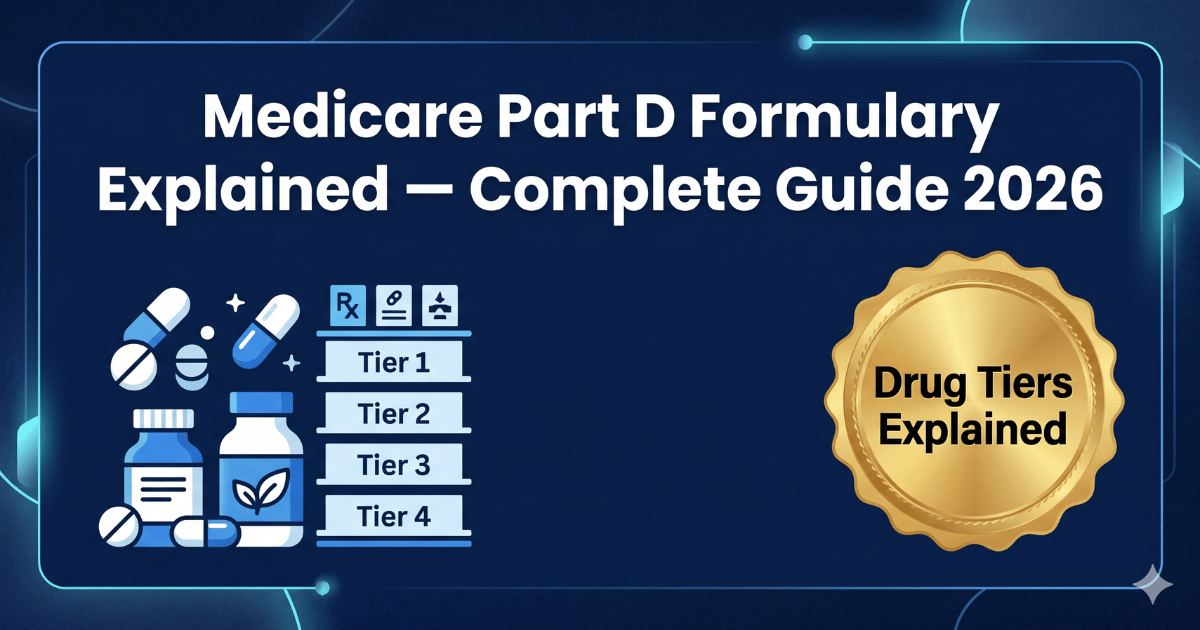
Medicare Part D Formulary Explained — Complete Guide 2026
What is a Medicare Part D formulary and how does it affect your prescription drug coverage in 2026? The Medicare Part D formulary is one of the most important — and most misunderstood — concepts in Medicare drug coverage. Every Medicare Part D plan and Medicare Advantage plan with drug coverage uses a formulary — a specific list of covered drugs organized into cost tiers — to determine what you pay for each medication. Understanding how the Medicare Part D formulary works in 2026 is essential for choosing the right drug plan, managing your medication costs, and knowing what to do when your drug is not covered. In this complete guide we explain everything about Medicare Part D formularies in 2026 — how they work, what drug tiers mean, how to find your plan’s formulary, what to do if your drug is not on the formulary, and how formularies change each year. All information is sourced from Medicare.gov and CMS.gov.
Also Read —
- Medicare Part D Drug Coverage Explained Simply 2026
- Medicare Plan Changes 2026
- Does Medicare Cover Diabetes Supplies 2026
What You Will Learn — Medicare Part D Formulary Explained
- What is a Medicare Part D formulary
- How Medicare drug formulary tiers work
- What drugs are typically on each formulary tier
- How formularies affect what you pay for medications
- How to find your Medicare plan’s formulary
- What to do if your drug is not on the formulary
- How to request a formulary exception
- How Medicare formularies change each year
- Frequently asked questions about Medicare Part D formularies 2026
What Is a Medicare Part D Formulary?
A Medicare Part D formulary is the official list of prescription drugs covered by a specific Medicare drug plan. Every Medicare Part D standalone drug plan and every Medicare Advantage plan with prescription drug coverage maintains a formulary — a carefully curated list of medications that the plan will cover for its members.
The formulary is not just a simple list of covered drugs — it is an organized system that categorizes drugs into tiers based on cost, clinical effectiveness, and the plan’s negotiated pricing with drug manufacturers. The tier a drug is placed on determines how much you pay for that medication — lower tiers mean lower cost-sharing for you and higher tiers mean higher cost-sharing.
Understanding the Medicare Part D formulary is critically important because:
- Not all drugs are covered — if your medication is not on your plan’s formulary Medicare does not pay for it
- The same drug can be on different tiers — and different tiers have very different costs
- Formularies change annually — a drug on Tier 1 this year may move to Tier 3 next year
- Different plans have different formularies — the drug plan with the best formulary for your medications may not be the plan with the lowest premium
The formulary is the most important factor in choosing the right Medicare Part D plan for your specific medications — more important than premium price in most cases.
How Medicare Drug Formulary Tiers Work
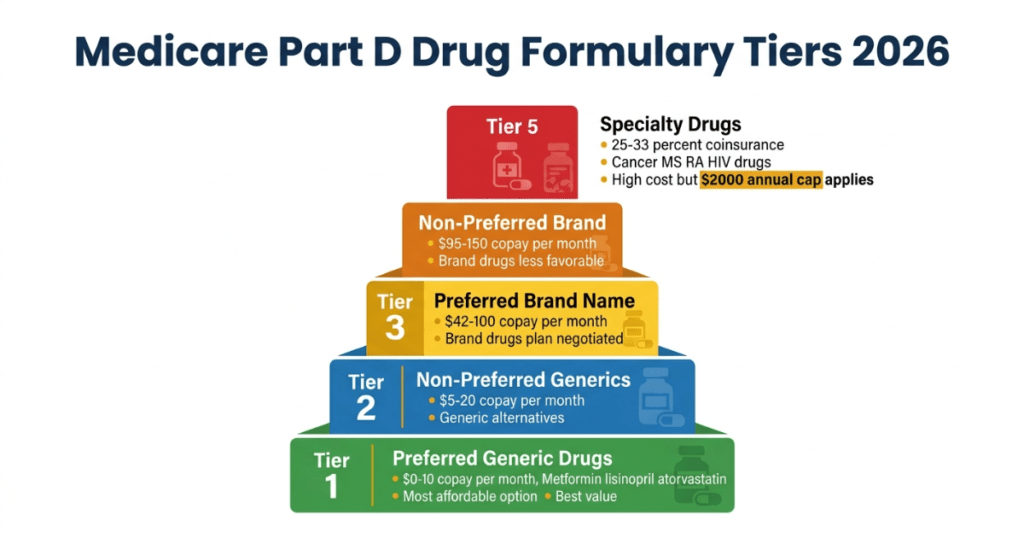
Medicare Part D formularies are organized into drug tiers — typically 5 to 6 tiers — with each tier representing a different level of cost-sharing. Here is how the Medicare formulary tier system works in 2026:
Tier 1 — Preferred Generic Drugs
Tier 1 contains preferred generic drugs — the lowest-cost medications on the formulary. Generic drugs are chemically equivalent to brand-name drugs but cost significantly less. Tier 1 drugs typically have the lowest copays — often $0 to $10 per prescription — making them the most affordable option for Medicare drug coverage.
Examples of typical Tier 1 drugs: metformin, lisinopril, atorvastatin, amlodipine, metoprolol, omeprazole, and hundreds of other widely used generic medications.
Tier 2 — Non-Preferred Generic Drugs
Tier 2 contains generic drugs that are not the preferred generics — typically generic versions of medications that have multiple manufacturers or that the plan has negotiated less favorable pricing for. Tier 2 copays are slightly higher than Tier 1 — typically $5 to $20 per prescription.
Tier 3 — Preferred Brand-Name Drugs
Tier 3 contains preferred brand-name drugs — brand medications that the plan has negotiated favorable pricing for and designated as preferred. Tier 3 copays are significantly higher than generic tiers — typically $42 to $100 per prescription depending on the plan.
Tier 4 — Non-Preferred Brand-Name Drugs
Tier 4 contains brand-name drugs that are not preferred — typically medications for which the plan has less favorable pricing or where preferred alternatives exist. Tier 4 cost-sharing is higher — typically $95 to $150 per prescription.
Tier 5 — Specialty Drugs
Tier 5 contains specialty drugs — high-cost medications typically used for complex or chronic conditions including cancer, rheumatoid arthritis, multiple sclerosis, HIV/AIDS, and hepatic conditions. Specialty drugs often cost thousands of dollars per month at retail prices. Medicare Part D plans typically charge coinsurance rather than a fixed copay for specialty drugs — often 25% to 33% of the medication cost.
The $2,000 annual Part D out-of-pocket maximum in 2026 is particularly important for patients taking specialty drugs — once you reach $2,000 in out-of-pocket drug costs Medicare covers 100% of your covered drug costs for the rest of the year.
Tier 6 — Select Care Drugs (Some Plans)
Some Medicare Part D plans include a Tier 6 for a small set of medications offered at very low or $0 copay — often generic drugs for common conditions like diabetes, hypertension, and heart disease that the plan has chosen to make maximally affordable.
What Drugs Are on Each Formulary Tier?
The specific drugs on each tier vary significantly between Medicare Part D plans. Two plans may both cover a drug but place it on different tiers — resulting in very different costs for the same medication.
Factors That Determine Formulary Tier Placement
Drug manufacturers negotiate rebates and pricing with Medicare Part D plan sponsors. Plans receive larger rebates for some drugs than others — and drugs with larger rebates are often placed on preferred lower-cost tiers. This means the drug on Tier 1 of your plan may reflect the plan’s negotiating success as much as the clinical preference for that drug.
Protected Drug Classes
Certain drug categories are protected under Medicare rules — meaning plans must cover all or substantially all drugs in these categories regardless of tier. Protected drug classes in 2026 include:
- Antiretroviral drugs for HIV
- Antineoplastic drugs for cancer
- Antipsychotic drugs
- Anticonvulsant drugs
- Antidepressants
- Immunosuppressants for organ transplant
These protected classes ensure Medicare beneficiaries can access all drugs in these critical categories even if a specific drug is expensive.
How Formularies Affect What You Pay for Medications
The tier your medication is placed on has a dramatic impact on what you pay. Here is a concrete example showing how formulary tiers affect medication costs:
Example — Lisinopril (Blood Pressure Medication)
Lisinopril is an extremely common generic blood pressure medication available at very low cost.
- On Tier 1 — typical copay $0 to $5 per month
- On Tier 2 — typical copay $10 to $20 per month
- Without a Part D plan — retail price $15 to $50 per month at most pharmacies
In this case the tier placement matters but the cost difference is modest because the underlying drug is inexpensive.
Example — Eliquis (Blood Thinner)
Eliquis is a popular brand-name anticoagulant with no generic equivalent. It costs $500 to $600 per month at retail price.
- On Tier 3 preferred brand — typical copay $45 to $95 per month
- On Tier 4 non-preferred — typical copay $95 to $150 per month
- On Tier 5 specialty — 25% to 33% coinsurance — potentially $125 to $200 per month
For a drug like Eliquis which plan your drug is on and which tier it is placed on can mean a difference of hundreds of dollars per month — and potentially thousands of dollars per year before reaching the $2,000 annual maximum.
How to Find Your Medicare Plan’s Formulary
Finding your Medicare plan’s formulary and checking whether your specific medications are covered — and at what tier — is essential before enrolling in any Medicare Part D plan.
Method 1 — Medicare Plan Finder
The easiest way to check formulary coverage is through Medicare.gov/plan-compare:
- Enter your zip code
- Enter all your prescription medications — drug name, dosage, and quantity
- Medicare Plan Finder shows you the estimated annual drug cost for each plan based on your specific medications
- The tool shows which tier each of your drugs is on and what your monthly cost would be
- Plans are ranked by total estimated annual drug cost for your medications
This tool does the formulary comparison work for you — calculating exactly what each plan would cost for your specific medication list.
Method 2 — Plan’s Official Formulary Document
Every Medicare Part D plan must publish its complete formulary — called the Drug List — on its website and provide it to members. The formulary document lists every covered drug, its tier, and any coverage restrictions.
Method 3 — Call the Plan Directly
Call the Medicare Part D plan directly and ask whether your specific medications are covered, what tier they are on, and what your copay would be. Plans are required to answer formulary questions.
Method 4 — Your Pharmacist
Your pharmacist can often check whether a specific drug is covered under a Medicare Part D plan and at what cost using pharmacy software that accesses plan formulary data.
What to Do If Your Drug Is Not on the Formulary
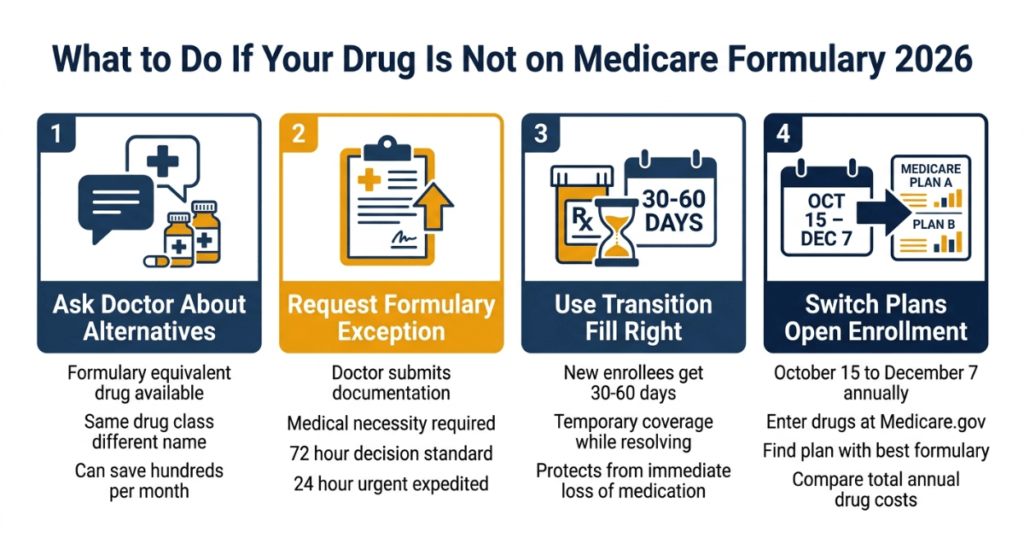
What do you do if your medication is not on your Medicare Part D plan’s formulary — or is on a very high-cost tier? You have several options:
Option 1 — Ask Your Doctor About Formulary Alternatives
If your current medication is not covered or is on a high-cost tier ask your doctor whether a formulary alternative — a similar drug that is on a lower tier — could work equally well for your condition. Many drug classes have multiple options and switching to a preferred formulary alternative can save significant money.
Option 2 — Request a Formulary Exception
You can formally request a formulary exception — asking your Medicare Part D plan to cover a non-formulary drug or to cover a drug at a lower tier cost-sharing level. To request a formulary exception:
- Ask your doctor to submit a coverage determination request to the plan
- Your doctor must provide medical documentation showing why the formulary alternative would not be effective for your condition or would cause adverse effects
- The plan must respond within 72 hours for standard requests or 24 hours for expedited requests
If the exception is approved the plan covers your non-formulary drug — usually at the highest tier cost-sharing. If denied you can appeal through the Medicare appeals process.
Option 3 — Use the Transition Fill Right
When you first enroll in a new Medicare Part D plan you have transition fill rights — the plan must cover a temporary supply of your non-formulary medication (typically 30 to 60 days) while you work with your doctor to find a formulary alternative or request an exception. This protects you from an abrupt loss of medication coverage when switching plans.
Option 4 — Switch to a Plan That Covers Your Drug
During Medicare Open Enrollment October 15 to December 7 you can switch to a Medicare Part D plan that covers your specific medications at a lower tier. Always enter your medications in Medicare Plan Finder before Open Enrollment to find the plan with the best formulary and lowest total cost for your drug list.
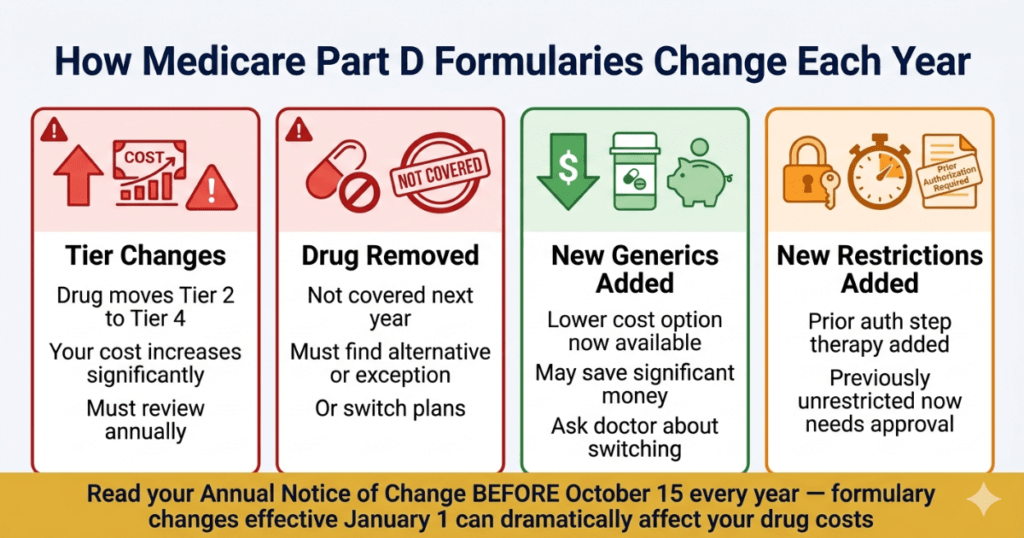
How Medicare Formularies Change Each Year
Medicare Part D formularies change significantly from year to year — this is one of the most important reasons to review your Medicare drug coverage every year during Open Enrollment.
Annual Formulary Changes
Medicare Part D plans can change their formularies on January 1 each year. Common formulary changes include:
- Drugs moving from lower tiers to higher tiers — increasing your cost
- Drugs being removed from the formulary entirely
- New generic drugs being added at lower tiers — decreasing your cost
- Prior authorization requirements being added to previously unrestricted drugs
- Step therapy requirements being added — requiring you to try a less expensive drug first
Annual Notice of Change
Your Medicare Part D plan must notify you of significant formulary changes in the Annual Notice of Change sent before October 15. Read this notice carefully — it tells you exactly how your drug coverage is changing on January 1.
Protected Drug Class Exceptions
Even for protected drug classes plans can change cost tiers — a protected class drug that was on Tier 3 can move to Tier 4 — as long as the drug remains on the formulary. Review tier changes for your medications even if they remain covered.
Formulary Restrictions — Prior Authorization and Step Therapy
In addition to tier placement Medicare Part D formularies may include coverage restrictions that affect when and how you can access certain medications:
Prior Authorization
Some drugs on the formulary require prior authorization — the plan reviews your case before approving coverage. Prior authorization is typically required for:
- High-cost specialty drugs
- Drugs with significant abuse potential
- Drugs where clinical guidelines recommend trying lower-cost alternatives first
Your doctor submits prior authorization documentation to the plan. Standard prior authorization decisions are made within 72 hours. Urgent requests must be decided within 24 hours.
Step Therapy
Step therapy — also called fail first requirements — requires you to try and fail on a less expensive drug before the plan will cover a more expensive alternative. For example a plan may require you to try a generic blood pressure medication before covering a brand-name alternative.
Your doctor can request an exception to step therapy requirements with clinical documentation showing why the step therapy protocol is not appropriate for your situation.
Quantity Limits
Some drugs on the formulary have quantity limits — the plan will only cover a certain quantity of the medication per prescription fill period. Quantity limits are often based on FDA-approved dosing guidelines or clinical guidelines.
Frequently Asked Questions — Medicare Part D Formulary
What is a Medicare Part D formulary?
A Medicare Part D formulary is the official list of covered prescription drugs for a specific Medicare drug plan organized into cost tiers. The tier a drug is placed on determines what you pay — Tier 1 generic drugs have the lowest copays while Tier 5 specialty drugs have the highest cost-sharing. Not all drugs are on every plan’s formulary — if your drug is not covered you pay the full retail price.
How do Medicare drug tiers work?
Medicare drug tiers organize covered medications by cost — Tier 1 preferred generics have the lowest copays typically $0 to $10, Tier 2 non-preferred generics slightly higher, Tier 3 preferred brands typically $42 to $100, Tier 4 non-preferred brands higher, and Tier 5 specialty drugs with coinsurance often 25% to 33%. The tier your drug is on significantly affects your monthly medication costs.
What happens if my drug is not on the formulary?
If your drug is not on the formulary you have three main options — ask your doctor about a covered formulary alternative, request a formulary exception with medical documentation of why the alternative would not work, or switch to a plan with better coverage during Open Enrollment. New plan enrollees have transition fill rights allowing temporary coverage of non-formulary drugs while resolving coverage.
How do formularies change each year?
Medicare Part D formularies can change significantly on January 1. Drugs can move to higher tiers, be removed from coverage, have new restrictions added, or new generics added at lower cost. Your plan must notify you of significant formulary changes in the Annual Notice of Change before October 15. Always review your drug coverage during Open Enrollment.
How do I find the Medicare plan with the best formulary for my drugs?
Use Medicare.gov Plan Finder and enter all your medications. The tool shows the estimated annual drug cost for each available plan based on your specific medications — effectively comparing formulary coverage and cost-sharing across all plans in your area.
Summary — Medicare Part D Formulary Explained 2026
The Medicare Part D formulary is the foundation of your Medicare drug coverage — determining which medications are covered, what tier they are on, and what you pay for each prescription. Understanding how formulary tiers work in 2026 helps you choose the right plan for your medications and know what to do when your drug is not covered or moves to a higher tier.
The most important formulary-related actions every Medicare beneficiary should take annually are entering their medications in Medicare.gov Plan Finder during Open Enrollment to find the plan with the best coverage and lowest total cost for their specific drug list — and reading their Annual Notice of Change carefully to identify any formulary changes affecting their medications.
For free help understanding your Medicare Part D formulary and finding the best drug coverage contact your State Health Insurance Assistance Program (SHIP) at shiphelp.org or call Medicare free at 1-800-633-4227.
This guide is for informational purposes only and is not medical or financial advice. Always verify current Medicare Part D formulary details at Medicare.gov before making enrollment decisions.
Sources: Medicare.gov | CMS.gov | SSA.gov | AARP.org
Last updated: April 2026 | Author: James Carter, Independent Medicare Research Analyst