Medicare for Federal Employees — Complete Guide 2026
Medicare for federal employees in 2026 is one of the most complex and most important Medicare decisions facing the millions of Americans who spent their careers working for the federal government. Federal employees and retirees have access to the Federal Employees Health Benefits (FEHB) program — one of the most comprehensive employer health insurance programs in the world — and understanding exactly how Medicare for federal employees works in 2026 — whether to enroll in Medicare Part B, how FEHB and Medicare coordinate, and whether Medicare provides additional value — is essential for maximizing healthcare coverage and minimizing costs. In this complete guide we explain everything about Medicare for federal employees in 2026. All information is sourced from Medicare.gov, OPM.gov, and CMS.gov.
Also Read —
- Medicare Enrollment Periods Explained 2026
- Medicare Part B Premium 2026
- Medigap Plan G vs Plan N — Which is Better in 2026?
What You Will Learn — Medicare for Federal Employees 2026
- How FEHB and Medicare work together for federal retirees
- Should federal employees enroll in Medicare Part A
- Should federal employees enroll in Medicare Part B
- How FEHB coordinates with Medicare as primary vs secondary
- The Medicare Part B late enrollment penalty for federal employees
- FEHB plans that waive premiums when Medicare is primary
- Medicare Advantage and FEHB — can you have both
- TRICARE and Medicare for military federal employees
- Tips for optimizing Medicare for federal employees
- Frequently asked questions about Medicare for federal employees 2026
Overview — Medicare for Federal Employees in 2026
Medicare for federal employees in 2026 presents a unique situation that differs fundamentally from Medicare planning for private sector retirees. Federal employees and retirees have access to FEHB — the Federal Employees Health Benefits program — which provides comprehensive health coverage through hundreds of plan options administered by the Office of Personnel Management (OPM). This FEHB coverage continues into retirement — unlike most private sector employer coverage which ends at retirement.
This creates the central question for Medicare for federal employees — when you already have excellent FEHB coverage should you also enroll in Medicare? The answer depends on a careful analysis of costs, benefits, and individual circumstances — and the optimal strategy varies significantly between individuals.
Over 8 million people are enrolled in FEHB — including approximately 2 million federal retirees and their family members. Many federal retirees are reaching Medicare eligibility every year and facing this critical coverage coordination decision.
Medicare Part A for Federal Employees — Almost Always Enroll
Should federal employees enroll in Medicare Part A?
Yes — virtually all federal employees should enroll in Medicare Part A at age 65 or when first eligible even if they plan to keep FEHB as their primary coverage.
Why Part A Is Free for Most Federal Employees
Most federal employees and retirees qualify for premium-free Medicare Part A because:
- They paid Medicare taxes throughout their federal career — FICA Medicare taxes apply to all federal employees hired after 1983
- Their spouse paid Medicare taxes — qualifying based on spousal work history
For federal employees who qualify for premium-free Part A there is essentially no reason not to enroll — it costs nothing and provides additional hospital coverage that can coordinate with FEHB.
How Part A Coordinates with FEHB
When a federal retiree has both FEHB and Medicare Part A the coordination depends on which coverage is primary:
If Medicare is primary — Part A covers hospitalization first, FEHB pays remaining costs as secondary If FEHB is primary — FEHB covers hospitalization first, Part A covers remaining costs as secondary
Enrolling in Part A Without Part B
Federal employees can enroll in Part A without enrolling in Part B — these are separate enrollment decisions. Many federal employees choose to take Part A (free) but delay or decline Part B (monthly premium).
Medicare Part B for Federal Employees — The Critical Decision
Should federal employees enroll in Medicare Part B? This is the central and most complex decision in Medicare for federal employees planning.
Medicare Part B in 2026 costs $185.00 per month — $2,220 per year — for most beneficiaries. For federal retirees already paying FEHB premiums adding Part B represents a significant additional monthly expense. The question is whether the additional Part B coverage justifies this cost.

Arguments FOR Enrolling in Medicare Part B as a Federal Employee
Argument 1 — FEHB premium reduction when Medicare is primary:
Many FEHB plans significantly reduce their premiums for retirees who have Medicare as their primary payer — because the FEHB plan’s costs decrease dramatically when Medicare pays first. Some FEHB plans reduce premiums by more than the cost of Part B — making the combination of Medicare plus reduced FEHB less expensive than FEHB alone.
Specific FEHB plans — particularly the Government Employees Health Association (GEHA) plan — offer dramatic premium reductions for Medicare-primary enrollees. GEHA’s Medicare Advantage plan eliminates the FEHB premium entirely for Medicare-primary enrollees — making Medicare Part B enrollment financially compelling.
Argument 2 — Reduced out-of-pocket costs:
With Medicare as primary and FEHB as secondary many federal retirees pay virtually nothing out of pocket for covered healthcare services. Medicare covers most costs at 80% after the deductible — FEHB covers the remaining 20% as a secondary payer — creating a highly comprehensive coverage combination.
Argument 3 — Access to Medicare Advantage plans:
Federal retirees with Medicare Part A and B can enroll in certain Medicare Advantage plans — including FEHB Medicare Advantage plans offered by some carriers — that may provide additional benefits or lower costs than traditional FEHB coverage.
Arguments AGAINST Enrolling in Medicare Part B as a Federal Employee
Argument 1 — High Part B premium:
At $185.00 per month ($2,220 per year) Part B is expensive — particularly if FEHB already provides comprehensive coverage. For federal retirees with generous FEHB coverage and low healthcare utilization the Part B premium may exceed the additional value it provides.
Argument 2 — FEHB already provides comprehensive coverage:
High-option FEHB plans provide comprehensive coverage that in many respects rivals Medicare — making Part B a redundant expense for some federal retirees.
Argument 3 — IRMAA surcharges:
High-income federal retirees with substantial federal pension income may face IRMAA surcharges — significantly increasing the Part B premium beyond the standard $185.00.
How FEHB Coordinates with Medicare
When a federal retiree has both FEHB and Medicare understanding the coordination of benefits rules is essential.
Medicare Primary — FEHB Secondary
When Medicare is primary:
- Medicare pays first — covering up to Medicare-approved amounts
- FEHB pays second — covering remaining costs including deductibles and coinsurance
This combination typically results in minimal or zero out-of-pocket costs for covered services. Most major FEHB plans coordinate generously as secondary payers — filling in virtually all Medicare gaps when Medicare is primary.
FEHB Primary — Medicare Secondary
When FEHB is primary:
- FEHB pays first according to its coverage rules
- Medicare pays remaining costs as secondary up to Medicare-approved amounts
Which Is Primary?
For federal retirees — Medicare is generally primary over FEHB when the retiree is enrolled in both Medicare Part A and Part B.
For active federal employees who continue working past 65 — FEHB is primary and Medicare is secondary.
The Active Worker Exception
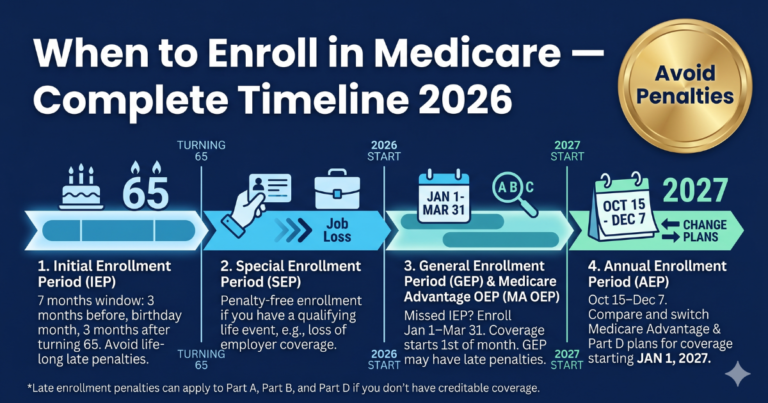
Federal employees who continue working past age 65 can delay Medicare Part B enrollment without penalty — because they have employer group health coverage through FEHB. The active worker exception allows federal employees to delay Part B and avoid late enrollment penalties as long as they remain actively employed and enrolled in FEHB.
When federal employment ends — whether at retirement or otherwise — the employee has an 8-month Special Enrollment Period to enroll in Part B without penalty.
The Medicare Part B Late Enrollment Penalty for Federal Employees
Can federal employees face the Medicare Part B late enrollment penalty?
Yes — federal employees who do not properly use the Special Enrollment Period when they retire and delay Part B enrollment beyond the SEP period can face the late enrollment penalty.
How the Penalty Works
The Part B late enrollment penalty is 10% of the standard Part B premium for each 12-month period you were eligible for Part B but did not enroll without a valid exception.
For federal employees:
- Working past 65 with FEHB — no penalty accumulates — FEHB qualifies as employer group health coverage
- Retiring and enrolling in Part B within the 8-month SEP — no penalty
- Retiring and failing to enroll during the 8-month SEP — penalty applies for every 12 months of delay
Federal Employees Who Kept FEHB After Retirement but Delayed Part B
Some federal retirees made the decision to keep FEHB alone without Medicare Part B — relying on FEHB as their sole coverage. If these retirees later decide to add Part B they may face late enrollment penalties for the years they delayed enrollment after retirement.
The late enrollment penalty for a 10-year delay — 100% of the standard premium — meaning $370 per month instead of $185 per month — is permanent and applies for life.
This is one of the most financially consequential Medicare decisions federal employees face — and getting the timing right matters enormously.

FEHB Plans That Waive Premiums for Medicare-Primary Enrollees
One of the most important — and most valuable — aspects of Medicare for federal employees planning is identifying FEHB plans that dramatically reduce or eliminate premiums when Medicare is primary.
GEHA — Government Employees Health Association
GEHA offers one of the most compelling Medicare coordination arrangements in the FEHB program:
GEHA Medicare Advantage Plan — when federal retirees enroll in GEHA’s Medicare Advantage option the FEHB premium is eliminated entirely. The retiree pays only the Medicare Part B premium ($185/month) and receives comprehensive Medicare Advantage coverage with additional FEHB-style benefits. This arrangement can save retired federal employees thousands of dollars per year in FEHB premiums.
Aetna Advantage FEHB Plans
Aetna offers FEHB Medicare Advantage integration plans that provide premium reductions for Medicare-primary federal retirees.
Blue Cross Blue Shield Federal Employee Program (FEP)
The BCBS Federal Employee Program — the largest FEHB plan — offers the FEP Blue Focus plan with Medicare coordination that reduces costs for Medicare-primary enrollees.
How to Find Premium-Waiving FEHB Plans
Review the FEHB Open Season each November — when you can change FEHB plans. Look specifically for plan brochures that describe Medicare coordination benefits and premium reductions or eliminations for Medicare-primary retirees.
OPM’s plan comparison tool at opm.gov/fehb allows comparison of Medicare coordination features across FEHB plans.
Medicare Advantage and FEHB — Can You Have Both?
Can federal employees and retirees have both Medicare Advantage and FEHB?
Yes — federal retirees can technically be enrolled in both Medicare Advantage and FEHB simultaneously. However the practical value depends on specific plan combinations:
FEHB Medicare Advantage Integration Plans
Some FEHB carriers offer integrated Medicare Advantage plans — GEHA’s Medicare Advantage option is the most prominent example. These plans are specifically designed for federal retirees with Medicare — providing coordinated Medicare Advantage and FEHB benefits in a single integrated package.
Standard Medicare Advantage Plus FEHB
Federal retirees can also enroll in a standard Medicare Advantage plan while maintaining FEHB — but the coordination can be complex and the value depends on specific plan cost structures.
Medicare Supplement Plus FEHB
Federal retirees can also maintain FEHB and purchase a standalone Medigap supplement — though with comprehensive FEHB coverage coordinating as secondary this is rarely the most cost-effective approach.
TRICARE For Life and Medicare — Military Federal Employees
Federal employees who are also military retirees have a unique Medicare coordination situation — TRICARE For Life.
TRICARE For Life automatically provides comprehensive Medicare wraparound coverage for military retirees who enroll in Medicare Part A and Part B. TRICARE For Life:
- Covers Medicare cost-sharing — deductibles and coinsurance
- Functions similarly to Medigap Plan G with no monthly premium
- Provides coverage for services Medicare does not cover
For federal employees who are also military retirees the combination of Medicare plus TRICARE For Life essentially eliminates the need for separate FEHB coverage in most circumstances — though FEHB may still be valuable for prescription drug coverage and other specific benefits.
Military federal employees should carefully review the Medicare, FEHB, and TRICARE For Life interaction with a benefits specialist — the optimal combination varies by individual circumstances.
Key Tips for Optimizing Medicare for Federal Employees
Tip 1 — Enroll in Part A at 65 Almost Always
Premium-free Part A has essentially no downside for federal employees — enroll when first eligible.
Tip 2 — Carefully Evaluate Part B Enrollment Timing
If you plan to enroll in Part B eventually — enroll during your 8-month Special Enrollment Period after retirement to avoid permanent late enrollment penalties.
Tip 3 — Review FEHB Plans Each Open Season
FEHB Open Season each November — coinciding with Medicare Open Enrollment — is the time to compare FEHB plan Medicare coordination benefits. Plans change their Medicare coordination features annually.
Tip 4 — Look for FEHB Plans That Eliminate Premiums When Medicare Is Primary
GEHA Medicare Advantage and other integrated plans can save thousands annually in FEHB premiums — making Part B enrollment financially compelling even with the Part B premium.
Tip 5 — Calculate Your Individual Break-Even Point
The financial case for Part B varies significantly by individual. Calculate:
- Part B premium cost ($185/month plus any IRMAA)
- FEHB premium reduction when Medicare is primary
- Expected reduction in out-of-pocket costs with Medicare primary
- Net benefit or cost of Part B enrollment
Tip 6 — Consult OPM and SHIP Resources
OPM provides federal employee retirement benefits counseling. State SHIP programs also provide free Medicare counseling — including guidance on FEHB-Medicare coordination.
How Much Does Medicare for Federal Employees Cost in 2026?
Scenario 1 — FEHB Only No Medicare Part B
FEHB premium varies by plan — typically $200 to $600 per month for self-only coverage No Part B premium FEHB deductibles and cost-sharing apply
Scenario 2 — FEHB Plus Medicare Part A Only
FEHB premium — same as above Part A — $0 premium Part A coordinates with FEHB as primary or secondary
Scenario 3 — FEHB Plus Medicare Part A and Part B
FEHB premium — may be significantly reduced when Medicare is primary Part B premium — $185.00 per month standard IRMAA surcharge — if applicable based on income Out-of-pocket costs — often minimal or zero with Medicare primary and FEHB secondary
Scenario 4 — GEHA Medicare Advantage — No FEHB Premium
Part B premium — $185.00 per month FEHB premium — $0 with GEHA Medicare Advantage integration Net cost — $185/month for comprehensive Medicare Advantage plus FEHB benefits

Frequently Asked Questions — Medicare for Federal Employees
Should federal employees enroll in Medicare Part B?
The Part B enrollment decision for federal employees depends on individual FEHB plan choice, income level, and healthcare utilization. For many federal retirees — particularly those who choose FEHB plans that eliminate premiums when Medicare is primary — Part B enrollment is financially beneficial. For others with low healthcare utilization and comprehensive FEHB plans the Part B premium may exceed its value. Calculate your individual break-even carefully.
Can federal employees delay Medicare Part B without penalty?
Active federal employees with FEHB coverage can delay Part B enrollment without penalty while actively employed. Upon retirement they have an 8-month Special Enrollment Period to enroll in Part B without penalty. Missing this SEP results in permanent late enrollment penalties.
What happens to FEHB when a federal employee enrolls in Medicare?
FEHB continues when a federal retiree enrolls in Medicare — the two coverages coordinate. Medicare becomes primary and FEHB becomes secondary for most covered services — typically resulting in minimal out-of-pocket costs. Some FEHB plans significantly reduce premiums for Medicare-primary enrollees.
What is GEHA Medicare Advantage for federal employees?
GEHA Medicare Advantage is an FEHB integrated Medicare Advantage plan that eliminates the FEHB premium for enrolled federal retirees with Medicare. Federal retirees pay only the Part B premium and receive comprehensive Medicare Advantage coverage with additional FEHB benefits — often saving thousands annually compared to high-option FEHB plus Medicare.
Do federal employees need a Medigap supplement?
Most federal retirees do not need a separate Medigap supplement because FEHB serves as a comprehensive secondary payer when Medicare is primary — covering most or all Medicare cost-sharing. Purchasing a Medigap supplement on top of FEHB would typically be redundant and unnecessarily expensive.
Summary — Medicare for Federal Employees 2026
Medicare for federal employees in 2026 requires careful analysis of FEHB-Medicare coordination — particularly the Part B enrollment decision which has lifelong financial consequences. The key takeaways:
Medicare Part A — enroll when first eligible — it is free and provides additional hospital coverage.
Medicare Part B — evaluate carefully based on your specific FEHB plan and individual circumstances. The 8-month Special Enrollment Period at retirement is critical — missing it results in permanent penalty.
FEHB-Medicare coordination — when Medicare is primary and FEHB is secondary most federal retirees pay minimal out-of-pocket costs. Some FEHB plans — particularly GEHA Medicare Advantage — eliminate FEHB premiums entirely for Medicare-primary retirees.
FEHB Open Season each November is the annual opportunity to optimize your FEHB-Medicare combination — compare plans specifically for Medicare coordination benefits.
For free help understanding Medicare for federal employees contact your State Health Insurance Assistance Program (SHIP) at shiphelp.org or call Medicare free at 1-800-633-4227. Federal-employee specific resources are available at opm.gov.
This guide is for informational purposes only. Always verify current Medicare and FEHB details at Medicare.gov and OPM.gov before making enrollment decisions.
Sources: Medicare.gov | OPM.gov | CMS.gov | SSA.gov | AARP.org
Last updated: April 2026 | Author: James Carter, Independent Medicare Research Analyst