Medicare Advantage Dental Benefits 2026 — Complete Guide
Medicare Advantage dental benefits in 2026 are one of the most important and most valuable extra benefits that Medicare Advantage plans offer over Original Medicare. Since Original Medicare does not cover routine dental care — cleanings, exams, fillings, or most dental procedures — Medicare Advantage dental benefits fill one of the biggest gaps in standard Medicare coverage. But not all Medicare Advantage dental benefits are created equal — there is enormous variation in what different plans cover, how much they pay, and what networks they use. In this complete guide we explain everything about Medicare Advantage dental benefits in 2026 — what is covered, how annual maximums work, the difference between basic and comprehensive dental, how to compare dental benefits across plans, and which Medicare Advantage plans offer the best dental coverage. All information is sourced from Medicare.gov and CMS.gov.
Also Read —
- Does Medicare Cover Dental Cleanings 2026
- Does Medicare Cover Dental Implants 2026
- What Does Medicare Cover in 2026 — Complete Coverage Guide
What You Will Learn — Medicare Advantage Dental Benefits 2026
- Why Medicare Advantage dental benefits matter so much
- Basic preventive dental vs comprehensive dental benefits
- What Medicare Advantage dental typically covers
- How annual dental maximums work
- Does Medicare Advantage cover dental implants
- How to compare Medicare Advantage dental benefits
- Which Medicare Advantage plans have the best dental benefits 2026
- Medicare Advantage dental networks — what to know
- Frequently asked questions about Medicare Advantage dental benefits 2026
Why Medicare Advantage Dental Benefits Matter So Much
Medicare Advantage dental benefits are among the most financially important extra benefits available through Medicare Advantage plans — and understanding them is critical for every Medicare beneficiary considering Medicare Advantage enrollment.
Original Medicare — Parts A and B — explicitly excludes routine dental care. This means Medicare beneficiaries on Original Medicare pay 100% out of pocket for dental cleanings, exams, X-rays, fillings, crowns, root canals, dentures, and virtually all other dental services. The only dental care Original Medicare covers is in very limited medical circumstances — such as dental work that is directly integral to a covered medical procedure.
The financial impact of this dental coverage gap is significant. The average American spends $1,000 to $2,000 per year on dental care. Seniors with dental problems — which become more common with age — can spend $3,000 to $10,000 or more per year on dental treatment. Over a typical 20-year retirement the cumulative dental cost without insurance can reach $20,000 to $40,000 or more.
Medicare Advantage dental benefits address this gap directly — providing coverage for preventive dental care and in many cases more comprehensive dental treatment as part of the Medicare Advantage plan at little or no additional monthly premium. This is why dental benefits are consistently cited as one of the top reasons Medicare beneficiaries choose Medicare Advantage over Original Medicare with Medigap.
Basic Preventive Dental vs Comprehensive Dental Benefits
The most important distinction in Medicare Advantage dental benefits is the difference between basic preventive dental coverage and comprehensive dental coverage. Understanding this distinction is essential for evaluating whether a specific plan’s dental benefits meet your needs.
Basic Preventive Dental Benefits
Most Medicare Advantage plans — even $0 premium plans — include at minimum basic preventive dental benefits covering:
- Two dental cleanings per year — typically at $0 copay
- Annual dental exam — typically at $0 copay
- Dental X-rays — bitewing X-rays covered annually
- Fluoride treatment — on some plans
Basic preventive dental benefits have limited or no annual maximum because they cover only low-cost preventive services. The value of basic dental benefits is meaningful — two cleanings per year at $0 saves approximately $150 to $400 annually compared to paying out of pocket.
Comprehensive Dental Benefits
More generous Medicare Advantage plans include comprehensive dental benefits that go beyond preventive care to cover restorative and major dental procedures:
Basic restorative services:
- Fillings — typically covered at 50% to 80%
- Simple tooth extractions — typically covered at 50% to 80%
- Emergency dental care
Major restorative services — on plans with the most comprehensive dental coverage:
- Crowns — typically covered at 50% after waiting period
- Root canals — typically covered at 50% after waiting period
- Dentures and partial dentures — typically covered at 50%
- Bridges — typically covered at 50%
- Periodontal treatment — on some plans
- Dental implants — on some premium plans
Annual dental maximum — comprehensive plans have an annual maximum benefit — typically $1,000 to $3,000 — representing the most the plan will pay for dental services in a calendar year. After reaching the annual maximum you pay 100% of additional dental costs out of pocket.
The Annual Maximum Is Critical
The annual dental maximum is the single most important number to evaluate when comparing Medicare Advantage dental benefits. Here is why:
A $1,000 annual maximum is quickly exhausted — one crown or two fillings can exceed $1,000 in dental costs.
A $2,000 annual maximum provides more meaningful protection.
A $3,000 or higher annual maximum provides significant coverage for substantial dental work.
Some premium Medicare Advantage plans offer annual dental maximums of $5,000 or more — providing genuinely comprehensive dental protection.
What Medicare Advantage Dental Typically Covers in 2026
Here is a detailed breakdown of what Medicare Advantage dental benefits typically cover across different plan tiers in 2026:
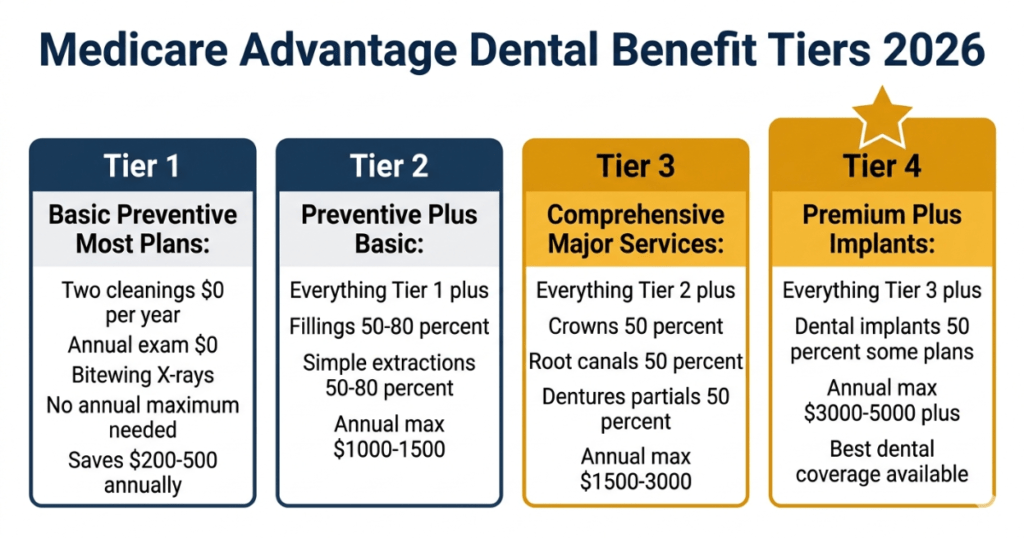
Tier 1 — Basic Preventive Only (Most Common)
Available on most $0 premium Medicare Advantage plans:
- Two prophylaxis cleanings per year — $0 copay
- Annual oral exam — $0 copay
- Bitewing X-rays annually — $0 copay
- Periapical X-rays when needed — $0 or small copay
- No annual maximum needed — covers only preventive
Annual value — approximately $200 to $500 in free preventive dental care
Tier 2 — Preventive Plus Basic Restorative
Available on many competitive Medicare Advantage plans:
- Everything in Tier 1 plus
- Fillings — 50% to 80% coverage after possible waiting period
- Simple extractions — 50% to 80% coverage
- Emergency dental treatment
- Annual maximum — typically $1,000 to $1,500
Annual value — $500 to $1,500 depending on usage
Tier 3 — Comprehensive Dental Including Major Services
Available on more generous Medicare Advantage plans:
- Everything in Tier 2 plus
- Crowns — 50% coverage typically after 12-month waiting period
- Root canals — 50% coverage
- Dentures and partials — 50% coverage
- Bridges — 50% coverage
- Periodontal scaling and root planing — covered
- Annual maximum — typically $1,500 to $3,000
Annual value — $1,000 to $3,000+ depending on dental needs
Tier 4 — Premium Comprehensive Including Implants
Available on the most generous Medicare Advantage plans in competitive markets:
- Everything in Tier 3 plus
- Dental implants — 50% coverage on some plans
- Higher annual maximums — $3,000 to $5,000 or more
- Fewer or no waiting periods
- Orthodontic benefits on rare plans
Annual value — $2,000 to $5,000+ for patients with significant dental needs
Does Medicare Advantage Cover Dental Implants?
Does Medicare Advantage cover dental implants in 2026? Some Medicare Advantage plans do cover dental implants — but implant coverage is far from universal and requires careful plan comparison.
Dental implants are among the most expensive dental procedures — typically costing $3,000 to $5,000 per implant including the implant post, abutment, and crown. Even with insurance coverage dental implants represent a major dental expense.
Medicare Advantage plans that cover implants typically:
- Cover implants at 50% of the cost
- Subject implant coverage to the annual maximum — meaning a $3,000 maximum may cover only one implant partially
- Require a waiting period before implants are covered — often 12 to 24 months
- Limit the number of covered implants per year
When evaluating Medicare Advantage plans for dental implant coverage look specifically at:
- Whether implants are explicitly listed as a covered benefit
- What percentage of implant costs the plan covers
- Whether the annual maximum is sufficient to meaningfully cover implant costs
- Whether the plan’s dental network includes implant dentists in your area
How Annual Dental Maximums Work
Understanding how annual dental maximums work is essential for getting the most value from Medicare Advantage dental benefits.
Annual Maximum Basics
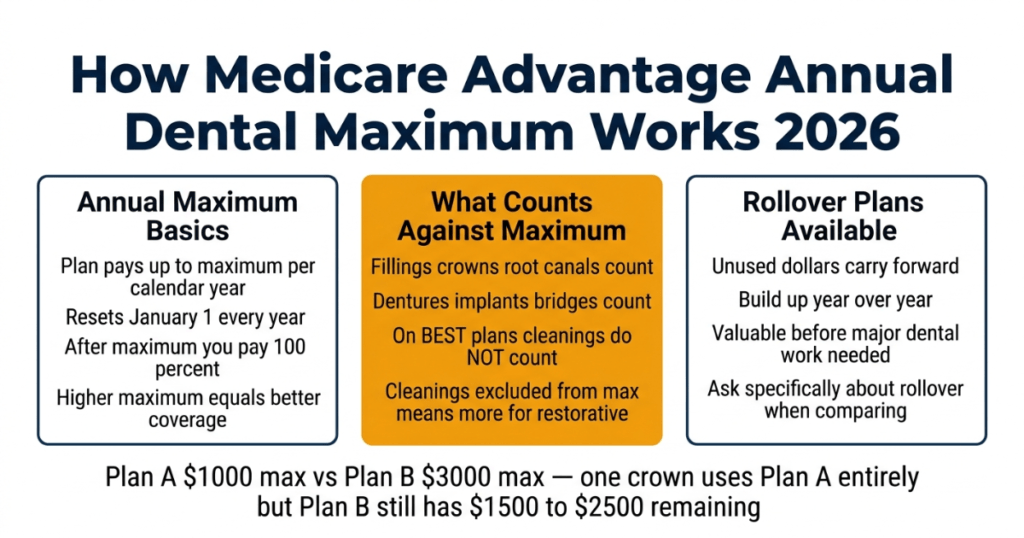
The annual dental maximum is the total dollar amount the Medicare Advantage plan will pay for your dental care in a calendar year. Once you reach the maximum you pay 100% of additional dental costs out of pocket until January 1 of the following year when the maximum resets.
Preventive Services and the Annual Maximum
Many Medicare Advantage plans do not count preventive services — cleanings and exams — against the annual dental maximum. This means your two free annual cleanings and exam do not reduce the dollars available for restorative treatment.
Always check whether preventive services count against the annual maximum when comparing plans. Plans that exclude preventive from the annual maximum provide significantly more effective coverage for restorative dental needs.
Annual Maximum Rollover
Some Medicare Advantage plans offer annual dental maximum rollover — unused portions of the annual maximum carry forward to the following year, building up over time. Rollover provisions can significantly increase the available benefit for patients who accumulate rollover dollars before needing major dental work.
Shared vs Separate Maximums
Some Medicare Advantage plans have separate maximums for preventive and restorative dental — or separate maximums for in-network and out-of-network dental. Always check whether the stated annual maximum is a combined maximum or a separate maximum for different service categories.
Medicare Advantage Dental Networks
Medicare Advantage dental benefits typically require you to use dentists in the plan’s dental network for covered rates. Understanding dental network considerations is important for getting maximum value from your dental benefits.
In-Network vs Out-of-Network Dental
With in-network dentists — dentists who have contracted with the Medicare Advantage plan’s dental network — you receive the plan’s covered benefits at the stated copays and cost-sharing. Your annual maximum applies to in-network services.
With out-of-network dentists — some plans provide no out-of-network dental benefits beyond emergencies. Others provide reduced out-of-network coverage at higher cost-sharing.
Dental Network Providers
Medicare Advantage plans typically use one of the major dental network organizations for their dental benefits:
- Dental insurance companies — Cigna Dental, Aetna Dental, Humana Dental
- Delta Dental network — one of the largest dental networks in the US
- DentaQuest — common in Medicare Advantage plans
- National dental networks — broad geographic coverage
Before enrolling check whether your current dentist is in the plan’s dental network. If your dentist is not in-network you may need to switch dentists or pay higher out-of-network costs for dental care.
PPO Dental vs HMO Dental
Some Medicare Advantage plans offer PPO dental networks — allowing you to see any licensed dentist with coverage but at higher cost-sharing for out-of-network providers.
Other plans offer HMO-style dental networks — requiring you to use in-network dentists with no coverage for out-of-network care.
PPO dental networks provide more flexibility — important if you have an established dentist relationship you want to maintain.
How to Compare Medicare Advantage Dental Benefits
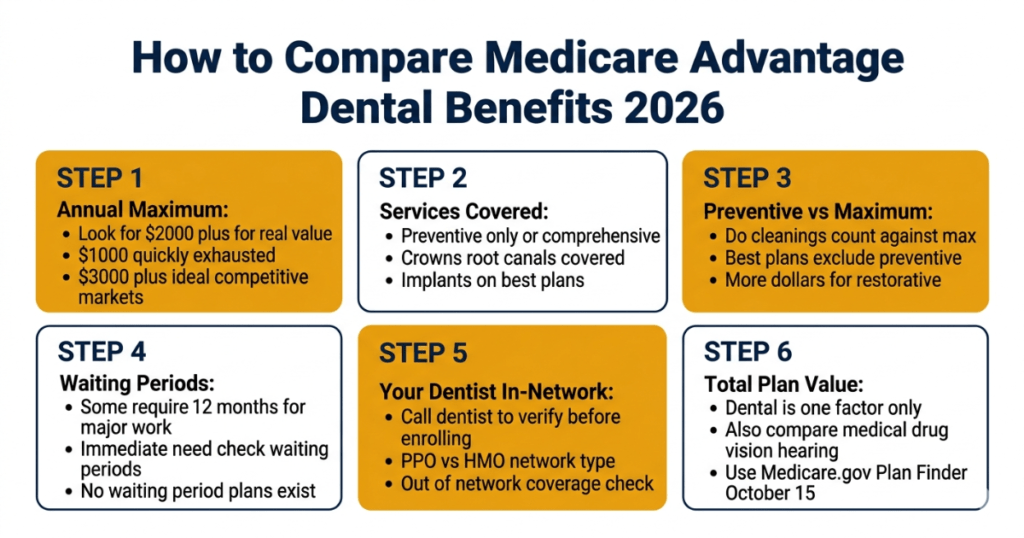
When comparing Medicare Advantage dental benefits during Open Enrollment from October 15 to December 7 use this systematic approach:
Step 1 — Check the Annual Maximum
Find the annual dental maximum for each plan you are comparing. Higher is better — look for plans with at least $1,500 to $2,000 annual maximum for meaningful restorative coverage.
Step 2 — Check What Services Are Covered
Verify whether the plan covers only preventive or also covers fillings, crowns, root canals, dentures, and potentially implants. Basic preventive only vs comprehensive coverage is a critical distinction.
Step 3 — Check Whether Preventive Counts Against the Maximum
Plans that exclude preventive from the annual maximum provide more effective coverage for restorative dental needs.
Step 4 — Check Waiting Periods
Some plans require 6 to 12 months of enrollment before major dental services are covered. If you need dental work soon waiting periods matter.
Step 5 — Verify Your Dentist Is In-Network
Call your dentist’s office to confirm they accept the Medicare Advantage plan’s dental network before enrolling.
Step 6 — Compare Total Plan Value
Do not select a Medicare Advantage plan solely for dental benefits — evaluate the complete plan including medical coverage, drug coverage, premium, and out-of-pocket maximum alongside dental benefits.
Which Medicare Advantage Plans Have the Best Dental Benefits in 2026?
The Medicare Advantage plans with the best dental benefits vary significantly by location. In competitive metropolitan markets plans tend to offer more generous dental benefits to attract enrollees. Here are the insurers that tend to offer the most competitive dental benefits nationally:
UnitedHealthcare AARP Medicare Advantage
UnitedHealthcare consistently offers some of the most generous dental benefits in Medicare Advantage nationally — with annual maximums up to $3,000 on many plans and comprehensive coverage including major dental services. Some UnitedHealthcare plans offer annual maximums of $5,000 or more in competitive markets.
Humana Medicare Advantage
Humana offers competitive dental benefits on most Medicare Advantage plans — typically including cleanings, exams, X-rays, fillings, and on some plans crowns and major services with annual maximums of $1,500 to $2,500.
Aetna Medicare Advantage
Aetna offers dental benefits on most Medicare Advantage plans — leveraging its CVS dental network for comprehensive coverage. Annual maximums range from $1,000 to $2,500 depending on plan and market.
Anthem Blue Cross Blue Shield
Anthem Medicare Advantage plans commonly include comprehensive dental benefits with annual maximums of $1,500 to $3,000 in many markets.
Important — Benefits Vary by Location
Dental benefit generosity varies dramatically by location. The same insurer may offer a $3,000 annual dental maximum in a competitive urban market and a $1,000 maximum in a less competitive rural market. Always check the specific dental benefits for plans in your zip code at Medicare.gov Plan Finder rather than assuming based on national reputation.
Frequently Asked Questions — Medicare Advantage Dental Benefits 2026
Do all Medicare Advantage plans include dental benefits?
Most Medicare Advantage plans include at minimum basic preventive dental benefits — two cleanings per year at $0 — but comprehensive dental coverage including fillings, crowns, and major services varies significantly. Always check the dental benefits section of any plan you are considering.
What is a good annual dental maximum for Medicare Advantage?
A good annual dental maximum for Medicare Advantage in 2026 is $2,000 to $3,000 or higher for plans that cover major dental services. A $1,000 maximum is quickly exhausted and provides limited protection for patients needing restorative work. Some premium plans offer $5,000 or higher maximums in competitive markets.
Does Medicare Advantage dental coverage include crowns?
Some Medicare Advantage plans cover crowns at 50% up to the annual maximum — typically after a 12-month waiting period. Not all plans cover crowns — check the plan’s dental benefits section specifically for crown coverage before enrolling.
Does Medicare Advantage cover dental implants?
Some Medicare Advantage plans cover dental implants — typically at 50% subject to the annual maximum and often with a waiting period. Implant coverage is not universal and requires specific plan comparison. In competitive markets some plans offer meaningful implant coverage.
Can I use any dentist with Medicare Advantage dental benefits?
With PPO dental networks you can typically use any dentist but pay less for in-network providers. With HMO-style dental networks you must use in-network dentists for covered benefits. Always verify your dentist’s network status before enrolling in a Medicare Advantage plan.
Summary — Medicare Advantage Dental Benefits 2026
Medicare Advantage dental benefits in 2026 represent one of the most valuable financial advantages of Medicare Advantage over Original Medicare — filling the significant dental coverage gap that Original Medicare leaves entirely uncovered. From basic preventive dental at $0 to comprehensive coverage including crowns, dentures, and potentially implants Medicare Advantage dental benefits vary enormously by plan and location.
The most important factors when comparing dental benefits are the annual maximum — look for $2,000 or higher for meaningful restorative coverage — whether preventive services count against the maximum, what major services are covered and at what cost-sharing, and whether your current dentist is in-network.
Use Medicare.gov Plan Finder during Open Enrollment from October 15 to December 7 and check the dental benefits section carefully for each plan you consider. Do not select a plan solely for dental — evaluate total plan value including medical coverage alongside dental benefits.
For free help comparing Medicare Advantage dental benefits contact your State Health Insurance Assistance Program (SHIP) at shiphelp.org or call Medicare free at 1-800-633-4227.
This guide is for informational purposes only and is not dental or financial advice. Always verify current Medicare Advantage dental benefits at Medicare.gov before making enrollment decisions.
Sources: Medicare.gov | CMS.gov | SSA.gov | AARP.org
Last updated: April 2026 | Author: James Carter, Independent Medicare Research Analyst