Medicare Part B vs Part D Drug Coverage — Complete Guide 2026
Medicare Part B vs Part D drug coverage — which part of Medicare covers your medications and why does it matter? This is one of the most common and most confusing Medicare questions — and the answer significantly affects how much you pay for medications and where you get them. Medicare covers drugs through two completely different pathways — Part B and Part D — and understanding the difference between these two drug coverage pathways is essential for every Medicare beneficiary. In this complete guide we explain exactly how Medicare Part B drug coverage and Medicare Part D drug coverage work in 2026 — what drugs each part covers, why the same drug might be covered differently, how costs compare, and what this means for your Medicare decisions. All information is sourced from Medicare.gov and CMS.gov.
Also Read —
- What Does Medicare Cover in 2026 — Complete Coverage Guide
- Medicare Part D Formulary Explained 2026
- Medicare Extra Help 2026
What You Will Learn — Medicare Part B vs Part D Drug Coverage
- The fundamental difference between Part B and Part D drug coverage
- What types of drugs Medicare Part B covers
- What types of drugs Medicare Part D covers
- Why some drugs are covered under Part B instead of Part D
- How costs differ between Part B and Part D drug coverage
- Examples of common drugs covered under each part
- Does the same drug ever switch between Part B and Part D
- How Medigap Plan G affects Part B drug coverage
- Frequently asked questions about Medicare Part B vs Part D drugs 2026
The Fundamental Difference Between Part B and Part D Drug Coverage
The most important concept to understand about Medicare drug coverage is that Medicare covers drugs through two completely separate systems — each with different coverage rules, different cost-sharing structures, and different administration processes.
Medicare Part B Drug Coverage — The Medical Benefit Drug Pathway
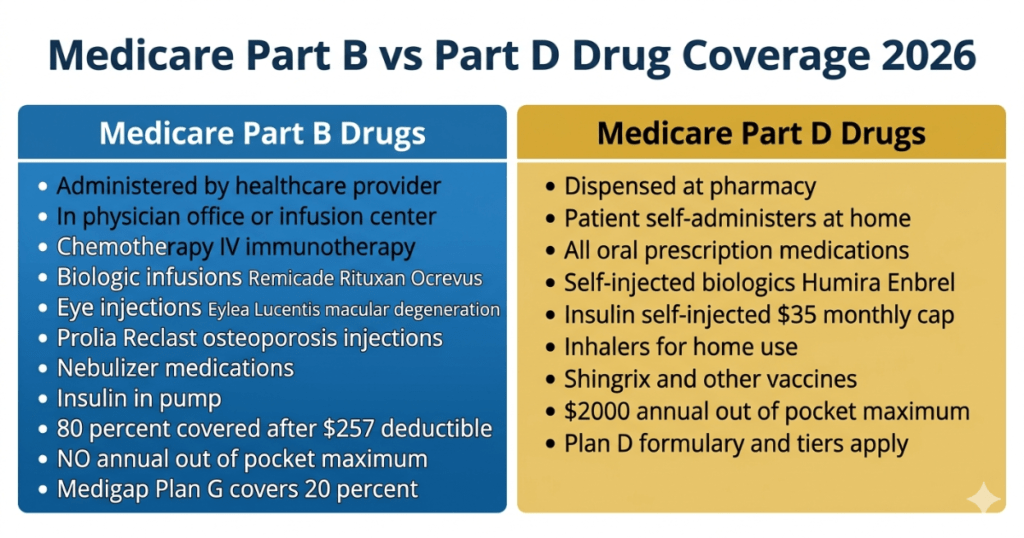
Medicare Part B is the medical insurance portion of Medicare — covering physician services, outpatient care, and medical equipment. Part B also covers a specific category of drugs — drugs that are administered by a healthcare provider in a clinical setting rather than drugs that you self-administer at home.
Part B drugs are typically:
- Administered by injection or infusion by a nurse, physician, or other healthcare provider
- Given in a physician’s office, outpatient hospital department, or infusion center
- Considered part of the medical service being provided
- Covered at 80% after the $257 annual Part B deductible
Medicare Part D Drug Coverage — The Prescription Drug Benefit Pathway
Medicare Part D is the prescription drug benefit — a separate voluntary program that covers drugs you obtain from a pharmacy and typically self-administer at home by swallowing, applying, or self-injecting.
Part D drugs are typically:
- Dispensed at a pharmacy with a prescription
- Self-administered by the patient at home
- Covered through your specific Part D plan’s formulary and cost-sharing structure
- Subject to the $2,000 annual out-of-pocket maximum
Why This Distinction Matters
The Part B vs Part D distinction matters enormously because:
- Cost-sharing is calculated differently — Part B drugs are subject to 20% coinsurance with no annual maximum under Original Medicare (though Medigap covers this) while Part D drugs are subject to the $2,000 annual out-of-pocket maximum.
- Medigap Plan G covers Part B drug costs (the 20% coinsurance) but does not cover Part D drug costs beyond what the Part D plan pays.
- The same drug may be covered under Part B in one setting (physician-administered IV) and Part D in another setting (self-injected at home).
- Prior authorization and formulary restrictions differ between Part B and Part D.
What Drugs Does Medicare Part B Cover?
Medicare Part B covers drugs in specific categories where the drug is considered integral to a medical service provided by a healthcare professional. Here are the major categories of Part B-covered drugs:
Drugs Administered in Physician Offices and Outpatient Settings
The largest category of Part B drugs — medications infused or injected by healthcare providers in clinical settings:
Cancer chemotherapy — IV and injectable chemotherapy drugs administered in oncology offices and infusion centers. This is one of the most important Part B drug benefits — covering expensive cancer drugs at 80% after the deductible. Examples include:
- Paclitaxel (Taxol)
- Carboplatin
- Oxaliplatin
- Docetaxel
- Rituximab (Rituxan)
- Trastuzumab (Herceptin)
- Pembrolizumab (Keytruda)
- Nivolumab (Opdivo)
- And hundreds of other IV chemotherapy and immunotherapy agents
Biologic infusions for autoimmune conditions — IV biologics administered in physician offices or infusion centers:
- Infliximab (Remicade) for rheumatoid arthritis, Crohn’s disease
- Tocilizumab IV (Actemra) for rheumatoid arthritis
- Rituximab (Rituxan) for rheumatoid arthritis and other conditions
- Natalizumab (Tysabri) for multiple sclerosis
- Ocrelizumab (Ocrevus) for multiple sclerosis
Osteoporosis injections — physician-administered:
- Denosumab (Prolia) — every 6 months injection
- Zoledronic acid (Reclast) — annual IV infusion
- Romosozumab (Evenity) — monthly injections for 12 months
Ophthalmologic injections — drugs injected into the eye by an ophthalmologist:
- Ranibizumab (Lucentis) for macular degeneration
- Bevacizumab (Avastin) for macular degeneration
- Aflibercept (Eylea) for macular degeneration and diabetic retinopathy
- Faricimab (Vabysmo) for macular degeneration
These anti-VEGF eye injections are among the most commonly administered Part B drugs in all of Medicare — given monthly or every 1 to 3 months to hundreds of thousands of Medicare beneficiaries with age-related macular degeneration.
Immunotherapy and infusion therapy:
- Intravenous immunoglobulin (IVIG) for immune deficiencies
- Natalizumab for multiple sclerosis
- Vedolizumab (Entyvio) for Crohn’s disease and ulcerative colitis
Dialysis medications when administered during dialysis — as part of the ESRD bundled payment
Drugs Related to Durable Medical Equipment
When Medicare covers durable medical equipment Part B also covers drugs that are directly related to the use of that equipment:
Nebulizer medications — drugs used with Medicare-covered nebulizers:
- Albuterol sulfate solution
- Ipratropium bromide solution
- Budesonide inhalation suspension (in some cases)
Insulin for insulin pumps — when Medicare covers an insulin pump the insulin used in that pump is covered under Part B rather than Part D.
Oxygen — while not a drug in the traditional sense supplemental oxygen and related supplies are covered under Part B DME.
Immunosuppressive Drugs After Organ Transplant
Medicare Part B covers immunosuppressive drugs for beneficiaries with Medicare-covered organ transplants — as a separate Part B benefit. This includes drugs taken after kidney transplant to prevent organ rejection.
Certain Oral Cancer Drugs
The Oral Cancer Drug Equity Act provisions require that certain oral cancer drugs that have equivalent IV formulations must be covered under Part B rather than Part D — ensuring equal coverage regardless of whether chemotherapy is administered by IV or taken as a pill.
Vaccines
Medicare Part B covers certain vaccines at $0:
- Annual influenza vaccine
- Pneumococcal vaccines
- COVID-19 vaccines
- Hepatitis B vaccine for medium and high-risk patients
What Drugs Does Medicare Part D Cover?
Medicare Part D covers prescription drugs that are typically obtained from a pharmacy and self-administered at home. Part D is the primary coverage pathway for most medications Medicare beneficiaries take.
Categories of Part D-Covered Drugs
Oral medications — virtually all prescription medications taken by mouth are Part D drugs:
- Blood pressure medications — lisinopril, amlodipine, metoprolol
- Cholesterol medications — atorvastatin, rosuvastatin
- Diabetes medications — metformin, glipizide, oral semaglutide
- Heart failure medications — sacubitril/valsartan (Entresto)
- Blood thinners — apixaban (Eliquis), rivaroxaban (Xarelto), warfarin
- Thyroid medications — levothyroxine
- Pain medications — gabapentin, pregabalin, tramadol
- Antidepressants — sertraline, fluoxetine, duloxetine (protected class)
- Antipsychotics — protected class — all covered
- Anticonvulsants — protected class — all covered
- And thousands of other prescription medications
Self-injected medications — drugs injected by the patient at home are generally Part D:
- Insulin — all types — subject to $35 per month per product cap under Part D
- Self-injected biologics — adalimumab (Humira), etanercept (Enbrel) — covered Part D
- GLP-1 receptor agonists — semaglutide (Ozempic, Wegovy), dulaglutide (Trulicity)
- Teriparatide (Forteo) — self-injected osteoporosis treatment
- Growth hormone injections
Topical medications — creams, patches, and other topical applications
Inhalers and respiratory medications — for home use:
- Short and long-acting bronchodilators — albuterol inhaler
- Combination inhalers — Advair, Symbicort, Trelegy
- Inhaled corticosteroids
Vaccines not covered under Part B — covered under Part D at $0:
- Shingles vaccine (Shingrix)
- Tdap vaccine
- Other ACIP-recommended vaccines
Protected Drug Classes Under Part D
Medicare Part D has six protected drug classes — plans must cover all or substantially all drugs in these categories:
- Antidepressants
- Antipsychotics
- Anticonvulsants
- Immunosuppressants for organ transplant
- Antiretroviral drugs for HIV
- Antineoplastic drugs (cancer drugs not covered under Part B)
Why Some Drugs Switch Between Part B and Part D
One of the most common points of confusion is why the same drug might be covered under Part B in one situation and Part D in another — or why a drug might switch coverage pathways.
The Setting of Administration Rule
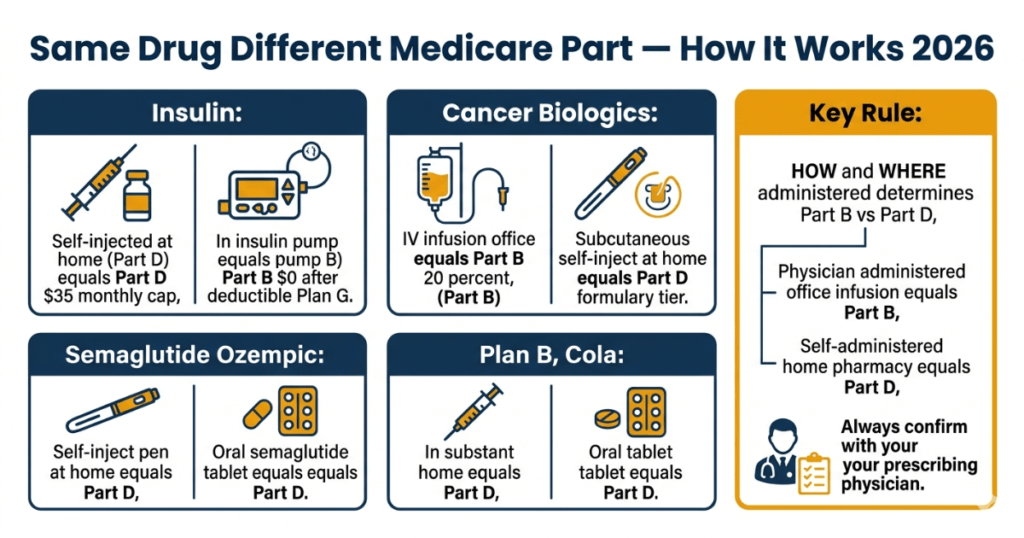
The primary factor determining whether a drug is Part B or Part D is how and where it is administered:
Physician-administered in office/infusion center — Part B Patient self-administered at home — Part D
Example — Insulin Coverage
Insulin provides the clearest example of this dual coverage:
Insulin injected at home by the patient — Part D (subject to $35 monthly cap per product) Insulin used in an insulin pump covered by Medicare — Part B (as part of the DME benefit)
Example — Semaglutide
Semaglutide (Ozempic/Wegovy) also illustrates this distinction:
Self-injected semaglutide at home — Part D IV or physician-administered formulations — potentially Part B (less common)
Example — Cancer Biologics
Some cancer biologics are available in both IV and oral/subcutaneous forms:
IV trastuzumab (Herceptin) administered in infusion center — Part B Subcutaneous trastuzumab (Herceptin Hylecta) self-injected — potentially Part D or Part B depending on circumstances
The Oral Anti-Cancer Drug Rule
The Oral Cancer Drug Equity Act provisions address situations where oral cancer drugs have equivalent IV formulations — requiring Part B coverage for certain oral cancer drugs that would otherwise be Part D drugs.
How Costs Compare — Part B vs Part D Drug Coverage
Understanding how costs differ between Part B and Part D drug coverage is critically important for Medicare financial planning.
Part B Drug Costs with Original Medicare
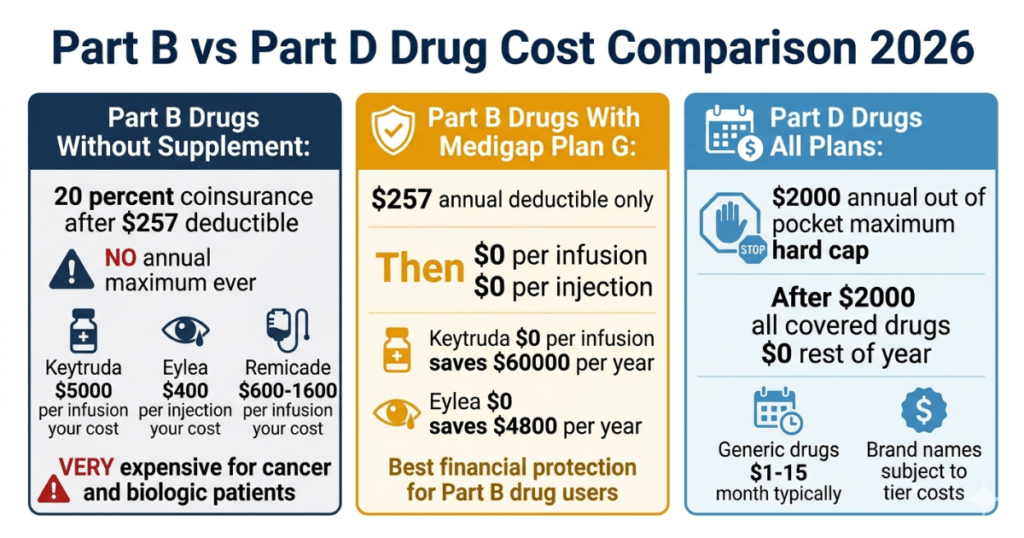
With Original Medicare Part B covers drugs at 80% after the $257 annual Part B deductible:
- You pay 20% coinsurance on all Part B drugs
- There is no annual out-of-pocket maximum for Part B under Original Medicare
- Expensive Part B drugs — chemotherapy, eye injections, biologic infusions — can result in very high 20% coinsurance bills
Examples of 20% coinsurance for expensive Part B drugs:
- Pembrolizumab (Keytruda) cancer immunotherapy — Medicare-approved approximately $25,000 per infusion — your 20% is $5,000 per infusion
- Aflibercept (Eylea) eye injection — Medicare-approved approximately $2,000 per injection — your 20% is $400 per injection
- Infliximab (Remicade) infusion — Medicare-approved approximately $3,000 to $8,000 per infusion — your 20% is $600 to $1,600
Part B Drug Costs with Medigap Plan G
Medigap Plan G covers the 20% Part B coinsurance after the $257 annual deductible — making all Part B drug costs $0 after the annual deductible. This is one of the most financially significant benefits of Medigap Plan G — particularly for cancer patients receiving expensive IV chemotherapy and immunotherapy.
A cancer patient receiving monthly pembrolizumab (Keytruda) infusions:
- Without Medigap — 20% coinsurance of approximately $5,000 per infusion — $60,000 per year
- With Medigap Plan G — $0 per infusion after the $257 annual deductible
This extraordinary savings makes Medigap Plan G financially essential for Medicare beneficiaries receiving expensive IV cancer treatments.
Part D Drug Costs
Part D drug costs are subject to:
- Plan-specific deductible (up to $590 in 2026)
- Tier-based copays and coinsurance
- $2,000 annual out-of-pocket maximum — after which Part D covers 100%
The $2,000 annual Part D cap means that no matter how expensive your Part D drugs are you never pay more than $2,000 per year. This cap does not apply to Part B drugs under Original Medicare — which is why Medigap Plan G is essential for beneficiaries with expensive Part B drugs.
Medicare Advantage and Part B vs Part D Drugs
Medicare Advantage plans must cover all Part B drugs at the same level as Original Medicare. However Medicare Advantage plans may require:
- Prior authorization for expensive Part B drugs including chemotherapy
- Step therapy for certain biologic infusions
- In-network infusion centers for Part B drug administration
The annual out-of-pocket maximum in Medicare Advantage plans — $9,350 — applies to all covered services including Part B drug cost-sharing. This provides some financial protection for Medicare Advantage enrollees receiving expensive Part B drugs — but $9,350 is a much higher maximum than the $2,000 Part D cap for drugs covered under Part D.
Frequently Asked Questions — Medicare Part B vs Part D Drug Coverage
What is the difference between Medicare Part B and Part D drug coverage?
Medicare Part B covers drugs administered by healthcare providers in clinical settings — infusions, injections, and medications used with DME. Part D covers drugs dispensed at pharmacies for self-administration at home. Part B drugs are covered at 80% after the $257 deductible with no annual cap. Part D drugs are covered with a $2,000 annual out-of-pocket maximum.
Does Medicare Part B cover chemotherapy drugs?
Yes — IV and injectable chemotherapy administered in an oncology office or infusion center is covered under Medicare Part B at 80% after the $257 annual Part B deductible. Medigap Plan G covers the 20% coinsurance — potentially saving tens of thousands of dollars per year for cancer patients.
Does Medicare Part D cover insulin?
Yes — insulin self-injected at home is covered under Medicare Part D with a $35 per month per product cap. Insulin used in a Medicare-covered insulin pump is covered under Part B rather than Part D.
Which Part covers eye injections for macular degeneration?
Anti-VEGF eye injections for macular degeneration — including Eylea, Lucentis, and Avastin — are covered under Medicare Part B because they are administered by an ophthalmologist in a clinical setting. With Medigap Plan G these injections cost $0 after the annual deductible.
How does Medigap Plan G affect Part B drug costs?
Medigap Plan G covers the 20% Part B coinsurance for all Part B drugs after the $257 annual Part B deductible. This is particularly valuable for beneficiaries receiving expensive IV chemotherapy, biologic infusions, or eye injections — where 20% coinsurance can amount to thousands of dollars per treatment.
Is there an annual maximum for Part B drug costs?
Original Medicare has no annual out-of-pocket maximum for Part B drugs — your 20% coinsurance continues regardless of total spending. This is why Medigap Plan G is so important for beneficiaries receiving expensive Part B drugs. Medicare Advantage plans have a $9,350 annual maximum that applies to Part B drug cost-sharing.
Summary — Medicare Part B vs Part D Drug Coverage 2026
Medicare Part B covers drugs administered by healthcare providers in clinical settings — including cancer chemotherapy, biologic infusions, eye injections, and nebulizer medications — at 80% after the $257 annual Part B deductible with no annual out-of-pocket maximum. Medicare Part D covers drugs dispensed at pharmacies for home self-administration — with a $2,000 annual out-of-pocket maximum.
The distinction between Part B and Part D drug coverage matters enormously for financial planning. Medigap Plan G covers the 20% Part B drug coinsurance — making it financially essential for Medicare beneficiaries receiving expensive IV cancer treatments, biologic infusions, or eye injections. The Part D $2,000 annual cap protects beneficiaries taking expensive oral or self-injected medications.
For free help understanding which part of Medicare covers your specific medications contact your State Health Insurance Assistance Program (SHIP) at shiphelp.org or call Medicare free at 1-800-633-4227.
This guide is for informational purposes only and is not medical or financial advice. Always verify current Medicare drug coverage at Medicare.gov before making healthcare or enrollment decisions.
Sources: Medicare.gov | CMS.gov | SSA.gov | AARP.org
Last updated: April 2026 | Author: James Carter, Independent Medicare Research Analyst