

Does Medicare Cover Cancer Treatment — Complete Guide 2026
Does Medicare cover cancer treatment in 2026? If you or a loved one has been diagnosed with cancer and you are on Medicare this is one of the most important questions you need answered immediately. The good news is that yes — Medicare does cover cancer treatment in 2026 and the coverage is comprehensive. Medicare covers virtually all types of cancer treatment including surgery, chemotherapy, radiation therapy, immunotherapy, targeted therapy, hormone therapy, and cancer screening. Cancer is one of the conditions Medicare covers most comprehensively because it affects millions of Medicare beneficiaries every year. In this complete guide we explain exactly what Medicare covers for cancer treatment in 2026 — every treatment type, every screening, costs, and how Medicare Advantage handles cancer care. All information is sourced from Medicare.gov and CMS.gov.
Also Read —
- Does Medicare Cover Colonoscopy 2026
- Medicare Advantage vs Original Medicare 2026
- Best Medicare Supplement Plans 2026
What You Will Learn — Does Medicare Cover Cancer Treatment
- Does Medicare cover cancer treatment in 2026
- What cancer treatments Medicare covers
- Does Medicare cover chemotherapy
- Does Medicare cover radiation therapy
- Does Medicare cover immunotherapy and targeted therapy
- Does Medicare cover cancer surgery
- Does Medicare cover cancer screenings
- How much does cancer treatment cost with Medicare in 2026
- Does Medicare cover clinical trials for cancer
- Does Medicare Advantage cover cancer treatment
- Frequently asked questions about Medicare cancer coverage 2026
Does Medicare Cover Cancer Treatment in 2026?
Yes — Medicare does cover cancer treatment in 2026 and the coverage is among the most comprehensive of any condition Medicare treats. Medicare covers cancer treatment because cancer is a leading cause of death and disability among Medicare beneficiaries with approximately 1 million new cancer diagnoses occurring in Americans aged 65 and older each year.
Medicare cancer coverage in 2026 applies to virtually all types of cancer including lung cancer, breast cancer, colon cancer, prostate cancer, bladder cancer, leukemia, lymphoma, multiple myeloma, pancreatic cancer, ovarian cancer, melanoma, and all other cancers. Medicare does not discriminate in cancer coverage based on cancer type — coverage is based on the type of treatment and whether it is medically necessary.
Medicare cancer treatment coverage comes through multiple parts of Medicare depending on where treatment is received and what type of treatment is provided. Understanding which part of Medicare covers which cancer treatment helps you understand your costs and coverage options.
What Cancer Treatments Does Medicare Cover in 2026?
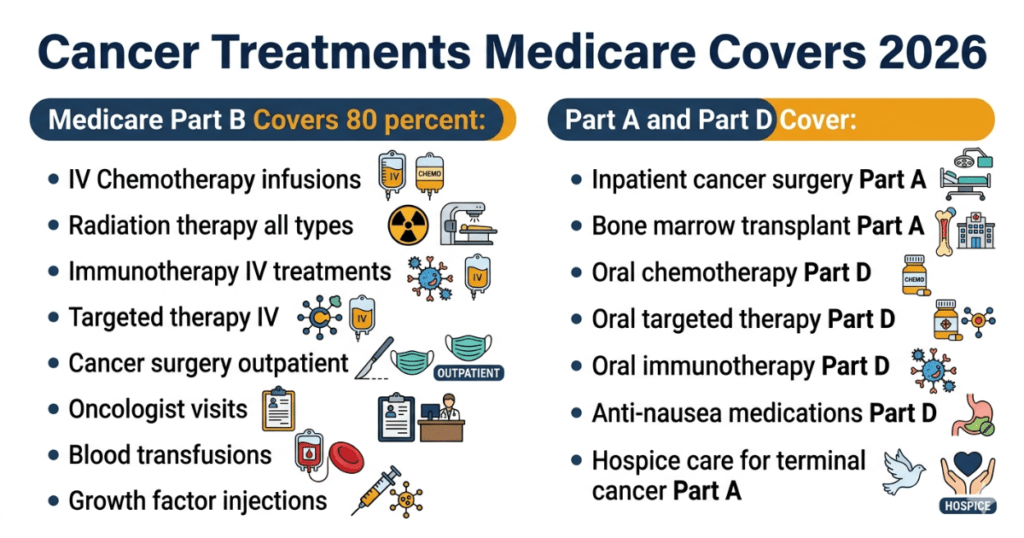
Medicare covers a comprehensive range of cancer treatments in 2026. Here is a complete breakdown of covered cancer treatments:
Cancer Surgery
Medicare Part A covers cancer surgery performed in an inpatient hospital setting. Cancer surgery is covered as a medically necessary surgical procedure when your doctor documents the medical necessity. Inpatient cancer surgery costs follow the standard Part A cost-sharing:
- Part A deductible — $1,676 per benefit period
- Hospital days 1 to 60 — $0 after deductible
Medicare Part B covers cancer surgery performed in an outpatient setting — ambulatory surgery centers or hospital outpatient departments — at 80% after the $257 annual Part B deductible.
Chemotherapy
Does Medicare cover chemotherapy in 2026? Yes — Medicare covers chemotherapy as one of the most important cancer treatment benefits. Medicare covers chemotherapy through two different pathways depending on how it is administered:
Intravenous (IV) chemotherapy administered in a hospital outpatient department — Medicare Part B covers IV chemotherapy at 80% after the Part B deductible. Most chemotherapy is administered in hospital outpatient infusion centers or oncology offices and is covered under Part B.
Oral chemotherapy drugs taken at home — Medicare Part D covers oral chemotherapy medications taken at home. Most Part D plans include oral chemotherapy drugs on their formularies. Under the Oral Chemotherapy Parity Act Medicare cannot charge higher cost-sharing for oral chemotherapy than for IV chemotherapy administered in a physician’s office — an important protection for cancer patients.
The $2,000 annual Part D out-of-pocket maximum in 2026 is extremely important for cancer patients who take expensive oral chemotherapy medications. Once you reach $2,000 in out-of-pocket drug costs Medicare Part D covers 100% of covered drug costs for the rest of the year.
Radiation Therapy
Does Medicare cover radiation therapy in 2026? Yes — Medicare Part B covers radiation therapy for cancer in 2026 at 80% after the Part B deductible. Radiation therapy covered by Medicare includes:
- External beam radiation therapy (EBRT)
- Intensity-modulated radiation therapy (IMRT)
- Stereotactic body radiation therapy (SBRT) — CyberKnife and similar technologies
- Stereotactic radiosurgery (SRS) — Gamma Knife
- Proton beam therapy
- Brachytherapy — internal radiation therapy
- Intraoperative radiation therapy
Medicare covers all of these radiation modalities when medically necessary and prescribed by a radiation oncologist.
Immunotherapy
Does Medicare cover immunotherapy for cancer in 2026? Yes — Medicare covers immunotherapy as a cancer treatment. Immunotherapy — which uses the body’s immune system to fight cancer — includes:
- Checkpoint inhibitors — drugs like pembrolizumab (Keytruda), nivolumab (Opdivo), and atezolizumab (Tecentriq)
- CAR T-cell therapy
- Interleukin therapy
- Cancer vaccines
IV immunotherapy administered in a hospital outpatient or physician office setting is covered under Medicare Part B at 80% after the Part B deductible. Oral immunotherapy drugs are covered under Medicare Part D.
Targeted Therapy
Medicare covers targeted therapy drugs that attack specific molecular targets in cancer cells. IV targeted therapy is covered under Part B. Oral targeted therapy drugs — such as imatinib (Gleevec), erlotinib (Tarceva), and many others — are covered under Medicare Part D with the $2,000 annual out-of-pocket maximum applying.
Hormone Therapy
Medicare covers hormone therapy for hormone-sensitive cancers such as breast cancer and prostate cancer. IV or injectable hormone therapy is covered under Part B. Oral hormone therapy medications are covered under Part D.
Bone Marrow and Stem Cell Transplants
Medicare Part A covers bone marrow transplants and stem cell transplants performed as inpatient procedures when medically necessary for covered cancer diagnoses. These complex procedures are covered as inpatient hospital care with standard Part A cost-sharing.
Supportive Cancer Care
Medicare covers a wide range of supportive care services for cancer patients including:
- Anti-nausea medications for chemotherapy — covered under Part D
- Growth factors to stimulate white blood cell production — covered under Part B when administered in a medical setting
- Pain management medications — covered under Part D
- Blood transfusions — covered under Part B or Part A depending on setting
- Nutritional support when medically necessary
- Palliative care services
- Hospice care for terminal cancer patients — covered under Medicare Part A hospice benefit
Does Medicare Cover Cancer Screenings in 2026?
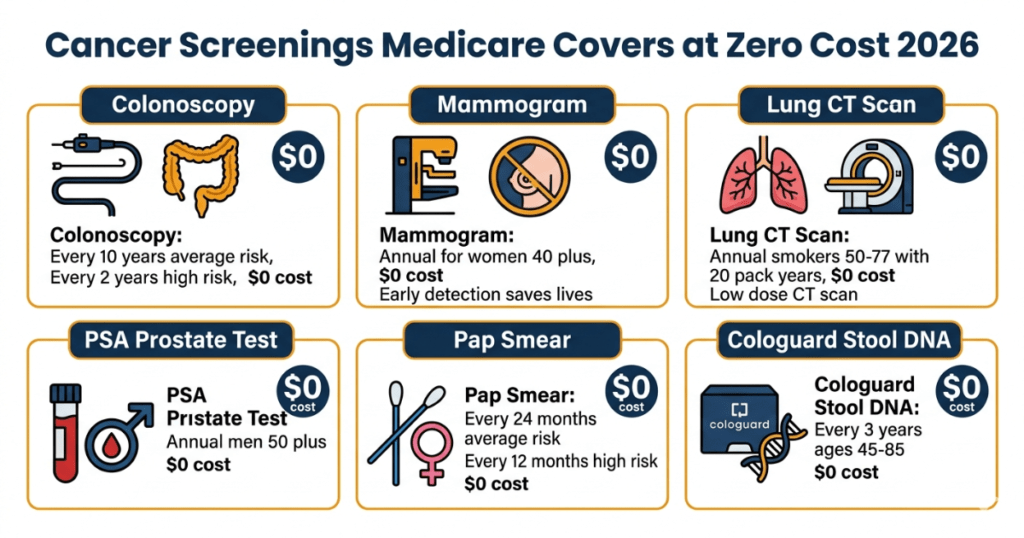
Does Medicare cover cancer screenings in 2026? Yes — Medicare covers a comprehensive range of cancer screening tests as preventive services at no cost to you. Here is the complete list of cancer screenings Medicare covers at $0 in 2026:
Colorectal Cancer Screenings
Medicare covers multiple colorectal cancer screening options:
- Colonoscopy — once every 10 years for average risk or once every 2 years for high risk — $0 cost
- Cologuard stool DNA test — once every 3 years for average risk beneficiaries aged 45 to 85 — $0 cost
- Fecal occult blood test — once every 12 months — $0 cost
- Flexible sigmoidoscopy — once every 48 months — $0 cost
Breast Cancer Screening
Medicare covers annual mammography for women aged 40 and older — $0 cost with no deductible or coinsurance. Medicare also covers diagnostic mammography when there are symptoms or concerns — covered under Part B at 80% after deductible.
Cervical and Vaginal Cancer Screening
Medicare covers Pap smear and pelvic exam once every 24 months for average risk women — $0 cost. Once every 12 months for high risk women — $0 cost.
Prostate Cancer Screening
Medicare covers annual Prostate-Specific Antigen (PSA) test for men aged 50 and older — $0 cost.
Lung Cancer Screening
Medicare covers annual low-dose CT scan for lung cancer screening for Medicare beneficiaries who meet all of the following criteria:
- Aged 50 to 77
- Current smoker or quit within the past 15 years
- Have a 20 pack-year smoking history
- Receive a written order from a physician or qualified clinician
- $0 cost — fully covered as preventive care
Skin Cancer Prevention Counseling
Medicare covers counseling to prevent skin cancer for fair-skinned individuals aged 6 months to 24 years and for adults at increased risk — $0 cost.
How Much Does Cancer Treatment Cost with Medicare in 2026?
Cancer treatment costs with Medicare can be significant depending on the type of cancer, the treatments required, and whether you have a Medigap supplement or Medicare Advantage. Here is the complete cost breakdown:
Chemotherapy Costs with Original Medicare
IV chemotherapy in outpatient setting:
- Annual Part B deductible — $257
- Your 20% coinsurance per infusion — varies significantly by drug
- Typical chemotherapy drug costs range from $1,000 to $30,000+ per infusion at Medicare-approved amounts
- Your 20% could be hundreds to thousands per infusion without a supplement
Oral chemotherapy under Part D:
- Annual Part D deductible — up to $590
- Cost-sharing until $2,000 annual out-of-pocket maximum
- After $2,000 — Part D covers 100% of all covered drug costs
Radiation Therapy Costs with Original Medicare
- Annual Part B deductible — $257
- 20% coinsurance on each radiation treatment session
- Typical radiation course — 20 to 40 sessions
- Total Medicare-approved amount for radiation course — $15,000 to $50,000+
- Your 20% — $3,000 to $10,000+ without a supplement
Cancer Surgery Costs with Original Medicare
Inpatient cancer surgery:
- Part A deductible — $1,676 per benefit period
- Plus Part B 20% for surgeon fee — $500 to $2,000+
Outpatient cancer surgery:
- Part B deductible — $257
- 20% of full Medicare-approved amount — $1,500 to $5,000+
With Medigap Plan G — The Most Important Cancer Insurance
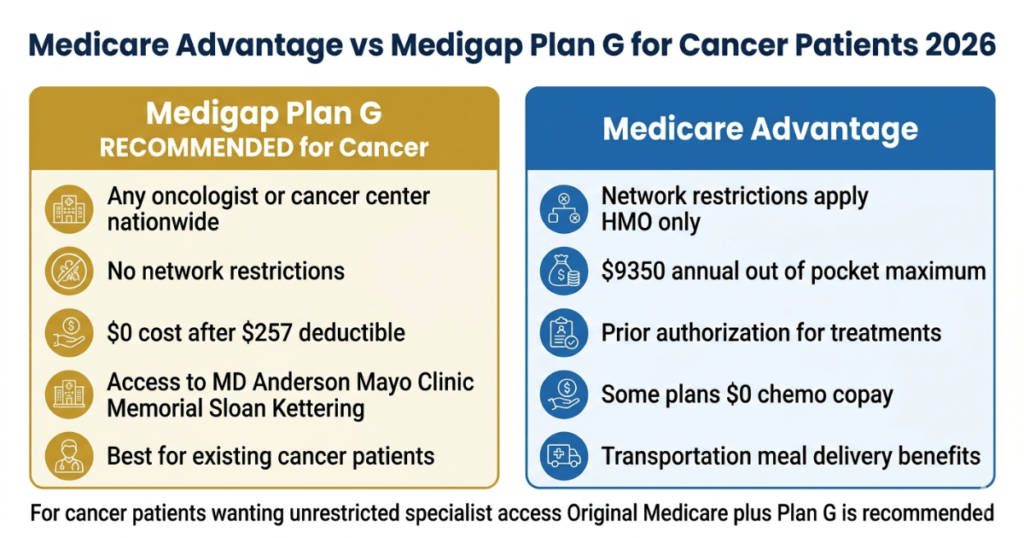
Medigap Plan G is the most important supplement for Medicare cancer patients. After your $257 annual Part B deductible Plan G covers 100% of all Medicare-approved Part B cost-sharing including chemotherapy infusions, radiation therapy, cancer surgery, and all outpatient oncology visits. Your effective cost for all Part B cancer treatment with Plan G is $0 after the annual deductible.
Plan G also covers the $1,676 Part A deductible for inpatient cancer surgery and hospitalization. For cancer patients who may require multiple hospitalizations this protection is invaluable.
Without Plan G a cancer patient undergoing chemotherapy and radiation could face $10,000 to $30,000 or more in out-of-pocket costs in a single year under Original Medicare. With Plan G these costs are eliminated after the $257 annual deductible.
With Medicare Advantage
Medicare Advantage plans cover cancer treatment with their own cost-sharing structure:
- Chemotherapy — typically $0 to $50 copay per infusion session on many plans
- Radiation — typically $0 to $100 copay per session
- Cancer surgery — copay or coinsurance counting toward $9,350 annual maximum
- Oral cancer drugs — covered under plan formulary with $2,000 annual maximum
The annual out-of-pocket maximum of $9,350 provides important protection for cancer patients under Medicare Advantage. However network restrictions mean you must use in-network oncologists and cancer centers — potentially limiting access to specialized cancer centers like MD Anderson, Mayo Clinic, or Memorial Sloan Kettering.
Does Medicare Cover Clinical Trials for Cancer?
Does Medicare cover clinical trials for cancer in 2026? Yes — Medicare covers routine costs associated with participation in approved clinical trials for cancer treatment. This is an important and often overlooked Medicare cancer benefit.
Medicare covers routine clinical trial costs including:
- Doctor visits and hospital stays required by the clinical trial
- Laboratory tests and imaging ordered as part of the trial protocol
- Treatments and procedures required by the trial
- Management of treatment side effects and complications
Medicare does not cover the investigational drug or treatment being studied in the trial — those costs are typically covered by the trial sponsor. Medicare covers the routine care that you would receive even if you were not in a trial.
To qualify for Medicare clinical trial coverage the trial must be an approved clinical trial — Phase I, II, III, or IV clinical trials of cancer treatment that meet Medicare’s standards for clinical trial coverage. The vast majority of cancer clinical trials conducted at National Cancer Institute-designated cancer centers qualify for Medicare coverage.
Clinical trial participation is particularly important for cancer patients because it provides access to cutting-edge treatments before they are widely available. Medicare’s clinical trial coverage ensures that beneficiaries are not financially penalized for choosing to participate in potentially life-saving research.
Does Medicare Cover Hospice Care for Terminal Cancer?
Does Medicare cover hospice care for terminal cancer patients in 2026? Yes — Medicare Part A covers hospice care for terminal cancer patients who have been certified by a doctor as having a life expectancy of 6 months or less if the illness runs its normal course.
Medicare hospice coverage for cancer patients includes:
- Physician and nursing care focused on comfort and pain management
- Prescription drugs for symptom control and pain relief — covered at 100% or with minimal cost-sharing
- Physical, occupational, and speech therapy for comfort
- Medical social worker services
- Spiritual and grief counseling
- Short-term inpatient care for pain or symptom management
- Short-term respite care to give family caregivers a break
- Home health aide and homemaker services
Medicare hospice is covered at 100% with minimal cost-sharing — you pay only a small copay for outpatient drugs (no more than $5 per drug) and 5% of the Medicare-approved amount for inpatient respite care.
Hospice care represents a complete shift in focus from curative treatment to comfort and quality of life. Choosing hospice does not mean giving up — it means focusing on the best possible quality of life. Medicare covers hospice for as long as you continue to meet the eligibility criteria — there is no time limit on Medicare hospice coverage.
Does Medicare Advantage Cover Cancer Treatment?
Does Medicare Advantage cover cancer treatment in 2026? Yes — all Medicare Advantage plans must cover cancer treatment because it is a Medicare-covered service. However there are critical differences in how Medicare Advantage handles cancer care compared to Original Medicare.
Network Access — The Most Critical Issue for Cancer Patients
The most important consideration for cancer patients with Medicare Advantage is network access. Major cancer centers — MD Anderson Cancer Center, Memorial Sloan Kettering, Mayo Clinic Cancer Center, Dana-Farber Cancer Institute, and others — may or may not be in your Medicare Advantage plan’s network. If your plan does not include your preferred cancer center in its network you may face out-of-network costs or may not be able to receive care there at all under HMO plans.
Before enrolling in Medicare Advantage — and particularly before a cancer diagnosis is made — confirm which cancer centers and oncologists are in your plan’s network. If you develop cancer and your preferred oncologist or cancer center is out of network you may face significant access limitations.
Prior Authorization for Cancer Treatments
Medicare Advantage plans frequently require prior authorization for cancer treatments including chemotherapy, immunotherapy, and radiation therapy. These authorizations add administrative burden during an already stressful time and delays in authorization can delay treatment. Work closely with your oncology team to ensure all required authorizations are obtained promptly.
Advantages of Medicare Advantage for Cancer
Medicare Advantage does offer important advantages for cancer patients:
- Annual out-of-pocket maximum of $9,350 limits total costs
- Many plans offer $0 copay for chemotherapy infusions
- Extra benefits like transportation to treatment, meal delivery, and supportive care programs
- Some plans offer enhanced oncology coordination programs
Frequently Asked Questions — Does Medicare Cover Cancer Treatment
Does Medicare cover cancer treatment in 2026?
Yes — Medicare provides comprehensive cancer treatment coverage in 2026 including surgery, chemotherapy, radiation therapy, immunotherapy, targeted therapy, hormone therapy, bone marrow transplants, and supportive care. Medicare Part A covers inpatient cancer care and Part B covers outpatient treatments. Part D covers oral cancer drugs with a $2,000 annual out-of-pocket maximum.
Does Medicare cover chemotherapy in 2026?
Yes — Medicare covers chemotherapy comprehensively. IV chemotherapy in outpatient settings is covered under Part B at 80% after the $257 deductible. Oral chemotherapy is covered under Part D with the $2,000 annual out-of-pocket maximum. The Oral Chemotherapy Parity Act prevents Medicare from charging higher cost-sharing for oral chemo than for IV chemo.
How much does cancer treatment cost with Medicare?
Without a Medigap supplement cancer treatment costs can be significant — potentially $10,000 to $30,000 or more in annual out-of-pocket costs for extensive chemotherapy and radiation. With Medigap Plan G your cost after the $257 annual deductible is $0 for all Medicare-approved Part B services — making Plan G the most important financial protection for Medicare cancer patients. Medicare Advantage limits costs to the $9,350 annual maximum.
Does Medicare cover cancer clinical trials?
Yes — Medicare covers routine care costs for participants in approved cancer clinical trials including doctor visits, tests, and procedures required by the trial protocol. Medicare does not cover the experimental drug or treatment itself — those costs are covered by the trial sponsor.
Does Medicare cover immunotherapy for cancer?
Yes — Medicare covers immunotherapy as a cancer treatment. IV immunotherapy administered in medical settings is covered under Part B at 80% after deductible. Oral immunotherapy drugs are covered under Part D. Immunotherapy drugs like pembrolizumab (Keytruda) and nivolumab (Opdivo) are on most Part D formularies and subject to the $2,000 annual out-of-pocket maximum.
Should cancer patients choose Medicare Advantage or Original Medicare?
For cancer patients this is one of the most important Medicare decisions. Original Medicare with Medigap Plan G provides unrestricted access to any oncologist or cancer center in the country — critical for patients who may want access to major cancer centers like MD Anderson or Memorial Sloan Kettering. Medicare Advantage limits you to in-network providers but caps your costs at $9,350 annually. For existing cancer patients or those at high cancer risk Original Medicare plus Plan G is typically the safer choice due to its unrestricted provider access.
Summary — Does Medicare Cover Cancer Treatment 2026
Does Medicare cover cancer treatment in 2026? Yes — Medicare provides comprehensive cancer coverage across all treatment modalities — surgery, chemotherapy, radiation, immunotherapy, targeted therapy, hormone therapy, and supportive care. Medicare also covers cancer screenings at $0 helping detect cancer before symptoms develop.
For cancer patients the most important financial decision is choosing between Medigap Plan G — which eliminates virtually all out-of-pocket costs for Medicare-approved treatments — and Medicare Advantage — which limits costs to $9,350 annually but restricts provider networks. For patients who want unrestricted access to the best cancer centers in the country Original Medicare plus Medigap Plan G is the recommended choice.
For free help understanding your Medicare cancer coverage contact your State Health Insurance Assistance Program (SHIP) counselor at shiphelp.org or call Medicare free at 1-800-633-4227.
This guide is for informational purposes only and is not medical advice. Always consult your oncologist and verify current Medicare coverage at Medicare.gov before making treatment decisions.
Sources: Medicare.gov | CMS.gov | SSA.gov | Cancer.gov | AARP.org
Last updated: April 2026 | Author: James Carter, Independent Medicare Research Analyst