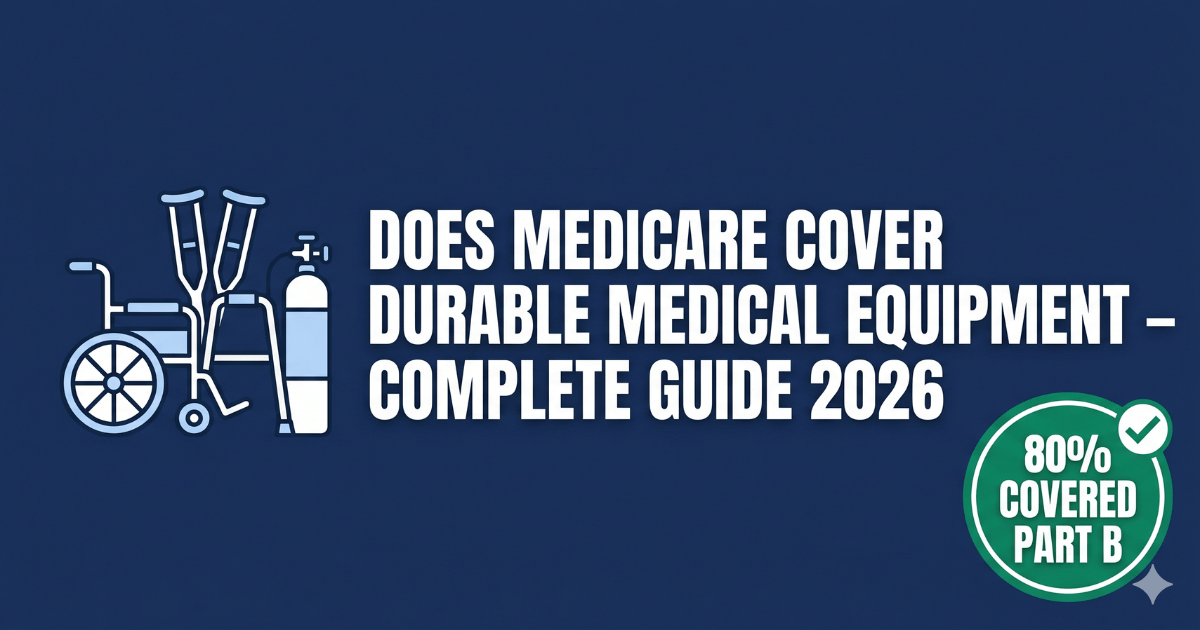
Does Medicare Cover Durable Medical Equipment — Complete Guide 2026
Does Medicare cover durable medical equipment in 2026? Medical equipment that helps you manage your health conditions and maintain independence at home is a critical part of healthcare for millions of Medicare beneficiaries — and understanding what Medicare covers for durable medical equipment (DME) is essential for accessing the equipment you need without unexpected costs. The answer is yes — Medicare does cover durable medical equipment in 2026 when it is medically necessary and prescribed by a physician. In this complete guide we explain exactly what Medicare covers for durable medical equipment in 2026 — what qualifies as DME, what equipment is covered, how much DME costs with Medicare, supplier requirements, and how Medicare Advantage handles DME coverage. All information is sourced from Medicare.gov and CMS.gov.
Also Read —
- Medicare Part D Drug Coverage Explained Simply 2026
- Does Medicare Cover Home Health Care 2026
- Medicare Part B Premium 2026
What You Will Learn — Does Medicare Cover Durable Medical Equipment
- What is durable medical equipment under Medicare
- Does Medicare cover durable medical equipment in 2026
- What DME does Medicare cover — complete list
- How much does durable medical equipment cost with Medicare
- Medicare DME supplier requirements
- Competitive bidding and DME pricing
- Does Medicare Advantage cover durable medical equipment
- Frequently asked questions about Medicare DME coverage 2026
What Is Durable Medical Equipment Under Medicare?
Before understanding what Medicare covers for durable medical equipment it is important to understand how Medicare defines DME. Not all medical products qualify as durable medical equipment under Medicare — a specific set of criteria must be met.
Medicare defines durable medical equipment as equipment that:
- Is durable — able to withstand repeated use
- Is primarily and customarily used to serve a medical purpose
- Is generally not useful to a person in the absence of illness or injury
- Is appropriate for use in the home
All four criteria must be met for equipment to qualify as Medicare-covered DME. Items that are primarily personal comfort items — recliners, regular mattresses, non-medical bath equipment — do not qualify as DME even if they help a person with a health condition feel better.
Examples of items that qualify as Medicare DME — wheelchairs, hospital beds, walkers, oxygen equipment, CPAP machines, blood glucose monitors, and insulin pumps.
Examples of items that do NOT qualify as Medicare DME — standard raised toilet seats purchased for convenience, ordinary bathtubs, regular mattresses, exercise equipment even when prescribed for health, and most personal hygiene items.
Does Medicare Cover Durable Medical Equipment in 2026?
Yes — Medicare Part B covers durable medical equipment in 2026 when it meets the DME definition and is:
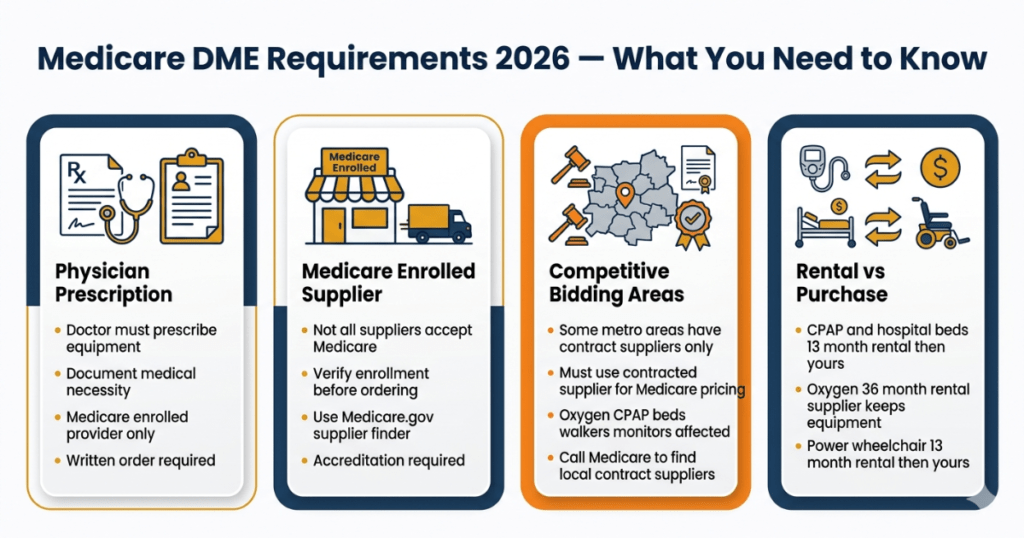
- Prescribed by a physician or other qualified healthcare provider who is enrolled in Medicare
- Medically necessary for treating a specific medical condition
- Obtained from a Medicare-enrolled DME supplier
Medicare Part B covers DME at 80% of the Medicare-approved amount after your $257 annual Part B deductible. You pay the remaining 20% coinsurance. With Medigap Plan G your 20% coinsurance is covered after the annual deductible — making your effective cost for covered DME $0 after the deductible.
What Durable Medical Equipment Does Medicare Cover?
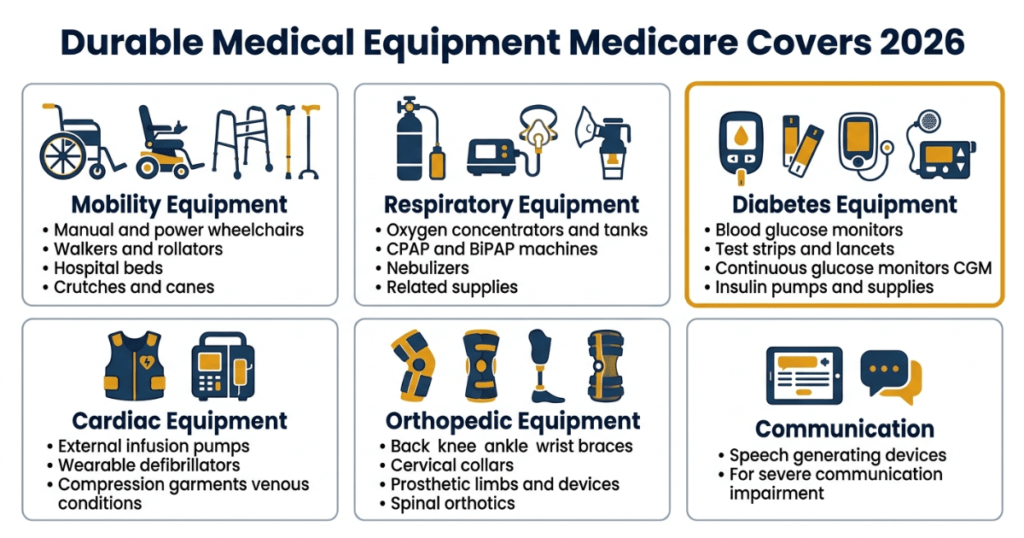
Medicare covers a comprehensive range of durable medical equipment in 2026. Here is the complete list of major DME categories covered:
Mobility Equipment
Wheelchairs — manual and power wheelchairs are covered when you have a mobility limitation that significantly impairs your ability to participate in mobility-related activities of daily living. Medicare covers:
- Manual standard wheelchairs
- Manual lightweight and ultra-lightweight wheelchairs
- Power wheelchairs when manual wheelchair is insufficient
- Scooters/power-operated vehicles when appropriate
The wheelchair qualification process requires a face-to-face evaluation with your physician and in many cases a home evaluation to confirm the wheelchair is needed for mobility in the home.
Walkers — standard walkers, wheeled walkers, rollators, and knee walkers are covered when medically necessary for ambulation assistance.
Crutches and canes — covered when medically necessary.
Hospital beds — covered when your condition requires positioning that cannot be achieved in a regular bed — including head and foot elevation, side rails, trapeze bars, and mattress overlays.
Respiratory Equipment
Oxygen equipment — covered for patients with chronic hypoxemia documented by qualifying blood oxygen levels. Coverage includes:
- Portable oxygen concentrators
- Stationary oxygen concentrators
- Oxygen tanks
- Related oxygen delivery supplies
CPAP machines — covered for diagnosed obstructive sleep apnea with physician prescription and compliance requirements. Coverage includes the CPAP machine, masks, tubing, and supplies.
BiPAP machines — covered when CPAP is insufficient or when a specific medical condition requires bilevel pressure therapy.
Nebulizers — covered for patients with asthma, COPD, or other respiratory conditions requiring aerosolized medications.
Diabetes Management Equipment
Blood glucose monitors — covered for all Medicare beneficiaries with diabetes.
Test strips and lancets — covered with monthly quantity limits based on insulin treatment status.
Continuous glucose monitors — covered for qualifying diabetic patients who use insulin or are at risk for hypoglycemia.
Insulin pumps — covered for Type 1 diabetes and qualifying Type 2 diabetes patients.
Therapeutic shoes for diabetics — covered for qualifying patients with diabetic foot disease.
Cardiac and Circulatory Equipment
External infusion pumps — covered for delivery of medications including antibiotics and pain medications when oral administration is not feasible.
External defibrillators — wearable cardioverter-defibrillators covered for qualifying cardiac patients at high risk for sudden cardiac arrest.
Support stockings and compression garments — covered for specific venous insufficiency and lymphedema conditions.
Orthopedic Equipment
Braces — covered for back, knee, ankle, wrist, and other joint braces when medically necessary for specific conditions.
Cervical collars — covered following cervical spine injuries or surgeries.
Casts and splints — covered as part of orthopedic treatment.
Prosthetics — artificial limbs and prosthetic devices are covered when medically necessary following amputation.
Orthotics — covered for foot, ankle, knee, and spinal orthotics when medically necessary.
Communication Devices
Speech-generating devices — covered for patients with severe communication impairments who cannot communicate effectively through natural speech.
How Much Does Durable Medical Equipment Cost with Medicare in 2026?
Standard DME Cost-Sharing with Original Medicare
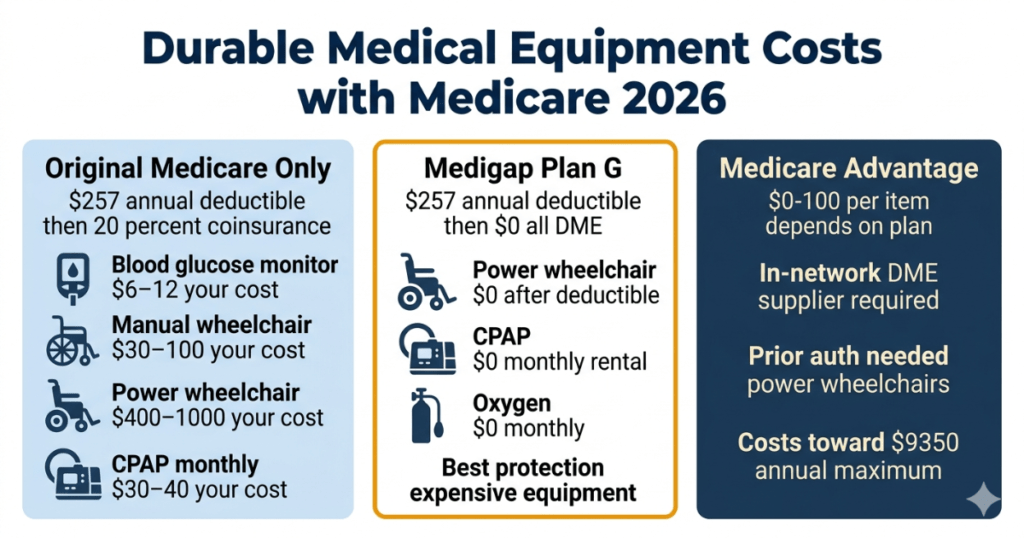
Medicare Part B covers DME at 80% of the Medicare-approved amount after the $257 annual Part B deductible. Your 20% coinsurance applies to all covered DME purchases.
Typical Medicare-approved amounts and your 20% costs for common DME items:
Wheelchair — manual standard:
- Medicare-approved — approximately $150 to $500
- Your 20% coinsurance — approximately $30 to $100
Power wheelchair:
- Medicare-approved — approximately $2,000 to $5,000
- Your 20% coinsurance — approximately $400 to $1,000
Hospital bed:
- Medicare-approved — approximately $100 to $200 (monthly rental initially)
- Your 20% per month rental
Oxygen concentrator:
- Medicare uses a rental model — approximately $100 to $200 per month Medicare-approved
- Your 20% per month — approximately $20 to $40 per month
CPAP machine:
- Medicare-approved monthly rental — approximately $150 to $200
- Your 20% per month — approximately $30 to $40
Blood glucose monitor:
- Medicare-approved — approximately $30 to $60
- Your 20% — approximately $6 to $12
With Medigap Plan G
Medigap Plan G covers your 20% DME coinsurance after the $257 annual Part B deductible. With Plan G your effective cost for covered DME is $0 after the annual deductible — including wheelchairs, oxygen equipment, CPAP machines, and all other covered DME.
For expensive items like power wheelchairs where 20% coinsurance can reach $400 to $1,000 Medigap Plan G provides substantial financial protection.
With Medicare Advantage
Medicare Advantage plans cover DME with their own cost-sharing structure — typically $0 to $100 copay or coinsurance depending on the item and plan. Medicare Advantage plans require use of in-network DME suppliers for covered rates.
Medicare DME Supplier Requirements
To receive Medicare-covered DME you must obtain equipment from a Medicare-enrolled DME supplier. Not all medical equipment companies accept Medicare — and using a non-enrolled supplier means Medicare will not pay for your equipment.
Finding Medicare-Enrolled DME Suppliers
You can find Medicare-enrolled DME suppliers in several ways:
- Ask your physician or discharge planner for recommended suppliers
- Use the Medicare supplier finder at Medicare.gov
- Call Medicare at 1-800-633-4227
Supplier Accreditation Requirements
Medicare requires that DME suppliers serving Medicare beneficiaries be accredited by a CMS-approved accreditation organization. Accreditation ensures suppliers meet quality and safety standards for Medicare DME.
Competitive Bidding Areas
CMS uses a Competitive Bidding Program to set payment amounts for certain types of DME in designated metropolitan areas. In competitive bidding areas:
- Only Medicare-contracted suppliers can furnish certain DME at Medicare prices
- You must use a competitive bidding contract supplier or pay more out of pocket
- Contact Medicare to find contracted suppliers in your area
Covered items in competitive bidding areas include:
- Oxygen equipment and supplies
- CPAP and RAD equipment and supplies
- Hospital beds and related items
- Walkers
- Manual wheelchairs
- Blood glucose monitors and testing supplies
Rental vs Purchase of Medicare DME
For certain types of DME Medicare uses a rental model rather than immediate purchase — particularly for higher-cost equipment. Understanding the rental-to-purchase process helps you understand your ongoing costs.
Rental-to-Purchase Items
For capped rental items — including CPAP machines, hospital beds, and certain other equipment — Medicare rents the equipment for a specified period (typically 13 months) and then ownership transfers to you. During the rental period you pay your 20% of the monthly rental charge. After the rental period ends the equipment becomes yours with no further payment.
Power Wheelchairs
Power wheelchairs use a 13-month rental-to-purchase model. After 13 months of Medicare-covered rental the wheelchair ownership transfers to you. Medicare continues to cover repairs and accessories after the rental period ends.
Oxygen Equipment
Oxygen equipment follows a 36-month rental period. After 36 months of rental Medicare continues to cover oxygen contents and accessories but the equipment is not transferred to you — it remains with the supplier who continues to service it.
Does Medicare Advantage Cover Durable Medical Equipment?
Does Medicare Advantage cover durable medical equipment in 2026? Yes — all Medicare Advantage plans must cover DME because it is a Medicare-covered benefit. However Medicare Advantage DME coverage has important differences from Original Medicare.
In-network DME suppliers — Medicare Advantage plans require you to use in-network DME suppliers. Using an out-of-network supplier may result in higher costs or no coverage on HMO plans. Always verify your DME supplier is in-network before ordering equipment.
Prior authorization — many Medicare Advantage plans require prior authorization for DME — particularly power wheelchairs and other high-cost items. Your physician’s office typically handles the authorization process but always confirm authorization before ordering.
Cost-sharing — Medicare Advantage plans use their own cost-sharing structure for DME — typically $0 to $100 copay or a percentage of cost counting toward the annual out-of-pocket maximum.
Enhanced benefits — some Medicare Advantage plans offer enhanced DME benefits beyond Original Medicare — for example covering additional types of equipment or providing higher allowances for specific items.
Frequently Asked Questions — Does Medicare Cover Durable Medical Equipment
Does Medicare cover durable medical equipment in 2026?
Yes — Medicare Part B covers medically necessary durable medical equipment at 80% after the $257 annual Part B deductible. Covered DME includes wheelchairs, walkers, hospital beds, oxygen equipment, CPAP machines, blood glucose monitors, insulin pumps, braces, prosthetics, and many other items when prescribed by a physician and obtained from a Medicare-enrolled supplier.
How much does durable medical equipment cost with Medicare?
With Original Medicare you pay 20% of the Medicare-approved amount after the $257 annual Part B deductible. Costs vary by item — a blood glucose monitor may cost you $6 to $12 while a power wheelchair may cost $400 to $1,000 in coinsurance. With Medigap Plan G your effective cost after the annual deductible is $0 for all covered DME.
Does Medicare cover wheelchairs?
Yes — Medicare covers manual and power wheelchairs when medically necessary for mobility limitations that significantly impair your ability to perform mobility-related activities of daily living. Coverage requires a physician evaluation and prescription and procurement from a Medicare-enrolled supplier.
Does Medicare cover oxygen equipment?
Yes — Medicare Part B covers oxygen equipment and supplies for patients with chronic hypoxemia documented by qualifying blood oxygen levels. Medicare uses a rental model — paying for oxygen equipment rental for 36 months with coverage of oxygen contents and accessories continuing after the rental period.
Does Medicare require a prescription for DME?
Yes — Medicare requires a physician or other qualified healthcare provider prescription for all covered DME. The prescribing provider must be enrolled in Medicare and must document the medical necessity of the equipment.
Does Medicare cover DME at any supplier?
With Original Medicare you must use a Medicare-enrolled DME supplier — but you can choose from any enrolled supplier. In Medicare competitive bidding areas you must use a contract supplier for certain items. With Medicare Advantage you must use in-network DME suppliers.
Summary — Does Medicare Cover Durable Medical Equipment 2026
Does Medicare cover durable medical equipment in 2026? Yes — Medicare Part B provides comprehensive coverage for medically necessary durable medical equipment at 80% after the annual deductible. The full range of covered DME includes mobility equipment, respiratory equipment, diabetes management devices, cardiac equipment, orthopedic braces and prosthetics, and communication devices — all covered when prescribed by a physician and obtained from a Medicare-enrolled supplier.
Medigap Plan G provides the most comprehensive financial protection for DME — covering the 20% coinsurance after the $257 annual deductible and making your effective cost $0 for all covered equipment. This protection is particularly valuable for expensive items like power wheelchairs where 20% coinsurance can amount to hundreds or thousands of dollars.
For free help understanding your Medicare DME coverage contact your State Health Insurance Assistance Program (SHIP) at shiphelp.org or call Medicare free at 1-800-633-4227.
This guide is for informational purposes only and is not medical advice. Always verify current Medicare DME coverage at Medicare.gov before ordering medical equipment.
Sources: Medicare.gov | CMS.gov | SSA.gov | AARP.org
Last updated: April 2026 | Author: James Carter, Independent Medicare Research Analyst