Medicare Supplement Plan F 2026 — Complete Guide
Medicare Supplement Plan F in 2026 — is it still available, who can get it, and is it still worth choosing? Plan F was the most popular Medicare supplement plan for decades — offering the most comprehensive coverage of any Medigap plan by covering virtually all Medicare cost-sharing including the Part B deductible. However a major change in Medicare law significantly restricted access to Plan F starting January 1, 2020. In this complete guide we explain everything about Medicare Supplement Plan F in 2026 — what Plan F covers, who can still get it, how it compares to Plan G, whether it is worth the premium, and the high-deductible Plan F option. All information is sourced from Medicare.gov and CMS.gov.
Also Read —
- Medigap Plan G vs Plan N 2026
- Best Medicare Supplement Plans 2026
- Medicare Advantage vs Medicare Supplement 2026
What You Will Learn — Medicare Supplement Plan F 2026
- What does Medicare Supplement Plan F cover in 2026
- Who can still get Medicare Supplement Plan F
- Why Plan F was restricted to pre-2020 Medicare enrollees
- Medicare Supplement Plan F vs Plan G comparison
- Is Medicare Supplement Plan F worth the higher premium
- High-Deductible Plan F explained
- How much does Medicare Supplement Plan F cost in 2026
- Should you switch from Plan F to Plan G
- Frequently asked questions about Medicare Supplement Plan F 2026
What Does Medicare Supplement Plan F Cover in 2026?
Medicare Supplement Plan F provides the most comprehensive coverage of any standardized Medigap plan — covering virtually all Medicare cost-sharing with essentially no out-of-pocket expenses for Medicare-approved services.
Medicare Supplement Plan F Coverage 2026
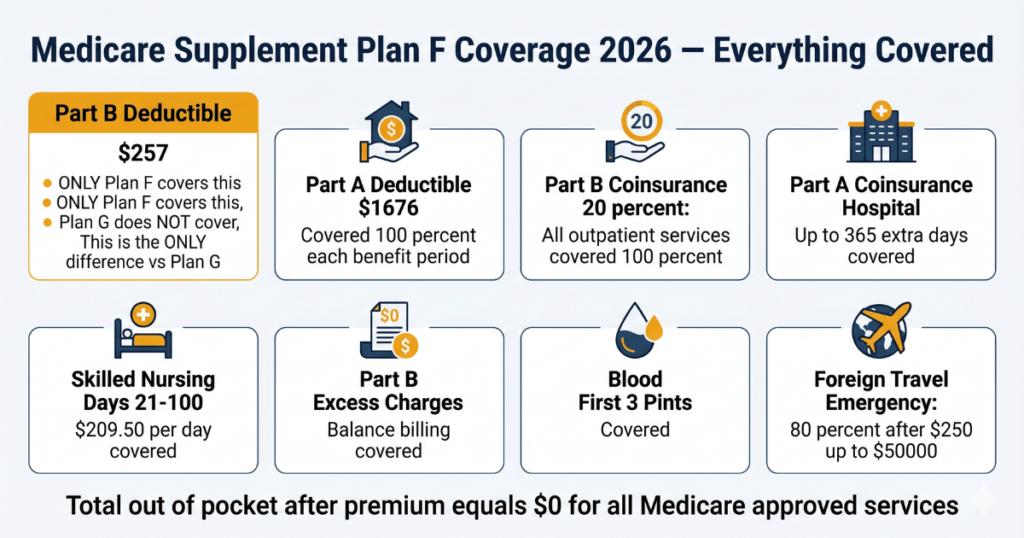
Plan F covers all of the following in 2026:
Medicare Part A coinsurance and hospital costs up to an additional 365 days after Medicare benefits end — covered 100%.
Medicare Part B coinsurance or copayment — the 20% you would otherwise pay for all Part B services — covered 100%.
Medicare Part A hospice care coinsurance or copayment — covered 100%.
Medicare Part A deductible — $1,676 per benefit period — covered 100%.
Medicare Part B deductible — $257 per year — covered 100%. This is the critical difference between Plan F and Plan G — Plan F covers the Part B deductible while Plan G does not.
Medicare Part B excess charges — charges above the Medicare-approved amount by non-participating providers — covered 100%.
Blood — first 3 pints of blood per year — covered 100%.
Skilled nursing facility coinsurance — days 21 to 100 at $209.50 per day — covered 100%.
Foreign travel emergency coverage — up to 80% after a $250 deductible up to the plan’s lifetime maximum of $50,000.
With Plan F Your Effective Out-of-Pocket Cost Is $0
The extraordinary benefit of Plan F is that after paying your monthly premium your effective out-of-pocket cost for all Medicare-approved services is $0. You pay no deductibles, no copays, and no coinsurance for any covered Medicare service. This complete elimination of Medicare cost-sharing made Plan F the most popular Medigap plan for decades.
Who Can Still Get Medicare Supplement Plan F in 2026?
This is the most important question about Plan F in 2026 — and the answer has a significant limitation that affects most newly eligible Medicare beneficiaries.
Plan F Is Only Available to Beneficiaries Who Were Medicare-Eligible Before January 1, 2020
The Medicare Access and CHIP Reauthorization Act of 2015 (MACRA) prohibited the sale of first-dollar coverage Medigap plans — plans that cover the Medicare Part B deductible — to newly eligible Medicare beneficiaries starting January 1, 2020.
This means:
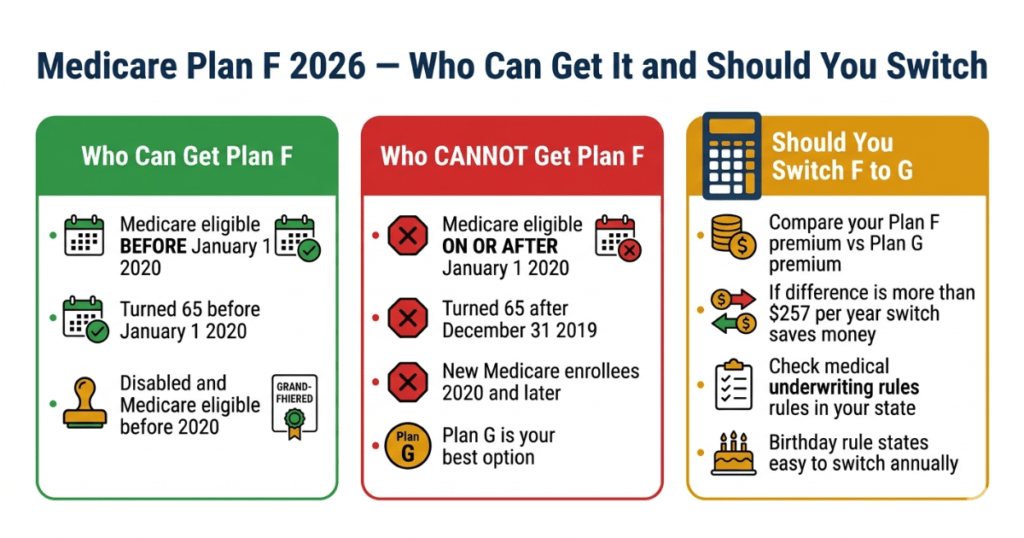
Who CAN get Plan F in 2026:
- Medicare beneficiaries who were eligible for Medicare before January 1, 2020 — meaning they turned 65 before January 1, 2020 or qualified for Medicare due to disability before that date
- These beneficiaries can still purchase Plan F if they did not previously enroll in Medigap or if they want to switch Medigap plans
Who CANNOT get Plan F in 2026:
- Medicare beneficiaries who first became eligible for Medicare on or after January 1, 2020 — those who turned 65 after December 31, 2019
- New Medicare enrollees who aged into Medicare after January 1, 2020 cannot purchase Plan F or Plan C (which also covers the Part B deductible)
Why Was Plan F Restricted?
Congress restricted first-dollar coverage Medigap plans starting in 2020 based on the theory that when patients pay nothing out-of-pocket they may overuse healthcare services — seeking care they do not truly need because there is no financial barrier. By requiring Medicare beneficiaries to pay at least the $257 Part B deductible Congress intended to introduce a small financial stake in healthcare utilization decisions.
This reasoning is somewhat controversial — many healthcare economists argue that the $257 annual deductible is too small to meaningfully affect healthcare utilization decisions especially for serious illness. However the law stands and Plan F remains restricted to pre-2020 Medicare eligibles.
Medicare Supplement Plan F vs Plan G Comparison 2026
The most important comparison in Medigap in 2026 is Plan F vs Plan G — because Plan G has replaced Plan F as the most comprehensive Medigap plan available to all Medicare beneficiaries.
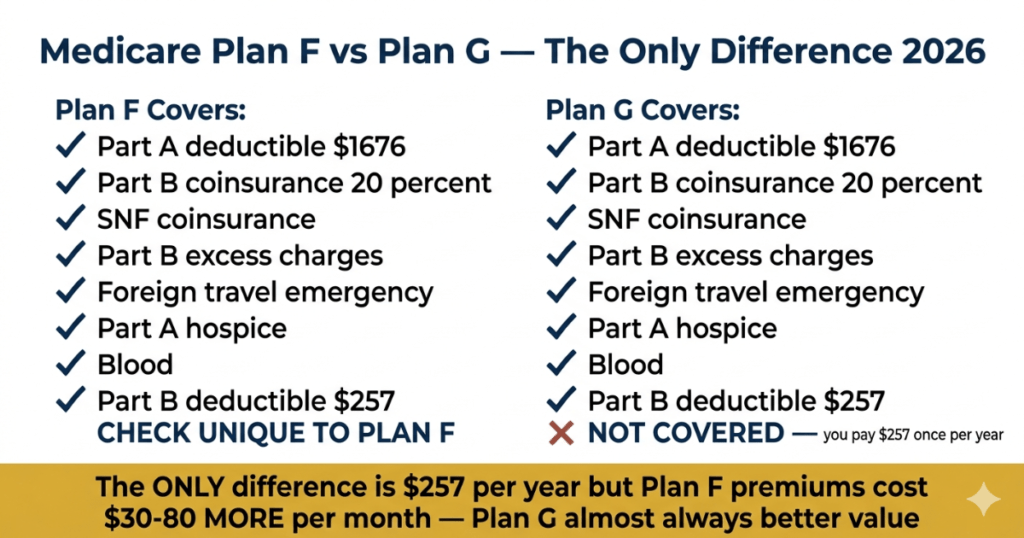
What Plan G Covers That Plan F Also Covers:
- Part A coinsurance and hospital costs — both cover 100%
- Part B coinsurance — both cover 100%
- Part A hospice coinsurance — both cover 100%
- Part A deductible $1,676 — both cover 100%
- Part B excess charges — both cover 100%
- Blood — both cover 100%
- Skilled nursing facility coinsurance — both cover 100%
- Foreign travel emergency — both cover up to 80%
The Only Difference — Part B Deductible
Plan F covers the $257 annual Medicare Part B deductible. Plan G does NOT cover the $257 annual Part B deductible — you pay this once per year.
This is the only difference between Plan F and Plan G. After paying the $257 annual deductible your coverage under Plan G is identical to Plan F.
The Financial Comparison — Plan F vs Plan G
Because Plan F covers the $257 annual deductible Plan F premiums are always higher than Plan G premiums. The question for beneficiaries eligible for both plans is — does the additional Plan F premium cost more or less than the $257 deductible Plan G requires you to pay?
In virtually every market in 2026 Plan F premiums exceed Plan G premiums by more than $257 per year — meaning you pay more for Plan F than you would save by not paying the Part B deductible.
Example calculation:
- Plan F annual premium — $3,000 per year ($250 per month)
- Plan G annual premium — $2,400 per year ($200 per month)
- Premium difference — $600 per year
- Part B deductible Plan G requires — $257 per year
- Net additional cost of Plan F over Plan G — $600 – $257 = $343 per year
In this example choosing Plan F costs $343 more per year than choosing Plan G — despite identical coverage after the deductible.
Conclusion — Plan G Is Almost Always Better Value Than Plan F
In virtually every market in the United States Plan G provides better value than Plan F because the premium difference between Plan F and Plan G exceeds the $257 annual deductible. Unless Plan F premiums are within $257 per year of Plan G premiums — which is extremely rare — Plan G provides identical coverage at lower total annual cost.
For Medicare beneficiaries eligible for both plans Plan G is almost always the financially superior choice in 2026.
Is Medicare Supplement Plan F Worth the Higher Premium?
Should you keep Plan F in 2026 if you already have it — or should you switch to Plan G?
For Current Plan F Holders — Should You Switch to Plan G?
If you currently have Plan F and you were Medicare-eligible before January 1, 2020 you may be wondering whether to switch to Plan G to save money. Here is how to evaluate this decision:
Step 1 — Compare your current Plan F monthly premium with available Plan G premiums in your area.
Step 2 — Calculate the annual premium difference between Plan F and Plan G.
Step 3 — If the annual premium difference is greater than $257 (the Part B deductible) you would save money by switching to Plan G.
Step 4 — Factor in any potential medical underwriting issues. In most states switching Medigap plans after the initial open enrollment period requires passing medical underwriting. If you have significant health conditions you may not be able to switch to Plan G.
States With Guaranteed Issue Protections
In states with guaranteed issue protections switching from Plan F to Plan G is easier:
- New York, Massachusetts, Connecticut — year-round guaranteed issue
- California, Oregon, Washington — birthday rule allows annual switching without underwriting
In these states current Plan F holders can switch to Plan G without medical underwriting — making the switch almost always financially advantageous.
In States Without Special Protections
In states without guaranteed issue protections switching from Plan F to Plan G requires passing medical underwriting. If you are healthy and can pass underwriting the switch is usually financially worthwhile. If you have significant health conditions that might cause you to be declined or rated up for Plan G it may be worth keeping Plan F for the certainty of coverage.
High-Deductible Plan F (HDHP-F) Explained
There is a second version of Medicare Supplement Plan F — the High-Deductible Plan F (HDHP-F). High-Deductible Plan F provides the same comprehensive coverage as standard Plan F but with a high annual deductible before the coverage kicks in.
How High-Deductible Plan F Works
With HDHP-F you pay all Medicare-approved costs — deductibles, copays, and coinsurance — out of pocket until you reach the annual high deductible threshold. In 2026 the high deductible for HDHP-F is $2,870.
After reaching the $2,870 annual deductible HDHP-F pays all Medicare-approved costs at 100% — just like standard Plan F.
High-Deductible Plan F Monthly Premium
Because of the high annual deductible HDHP-F premiums are dramatically lower than standard Plan F premiums — typically $30 to $75 per month compared to $150 to $300 per month for standard Plan F.
Who Is HDHP-F Right For?
High-Deductible Plan F can be a good choice for:
- Healthy beneficiaries who rarely reach the high deductible amount
- Beneficiaries who want catastrophic coverage protection at very low monthly premiums
- Those who can afford to pay out-of-pocket up to $2,870 per year if needed
High-Deductible Plan F is not appropriate for:
- Beneficiaries with significant ongoing medical expenses who would reach the deductible annually
- Beneficiaries who cannot afford the potential $2,870 annual out-of-pocket exposure
Note — HDHP-F also restricted to pre-2020 Medicare eligibles
Like standard Plan F the High-Deductible Plan F is also only available to beneficiaries who were eligible for Medicare before January 1, 2020. For newer Medicare beneficiaries the equivalent option is High-Deductible Plan G (HDHP-G) which provides similar catastrophic coverage for those not eligible for Plan F.
How Much Does Medicare Supplement Plan F Cost in 2026?
Medicare Supplement Plan F premiums vary significantly by age, gender, state, tobacco use, and insurance company. Here are approximate ranges for 2026:
Standard Plan F Monthly Premiums 2026 (Approximate):
Age 65 (newly eligible pre-2020) — $170 to $320 per month Age 70 — $210 to $380 per month Age 75 — $255 to $450 per month Age 80 — $315 to $540 per month
Plan F premiums are higher than Plan G premiums by approximately $30 to $80 per month in most markets — well above the $21.42 per month ($257/12) that the Part B deductible represents.
High-Deductible Plan F Monthly Premiums 2026 (Approximate):
Age 65 — $30 to $75 per month Age 70 — $40 to $95 per month Age 75 — $50 to $115 per month
Top Plan F Providers in 2026:
- AARP UnitedHealthcare — largest Plan F provider nationally
- Mutual of Omaha — competitive Plan F pricing
- Aetna — competitive Plan F rates
- Anthem Blue Cross Blue Shield — strong in many markets
- Various state and regional insurers
Frequently Asked Questions — Medicare Supplement Plan F 2026
Is Medicare Supplement Plan F still available in 2026?
Medicare Supplement Plan F is still available in 2026 but only for Medicare beneficiaries who were first eligible for Medicare before January 1, 2020 — meaning they turned 65 before January 1, 2020 or qualified for Medicare due to disability before that date. Beneficiaries who became Medicare-eligible on or after January 1, 2020 cannot purchase Plan F.
What is the difference between Plan F and Plan G?
The only difference between Plan F and Plan G is that Plan F covers the $257 annual Medicare Part B deductible while Plan G does not. After paying the $257 deductible under Plan G your coverage is identical to Plan F. In virtually every market Plan G provides better value because Plan F premiums exceed Plan G premiums by more than $257 per year.
Should I switch from Plan F to Plan G?
In most cases switching from Plan F to Plan G saves money because the premium difference between the two plans typically exceeds the $257 annual deductible. However switching requires passing medical underwriting in most states — check your state’s Medigap rules before attempting to switch. In states with guaranteed issue protections or birthday rules switching from Plan F to Plan G is almost always financially advantageous.
What is High-Deductible Plan F?
High-Deductible Plan F (HDHP-F) provides Plan F-level coverage after you pay a $2,870 annual deductible. HDHP-F has much lower monthly premiums — approximately $30 to $75 per month — but requires paying all Medicare costs out of pocket until reaching the deductible. Like standard Plan F it is only available to pre-2020 Medicare eligibles.
How much does Plan F cost in 2026?
Standard Plan F premiums in 2026 range from approximately $170 to $320 per month at age 65 — higher than comparable Plan G premiums by $30 to $80 per month. High-Deductible Plan F premiums range from approximately $30 to $75 per month at age 65.
Summary — Medicare Supplement Plan F 2026
Medicare Supplement Plan F in 2026 remains available to Medicare beneficiaries who were first eligible before January 1, 2020 — offering the most comprehensive Medigap coverage with $0 effective out-of-pocket cost for all Medicare-approved services. However Plan F premiums almost always exceed Plan G premiums by more than the $257 annual Part B deductible — making Plan G the better financial value for most beneficiaries who can choose between the two.
For newly eligible Medicare beneficiaries — those who became eligible on or after January 1, 2020 — Plan F is not available. Plan G provides virtually identical coverage at lower total cost and is the recommended comprehensive Medigap option for new Medicare enrollees.
Current Plan F holders should compare Plan F and Plan G premiums in their area annually — particularly in states with birthday rules or guaranteed issue protections where switching is easy — to determine whether switching to Plan G would provide savings.
For free help understanding Medicare Supplement Plan F and comparing it to Plan G contact your State Health Insurance Assistance Program (SHIP) at shiphelp.org or call Medicare free at 1-800-633-4227.
This guide is for informational purposes only and is not financial advice. Always verify current Medigap plan availability and premiums at Medicare.gov before making enrollment decisions.
Sources: Medicare.gov | CMS.gov | SSA.gov | AARP.org
Last updated: April 2026 | Author: James Carter, Independent Medicare Research Analyst