Does Medicare Cover Alzheimer’s Disease Treatment — Complete Guide 2026
Does Medicare cover Alzheimer’s disease treatment in 2026? Alzheimer’s disease is the most common form of dementia — affecting over 6 million Americans and millions of Medicare beneficiaries. As the population ages Alzheimer’s has become one of the most important Medicare coverage questions families face. The answer is yes — Medicare does cover Alzheimer’s disease treatment in 2026 including diagnostic evaluation, cognitive testing, physician management, medications, and supportive care. However Medicare’s coverage of Alzheimer’s has important limitations — particularly regarding long-term custodial care — that families must understand for realistic planning. In this complete guide we explain exactly what Medicare covers for Alzheimer’s disease in 2026 — from early diagnosis through advanced disease. All information is sourced from Medicare.gov and CMS.gov.
Also Read —
- Does Medicare Cover Nursing Home Care 2026
- Does Medicare Cover Home Health Care 2026
- What Does Medicare Cover in 2026 — Complete Coverage Guide
What You Will Learn — Does Medicare Cover Alzheimer’s Disease
- Does Medicare cover Alzheimer’s disease in 2026
- Medicare coverage for Alzheimer’s diagnosis and cognitive testing
- Does Medicare cover Alzheimer’s medications including new treatments
- Medicare coverage for Alzheimer’s care management
- Does Medicare cover memory care facilities
- What Medicare does NOT cover for Alzheimer’s disease
- How much does Alzheimer’s treatment cost with Medicare
- Does Medicare Advantage cover Alzheimer’s disease
- Long-term Alzheimer’s care — what pays after Medicare
- Frequently asked questions about Medicare Alzheimer’s coverage 2026
Does Medicare Cover Alzheimer’s Disease in 2026?
Yes — Medicare covers Alzheimer’s disease treatment in 2026 including diagnostic evaluation, cognitive assessment, physician management, medications, skilled nursing care for acute conditions, home health care for homebound patients, and hospice care for end-stage Alzheimer’s. Medicare’s coverage of Alzheimer’s disease reflects the enormous burden this condition places on Medicare beneficiaries and their families.
However Medicare’s Alzheimer’s coverage has critical and often misunderstood limitations — particularly regarding long-term custodial care. Medicare does not cover the ongoing personal care and supervision that Alzheimer’s patients primarily need as the disease progresses — the daily assistance with bathing, dressing, eating, and safety monitoring that most people associate with Alzheimer’s care. Understanding what Medicare covers and what it does not cover for Alzheimer’s disease is essential for realistic long-term care planning.
Medicare Coverage for Alzheimer’s Diagnosis and Cognitive Testing
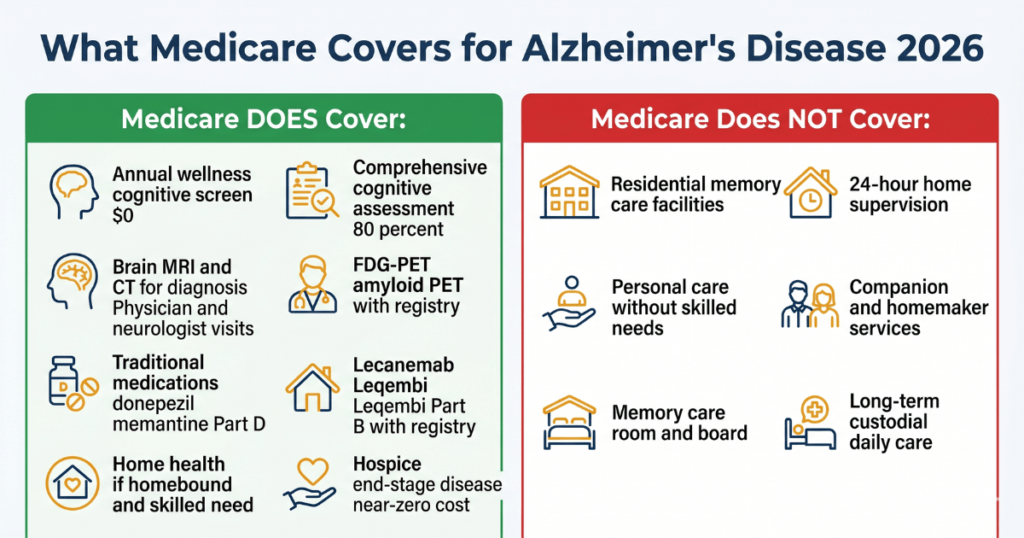
Annual Wellness Visit Cognitive Assessment — $0
Medicare covers cognitive assessment as part of the Annual Wellness Visit at absolutely no cost. Starting in 2011 Medicare required that every Annual Wellness Visit include a cognitive impairment assessment — identifying any cognitive concerns that warrant further evaluation. This $0 cognitive screening during the Annual Wellness Visit is often the first step in identifying early Alzheimer’s disease.
Comprehensive Cognitive Assessment — Covered
When cognitive impairment is suspected Medicare Part B covers a comprehensive cognitive assessment ordered by a physician. This assessment evaluates:
- Memory and recall
- Language and communication
- Attention and concentration
- Executive function and problem solving
- Visuospatial abilities
Comprehensive cognitive assessments are covered at 80% after the $257 annual Part B deductible.
Brain Imaging for Alzheimer’s Diagnosis — Covered
Medicare Part B covers brain imaging for Alzheimer’s evaluation including:
MRI brain — covered when ordered to evaluate cognitive impairment and rule out other causes of dementia such as stroke, tumors, or hydrocephalus. Covered at 80% after deductible.
CT brain — covered when MRI is contraindicated or when evaluating acute changes. Covered at 80% after deductible.
FDG-PET scan — Medicare covers FDG-PET (fluorodeoxyglucose positron emission tomography) brain scans for evaluating Alzheimer’s disease versus frontotemporal dementia in specific diagnostic situations. Coverage applies when imaging is ordered to distinguish between Alzheimer’s and frontotemporal dementia in diagnostically uncertain cases.
Amyloid PET scans — Medicare covers amyloid PET scans through the Coverage with Evidence Development (CED) program for patients who are enrolled in qualifying clinical trials or registries. Amyloid PET scans detect beta-amyloid plaques in the brain — a hallmark of Alzheimer’s disease.
Laboratory Tests for Alzheimer’s Workup — Covered
Medicare covers laboratory testing to evaluate for reversible causes of cognitive impairment at $0 including:
- Thyroid function tests
- Vitamin B12 levels
- Complete metabolic panel
- Complete blood count
- Syphilis serology if indicated
- Other tests as clinically indicated
Does Medicare Cover Alzheimer’s Medications?
Does Medicare cover Alzheimer’s medications in 2026? Yes — Medicare Part D covers FDA-approved Alzheimer’s medications.
Traditional Alzheimer’s Medications — Part D Covered
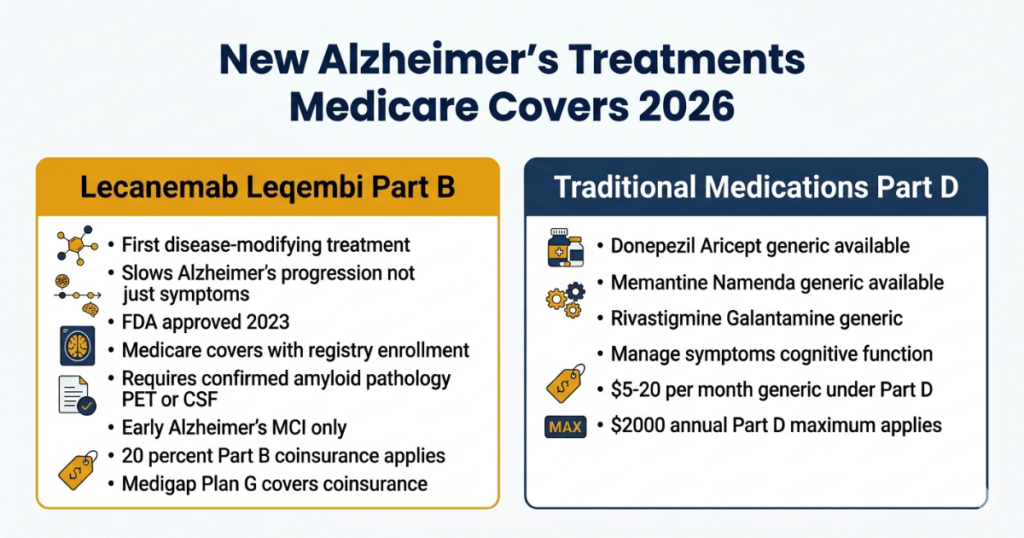
Medicare Part D covers the established Alzheimer’s medications used to manage cognitive symptoms:
Cholinesterase inhibitors — these medications help maintain acetylcholine levels in the brain to temporarily improve or stabilize cognitive symptoms:
- Donepezil (Aricept) — covered — typically Tier 2 generic
- Rivastigmine (Exelon) — covered — typically Tier 2 generic
- Galantamine (Razadyne) — covered — typically Tier 2 generic
NMDA receptor antagonist — this medication regulates glutamate activity to help with moderate to severe Alzheimer’s:
- Memantine (Namenda) — covered — typically Tier 2 generic
Combination therapy:
- Donepezil/memantine (Namzaric) — covered under Part D
These traditional Alzheimer’s medications are available as generics and are typically very affordable under Part D — often $5 to $20 per month for generic versions.
New Alzheimer’s Disease-Modifying Treatments — Part B Coverage
A significant development in Alzheimer’s treatment in recent years has been the approval of new disease-modifying therapies that target the underlying pathology of Alzheimer’s disease — specifically the beta-amyloid plaques associated with the disease.
Medicare Part B covers FDA-approved amyloid-targeting therapies for Alzheimer’s disease through the Coverage with Evidence Development (CED) program. This coverage requires that patients be enrolled in qualifying clinical trials or registries.
Lecanemab (Leqembi) — FDA-approved in 2023 for early Alzheimer’s disease with confirmed amyloid pathology. Medicare Part B covers lecanemab for beneficiaries enrolled in qualifying registries. Coverage requires:
- Diagnosis of mild cognitive impairment (MCI) due to Alzheimer’s or mild Alzheimer’s dementia
- Confirmed amyloid pathology via PET scan or CSF testing
- Enrollment in an approved data collection registry
Donanemab — a similar amyloid-targeting therapy that received FDA approval in 2024. Medicare coverage follows similar CED requirements.
These new treatments represent a significant breakthrough in Alzheimer’s therapy — the first treatments to potentially slow disease progression rather than just managing symptoms. Medicare’s coverage of these treatments — while requiring registry enrollment — ensures that Medicare beneficiaries who qualify have access to these important new options.
Medicare Coverage for Alzheimer’s Care Management
Physician and Specialist Visits — Covered
Medicare Part B covers ongoing physician and specialist visits for Alzheimer’s disease management at 80% after the Part B deductible. Regular visits with:
- Primary care physician for overall Alzheimer’s management
- Neurologist for cognitive assessment and medication management
- Geriatric psychiatrist for behavioral symptoms management
- Geriatrician for comprehensive geriatric care
Cognitive Behavioral Interventions — Covered in Some Contexts
Medicare covers certain behavioral health interventions for Alzheimer’s patients including:
- Psychiatric evaluation for behavioral symptoms
- Medication management for depression, anxiety, and agitation associated with Alzheimer’s
- Mental health counseling for caregiver support
Caregiver Training — Covered in Specific Programs
Medicare covers caregiver training when provided as part of a Medicare-covered service — for example occupational therapy may include caregiver training in home safety modifications and activity assistance for Alzheimer’s patients.
Advance Care Planning — Covered
Medicare covers advance care planning discussions for Alzheimer’s patients — including conversations about goals of care, advance directives, and future care preferences. This is covered at 80% after the deductible as a separate service or at $0 during the Annual Wellness Visit.
Does Medicare Cover Memory Care Facilities?
Does Medicare cover memory care facilities in 2026? No — this is one of the most important and most misunderstood aspects of Medicare Alzheimer’s coverage.
Medicare does not cover residential memory care — the specialized assisted living facilities designed for Alzheimer’s and dementia patients that provide 24-hour supervision, structured activities, and secure environments for wandering prevention.
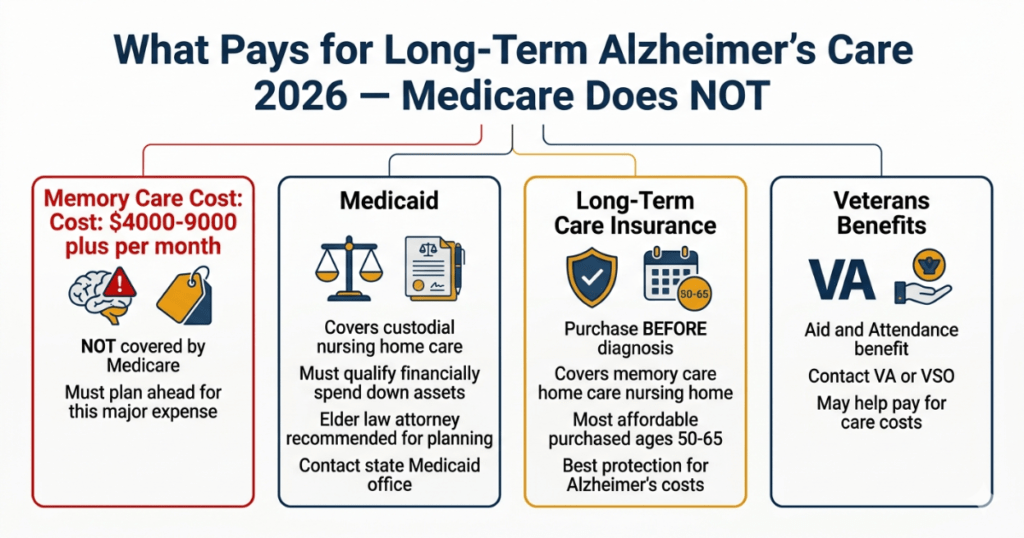
Memory care facilities charge $4,000 to $9,000 or more per month for their services. This ongoing residential custodial care is not covered by Medicare because it is considered custodial in nature — providing supervision and personal care rather than skilled medical treatment.
What Medicare Does Cover in Memory Care Contexts
While Medicare does not cover the room and board and custodial supervision of memory care facilities Medicare does cover skilled medical services provided to Alzheimer’s patients including:
Skilled nursing visits when medically necessary — if an Alzheimer’s patient in a memory care facility develops a medical condition requiring skilled nursing care — infection, wound care, medication management — Medicare may cover those specific skilled services.
Medicare Advantage supplemental benefits — some Medicare Advantage plans offer enhanced benefits that help pay for non-medical services in residential settings. Check your specific plan for these benefits.
Does Medicare Cover Home Health Care for Alzheimer’s?
Does Medicare cover home health care for Alzheimer’s patients in 2026? Yes — but with important limitations.
Medicare covers home health care for Alzheimer’s patients who are homebound and have skilled medical needs. Covered home health services for Alzheimer’s patients include:
Skilled nursing — for medical management of conditions occurring alongside Alzheimer’s — wound care, medication management, IV therapy.
Occupational therapy — for home safety assessment, fall prevention, adaptive equipment, and caregiver training in activity assistance.
Physical therapy — for mobility, balance, and fall prevention.
Medical social work — for care planning and community resource coordination.
Home health aide — when concurrent skilled care is being received.
The Critical Limitation
Medicare covers home health care only when the patient is homebound and has skilled medical needs. Medicare does not cover:
- 24-hour home supervision for safety
- Personal care without concurrent skilled service
- Companion or homemaker services
- Non-skilled oversight and monitoring
Most Alzheimer’s patients’ primary need is safety supervision and personal care — which Medicare does not cover. Family caregivers or privately funded home care workers must provide this non-skilled custodial care.
Does Medicare Cover Hospice for Alzheimer’s?
Does Medicare cover hospice care for end-stage Alzheimer’s in 2026? Yes — Medicare Part A covers hospice care for Alzheimer’s patients when a physician certifies that the patient has a life expectancy of 6 months or less if the disease runs its normal course.
Advanced Alzheimer’s disease with specific functional decline — the inability to perform daily activities, severe memory loss, inability to communicate meaningfully, and complications such as aspiration pneumonia or urinary tract infections — can meet hospice eligibility criteria.
Medicare hospice for Alzheimer’s covers:
- Nursing visits for comfort management
- Home health aide services for personal care — more comprehensive than standard home health
- Social work and spiritual care
- Medications for comfort
- Medical equipment for comfort
- Family caregiver support
Hospice is one of the most valuable and most underutilized Medicare benefits for advanced Alzheimer’s patients. Many Alzheimer’s patients spend months or years in the final stages of the disease without the comfort-focused support that Medicare hospice provides.
How Much Does Alzheimer’s Treatment Cost with Medicare?
Diagnostic Evaluation Costs
Annual Wellness Visit cognitive screen — $0 Comprehensive cognitive assessment — approximately $25 to $50 (20% of $125 to $250 approved amount) Brain MRI — approximately $60 to $100 (20% of $300 to $500 approved) With Medigap Plan G — $0 after annual deductible
Medication Costs Under Part D
Traditional Alzheimer’s drugs (donepezil, memantine generics) — approximately $5 to $20 per month under Part D Lecanemab (Leqembi) — covered under Part B with registry enrollment — 20% coinsurance which can be very significant given the drug’s high cost ($26,500 per year) With Medigap Plan G — Part B coinsurance covered at $0 after annual deductible
Ongoing Physician Visits
Monthly or quarterly physician visits — approximately $20 to $50 per visit (20% coinsurance) With Medigap Plan G — $0 after annual deductible
Long-Term Care Costs NOT Covered by Medicare
Memory care facility — $4,000 to $9,000+ per month — not covered by Medicare 24-hour home care — $18,000 to $25,000+ per month — not covered by Medicare These costs must be covered by private pay, long-term care insurance, or eventually Medicaid
What Pays for Long-Term Alzheimer’s Care When Medicare Ends?
Understanding what pays for long-term Alzheimer’s care is essential for every family. The options are:
Option 1 — Private Pay
Many families pay for memory care and home care out of pocket until assets are depleted. At $4,000 to $9,000 per month for memory care even substantial assets are depleted in a few years.
Option 2 — Medicaid
Medicaid covers long-term custodial care for Alzheimer’s patients who qualify financially. Medicaid pays for nursing home care and in many states for home and community-based services including memory care for qualifying low-income individuals. Medicaid planning with an elder law attorney can help families protect assets while qualifying for Medicaid.
Option 3 — Long-Term Care Insurance
Long-term care insurance purchased before an Alzheimer’s diagnosis can cover memory care, home care, and nursing home care. Alzheimer’s disease is one of the most common conditions triggering long-term care insurance benefits. Policies should be purchased in the 50s to early 60s before health problems develop.
Option 4 — Veterans Benefits
Veterans may qualify for Aid and Attendance benefits that can help pay for Alzheimer’s care. Contact your local VA or veterans service organization.
Does Medicare Advantage Cover Alzheimer’s Disease?
Does Medicare Advantage cover Alzheimer’s disease in 2026? All Medicare Advantage plans must cover medically necessary Alzheimer’s services including diagnostic evaluation, physician management, and medications.
Many Medicare Advantage plans offer enhanced benefits for Alzheimer’s and dementia patients including:
- Memory care support programs
- Caregiver support and education
- Transportation to medical appointments
- Meal delivery services
- Home safety assessments
- Telehealth for cognitive consultations
Prior authorization may be required for advanced diagnostic testing and new amyloid-targeting medications under Medicare Advantage. Ensure prior authorization is obtained promptly to avoid delays in accessing these important new treatments.
Frequently Asked Questions — Does Medicare Cover Alzheimer’s Disease
Does Medicare cover Alzheimer’s disease in 2026?
Yes — Medicare covers Alzheimer’s disease evaluation, diagnosis, physician management, FDA-approved medications including traditional treatments and new amyloid-targeting therapies, skilled nursing care for acute conditions, home health for homebound patients, and hospice for end-stage disease. Medicare does not cover residential memory care, 24-hour home supervision, or ongoing custodial personal care.
Does Medicare cover lecanemab (Leqembi) for Alzheimer’s?
Yes — Medicare Part B covers lecanemab for eligible patients enrolled in qualifying data collection registries. Coverage requires a diagnosis of mild cognitive impairment or mild Alzheimer’s dementia, confirmed amyloid pathology, and registry enrollment. The 20% Part B coinsurance on lecanemab — given its high cost — can be significant. Medigap Plan G covers this coinsurance after the annual deductible.
Does Medicare cover memory care facilities?
No — Medicare does not cover residential memory care facilities. Memory care costs $4,000 to $9,000+ per month and is considered custodial care not covered by Medicare. Long-term Alzheimer’s custodial care is primarily covered by Medicaid for qualifying individuals, long-term care insurance, or private pay.
Does Medicare cover home care for Alzheimer’s patients?
Medicare covers home health care for homebound Alzheimer’s patients with skilled medical needs — including nursing, therapy, and social work at 100%. Medicare does not cover 24-hour home supervision, companion care, or personal care without concurrent skilled service needs.
What pays for long-term Alzheimer’s care?
Long-term custodial Alzheimer’s care — memory care facilities and 24-hour home care — is primarily paid for through private pay, long-term care insurance, or Medicaid for qualifying individuals. Medicare does not cover long-term custodial Alzheimer’s care.
Summary — Does Medicare Cover Alzheimer’s Disease 2026
Does Medicare cover Alzheimer’s disease in 2026? Yes — Medicare covers comprehensive diagnostic evaluation, cognitive testing, physician management, FDA-approved medications including new amyloid-targeting therapies, home health care for homebound patients, and hospice for end-stage disease. Medicare does not cover residential memory care or long-term custodial care — the ongoing personal care and supervision that Alzheimer’s patients primarily need as the disease progresses.
For families facing an Alzheimer’s diagnosis planning for long-term care costs is critically important. Medicaid planning with an elder law attorney, long-term care insurance, and Veterans benefits are the primary options for covering long-term custodial Alzheimer’s care when Medicare reaches its limits.
For free help understanding your Medicare Alzheimer’s coverage contact your State Health Insurance Assistance Program (SHIP) at shiphelp.org or call Medicare free at 1-800-633-4227.
This guide is for informational purposes only and is not medical or financial advice. Always consult your physician and verify current Medicare Alzheimer’s coverage at Medicare.gov.
Sources: Medicare.gov | CMS.gov | SSA.gov | AARP.org | Alzheimers.gov
Last updated: April 2026 | Author: James Carter, Independent Medicare Research Analyst