Does Medicare Cover MRI Scans — Complete Guide 2026
Does Medicare cover MRI scans in 2026? If you or a loved one has been ordered an MRI scan and you are on Medicare this complete guide explains exactly how Medicare covers MRI imaging. The good news is that yes — Medicare does cover MRI scans in 2026 when they are medically necessary and ordered by a qualified healthcare provider. MRI scans are one of the most commonly ordered diagnostic imaging tests for Medicare beneficiaries and Medicare provides comprehensive coverage for medically necessary MRI studies. In this complete guide we explain exactly what Medicare covers for MRI scans in 2026 — what is covered, what is not covered, how much an MRI costs with Medicare, prior authorization requirements, and how Medicare Advantage handles MRI coverage. All information is sourced from Medicare.gov and CMS.gov.
Also Read —
- Does Medicare Cover Cancer Treatment 2026
- Does Medicare Cover Physical Therapy 2026
- Medicare Advantage vs Original Medicare 2026
What You Will Learn — Does Medicare Cover MRI Scans
- Does Medicare cover MRI scans in 2026
- Which part of Medicare covers MRI scans
- What conditions must be met for Medicare MRI coverage
- Does Medicare cover brain MRI scans
- Does Medicare cover spine MRI scans
- How much does an MRI cost with Medicare in 2026
- Does Medicare cover CT scans and other imaging
- Prior authorization for MRI under Medicare Advantage
- Does Medicare Advantage cover MRI scans
- Frequently asked questions about Medicare MRI coverage 2026
Does Medicare Cover MRI Scans in 2026?
Yes — Medicare does cover MRI scans in 2026 when they are medically necessary and ordered by a qualified healthcare provider. Medicare Part B covers MRI scans as diagnostic imaging services when a physician, nurse practitioner, physician assistant, or other qualified provider orders the scan to diagnose or monitor a medical condition.
Medicare MRI coverage in 2026 is not automatic for every scan. The key requirement is medical necessity — the MRI must be ordered to diagnose or manage a specific medical condition and must be appropriate for the clinical situation based on accepted medical standards. Medicare does not cover MRI scans ordered for screening purposes without a specific medical indication.
Does Medicare cover MRI scans for all Medicare beneficiaries? Yes — all Medicare beneficiaries enrolled in Part B are eligible for Medicare MRI coverage when the medical necessity criteria are met. There is no separate enrollment or qualification required for MRI coverage beyond standard Medicare Part B enrollment.
Which Part of Medicare Covers MRI Scans in 2026?
Medicare Part B — Outpatient MRI
Medicare Part B — medical insurance — covers MRI scans performed in outpatient settings in 2026. The vast majority of MRI scans are performed on an outpatient basis at:
- Hospital outpatient radiology departments
- Freestanding imaging centers
- Physician office imaging facilities
Medicare Part B covers the technical component — the actual MRI scan and imaging facility costs — and the professional component — the radiologist’s fee for reading and interpreting the images — at 80% after your $257 annual Part B deductible.
Medicare Part A — Inpatient MRI
If you are admitted as an inpatient to a hospital and an MRI is ordered as part of your inpatient care Medicare Part A covers the MRI as part of your overall inpatient hospital care. Inpatient MRI costs are included in your overall Part A cost-sharing — the $1,676 per benefit period deductible with no additional separate charge for imaging services.
What Conditions Must Be Met for Medicare MRI Coverage?
For Medicare to cover an MRI scan in 2026 several conditions must be met:
Medical Necessity
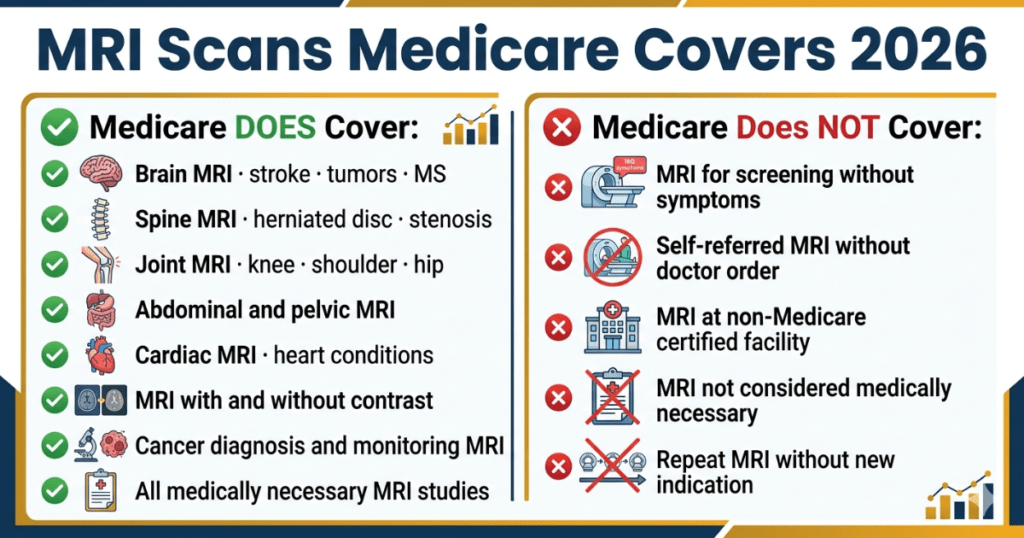
The most important condition is medical necessity. The ordering provider must document that the MRI is needed to diagnose or manage a specific medical condition. Medicare covers MRI scans ordered for clinically appropriate indications including but not limited to:
- Evaluation of neurological symptoms — headaches, dizziness, weakness, numbness
- Diagnosis and staging of cancer
- Evaluation of joint pain and injury
- Diagnosis of spinal conditions — herniated discs, stenosis, cord compression
- Cardiac evaluation — cardiac MRI
- Abdominal and pelvic evaluation
- Vascular evaluation — MRA (magnetic resonance angiography)
- Musculoskeletal injury evaluation
- Follow-up monitoring of known conditions
Ordered by a Qualified Provider
The MRI must be ordered by a physician, nurse practitioner, clinical nurse specialist, or physician assistant who is enrolled in Medicare. Self-referral — ordering your own MRI without a qualified provider’s order — is not covered by Medicare.
Performed at a Medicare-Certified Facility
The MRI must be performed at a facility that is certified by Medicare — a Medicare-enrolled imaging center or hospital. Most major imaging centers and hospital radiology departments are Medicare-certified. Always confirm that your imaging center accepts Medicare before scheduling.
Appropriate Frequency
Medicare covers MRI scans at medically appropriate frequencies for your specific condition. Medicare does not cover repetitive imaging that is not clinically indicated or medically necessary.
Does Medicare Cover Brain MRI Scans?
Does Medicare cover brain MRI scans in 2026? Yes — Medicare Part B covers brain MRI scans when medically necessary. Brain MRI is one of the most commonly ordered and Medicare-covered imaging studies. Medicare covers brain MRI for:
- Evaluation of stroke or TIA symptoms
- Diagnosis and monitoring of brain tumors
- Evaluation of multiple sclerosis
- Assessment of headaches when clinically indicated
- Evaluation of seizures
- Memory loss and cognitive decline evaluation
- Dizziness and balance disorders
- Traumatic brain injury evaluation
- Monitoring of known brain conditions
Brain MRI with and without contrast — using gadolinium contrast agent — is covered by Medicare when medically indicated. The contrast agent itself is also covered as part of the MRI procedure under Part B.
Brain MRI is covered at the standard Part B rate — Medicare pays 80% of the Medicare-approved amount after your $257 annual Part B deductible and you pay the remaining 20% coinsurance.
Does Medicare Cover Spine MRI Scans?
Does Medicare cover spine MRI scans in 2026? Yes — Medicare Part B covers spine MRI scans when medically necessary. Spine MRI is extremely common among Medicare beneficiaries given the prevalence of back pain and spinal conditions in the senior population. Medicare covers spine MRI for:
- Evaluation of low back pain with neurological symptoms
- Diagnosis of herniated discs
- Assessment of spinal stenosis
- Evaluation of spinal cord compression
- Diagnosis and monitoring of spinal tumors
- Evaluation of spinal fractures
- Assessment of degenerative disc disease
- Pre-surgical planning for spine surgery
- Post-surgical monitoring of spine surgery outcomes
Cervical spine MRI, thoracic spine MRI, and lumbar spine MRI are all covered by Medicare when medically necessary. Medicare typically requires documentation of clinical symptoms and often requires that conservative treatment — such as physical therapy and medications — has been tried before approving advanced imaging for uncomplicated back pain.
How Much Does an MRI Cost with Medicare in 2026?
Understanding how much an MRI costs with Medicare in 2026 helps you budget for this diagnostic procedure. Here is the complete cost breakdown:
MRI Cost with Original Medicare (Parts A and B)
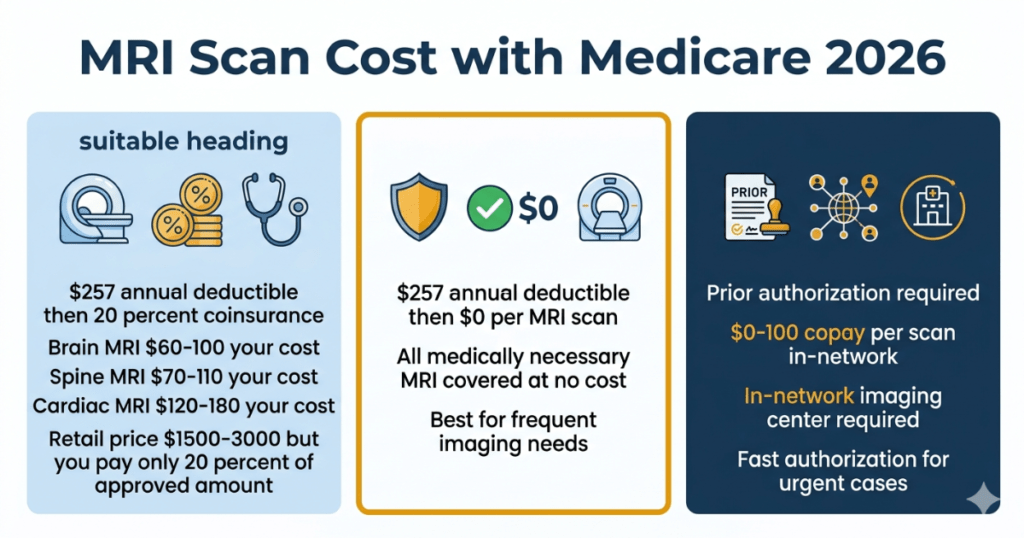
Annual Part B deductible — $257 per year. If you have not yet met your annual Part B deductible you pay the first $257 of Medicare-approved MRI costs.
After deductible — Medicare Part B pays 80% of the Medicare-approved amount for MRI scans. You pay the remaining 20% coinsurance.
Typical Medicare-approved amounts for MRI scans in 2026:
- Brain MRI without contrast — approximately $300 to $500 Medicare-approved
- Brain MRI with and without contrast — approximately $450 to $700 Medicare-approved
- Spine MRI lumbar — approximately $350 to $550 Medicare-approved
- Knee or shoulder MRI — approximately $300 to $500 Medicare-approved
- Abdominal MRI — approximately $400 to $650 Medicare-approved
- Cardiac MRI — approximately $600 to $900 Medicare-approved
Your 20% coinsurance for MRI with Original Medicare:
- Brain MRI — approximately $60 to $100 out of pocket
- Spine MRI — approximately $70 to $110 out of pocket
- Joint MRI — approximately $60 to $100 out of pocket
- Cardiac MRI — approximately $120 to $180 out of pocket
Note — the actual billed amount for an MRI is typically much higher than the Medicare-approved amount. A brain MRI might have a retail price of $1,500 to $3,000 — but if the imaging center accepts Medicare assignment they agree to accept the much lower Medicare-approved amount. Your 20% is calculated on the Medicare-approved amount — not the retail billed amount.
MRI Cost with Medigap Plan G
If you have Medigap Plan G your MRI costs are dramatically reduced. After your $257 annual Part B deductible Plan G covers 100% of the 20% coinsurance for all Medicare-approved MRI services. Your effective cost per MRI with Plan G after meeting the annual deductible is $0.
For patients who need multiple MRI scans in a year — for example cancer monitoring requiring quarterly brain or body MRI — Plan G provides significant savings by eliminating the 20% coinsurance on each scan.
MRI Cost with Medicare Advantage
Medicare Advantage plans cover MRI scans with their own cost-sharing structure. Typical Medicare Advantage MRI costs in 2026:
- MRI at in-network imaging center — $0 to $100 copay per scan on most plans
- Prior authorization is frequently required
- In-network imaging center required for lowest costs
Most Medicare Advantage plans with $0 premium offer MRI coverage at very low copays making MRI scans affordable for Medicare Advantage members.
Does Medicare Cover CT Scans and Other Diagnostic Imaging?
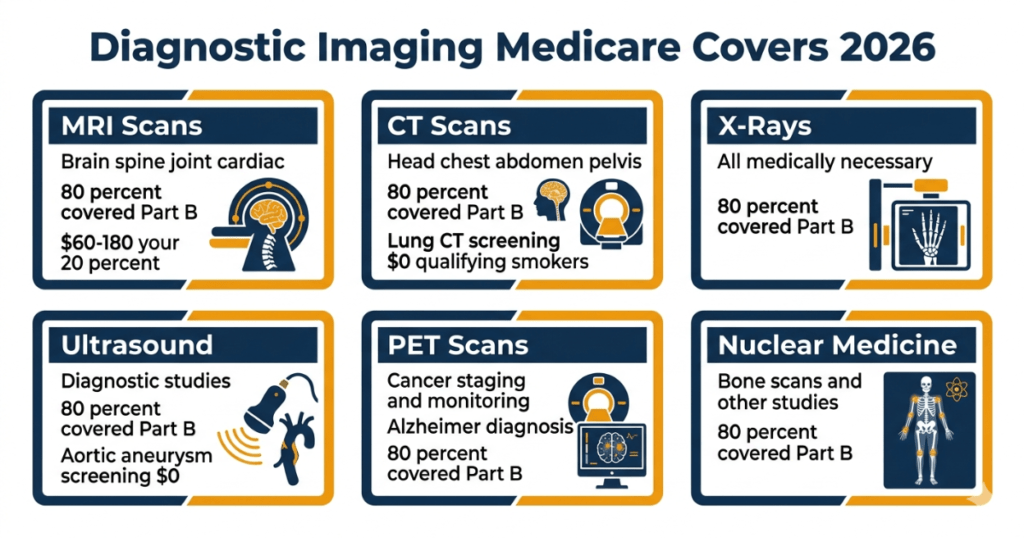
Does Medicare cover CT scans and other diagnostic imaging in 2026? Yes — Medicare Part B covers a comprehensive range of diagnostic imaging studies when medically necessary. Here is the complete list of imaging modalities Medicare covers:
CT Scans (Computed Tomography)
Medicare Part B covers CT scans at 80% after the Part B deductible when medically necessary. CT scans are commonly covered for:
- Head CT for neurological symptoms
- Chest CT for lung nodules and cancer screening
- Abdominal and pelvic CT for abdominal pain or cancer evaluation
- CT colonography — but NOT currently covered as a routine colorectal cancer screening
Annual low-dose CT scan for lung cancer screening is covered at $0 for qualifying high-risk patients aged 50 to 77 with significant smoking history.
X-Rays
Medicare Part B covers diagnostic X-rays when ordered by a physician for a medical condition at 80% after the Part B deductible.
Ultrasound
Medicare Part B covers diagnostic ultrasound when medically necessary at 80% after deductible. Abdominal aortic aneurysm screening ultrasound is covered once at $0 for qualifying beneficiaries who are at risk.
Nuclear Medicine Scans
Medicare Part B covers nuclear medicine scans including PET scans, bone scans, and other nuclear imaging studies when medically necessary at 80% after deductible.
PET Scans
Medicare Part B covers PET scans for specific cancer diagnoses and neurological conditions including Alzheimer’s disease diagnosis at 80% after the Part B deductible.
Echocardiography
Medicare Part B covers echocardiograms including transthoracic and transesophageal echocardiography when medically necessary at 80% after deductible.
Prior Authorization for MRI Under Medicare Advantage
One of the most significant differences between Original Medicare and Medicare Advantage for MRI coverage is prior authorization. Original Medicare does not require prior authorization for MRI scans — medical necessity is determined by the ordering physician’s documentation. Medicare Advantage plans frequently require prior authorization for MRI scans.
Prior authorization requirements for MRI under Medicare Advantage in 2026:
Many Medicare Advantage plans require prior authorization for all MRI scans — including routine diagnostic imaging. This means your ordering physician must submit a request to your Medicare Advantage plan before you can have your MRI performed. The plan’s utilization management team reviews the request to determine whether the scan is medically necessary.
The prior authorization process typically takes 1 to 5 business days for standard requests or 24 to 72 hours for urgent requests. If authorization is denied you have the right to appeal.
The Improving Seniors’ Timely Access to Care Act — enacted in 2022 — requires Medicare Advantage plans to streamline prior authorization processes and implement electronic prior authorization for certain services including diagnostic imaging. This law has begun reducing delays in authorization for MRI and other imaging services.
For urgent clinical situations — such as suspected stroke — Medicare Advantage plans must process prior authorization requests on an expedited basis within 72 hours. For true medical emergencies Medicare Advantage plans cannot require prior authorization for emergency imaging services.
Does Medicare Advantage Cover MRI Scans?
Does Medicare Advantage cover MRI scans in 2026? Yes — all Medicare Advantage plans must cover MRI scans because they are Medicare-covered services. However Medicare Advantage MRI coverage has important differences from Original Medicare.
In-network imaging center requirement — Medicare Advantage plans require you to use in-network imaging centers and radiology facilities for the lowest costs. Using an out-of-network facility can result in significantly higher costs or no coverage on HMO plans.
Prior authorization — most Medicare Advantage plans require prior authorization for MRI scans. Your ordering physician typically handles this process but always confirm authorization is obtained before scheduling your MRI.
Copay vs coinsurance — Medicare Advantage plans typically charge a fixed copay per MRI rather than 20% coinsurance. Copays typically range from $0 to $100 per MRI scan depending on the plan.
Out-of-pocket maximum — all MRI costs under Medicare Advantage count toward your $9,350 annual out-of-pocket maximum.
Frequently Asked Questions — Does Medicare Cover MRI Scans
Does Medicare cover MRI scans in 2026?
Yes — Medicare Part B covers MRI scans in 2026 when medically necessary and ordered by a qualified healthcare provider. Medicare pays 80% of the Medicare-approved amount after your $257 annual Part B deductible. You pay the remaining 20% coinsurance — approximately $60 to $180 depending on the type of MRI. With Medigap Plan G your effective cost after the annual deductible is $0.
Does Medicare cover brain MRI scans?
Yes — Medicare covers brain MRI scans when medically necessary including evaluation of stroke symptoms, brain tumors, multiple sclerosis, headaches, seizures, and cognitive decline. Brain MRI with and without contrast is covered when clinically indicated. Medicare pays 80% after the Part B deductible — your 20% coinsurance is approximately $60 to $100 per scan.
Does Medicare cover spine MRI scans?
Yes — Medicare covers spine MRI scans when medically necessary including evaluation of back pain with neurological symptoms, herniated discs, spinal stenosis, and spinal cord conditions. Medicare typically requires documentation of clinical symptoms and may require evidence of prior conservative treatment for uncomplicated back pain.
How much does an MRI cost with Medicare in 2026?
With Original Medicare your cost for an MRI is 20% of the Medicare-approved amount after your $257 annual Part B deductible — approximately $60 to $180 per scan depending on the type. With Medigap Plan G your effective cost after the annual deductible is $0. Medicare Advantage plans typically charge $0 to $100 per MRI with prior authorization required.
Does Medicare require a referral for MRI?
Medicare requires that an MRI be ordered by a qualified healthcare provider — physician, nurse practitioner, physician assistant, or clinical nurse specialist. This is not technically a referral requirement — it is a medical necessity documentation requirement. Your ordering provider must document the clinical indication for the scan. For Medicare Advantage plans prior authorization from the plan is typically also required before the MRI can be scheduled.
Does Medicare cover MRI with contrast?
Yes — Medicare covers MRI with contrast and MRI without contrast when medically necessary. The gadolinium contrast agent used in MRI with contrast is covered as part of the MRI procedure under Medicare Part B. Medicare pays 80% of the total Medicare-approved amount for the MRI including contrast at the standard Part B cost-sharing.
Does Medicare Advantage cover MRI scans?
Yes — all Medicare Advantage plans must cover MRI scans. Most plans require prior authorization and in-network imaging centers. Copays typically range from $0 to $100 per scan. Prior authorization is the most important consideration for Medicare Advantage MRI coverage — ensure authorization is obtained before scheduling your scan to avoid coverage denial.
Summary — Does Medicare Cover MRI Scans 2026
Does Medicare cover MRI scans in 2026? Yes — Medicare Part B provides comprehensive coverage for medically necessary MRI scans including brain MRI, spine MRI, joint MRI, abdominal MRI, cardiac MRI, and other imaging studies. Medicare pays 80% of the Medicare-approved amount after your $257 annual Part B deductible — your 20% coinsurance is approximately $60 to $180 per scan.
To minimize your MRI costs Medigap Plan G covers your 20% coinsurance after the annual deductible making your effective MRI cost $0 for covered scans. Medicare Advantage plans cover MRI scans with low copays but require prior authorization and in-network imaging centers.
For free help understanding your Medicare imaging coverage contact your State Health Insurance Assistance Program (SHIP) counselor at shiphelp.org or call Medicare free at 1-800-633-4227.
This guide is for informational purposes only and is not medical advice. Always consult your doctor and verify current Medicare imaging coverage at Medicare.gov before scheduling diagnostic imaging.
Sources: Medicare.gov | CMS.gov | SSA.gov | AARP.org
Last updated: April 2026 | Author: James Carter, Independent Medicare Research Analyst