Does Medicare Cover Weight Loss Surgery — Complete Guide 2026
Does Medicare cover weight loss surgery in 2026? If you or a loved one is considering bariatric surgery and wondering whether Medicare will pay for it this complete guide has every answer you need. The good news is that yes — Medicare does cover weight loss surgery in 2026 but only when specific medical criteria are met. Medicare Part B covers bariatric surgery including gastric bypass, gastric sleeve, and other weight loss procedures when they are deemed medically necessary for qualifying patients. In this complete guide we explain exactly what Medicare covers for weight loss surgery in 2026 — who qualifies, what procedures are covered, how much weight loss surgery costs with Medicare, and what steps you need to take to get Medicare to cover your bariatric procedure. All information is sourced from Medicare.gov and CMS.gov.
Also Read —How Much Does Medicare Cost Per Month in 2026 — Complete Breakdown Also Read- Best Medicare Plans in Texas 2026 — Complete Guide
What You Will Learn — Does Medicare Cover Weight Loss Surgery
- Does Medicare cover weight loss surgery in 2026
- Who qualifies for Medicare weight loss surgery coverage
- What weight loss surgery procedures Medicare covers
- Does Medicare cover gastric bypass surgery
- Does Medicare cover gastric sleeve surgery
- Does Medicare cover lap band surgery
- How much does weight loss surgery cost with Medicare
- How to get Medicare to approve weight loss surgery
- Does Medicare Advantage cover weight loss surgery
- Frequently asked questions about Medicare weight loss surgery coverage 2026
Does Medicare Cover Weight Loss Surgery in 2026?
Yes — Medicare does cover weight loss surgery in 2026 when specific medical necessity criteria are met. Medicare covers bariatric surgery — the medical term for surgical procedures that help patients lose weight — as a medically necessary treatment for severe obesity when other methods have failed and when obesity is causing serious health complications.
Medicare coverage for weight loss surgery in 2026 is not automatic. You must meet specific BMI and health condition requirements before Medicare will approve weight loss surgery. Medicare views bariatric surgery as a last resort treatment for severe obesity — not a first-line weight loss option. This means you must demonstrate that less invasive weight loss methods have been tried and have not been successful.
Does Medicare cover weight loss surgery for all Medicare beneficiaries? No — Medicare covers weight loss surgery only for beneficiaries who meet the specific qualifying criteria. Understanding these criteria is the first step in determining whether Medicare will cover your weight loss surgery.
Who Qualifies for Medicare Weight Loss Surgery Coverage?
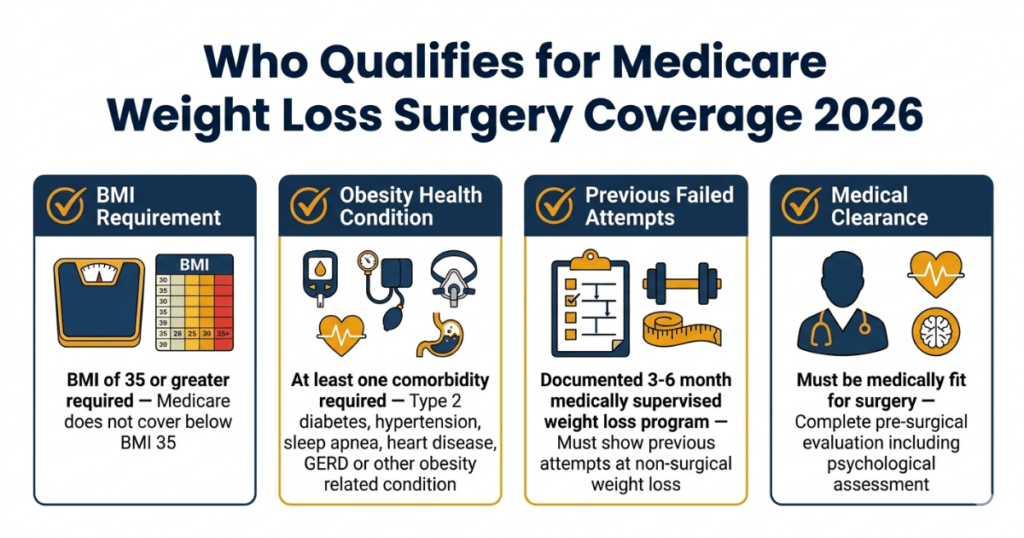
For Medicare to cover weight loss surgery in 2026 you must meet all of the following criteria:
BMI Requirement
You must have a Body Mass Index (BMI) of 35 or greater. Medicare does not cover weight loss surgery for patients with a BMI below 35 regardless of other health conditions. Some Medicare Advantage plans and some specific procedures may have different BMI thresholds but the standard Medicare requirement is BMI 35 or above.
Obesity-Related Health Conditions
You must have at least one serious obesity-related health condition — also called a comorbidity. Medicare recognized obesity-related conditions that support weight loss surgery coverage include:
- Type 2 diabetes
- Hypertension (high blood pressure)
- Hyperlipidemia (high cholesterol)
- Obstructive sleep apnea
- Obesity-related heart disease
- Gastroesophageal reflux disease (GERD)
- Osteoarthritis related to obesity
- Non-alcoholic fatty liver disease
- Urinary stress incontinence related to obesity
Previous Failed Weight Loss Attempts
Medicare requires documentation that you have attempted other methods of weight loss without achieving adequate results. This typically means documented participation in a medically supervised weight loss program for a period of time — usually 3 to 6 months — that did not result in successful long-term weight loss. Your doctor must document these previous weight loss attempts in your medical records.
Surgical Candidacy
You must be medically fit for surgery. Your doctor must determine that you are an appropriate surgical candidate — meaning the risks of surgery are acceptable given your overall health status and the benefits of weight loss surgery outweigh the surgical risks.
Pre-Surgery Requirements
Medicare typically requires completion of a comprehensive pre-surgical evaluation before approving weight loss surgery. This evaluation includes:
- Medical evaluation and clearance from your primary care physician
- Psychological evaluation to assess your readiness for the lifestyle changes required
- Nutritional counseling and dietary evaluation
- Evaluation by the bariatric surgery team
- Documentation of previous weight loss attempts
What Weight Loss Surgery Procedures Does Medicare Cover?
Medicare covers the following weight loss surgery procedures in 2026 when the qualifying criteria are met:
Gastric Bypass Surgery — Roux-en-Y
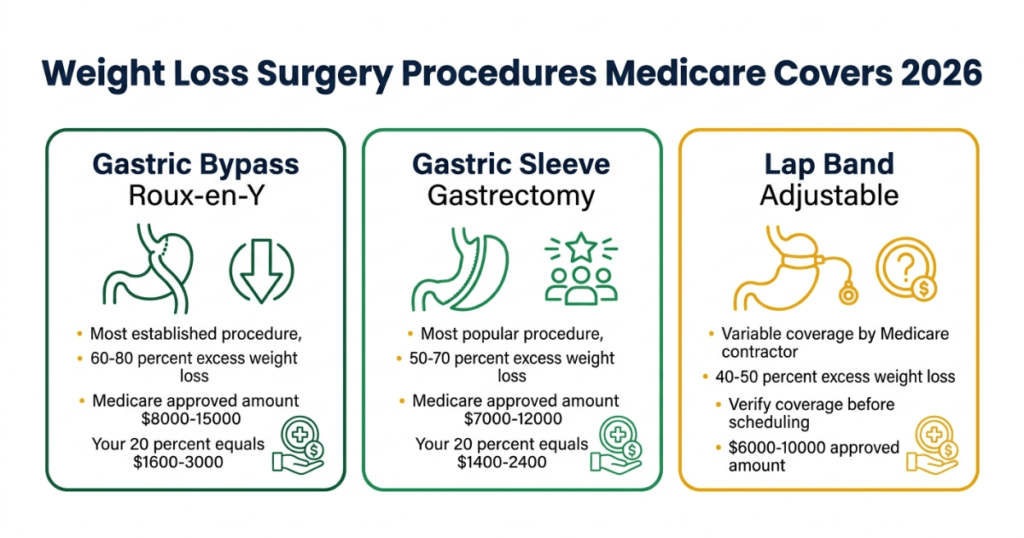
Medicare covers gastric bypass surgery — specifically the Roux-en-Y gastric bypass — as one of the most commonly covered bariatric procedures. Gastric bypass reduces the size of the stomach and reroutes the digestive system. It is one of the most effective weight loss surgeries with patients typically losing 60% to 80% of their excess body weight. Medicare covers gastric bypass as both an open surgery and a laparoscopic procedure.
Gastric Sleeve Surgery — Sleeve Gastrectomy
Medicare covers gastric sleeve surgery — also called sleeve gastrectomy — which removes approximately 75% to 80% of the stomach leaving a banana-shaped sleeve. Gastric sleeve is one of the most commonly performed bariatric surgeries in the United States. Patients typically lose 50% to 70% of their excess body weight. Medicare covers laparoscopic sleeve gastrectomy for qualifying patients.
Adjustable Gastric Band — Lap Band
Medicare covers adjustable gastric band surgery — commonly known as the Lap Band — in some circumstances. The Lap Band places an adjustable band around the upper portion of the stomach to create a smaller pouch. However Lap Band coverage by Medicare varies and some Medicare contractors have more restrictive coverage policies for this procedure. Check with your Medicare plan and surgeon before assuming Lap Band surgery is covered.
Biliopancreatic Diversion with Duodenal Switch (BPD/DS)
Medicare covers biliopancreatic diversion with duodenal switch — a more complex bariatric procedure that combines a sleeve gastrectomy with intestinal bypass. BPD/DS typically results in the most significant weight loss of any bariatric procedure but also has higher nutritional complication risks.
Revision Bariatric Surgery
Medicare may cover revision bariatric surgery — additional surgery to correct complications or inadequate results from a previous weight loss procedure — when medically necessary. Revision surgery coverage requires specific documentation of the medical necessity for the revision.
Does Medicare Cover Gastric Bypass Surgery?
Does Medicare cover gastric bypass surgery in 2026? Yes — Medicare does cover gastric bypass surgery (Roux-en-Y) when you meet the qualifying criteria. Gastric bypass is one of the most well-established and well-covered bariatric procedures under Medicare. Both open and laparoscopic approaches to gastric bypass are covered when medically necessary.
Medicare covers gastric bypass surgery under Medicare Part B as an outpatient procedure in most cases — or under Part A if you require an inpatient hospital admission for the procedure. Most modern gastric bypass surgeries are performed laparoscopically as outpatient procedures covered under Part B.
Does Medicare Cover Gastric Sleeve Surgery?
Does Medicare cover gastric sleeve surgery in 2026? Yes — Medicare covers gastric sleeve surgery (sleeve gastrectomy) for qualifying patients. Gastric sleeve has become one of the most commonly covered bariatric procedures under Medicare in recent years due to its effectiveness and lower complication rate compared to gastric bypass.
Medicare covers laparoscopic sleeve gastrectomy as an outpatient procedure under Part B when all qualifying criteria are met. The pre-surgical evaluation requirements are the same as for other bariatric procedures.
Does Medicare Cover Lap Band Surgery?
Does Medicare cover Lap Band surgery in 2026? Medicare coverage for Lap Band (adjustable gastric band) surgery is more variable than for gastric bypass or gastric sleeve. While Medicare does cover adjustable gastric band surgery in principle coverage depends on your specific Medicare plan and local Medicare contractor policies.
Some Medicare contractors cover Lap Band surgery while others have restricted or eliminated coverage for this procedure due to higher complication rates and lower long-term effectiveness compared to gastric bypass and sleeve gastrectomy. Always verify with your specific Medicare plan and your bariatric surgeon whether Lap Band surgery will be covered before proceeding.
How Much Does Weight Loss Surgery Cost with Medicare in 2026?
Understanding how much weight loss surgery costs with Medicare in 2026 helps you plan and budget for this procedure.
Weight Loss Surgery Under Medicare Part B (Outpatient)
Most laparoscopic bariatric surgeries are performed as outpatient procedures covered under Medicare Part B.
Annual Part B deductible — $257 if not yet met for the year.
After deductible — Medicare Part B pays 80% of the Medicare-approved amount for the surgery. You pay the remaining 20% coinsurance.
Typical Medicare-approved amounts for bariatric surgery in 2026:
- Laparoscopic gastric bypass — Medicare-approved amount approximately $8,000 to $15,000
- Laparoscopic gastric sleeve — Medicare-approved amount approximately $7,000 to $12,000
- Adjustable gastric band — Medicare-approved amount approximately $6,000 to $10,000
Your 20% coinsurance with Original Medicare:
- Gastric bypass — approximately $1,600 to $3,000 out of pocket
- Gastric sleeve — approximately $1,400 to $2,400 out of pocket
- Adjustable gastric band — approximately $1,200 to $2,000 out of pocket
Weight Loss Surgery Under Medicare Part A (Inpatient)
If your weight loss surgery requires an inpatient hospital stay Medicare Part A covers the hospital costs:
- Part A deductible — $1,676 per benefit period
- Hospital days 1 to 60 — $0 after deductible
With Medigap Plan G
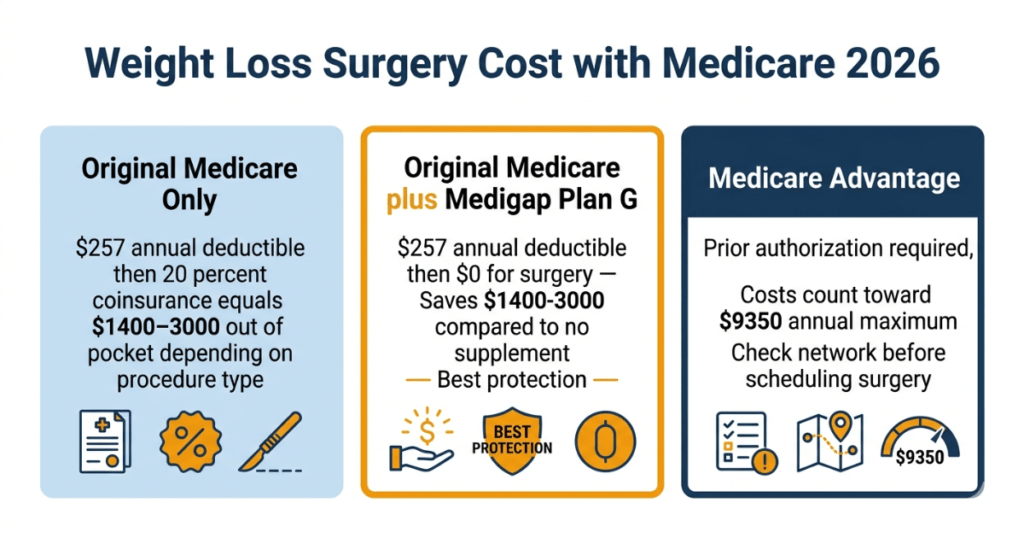
If you have Medigap Plan G your weight loss surgery costs are dramatically reduced. After your $257 annual Part B deductible Plan G covers 100% of the 20% coinsurance. Your effective out-of-pocket cost for weight loss surgery with Plan G is just the $257 annual deductible — then $0 for the surgery costs. This represents savings of $1,400 to $3,000 compared to Original Medicare without a supplement.
With Medicare Advantage
Medicare Advantage plans cover weight loss surgery with their own cost-sharing structure:
- Typically requires prior authorization before surgery
- Your cost depends on your plan’s specific cost-sharing for inpatient or outpatient surgery
- Out-of-pocket costs count toward your annual maximum of $9,350
How to Get Medicare to Approve Weight Loss Surgery in 2026
Getting Medicare to approve weight loss surgery requires careful preparation and documentation. Here are the steps to maximize your chances of Medicare approving your weight loss surgery:
Step 1 — Confirm you meet the BMI and comorbidity criteria
Your BMI must be 35 or greater and you must have at least one serious obesity-related health condition. Have your primary care doctor document both your BMI and all relevant obesity-related conditions in your medical records.
Step 2 — Complete a medically supervised weight loss program
Participate in and complete a medically supervised weight loss program — typically 3 to 6 months — with documentation of your participation and results. Your primary care doctor or an obesity medicine specialist should supervise and document this program.
Step 3 — Choose a Medicare-certified bariatric program
Medicare requires that weight loss surgery be performed at a Medicare-certified bariatric surgery facility. Make sure the hospital and surgeon you choose are enrolled in Medicare and certified for bariatric surgery. The American College of Surgeons Metabolic and Bariatric Surgery Accreditation and Quality Improvement Program (MBSAQIP) certification is widely recognized.
Step 4 — Complete pre-surgical evaluations
Complete all required pre-surgical evaluations including medical clearance, psychological evaluation, nutritional counseling, and bariatric team evaluation. Thorough documentation at each step strengthens your Medicare coverage request.
Step 5 — Obtain prior authorization
Work with your bariatric surgeon’s office to obtain prior authorization from Medicare or your Medicare Advantage plan before scheduling surgery. Submit all required documentation including your BMI documentation, comorbidity documentation, and previous weight loss attempt records.
Step 6 — Appeal a denial if necessary
If Medicare denies coverage for weight loss surgery you have the right to appeal. Work with your doctor to submit a comprehensive appeal with complete medical documentation supporting the medical necessity of the procedure.
Does Medicare Advantage Cover Weight Loss Surgery?
Does Medicare Advantage cover weight loss surgery in 2026? Yes — all Medicare Advantage plans must cover weight loss surgery because it is a Medicare-covered service when the qualifying criteria are met. However Medicare Advantage coverage has important differences from Original Medicare.
Prior authorization — virtually all Medicare Advantage plans require prior authorization for weight loss surgery. Your surgeon’s office typically handles this process but always confirm authorization is obtained before your surgery date.
Network restrictions — Medicare Advantage plans require you to use in-network bariatric surgeons and facilities. Always verify that your bariatric surgeon and the surgery center are in your plan’s network before proceeding.
Additional requirements — some Medicare Advantage plans have more extensive pre-surgery program requirements than Original Medicare. Always check your specific plan’s requirements early in the process.
Cost-sharing — Medicare Advantage plans use their own cost-sharing structure. Your costs depend on your plan’s specific copays or coinsurance for surgical procedures. All costs count toward your annual out-of-pocket maximum of $9,350.
Frequently Asked Questions — Does Medicare Cover Weight Loss Surgery
Does Medicare cover weight loss surgery in 2026?
Yes — Medicare covers weight loss surgery in 2026 for patients who meet the qualifying criteria. You must have a BMI of 35 or greater, at least one serious obesity-related health condition, documented previous failed weight loss attempts, and medical clearance for surgery. Medicare covers gastric bypass, gastric sleeve, and adjustable gastric band procedures when these criteria are met.
What BMI do you need for Medicare to cover weight loss surgery?
Medicare requires a BMI of 35 or greater for weight loss surgery coverage. Medicare does not cover bariatric surgery for patients with a BMI below 35 under standard coverage rules. You must also have at least one serious obesity-related health condition such as type 2 diabetes, hypertension, or sleep apnea.
How much does weight loss surgery cost with Medicare in 2026?
With Original Medicare your out-of-pocket cost for weight loss surgery is 20% of the Medicare-approved amount after your $257 annual deductible — approximately $1,400 to $3,000 depending on the procedure. With Medigap Plan G your effective cost after the annual deductible is $0. Medicare Advantage plans cover weight loss surgery with their own cost-sharing structure counting toward your annual out-of-pocket maximum.
Does Medicare cover gastric sleeve surgery?
Yes — Medicare covers laparoscopic gastric sleeve surgery (sleeve gastrectomy) for patients who meet the qualifying BMI and comorbidity criteria. Gastric sleeve has become one of the most commonly covered bariatric procedures under Medicare in recent years.
How do I get Medicare to approve weight loss surgery?
To get Medicare to approve weight loss surgery document your BMI and obesity-related health conditions, complete a medically supervised weight loss program for 3 to 6 months, choose a Medicare-certified bariatric surgery program, complete all required pre-surgical evaluations, and obtain prior authorization before scheduling surgery. Work closely with your bariatric surgeon’s office throughout this process.
Does Medicare Advantage cover weight loss surgery?
Yes — all Medicare Advantage plans must cover weight loss surgery when the qualifying criteria are met. Medicare Advantage plans require prior authorization and in-network providers. Always confirm your bariatric surgeon and facility are in your plan’s network and obtain prior authorization before scheduling surgery.
Summary — Does Medicare Cover Weight Loss Surgery 2026
Does Medicare cover weight loss surgery in 2026? Yes — Medicare covers bariatric surgery including gastric bypass, gastric sleeve, and adjustable gastric band procedures for patients who meet the specific qualifying criteria — BMI of 35 or greater, at least one obesity-related health condition, and documented previous failed weight loss attempts.
Understanding the qualification requirements and following the proper pre-authorization process is essential for getting Medicare to cover your weight loss surgery. With Medigap Plan G your out-of-pocket cost for Medicare-covered weight loss surgery after the annual deductible is essentially $0 — making it one of the most valuable Medigap benefits for patients undergoing bariatric procedures.
For free help understanding your Medicare coverage for weight loss surgery contact your State Health Insurance Assistance Program (SHIP) counselor at shiphelp.org or call Medicare free at 1-800-633-4227.
This guide is for informational purposes only and is not medical advice. Always consult your doctor and bariatric surgeon and verify current Medicare coverage at Medicare.gov before making surgical decisions.
Sources: Medicare.gov | CMS.gov | SSA.gov | AARP.org
Last updated: April 2026 | Author: James Carter, Independent Medicare Research Analyst