
Does Medicare Cover Podiatry — Complete Guide 2026
Does Medicare cover podiatry in 2026? Foot health is critically important for Medicare beneficiaries — particularly seniors with diabetes, peripheral artery disease, and other conditions that can cause serious foot complications. The answer to whether Medicare covers podiatry is similar to eye care — Medicare covers medically necessary podiatry but generally does not cover routine foot care. In this complete guide we explain exactly what Medicare covers for podiatry in 2026 — what foot care services are covered, what is not covered, when foot care becomes medically necessary, how much podiatry costs with Medicare, and how Medicare Advantage handles foot care coverage. All information is sourced from Medicare.gov and CMS.gov.
Also Read —
- How to Switch Medicare Plans 2026 — Complete Guide
- Does Medicare Cover Physical Therapy 2026
- Medicare Advantage vs Original Medicare 2026
What You Will Learn — Does Medicare Cover Podiatry
- Does Medicare cover podiatry in 2026
- What podiatry services Medicare covers
- Does Medicare cover routine foot care
- When does foot care become medically necessary under Medicare
- Does Medicare cover diabetic foot care
- How much does podiatry cost with Medicare
- Does Medicare cover orthotics and shoe inserts
- Does Medicare cover bunion surgery
- Does Medicare Advantage cover podiatry
- Frequently asked questions about Medicare podiatry coverage 2026
Does Medicare Cover Podiatry in 2026?
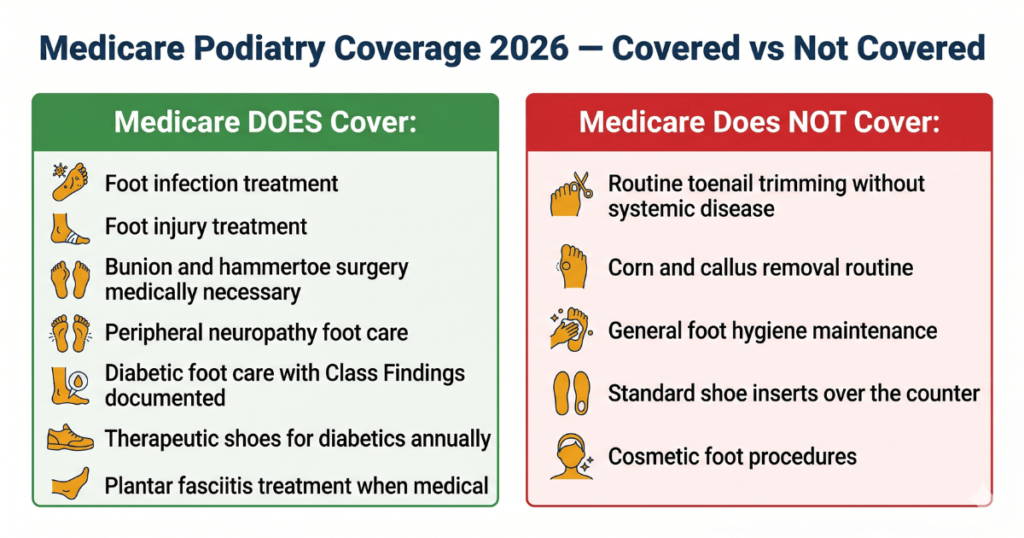
Medicare does cover podiatry in 2026 — but with important limitations that every Medicare beneficiary should understand before scheduling foot care appointments. Original Medicare Part B covers medically necessary podiatry services but generally does not cover routine foot care.
The distinction between medically necessary podiatry and routine foot care is the foundation of Medicare podiatry coverage. Medically necessary podiatry involves treatment of specific foot conditions and diseases — infections, injuries, diabetic foot complications, structural deformities requiring surgery. Routine foot care involves basic maintenance — trimming toenails, treating corns and calluses, general hygiene — which Medicare considers custodial in nature and excludes from coverage.
For the millions of Medicare beneficiaries with diabetes this distinction is particularly important. Diabetic foot care receives significantly more Medicare coverage than routine foot care for non-diabetic patients because diabetes creates serious foot complications that require skilled medical management. Understanding the diabetic foot care exception can mean the difference between covered and uncovered services for diabetic Medicare beneficiaries.
What Podiatry Services Does Medicare Cover?
Treatment of Foot Infections — Covered
Medicare Part B covers treatment of bacterial and fungal infections of the foot when performed by a qualified podiatrist or physician. This includes:
- Treatment of infected ingrown toenails
- Treatment of foot and toenail fungal infections requiring medical intervention
- Wound care for infected foot wounds
- Antibiotic therapy for foot infections
Treatment of Foot Injuries — Covered
Medicare covers treatment of foot injuries including fractures, sprains, lacerations, and trauma-related conditions. Injury treatment is medically necessary and covered at the standard Part B rate.
Structural Foot Deformities — Covered When Causing Pain or Impairment
Medicare covers treatment of structural foot deformities — bunions, hammertoes, heel spurs, plantar fasciitis — when the condition causes significant pain or functional impairment and conservative treatment has failed. Coverage includes both conservative treatment and surgical correction when medically indicated.
Neurological Conditions Affecting the Feet — Covered
Medicare covers podiatric care for neurological conditions affecting foot health including peripheral neuropathy evaluation and management. This is particularly relevant for diabetic patients who develop nerve damage in their feet.
Vascular Conditions Affecting the Feet — Covered
Medicare covers evaluation and treatment of vascular conditions affecting the feet including peripheral artery disease — reduced blood flow to the lower extremities that can cause serious foot complications.
Diabetic Foot Care — Covered with Important Exceptions
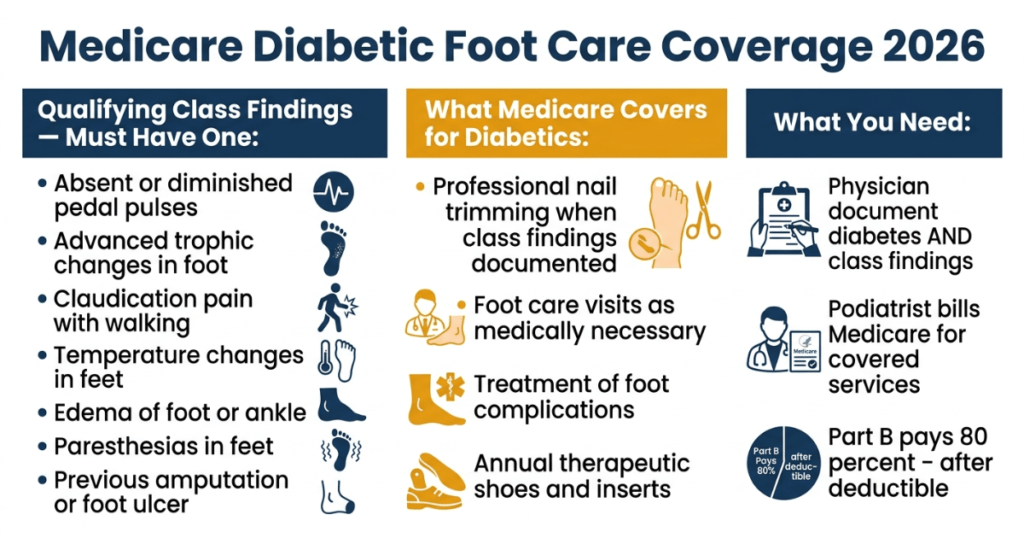
Medicare Part B covers certain foot care services for diabetics that would otherwise be considered routine. Specifically Medicare covers therapeutic foot care for patients with diabetes when there is documentation of systemic conditions — particularly diabetes — that create Class Findings showing the patient needs professional foot care to avoid serious complications.
Class Findings that qualify diabetic patients for covered foot care include:
- Non-traumatic amputation of the foot or an integral part of the foot
- Absent or diminished pedal pulses
- Advanced trophic changes — hair growth, nail changes, skin texture changes
- Claudication — pain in the legs or feet with walking due to poor circulation
- Temperature changes in the feet
- Edema of the foot or ankle
- Paresthesias — abnormal sensations in the feet
When a diabetic patient has qualifying Class Findings their podiatrist can bill Medicare for routine foot care services that would otherwise be excluded. This is one of the most important diabetic Medicare benefits — and many diabetic patients are unaware they qualify for covered foot care.
Does Medicare Cover Routine Foot Care?
Does Medicare cover routine foot care in 2026? Generally no — routine foot care is one of the clearest exclusions in Original Medicare. Medicare does not cover:
- Trimming, cutting, or clipping of toenails when done as a routine maintenance service
- Removal of corns and calluses without a documented medical condition
- Routine foot hygiene maintenance
- Preventive foot care without documented medical necessity
This exclusion surprises many Medicare beneficiaries who see a podiatrist regularly for nail trimming and corn removal. Unless you have a qualifying systemic condition like diabetes, peripheral artery disease, or peripheral neuropathy these services are not covered by Original Medicare.
However there is an important exception for systemic conditions. When a patient has a systemic condition that creates hazardous conditions in the lower limbs Medicare can cover routine foot care services that would otherwise be excluded. The key is documentation — your doctor must document your systemic condition and its impact on your foot health to establish medical necessity.
When Does Foot Care Become Medically Necessary?
Understanding when foot care crosses from routine to medically necessary is essential for Medicare coverage. Foot care becomes medically necessary under Medicare when:
Systemic Disease Creates Hazardous Conditions
When a patient has a systemic disease that affects the lower limbs — particularly diabetes, peripheral artery disease, or peripheral neuropathy — basic foot care that would otherwise be routine becomes medically necessary. The treating physician must document the systemic condition and certify that the patient’s foot care requires professional management to prevent serious complications.
Infection or Injury Present
Any foot care provided in the context of treating an infection, injury, or wound is medically necessary regardless of whether the patient has a systemic condition.
Surgical Treatment Required
When foot conditions require surgical correction — bunionectomy, hammertoe correction, plantar fascia release — the surgery and associated care are medically necessary and covered by Medicare.
Class Findings Documented
When a diabetic or other qualifying patient has Class Findings documented by a physician Medicare covers foot care services that would otherwise be routine.
How Much Does Podiatry Cost with Medicare in 2026?
Medically Necessary Podiatry with Original Medicare
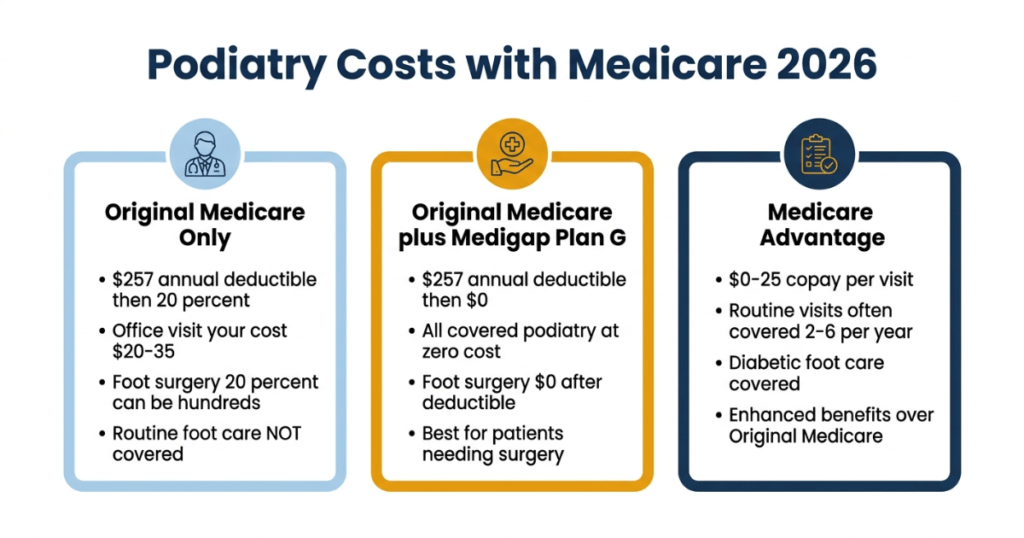
For covered medically necessary podiatry services your costs with Original Medicare are:
- Annual Part B deductible — $257 per year
- After deductible — Medicare pays 80% of Medicare-approved amount
- Your cost — 20% coinsurance
Typical Medicare-approved amounts for podiatry services in 2026:
- Routine office visit with a podiatrist — approximately $100 to $175 Medicare-approved — your 20% is $20 to $35
- Treatment of nail conditions — approximately $75 to $150 approved — your 20% is $15 to $30
- Bunion surgery outpatient — approximately $2,000 to $5,000 approved — your 20% is $400 to $1,000
- Hammertoe correction — approximately $1,500 to $3,500 approved — your 20% is $300 to $700
With Medigap Plan G
Medigap Plan G covers your 20% coinsurance for all covered medically necessary podiatry services after your $257 annual Part B deductible. Your effective cost for covered podiatry with Plan G after the annual deductible is $0. This is particularly valuable for patients needing foot surgery where 20% coinsurance without a supplement could amount to hundreds or thousands of dollars.
With Medicare Advantage
Medicare Advantage plans cover medically necessary podiatry services with their own cost-sharing. Typical Medicare Advantage podiatry costs:
- Office visit copay — $0 to $25 per visit
- Foot surgery — copay or coinsurance counting toward annual out-of-pocket maximum
Many Medicare Advantage plans also cover routine podiatry visits — including nail trimming and corn removal — as part of their enhanced benefits package. This is one area where Medicare Advantage often provides more comprehensive coverage than Original Medicare.
Does Medicare Cover Orthotics and Shoe Inserts?
Does Medicare cover orthotics and shoe inserts in 2026? The answer depends on the type of orthotic and the medical condition being treated.
Therapeutic Shoes and Inserts for Diabetics — Covered
Medicare Part B covers one pair of therapeutic shoes plus inserts per calendar year for Medicare beneficiaries with diabetes who have severe diabetic foot disease. The Therapeutic Shoe Program requires:
- A physician treating your diabetes certifies the need for therapeutic shoes
- You have severe diabetic foot disease including one or more of these conditions: previous foot amputation, previous foot ulceration, history of pre-ulcerative calluses, peripheral neuropathy with evidence of callus formation, foot deformity, or poor circulation
Medicare covers therapeutic diabetic shoes at 80% after the Part B deductible. This is a valuable benefit for diabetic patients who qualify — therapeutic shoes can help prevent serious foot complications.
Custom Orthotics — Sometimes Covered
Custom orthotic devices — rigid inserts prescribed by a physician to treat a specific diagnosed condition — may be covered by Medicare as durable medical equipment under Part B when medically necessary. Off-the-shelf inserts purchased for general comfort are not covered.
Standard Shoe Inserts — Not Covered
Standard over-the-counter shoe inserts, arch supports, or comfort insoles are not covered by Medicare as they are considered personal items rather than medical equipment.
Does Medicare Cover Bunion Surgery?
Does Medicare cover bunion surgery in 2026? Yes — Medicare covers bunion surgery when it is medically necessary. Bunion surgery — called a bunionectomy — is covered by Medicare Part A if performed as an inpatient procedure or Part B if performed outpatient when:
- The bunion causes significant pain that interferes with daily activities
- Conservative treatment — proper footwear, orthotics, physical therapy, pain management — has been tried and failed to provide adequate relief
- A physician documents the medical necessity of surgical correction
Medicare covers bunion surgery at the standard cost-sharing rates — Part A hospital deductible for inpatient or Part B 20% coinsurance for outpatient. With Medigap Plan G your effective cost after the annual deductible is $0 for all Medicare-approved costs.
Medicare does not cover bunion surgery performed purely for cosmetic reasons — the procedure must be medically indicated with documented pain and functional impairment.
Does Medicare Advantage Cover Podiatry?
Does Medicare Advantage cover podiatry in 2026? All Medicare Advantage plans must cover medically necessary podiatry services because podiatry is a Medicare-covered service. However Medicare Advantage plans often offer enhanced podiatry benefits beyond Original Medicare including:
Routine foot care visits — many Medicare Advantage plans cover a set number of routine podiatry visits per year including nail trimming, corn and callus removal, and general foot health maintenance. This coverage for routine foot care is not available under Original Medicare and is one of the reasons diabetic and elderly patients often prefer Medicare Advantage.
Number of covered visits typically ranges from 2 to 6 routine podiatry visits per year depending on the plan.
Prior authorization — some Medicare Advantage plans require prior authorization for podiatric surgery. Your podiatrist’s office typically handles this process but always confirm authorization is obtained before scheduling surgery.
Network podiatrists — Medicare Advantage plans require you to use in-network podiatrists for covered benefits at the lowest cost. Always verify your podiatrist accepts your specific Medicare Advantage plan before scheduling appointments.
Frequently Asked Questions — Does Medicare Cover Podiatry
Does Medicare cover podiatry in 2026?
Medicare Part B covers medically necessary podiatry services in 2026 including treatment of foot infections, injuries, structural deformities requiring surgery, and diabetic foot care when Class Findings are documented. Medicare does not cover routine foot care — nail trimming, corn removal, and general hygiene — unless the patient has a qualifying systemic condition like diabetes or peripheral artery disease.
Does Medicare cover diabetic foot care?
Yes — Medicare covers certain foot care services for diabetic patients that would otherwise be considered routine. When a diabetic patient has documented Class Findings — absent pulses, neuropathy, trophic changes, or other qualifying conditions — Medicare covers professional foot care including nail trimming as a medically necessary service. Your treating physician must document your diabetes and qualifying foot conditions for this coverage to apply.
Does Medicare cover toenail trimming?
Medicare does not cover routine toenail trimming as a standalone service. However if you have diabetes with qualifying Class Findings or another systemic condition that creates hazardous foot conditions toenail trimming by a podiatrist may be covered as medically necessary. Your physician must document your qualifying condition.
How much does a podiatry visit cost with Medicare?
For covered medically necessary podiatry visits Medicare pays 80% of the approved amount after your $257 annual Part B deductible. Your 20% coinsurance is approximately $20 to $35 per office visit. With Medigap Plan G your effective cost after the annual deductible is $0. Medicare Advantage typically charges $0 to $25 copay per podiatry visit.
Does Medicare cover therapeutic shoes for diabetics?
Yes — Medicare covers one pair of therapeutic shoes plus inserts per year for diabetic patients with severe diabetic foot disease. A physician treating your diabetes must certify the need and document qualifying foot conditions. Medicare covers therapeutic diabetic shoes at 80% after the Part B deductible.
Does Medicare Advantage cover routine podiatry visits?
Many Medicare Advantage plans cover routine podiatry visits — including nail trimming and corn removal — as part of their enhanced benefits beyond Original Medicare. Coverage typically includes 2 to 6 routine visits per year. This enhanced podiatry coverage is one of the reasons many diabetic and elderly seniors prefer Medicare Advantage over Original Medicare.
Summary — Does Medicare Cover Podiatry 2026
Does Medicare cover podiatry in 2026? Medicare covers medically necessary podiatry including foot infection treatment, injury care, structural deformity surgery, and diabetic foot care with qualifying Class Findings. Medicare does not cover routine foot care — nail trimming, corn and callus removal — unless you have a qualifying systemic condition that makes professional foot care medically necessary.
For diabetic Medicare beneficiaries the diabetic foot care exception and therapeutic shoe benefit are critically important covered services that many patients are unaware of. Work with your treating physician to ensure your diabetic foot conditions are properly documented so Medicare can cover your necessary foot care.
For the most comprehensive podiatry coverage — including routine foot care visits — Medicare Advantage plans commonly offer enhanced podiatry benefits beyond Original Medicare.
For free help understanding your Medicare podiatry coverage contact your State Health Insurance Assistance Program (SHIP) at shiphelp.org or call Medicare free at 1-800-633-4227.
This guide is for informational purposes only and is not medical advice. Always verify current Medicare podiatry coverage at Medicare.gov before scheduling foot care appointments.
Sources: Medicare.gov | CMS.gov | SSA.gov | AARP.org
Last updated: April 2026 | Author: James Carter, Independent Medicare Research Analyst