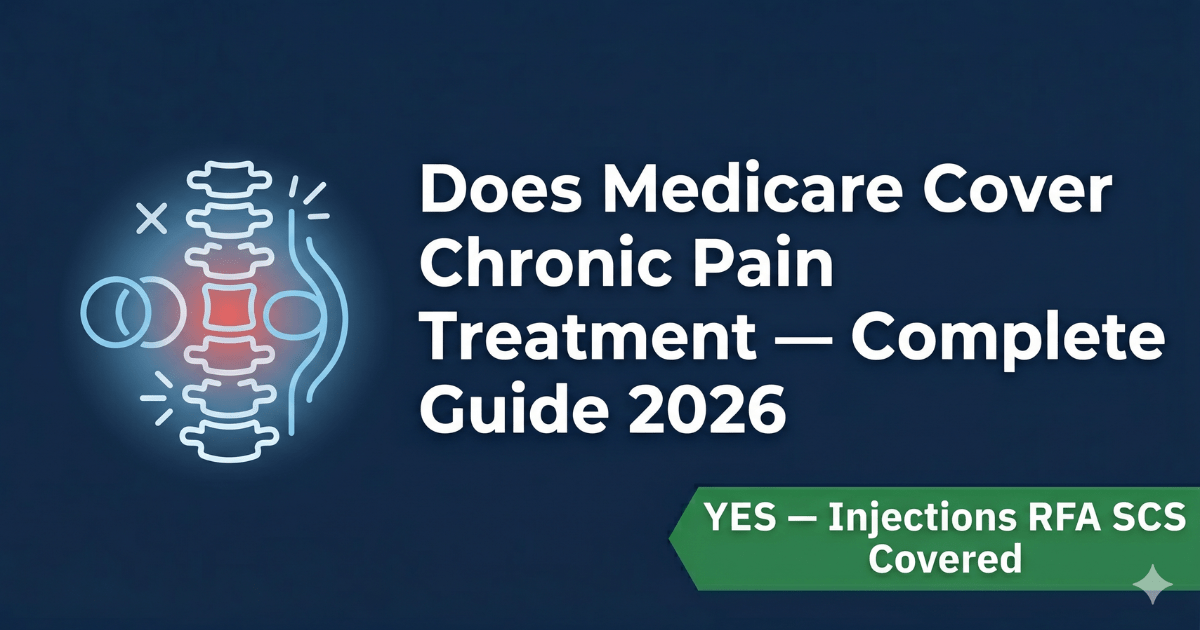
Does Medicare Cover Chronic Pain Treatment — Complete Guide 2026
Does Medicare cover chronic pain treatment in 2026? Chronic pain — defined as pain lasting more than 3 months — affects approximately 50 million Americans and is one of the most common and most disabling conditions among Medicare beneficiaries. Managing chronic pain requires a comprehensive multidisciplinary approach including medications, interventional procedures, physical therapy, and psychological support. The good news is that yes — does Medicare cover chronic pain treatment in 2026 — comprehensively across multiple treatment modalities. In this complete guide we explain exactly what Medicare covers for chronic pain treatment in 2026. All information is sourced from Medicare.gov and CMS.gov.
Also Read —
- Does Medicare Cover Physical Therapy 2026
- Does Medicare Cover Neuropathy Treatment 2026
- Does Medicare Cover Back Surgery 2026
What You Will Learn — Does Medicare Cover Chronic Pain
- Does Medicare cover chronic pain treatment in 2026
- Does Medicare cover pain management medications
- Does Medicare cover epidural steroid injections
- Does Medicare cover nerve blocks for chronic pain
- Does Medicare cover radiofrequency ablation
- Does Medicare cover spinal cord stimulation
- Does Medicare cover physical therapy for chronic pain
- Does Medicare cover psychological treatment for chronic pain
- Does Medicare cover ketamine infusion for pain
- How much does chronic pain treatment cost with Medicare
- Frequently asked questions about Medicare chronic pain coverage 2026
Does Medicare Cover Chronic Pain Treatment in 2026?
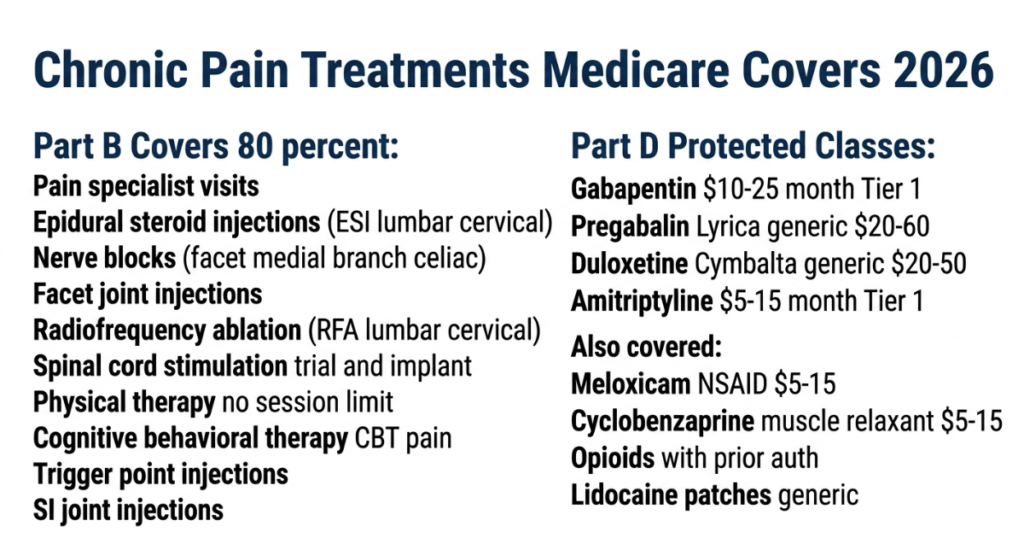
Yes — does Medicare cover chronic pain treatment in 2026 — across multiple treatment categories. Medicare Part B covers physician and pain specialist visits, interventional pain management procedures including epidural steroid injections and nerve blocks, radiofrequency ablation, spinal cord stimulation, physical therapy, and psychological pain management. Medicare Part D covers chronic pain medications including anticonvulsants, antidepressants, and opioid analgesics.
Chronic pain management has evolved significantly — moving from a primarily opioid-centered approach toward multimodal pain management using multiple treatment strategies simultaneously. Medicare’s coverage reflects this multimodal approach — covering a wide range of non-opioid interventions alongside medication management. Understanding does Medicare cover chronic pain across all these treatment options helps Medicare beneficiaries access the most comprehensive and effective pain management available.
Does Medicare Cover Pain Management Medications?
Does Medicare cover chronic pain medications in 2026? Yes — Medicare Part D covers the full range of chronic pain medications.
Anticonvulsants — Protected Drug Class
Anticonvulsants are one of the six Medicare Part D protected drug classes — ensuring comprehensive coverage for the most important non-opioid pain medications:
- Gabapentin — generic — Tier 1 — approximately $10 to $25 per month — most commonly prescribed chronic pain medication
- Pregabalin (Lyrica) — generic available — approximately $20 to $60 per month
- Carbamazepine — generic — very affordable
- Topiramate — generic — affordable
Antidepressants — Protected Drug Class
Antidepressants are also a protected drug class — ensuring coverage for medications with strong evidence for chronic pain:
- Duloxetine (Cymbalta) — generic — FDA-approved for chronic musculoskeletal pain — approximately $20 to $50 per month
- Amitriptyline — generic — Tier 1 — approximately $5 to $15 per month
- Nortriptyline — generic — very affordable
- Venlafaxine — generic — covered Part D
Muscle Relaxants — Covered Part D
- Cyclobenzaprine — generic — very affordable — approximately $5 to $15 per month
- Baclofen — generic — very affordable
- Tizanidine — generic — very affordable
- Methocarbamol — generic — covered Part D
Opioid Analgesics — Covered Part D with Restrictions
Medicare Part D covers opioid pain medications for chronic pain when medically appropriate:
- Oxycodone — generic — covered Part D
- Hydrocodone — generic — covered Part D
- Morphine — generic — very affordable
- Oxymorphone — generic — covered Part D
- Tramadol — generic — covered Part D
- Tapentadol (Nucynta) — covered Part D — $2,000 cap applies brand version
- Buprenorphine — covered Part D — also used for opioid use disorder
Most Medicare Part D plans require prior authorization for opioid medications — particularly for higher doses and longer treatment durations consistent with CDC opioid prescribing guidelines.
Topical Pain Medications — Covered Part D
- Lidocaine patches (Lidoderm) — generic available — covered Part D for postherpetic neuralgia
- Diclofenac gel (Voltaren) — prescription strength — covered Part D
- Capsaicin patch (Qutenza 8%) — physician-applied — covered Part D
NSAIDs — Covered Part D
- Meloxicam — generic — Tier 1 — approximately $5 to $15 per month — very affordable
- Naproxen — generic — very affordable
- Celecoxib (Celebrex) — generic available — covered Part D
- Diclofenac — generic — covered Part D
Does Medicare Cover Epidural Steroid Injections?
Does Medicare cover epidural steroid injections for chronic pain in 2026? Yes — Medicare Part B covers epidural steroid injections (ESI) at 80% after the $257 annual Part B deductible.
Epidural Steroid Injection Coverage
Epidural steroid injections — delivering corticosteroid medication into the epidural space to reduce nerve inflammation and pain — are covered for:
- Lumbar radiculopathy — sciatica from herniated disc or spinal stenosis
- Cervical radiculopathy — arm pain from cervical disc or stenosis
- Thoracic radiculopathy — chest and back pain from thoracic pathology
Medicare typically covers a series of epidural injections — usually up to 3 injections per region per year with documentation of clinical response.
Interlaminar ESI — Covered
Interlaminar epidural steroid injection — standard approach — covered at 80% after deductible.
Transforaminal ESI — Covered
Transforaminal epidural steroid injection — more targeted approach delivering medication closer to the nerve root — covered at 80%.
Caudal ESI — Covered
Caudal epidural steroid injection — covered at 80% after deductible.
ESI Costs with Medicare
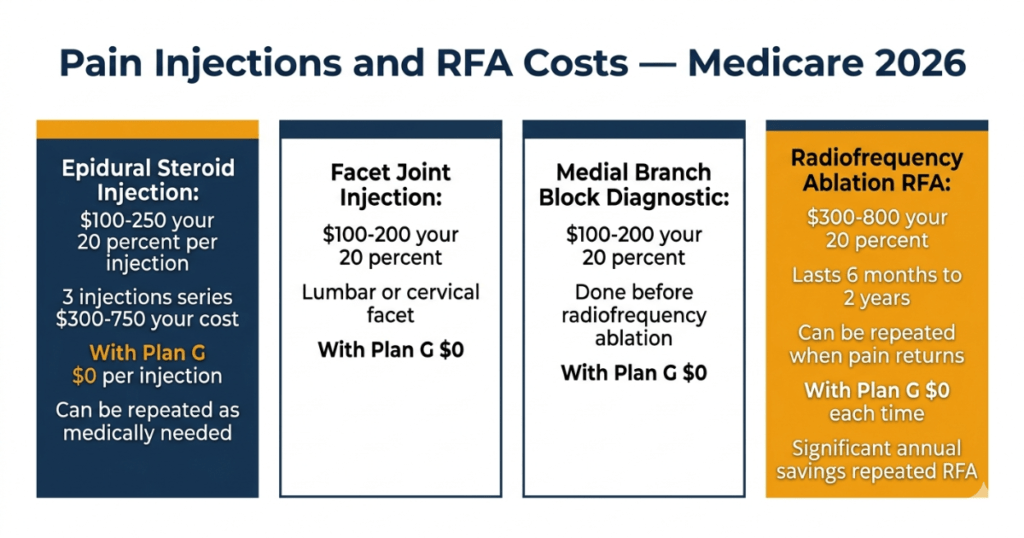
With Original Medicare — approximately $100 to $250 your 20% per injection With Medigap Plan G — $0 per injection after annual deductible
Does Medicare Cover Nerve Blocks for Chronic Pain?
Does Medicare cover nerve blocks for chronic pain in 2026? Yes — Medicare Part B covers a range of nerve block procedures at 80% after the annual deductible.
Peripheral Nerve Blocks — Covered
Nerve block injections blocking specific peripheral nerves for regional pain — covered when medically necessary for specific pain conditions.
Facet Joint Injections — Covered
Facet joint injections — injecting corticosteroid into the small joints of the spine — covered for facet-mediated low back pain and neck pain at 80% after deductible.
Medial Branch Blocks — Covered
Medial branch nerve blocks — blocking the nerves that supply the facet joints — covered. Often performed as a diagnostic procedure before radiofrequency ablation.
Celiac Plexus Block — Covered
Celiac plexus nerve block — for abdominal pain from pancreatic cancer or chronic pancreatitis — covered at 80% after deductible.
Stellate Ganglion Block — Covered
Stellate ganglion block — for complex regional pain syndrome and other conditions — covered when medically indicated.
With Medigap Plan G — all nerve block procedures cost $0 after the annual deductible.
Does Medicare Cover Radiofrequency Ablation?
Does Medicare cover radiofrequency ablation (RFA) for chronic pain in 2026? Yes — Medicare Part B covers radiofrequency ablation at 80% after the $257 annual Part B deductible.
What Is Radiofrequency Ablation?
Radiofrequency ablation uses heat generated by radio waves to destroy the nerve fibers transmitting pain signals — providing long-lasting pain relief typically lasting 6 months to 2 years. RFA is most commonly performed for:
- Facet-mediated low back pain — lumbar RFA
- Facet-mediated neck pain — cervical RFA
- Sacroiliac joint pain — SI joint RFA
- Knee arthritis pain — genicular nerve RFA
Medicare RFA Coverage Requirements
Medicare typically requires documentation of:
- Positive response to diagnostic medial branch block or other diagnostic nerve block before RFA
- Failed conservative treatment
- Appropriate clinical indication
RFA Costs with Medicare
Medicare-approved amounts for RFA — approximately $1,500 to $4,000 per procedure Your 20% coinsurance — approximately $300 to $800 With Medigap Plan G — $0 after annual deductible
RFA can be repeated when pain returns — typically every 6 to 24 months. Does Medicare cover chronic pain through repeated RFA — yes each medically necessary RFA is covered.
Does Medicare Cover Spinal Cord Stimulation for Chronic Pain?
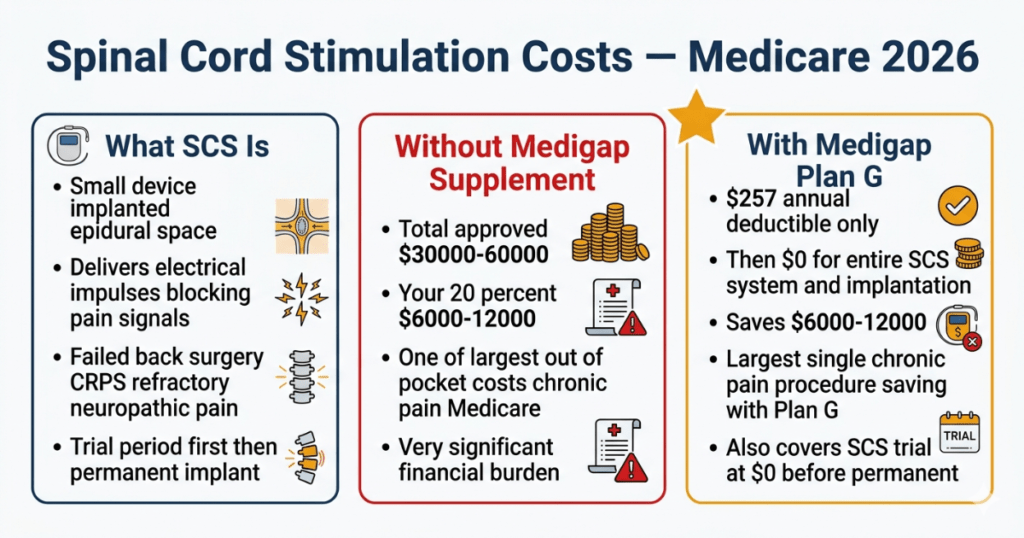
Does Medicare cover spinal cord stimulation for chronic pain in 2026? Yes — Medicare covers spinal cord stimulator (SCS) trial and implantation for qualifying chronic pain patients.
SCS Coverage
Medicare Part B covers spinal cord stimulation for:
- Failed back surgery syndrome with persistent neuropathic leg pain
- Complex regional pain syndrome (CRPS)
- Other chronic neuropathic pain refractory to conservative treatment
SCS Trial — Covered
Before permanent implantation Medicare covers a trial stimulation period — typically 5 to 7 days — to assess response. Coverage at 80% after the deductible.
Permanent SCS Implantation — Covered
After successful trial Medicare covers permanent implantation of the spinal cord stimulator system including:
- The IPG (implantable pulse generator)
- Paddle or percutaneous leads
- The implantation procedure
SCS Costs with Medicare
SCS implantation is a significant investment — Medicare-approved total approximately $30,000 to $60,000. Your 20% coinsurance — approximately $6,000 to $12,000 without supplement.
With Medigap Plan G — SCS implantation costs $0 after the $257 annual deductible — saving $6,000 to $12,000. This is one of the largest possible single-procedure Plan G savings for chronic pain patients.
Does Medicare Cover Physical Therapy for Chronic Pain?
Does Medicare cover physical therapy for chronic pain in 2026? Yes — Medicare Part B covers physical therapy for chronic pain conditions at 80% after the annual deductible with no predetermined session limit.
Physical therapy for chronic pain includes:
- Manual therapy — hands-on treatment
- Therapeutic exercise — strengthening and flexibility
- Modalities — heat cold ultrasound TENS
- Functional restoration — returning to daily activities
- Posture and body mechanics training
Medicare covers PT for chronic pain as long as it is medically necessary. The Jimmo v. Sebelius standard allows ongoing maintenance PT when skilled therapy is needed to maintain function — important for chronic pain patients who need ongoing management.
With Medigap Plan G — all PT sessions cost $0 after the annual deductible.
Does Medicare Cover Psychological Treatment for Chronic Pain?
Does Medicare cover psychological treatment for chronic pain in 2026? Yes — Medicare Part B covers psychological and behavioral health treatment for chronic pain at 80% after the annual deductible.
Cognitive Behavioral Therapy for Chronic Pain — Covered
CBT for chronic pain — one of the most evidence-based psychological treatments for chronic pain — is covered by Medicare as individual psychotherapy at 80% after the deductible. No predetermined session limit.
Biofeedback — Covered in Some Circumstances
Biofeedback — teaching patients to control physiological responses to pain — may be covered when performed by a qualified practitioner in a clinical setting.
Pain Psychology — Covered
Psychological evaluation and treatment for chronic pain-related depression, anxiety, and pain catastrophizing — covered at 80% after deductible.
With Medigap Plan G — all psychological pain treatment sessions cost $0 after the annual deductible.
Does Medicare Cover Ketamine Infusion for Chronic Pain?
Does Medicare cover ketamine infusion therapy for chronic pain in 2026? This is one of the most asked pain management questions and the answer is nuanced.
Ketamine Infusion — Limited Coverage
Medicare does not have a specific coverage policy for ketamine infusions for chronic pain. Coverage for ketamine infusions varies by Medicare Administrative Contractor (MAC) — the regional Medicare administrator — and by clinical indication.
For some specific indications — particularly complex regional pain syndrome and other severe refractory pain conditions — some MACs have covered ketamine infusions when other treatments have failed. However this coverage is not uniform across all Medicare regions.
Medicare Advantage plans may have individual coverage policies for ketamine infusions — some plans cover ketamine for specific indications while others do not.
Patients interested in ketamine infusion should ask their pain physician to submit a prior authorization request documenting the clinical necessity and failed prior treatments — this gives the best chance of obtaining Medicare coverage.
How Much Does Chronic Pain Treatment Cost with Medicare in 2026?
Medications Part D
Gabapentin generic — $10 to $25 per month — very affordable Duloxetine generic — $20 to $50 per month — affordable Meloxicam generic NSAID — $5 to $15 per month — very affordable Opioids generic — varies by drug — most affordable generics
Epidural Steroid Injections
With Original Medicare — approximately $100 to $250 per injection your 20% Series of 3 — approximately $300 to $750 your 20% With Medigap Plan G — $0 per injection series after annual deductible
Radiofrequency Ablation
With Original Medicare — approximately $300 to $800 your 20% With Medigap Plan G — $0 after annual deductible
Spinal Cord Stimulation
With Original Medicare — approximately $6,000 to $12,000 your 20% With Medigap Plan G — $0 after annual deductible — saves $6,000 to $12,000
Physical Therapy
Each session — approximately $16 to $35 your 20% With Medigap Plan G — $0 per session
Psychological Treatment
Each session — approximately $25 to $50 your 20% With Medigap Plan G — $0 per session
Does Medicare Advantage Cover Chronic Pain?
Does Medicare Advantage cover chronic pain treatment in 2026? Yes — all Medicare Advantage plans must cover chronic pain treatment as Medicare-required services.
Prior authorization — required for spinal cord stimulation, radiofrequency ablation, and opioid medications on most plans. In-network pain specialist — verify before scheduling procedures. Annual maximum $9,350 — SCS patients may reach this. Part D $2,000 maximum — same protection for expensive brand-name pain medications.
Frequently Asked Questions — Does Medicare Cover Chronic Pain
Does Medicare cover chronic pain treatment in 2026?
Yes — does Medicare cover chronic pain comprehensively in 2026 including protected-class gabapentin and antidepressants under Part D, epidural steroid injections and nerve blocks at 80%, radiofrequency ablation at 80%, spinal cord stimulation at 80%, physical therapy with no session limit, and psychological CBT for chronic pain. With Medigap Plan G most chronic pain procedures cost $0 after the annual deductible.
Does Medicare cover epidural steroid injections?
Yes — Medicare Part B covers epidural steroid injections for radiculopathy and nerve compression pain at 80% after the $257 annual deductible. Each injection costs approximately $100 to $250 in 20% coinsurance without a supplement. With Medigap Plan G epidural injections cost $0 after the annual deductible.
Does Medicare cover spinal cord stimulation?
Yes — Medicare covers spinal cord stimulator trial and implantation for qualifying chronic pain patients at 80% after the deductible. Without a supplement SCS implantation costs $6,000 to $12,000 in 20% coinsurance. With Medigap Plan G SCS implantation costs $0 after the annual deductible — one of the largest possible single-procedure savings for chronic pain patients.
Does Medicare cover radiofrequency ablation for back pain?
Yes — Medicare Part B covers radiofrequency ablation for facet-mediated low back and neck pain at 80% after the $257 annual deductible. Positive response to prior diagnostic nerve blocks is typically required. With Medigap Plan G RFA costs $0 after the annual deductible.
Does Medicare cover ketamine infusions for chronic pain?
Medicare coverage for ketamine infusions is limited and inconsistent — varying by region and clinical indication. Some Medicare Administrative Contractors cover ketamine for severe refractory conditions like CRPS when other treatments have failed. Submit a prior authorization request with comprehensive documentation for the best coverage outcome.
Summary — Does Medicare Cover Chronic Pain 2026
Does Medicare cover chronic pain treatment in 2026? Yes — Medicare provides comprehensive chronic pain management coverage including protected-class medications, interventional procedures, physical therapy, and psychological treatment. The financial protection is strong — Medigap Plan G eliminates coinsurance on all procedures while Part D’s protected drug classes ensure access to gabapentin and antidepressants without restriction.
For chronic pain patients requiring spinal cord stimulation Medigap Plan G provides the most significant financial protection — eliminating $6,000 to $12,000 in coinsurance on SCS implantation. For patients requiring repeated injections or RFA Plan G eliminates recurring coinsurance costs throughout the year.
For free help understanding your Medicare chronic pain coverage contact your State Health Insurance Assistance Program (SHIP) at shiphelp.org or call Medicare free at 1-800-633-4227.
This guide is for informational purposes only. Always consult your pain specialist and verify current Medicare coverage at Medicare.gov.
Sources: Medicare.gov | CMS.gov | SSA.gov | AARP.org
Last updated: April 2026 | Author: James Carter, Independent Medicare Research Analyst