

Medicare Advantage Hearing Benefits 2026 — Complete Guide
Medicare Advantage hearing benefits in 2026 are one of the most financially significant extra benefits available through Medicare Advantage — providing eligible beneficiaries with annual hearing exams at $0 and meaningful allowances toward hearing aids that can cost $3,000 to $6,000 per pair at retail. Medicare Advantage hearing benefits in 2026 fill a critical coverage gap because Original Medicare does not cover routine hearing exams or conventional hearing aids — leaving millions of seniors with untreated hearing loss due to cost. In this complete guide we explain everything about Medicare Advantage hearing benefits in 2026 — what is covered, how hearing allowances work, the best plans for hearing benefits, and how to get the most value from your Medicare Advantage hearing benefit. All information is sourced from Medicare.gov and CMS.gov.
Also Read —
- Does Medicare Cover Hearing Aids 2026
- Medicare Advantage Dental Benefits 2026
- Medicare for People Under 65 with Disability — Complete Guide 2026
What You Will Learn — Medicare Advantage Hearing Benefits 2026
- Why Medicare Advantage hearing benefits matter so much
- What Original Medicare covers vs does not cover for hearing
- What Medicare Advantage hearing benefits include in 2026
- How hearing aid allowances work
- The best Medicare Advantage plans for hearing benefits 2026
- TruHearing and other hearing networks explained
- Over-the-counter hearing aids and Medicare Advantage
- How to compare Medicare Advantage hearing benefits
- Frequently asked questions about Medicare Advantage hearing benefits 2026
Why Medicare Advantage Hearing Benefits Matter So Much
Medicare Advantage hearing benefits in 2026 are critically important because untreated hearing loss is one of the most significant and most common health challenges facing the Medicare population — and the cost of hearing aids is one of the largest uninsured out-of-pocket expenses for seniors.
Hearing loss affects approximately 48 million Americans — with prevalence increasing dramatically with age. Among adults over 65 approximately two-thirds have some degree of hearing loss. Among adults over 75 the prevalence of significant hearing loss exceeds 75%. Despite this extraordinary prevalence the majority of people with hearing loss who could benefit from hearing aids do not wear them — and cost is consistently cited as the primary barrier.
Hearing aids are expensive — premium hearing aids cost $3,000 to $6,000 per pair and even basic digital hearing aids cost $800 to $1,500 per pair. Without insurance coverage the cost of hearing aids represents a major financial barrier for seniors on fixed incomes.
Original Medicare — Parts A and B — explicitly excludes conventional hearing aids and routine hearing exams for fitting purposes. This exclusion has existed since Medicare’s founding in 1965 and leaves millions of Medicare beneficiaries without hearing aid coverage.
The health consequences of untreated hearing loss extend far beyond communication difficulties. Research consistently shows that untreated hearing loss is associated with:
- Significantly increased risk of cognitive decline and dementia
- Higher rates of depression and social isolation
- Increased fall risk
- Reduced quality of life and independence
- Higher overall healthcare utilization and costs
Medicare Advantage hearing benefits directly address this gap — providing hearing exams and hearing aid allowances that make hearing health care financially accessible for Medicare beneficiaries.
What Original Medicare Covers for Hearing
Before evaluating Medicare Advantage hearing benefits it is important to understand what Original Medicare does and does not cover.
Original Medicare DOES Cover — Medical Hearing Services
- Diagnostic hearing tests — when ordered by a physician to evaluate a medical condition — covered at 80% after the Part B deductible
- Cochlear implant surgery — for qualifying patients with severe to profound hearing loss — covered under Part A and Part B
- Treatment for medical ear conditions — covered
Original Medicare Does NOT Cover — Routine Hearing
- Annual routine hearing examination for hearing aid evaluation — NOT covered
- Hearing aids of any type — NOT covered
- Hearing aid fittings and follow-up — NOT covered
- Hearing aid batteries and supplies — NOT covered
The result — Medicare beneficiaries on Original Medicare pay 100% out of pocket for hearing aids and routine hearing exams.
What Medicare Advantage Hearing Benefits Include in 2026
Most Medicare Advantage plans include hearing benefits as extra benefits beyond standard Medicare coverage. Here is what Medicare Advantage hearing benefits typically include:
Annual Hearing Exam — Covered at $0
The annual routine hearing examination — including audiological evaluation for hearing aid fitting — is covered at $0 on most Medicare Advantage plans. This saves $75 to $250 per year compared to paying out of pocket.
Hearing Aid Allowance — The Most Important Benefit
The annual or biennial hearing aid allowance is the most financially significant component of Medicare Advantage hearing benefits — a dollar amount the plan contributes toward hearing aid purchases.
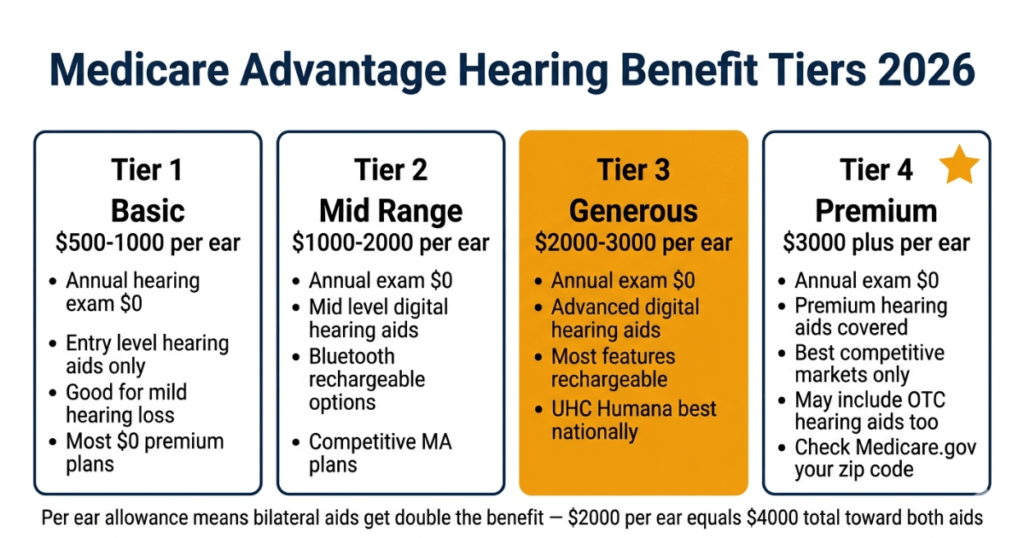
Typical hearing allowance ranges in 2026:
- Basic — $500 to $1,000 per ear per year or per pair every two years
- Mid-range — $1,000 to $2,000 per ear per year
- Generous — $2,000 to $3,000 per ear per year
- Premium — $3,000 or more per ear per year in competitive markets
Hearing Aid Fitting — Covered
Professional hearing aid fitting by an audiologist or hearing instrument specialist — covered on most plans as part of the hearing benefit.
Follow-Up Hearing Care — Covered
Follow-up visits for hearing aid adjustments and programming — covered on many plans.
Hearing Aid Batteries and Supplies — Covered on Some Plans
Some Medicare Advantage plans cover hearing aid batteries and maintenance supplies as part of the hearing benefit.
How Hearing Aid Allowances Work in Medicare Advantage
Understanding exactly how Medicare Advantage hearing benefits allowances work prevents confusion and ensures beneficiaries maximize the value of their benefit.
Allowance Structure
Per ear annually — the allowance applies separately to each ear each year. A $1,500 per ear annual allowance means $3,000 per year toward bilateral hearing aids.
Per pair annually — the allowance applies to a pair of hearing aids each year. A $2,500 per pair annual allowance means $2,500 total toward both hearing aids per year.
Per pair biennially — the allowance applies every two years. A $3,000 per pair biennial allowance means $1,500 per year effective value.
Network Hearing Providers
Medicare Advantage hearing benefits require using the plan’s hearing care network. Plans typically partner with one or more hearing care networks:
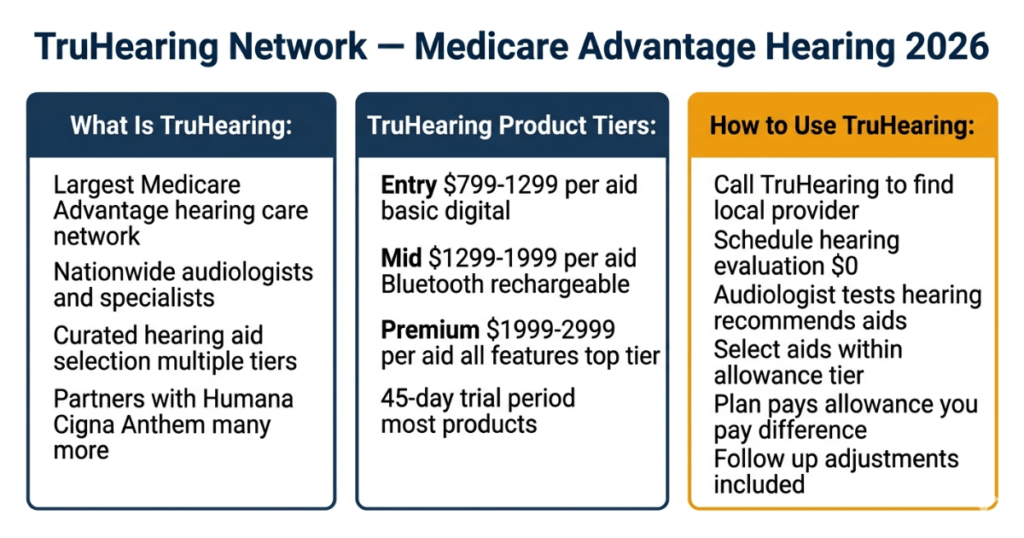
TruHearing — one of the most widely used hearing care networks partnered with Medicare Advantage plans. TruHearing provides access to a nationwide network of audiologists and hearing instrument specialists and a curated selection of hearing aids across multiple price tiers.
Hearing Care Solutions — another major Medicare Advantage hearing care partner.
UnitedHealthcare Hearing — UnitedHealthcare’s proprietary hearing care network for AARP Medicare Advantage members.
Amplifon — a major hearing care network used by some Medicare Advantage plans.
How to Use the Hearing Allowance
- Contact your Medicare Advantage plan to identify network hearing providers in your area
- Schedule a hearing evaluation with a network audiologist
- The audiologist evaluates your hearing loss and recommends appropriate hearing aids
- Select hearing aids within the plan’s approved product lineup
- Plan pays up to the allowance amount — you pay any difference above the allowance
- Professional fitting and programming included
What Is Available Through TruHearing
TruHearing is one of the most important hearing care networks for Medicare Advantage beneficiaries — providing access to hearing aids from major manufacturers at predetermined prices aligned with typical Medicare Advantage allowances.
TruHearing product tiers typically include:
- Entry level — basic digital hearing aids — typically $799 to $1,299 per aid
- Mid-level — advanced digital hearing aids with Bluetooth and rechargeable options — typically $1,299 to $1,999 per aid
- Premium — top-tier hearing aids with full features — typically $1,999 to $2,999 per aid
With a generous Medicare Advantage hearing allowance many beneficiaries can obtain quality hearing aids at minimal or no additional out-of-pocket cost.
Best Medicare Advantage Plans for Hearing Benefits in 2026
The best Medicare Advantage hearing benefits vary significantly by location — but here are the insurers that consistently offer the most competitive hearing benefits nationally:
UnitedHealthcare AARP Medicare Advantage
UnitedHealthcare consistently offers some of the most generous hearing benefits nationally through its AARP Medicare Advantage plans:
- UnitedHealthcare Hearing network — comprehensive product selection
- Annual hearing allowances of $1,500 to $3,000 or more per ear on competitive plans
- $0 annual hearing exam
- Wide audiologist and hearing specialist network
- Bluetooth and rechargeable hearing aid options
- Best-in-class hearing benefits in many markets
Humana Medicare Advantage
Humana offers competitive hearing benefits on most Medicare Advantage plans:
- TruHearing network partnership — broad provider access
- Annual allowances of $1,000 to $2,500 per ear on competitive plans
- $0 annual hearing exam
- Good product selection through TruHearing
Aetna Medicare Advantage
Aetna offers hearing benefits through Hearing Care Solutions and other networks:
- $0 annual hearing exam
- Annual allowances of $1,000 to $2,000 on competitive plans
- Good coverage in competitive markets
Anthem Blue Cross Blue Shield Medicare Advantage
Anthem offers hearing benefits including:
- $0 annual hearing exam
- Annual allowances of $1,500 to $2,500 per ear on competitive plans
- Partnership with major hearing care networks
Cigna Medicare Advantage
Cigna offers hearing benefits including:
- $0 annual hearing exam
- Annual allowances on competitive plans
- TruHearing network partnership in many markets
Important — Benefits Vary Dramatically by Location
Hearing benefit generosity varies as dramatically as dental and vision benefits by market. The same insurer may offer a $3,000 per ear annual allowance in a competitive urban market and $500 per ear in a less competitive market. Always check the specific hearing benefits for plans in your zip code at Medicare.gov Plan Finder — never assume based on national reputation alone.
Over-the-Counter Hearing Aids and Medicare Advantage
The FDA authorized over-the-counter (OTC) hearing aids in 2022 for adults with mild to moderate hearing loss — creating a new category of hearing devices available without a prescription or audiologist fitting.
OTC hearing aids typically cost $200 to $1,500 per pair — significantly less than prescription hearing aids. Popular OTC hearing aid brands include Jabra Enhance, Lexie Lumen, Sony CRE series, and others.
Medicare Advantage and OTC Hearing Aids
Some Medicare Advantage plans extend their hearing allowances to cover OTC hearing aids — allowing beneficiaries with mild to moderate hearing loss to use their hearing allowance toward OTC devices. This can make OTC hearing aids essentially free for Medicare Advantage beneficiaries with applicable plans.
Check your specific plan’s hearing benefit description — look for whether OTC hearing aids are included in the hearing allowance.
The Connection Between Hearing Loss and Dementia
One of the most compelling reasons for Medicare Advantage hearing benefits to be comprehensive is the growing body of evidence linking untreated hearing loss to increased dementia risk.
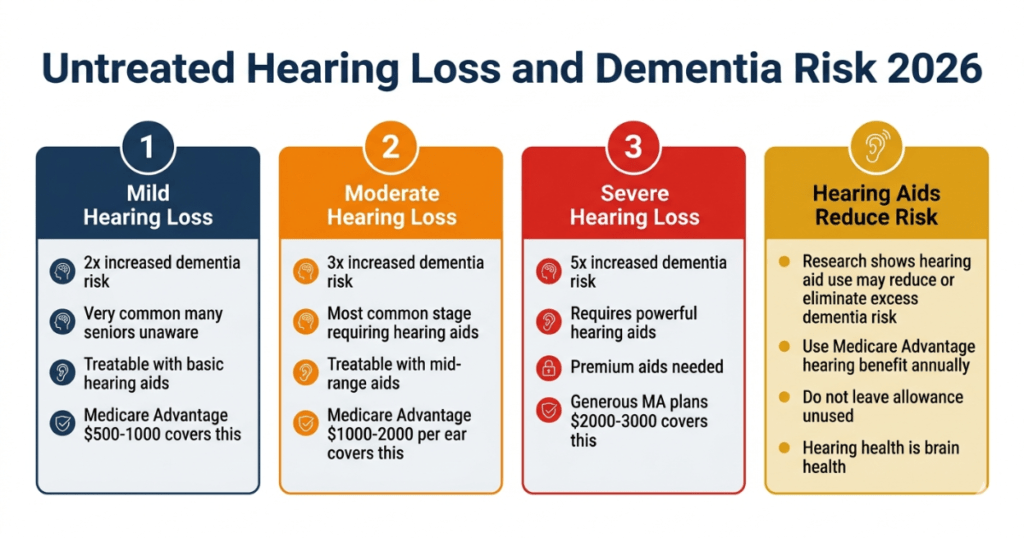
Research from Johns Hopkins and other leading institutions has consistently shown:
- Mild hearing loss doubles the risk of dementia
- Moderate hearing loss triples the risk of dementia
- Severe hearing loss increases dementia risk by five times
- Hearing aid use may reduce or eliminate the excess dementia risk associated with hearing loss
For Medicare Advantage plans — which benefit financially when their members stay healthier — comprehensive hearing benefits represent a meaningful investment in member cognitive health. This is why the most forward-thinking Medicare Advantage plans are offering increasingly generous hearing benefits.
How to Compare Medicare Advantage Hearing Benefits
When comparing Medicare Advantage hearing benefits during Open Enrollment October 15 to December 7 use this systematic approach:
Step 1 — Check the Annual Hearing Allowance Amount
Find the specific hearing allowance — per ear annually or per pair annually or biennially. Higher annual per ear allowance provides the best bilateral hearing aid coverage.
Step 2 — Check Allowance Frequency
Annual vs biennial — annual allowances are significantly more valuable for patients who need hearing aid updates or replacements more frequently.
Step 3 — Check the Hearing Care Network
Identify which hearing care network the plan uses — TruHearing, UHC Hearing, Amplifon. Ensure network providers are available in your area.
Step 4 — Check Product Selection
Review what hearing aids are available within the allowance — entry-level only or higher tiers. If you have severe hearing loss or specific technology needs confirm appropriate products are available.
Step 5 — Check Whether OTC Hearing Aids Are Covered
If you have mild to moderate hearing loss check whether OTC hearing aids are covered under the plan’s hearing allowance — this can provide essentially free OTC hearing aids.
Step 6 — Check Battery and Maintenance Coverage
Some plans cover hearing aid batteries and supplies — useful for patients with non-rechargeable aids.
Step 7 — Consider Total Plan Value
Do not select a Medicare Advantage plan solely for hearing benefits. Evaluate the complete plan including medical coverage, drug coverage, dental, vision, and OTC benefits alongside hearing benefits.
Frequently Asked Questions — Medicare Advantage Hearing Benefits 2026
Do all Medicare Advantage plans cover hearing aids?
Most Medicare Advantage plans include some hearing benefit — at minimum a $0 annual hearing exam. Hearing aid allowances vary significantly from plans with no hardware allowance to plans with $3,000 or more per ear annually. Always check the specific hearing benefits for plans in your zip code.
How much is the hearing aid allowance on Medicare Advantage?
Medicare Advantage hearing aid allowances in 2026 range from $500 to $3,000 or more per ear per year depending on plan and market. UnitedHealthcare and Humana consistently offer competitive allowances nationally. Check specific plans at Medicare.gov Plan Finder for your zip code.
What is TruHearing and how does it work with Medicare Advantage?
TruHearing is one of the largest hearing care networks partnered with Medicare Advantage plans. TruHearing provides access to audiologists and hearing instrument specialists nationwide and a selection of hearing aids at various price tiers. When your Medicare Advantage plan partners with TruHearing you access hearing care and purchase hearing aids through the TruHearing network with your allowance applied.
Does Medicare Advantage cover OTC hearing aids?
Some Medicare Advantage plans extend their hearing allowances to cover OTC hearing aids for mild to moderate hearing loss. Check your specific plan’s hearing benefit details for OTC coverage eligibility.
Why is treating hearing loss important for overall health?
Research consistently shows that untreated hearing loss is associated with significantly increased risk of cognitive decline, dementia, depression, social isolation, and falls. Medicare Advantage hearing benefits that make hearing aids financially accessible help address these serious downstream health consequences of untreated hearing loss.
Summary — Medicare Advantage Hearing Benefits 2026
Medicare Advantage hearing benefits in 2026 represent one of the most important and most financially significant advantages of Medicare Advantage over Original Medicare — particularly given the extraordinary prevalence of hearing loss among seniors and the serious health consequences of untreated hearing loss including dementia risk.
With hearing allowances ranging from $500 to $3,000 or more per ear annually the right Medicare Advantage plan can make hearing aids financially accessible for Medicare beneficiaries who would otherwise pay $3,000 to $6,000 per pair out of pocket. The most generous plans — particularly UnitedHealthcare AARP Medicare Advantage in competitive markets — provide enough hearing allowance to cover quality rechargeable hearing aids at little or no additional out-of-pocket cost.
Use Medicare.gov Plan Finder during Open Enrollment October 15 to December 7 and carefully review the hearing benefits section — comparing the annual per ear allowance, hearing care network, product availability, and OTC coverage for each plan in your zip code.
For free help comparing Medicare Advantage hearing benefits contact your State Health Insurance Assistance Program (SHIP) at shiphelp.org or call Medicare free at 1-800-633-4227.
This guide is for informational purposes only. Always verify current Medicare Advantage hearing benefits at Medicare.gov before making enrollment decisions.
Sources: Medicare.gov | CMS.gov | SSA.gov | AARP.org
Last updated: April 2026 | Author: James Carter, Independent Medicare Research Analyst