
Medicare for People Under 65 with Disability — Complete Guide 2026
Medicare under 65 disability coverage is available to anyone who has received Social Security Disability Insurance (SSDI) benefits for 24 months — with instant eligibility for ALS and ESRD patients.
- Standard waiting period: 24 months of SSDI benefits
- ALS exception: Medicare starts immediately — no waiting period
- ESRD exception: Medicare starts 4th month of dialysis (or 1st if home dialysis)
- Enrollment: Automatic after 24 months of SSDI
- Part B premium 2026: $185/month
- Medigap under 65: Not federally guaranteed — depends on your state
- SSDI income limit 2026: $1,690/month ($2,830 if blind)
- Compassionate Allowances list: 300+ conditions fast-tracked
| Pathway | Waiting Period | How Enrollment Works |
|---|---|---|
| SSDI (standard disability) | 24 months | Automatic at month 25 |
| ALS (Lou Gehrig’s disease) | None — immediate | Automatic when SSDI starts |
| ESRD (kidney failure) | 4th month of dialysis | Must enroll — not automatic |
| Home dialysis training | 1st month | Must enroll — not automatic |
| Compassionate Allowances | Fast-tracked SSDI approval | Automatic after SSDI granted |
| Government employee (no SS) | 24 months after disability | Must apply manually |
Medicare for people under 65 with disability is available to millions of Americans who qualify before the standard age of 65. If you are under 65 and have a disability you may already be eligible for Medicare under 65 right now. Understanding how Medicare works for people under 65 with disability is critical because the rules, enrollment process, and coverage are different from standard age-based Medicare enrollment. In this complete 2026 guide we explain exactly who qualifies for Medicare under 65 with disability, how to enroll, what Medicare covers for disabled people under 65, and what costs you can expect. All information is sourced from Medicare.gov and SSA.gov.
Also Read- How Much Does Medicare Cost Per Month in 2026 — Complete Breakdown
What You Will Learn — Medicare Under 65 Disability
- Who qualifies for Medicare under 65 with disability in 2026
- How Medicare for people under 65 with disability works
- The 24-month waiting period for Medicare under 65 disability
- Medicare under 65 for ESRD and ALS
- How to enroll in Medicare under 65 with disability
- What Medicare covers for disabled people under 65 in 2026
- How much Medicare costs for people under 65 with disability
- Medigap options for people under 65 with disability
- Frequently asked questions about Medicare under 65 disability
Who Qualifies for Medicare Under 65 with Disability?
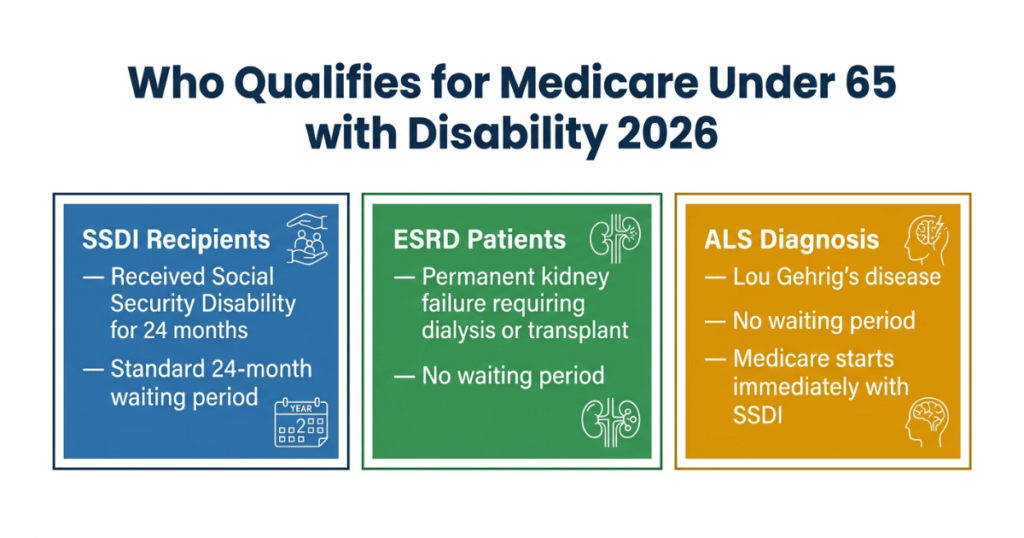
Medicare for people under 65 with disability is available to three specific groups of Americans who qualify before the standard age of 65. Understanding which group applies to your situation determines how you qualify for Medicare under 65 with disability.
Group 1 — Social Security Disability Insurance Recipients
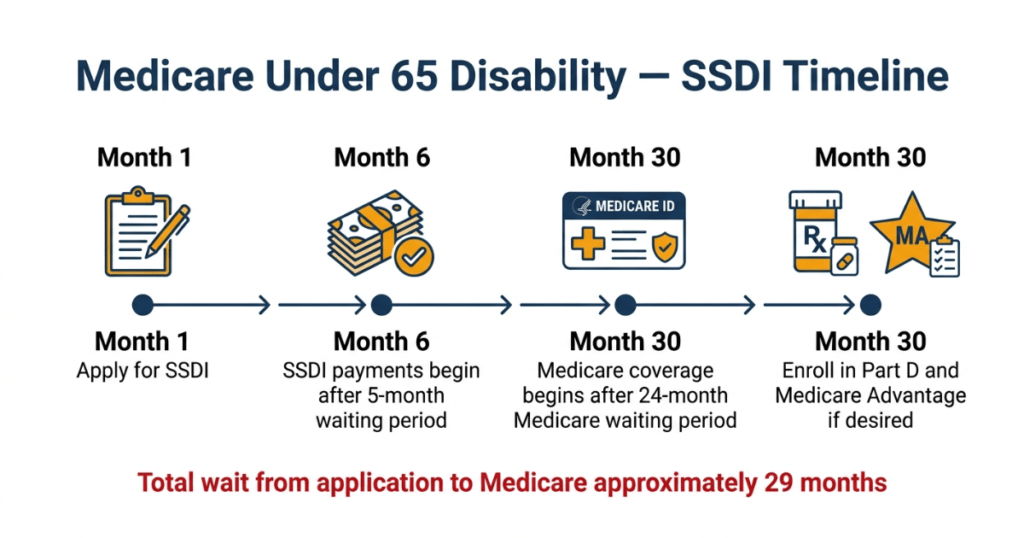
The most common way to qualify for Medicare under 65 with disability is through Social Security Disability Insurance (SSDI). You qualify for Medicare under 65 with disability through SSDI if you have been receiving SSDI benefits for 24 months. The 24-month waiting period for Medicare under 65 disability begins the month you were entitled to receive SSDI benefits — not the month you applied.
This means most people who qualify for Medicare under 65 with disability through SSDI wait approximately 29 months from the time they apply for SSDI before their Medicare coverage begins — 5 months SSDI waiting period plus 24 months Medicare waiting period.
Group 2 — End-Stage Renal Disease
You qualify for Medicare under 65 with disability immediately if you have End-Stage Renal Disease (ESRD) — permanent kidney failure requiring regular dialysis or a kidney transplant. Medicare under 65 for ESRD does not require a 24-month waiting period like SSDI-based Medicare under 65.
Medicare under 65 for ESRD begins on the first day of the fourth month of dialysis treatments. If you are doing home dialysis and you or a family member completes training for home dialysis Medicare under 65 for ESRD can begin as early as the first month of dialysis.
If you receive a kidney transplant Medicare under 65 for ESRD begins the month you are admitted to the hospital for the transplant.
Group 3 — Amyotrophic Lateral Sclerosis (ALS)
You qualify for Medicare under 65 with disability immediately if you have been diagnosed with Amyotrophic Lateral Sclerosis — also known as ALS or Lou Gehrig’s disease. Medicare under 65 for ALS is unique because it begins automatically the same month you become entitled to SSDI — there is no 24-month waiting period for Medicare under 65 with ALS. This is the only exception to the standard 24-month Medicare under 65 disability waiting period.
The 24-Month Waiting Period for Medicare Under 65 Disability
The 24-month waiting period is the most frustrating aspect of Medicare under 65 with disability for SSDI recipients. Understanding exactly how the Medicare under 65 disability waiting period works helps you plan your healthcare coverage during this gap period.
The 24-month Medicare under 65 disability waiting period begins the first month you are entitled to receive SSDI benefits. The waiting period counts consecutive months of SSDI entitlement. During the Medicare under 65 disability waiting period you are not yet eligible for Medicare and must find other health coverage.
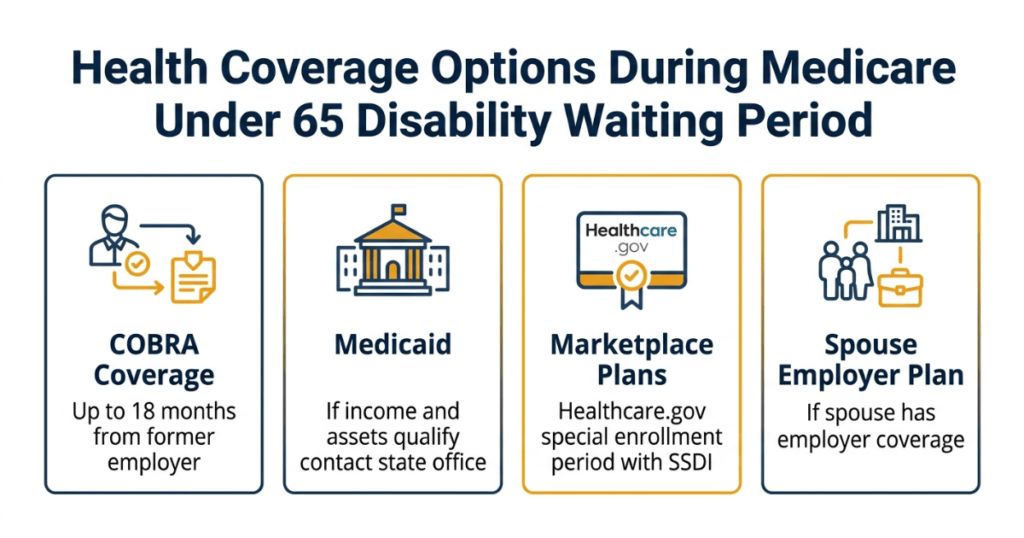
Options for health coverage during the Medicare under 65 disability waiting period include COBRA continuation coverage from a former employer which lasts up to 18 months, Medicaid if your income and assets qualify, marketplace health insurance plans through Healthcare.gov — you qualify for a special enrollment period when you receive SSDI, and coverage through a spouse’s employer health plan if available.
The Medicare under 65 disability waiting period does not apply to ESRD or ALS — only to SSDI-based Medicare under 65 disability enrollment.
After completing the 24-month Medicare under 65 disability waiting period you are automatically enrolled in Medicare Parts A and B. You will receive your red white and blue Medicare card in the mail approximately 3 months before your Medicare under 65 disability coverage begins.
How Does Medicare Under 65 with Disability Work?
Medicare for people under 65 with disability works almost identically to Medicare for seniors aged 65 and older. You receive the same Medicare Parts A and B coverage, the same Medicare Advantage options, the same Part D drug coverage, and the same preventive care benefits. However there are some important differences in how Medicare under 65 with disability works compared to age-based Medicare.
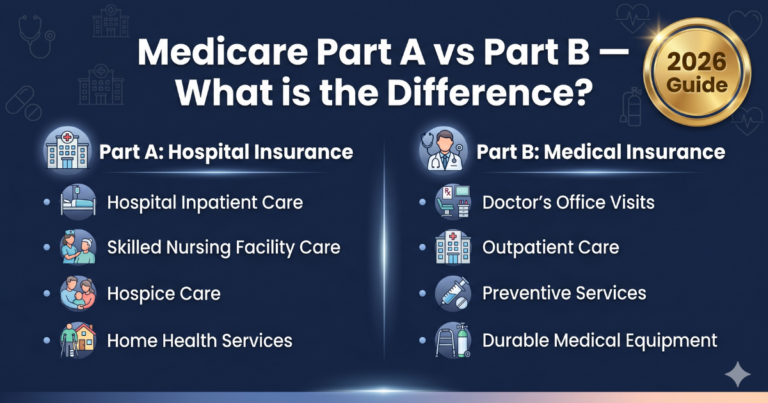
Medicare Part A for people under 65 with disability covers the same services as for seniors — inpatient hospital care, skilled nursing facility care, hospice care, and home health care. The costs are identical to age-based Medicare Part A in 2026 including the $1,676 per benefit period deductible.
Medicare Part B for people under 65 with disability covers the same outpatient services as for seniors — doctor visits, preventive care, mental health services, durable medical equipment, and ambulance services. The standard Part B premium for Medicare under 65 with disability in 2026 is $185.00 per month — the same as for seniors.
Medicare Advantage for people under 65 with disability — if you have Medicare under 65 with disability you can enroll in Medicare Advantage plans that accept disabled members under 65. Not all Medicare Advantage plans accept members under 65 but many do. Check with specific plans in your area.
Medicare Part D for people under 65 with disability works exactly the same as for seniors. You can enroll in a standalone Part D plan to get prescription drug coverage.
Medicare Under 65 Disability — Enrollment Process
How you enroll in Medicare under 65 with disability depends on which qualifying condition you have.
Automatic enrollment for SSDI recipients
If you qualify for Medicare under 65 with disability through SSDI you will be automatically enrolled in Medicare Parts A and B after your 24-month waiting period. You do not need to apply for Medicare — the Social Security Administration automatically enrolls you and mails your Medicare card approximately 3 months before your coverage starts.
You will receive a Medicare Initial Enrollment Period when your Medicare under 65 disability coverage begins. During this period you can enroll in Medicare Advantage or Part D plans.
Enrollment for ESRD patients
If you qualify for Medicare under 65 with disability through ESRD you must actively enroll in Medicare — it is not automatic. Contact the Social Security Administration at 1-800-772-1213 or visit your local Social Security office to apply for Medicare under 65 for ESRD.
Enrollment for ALS patients
If you qualify for Medicare under 65 with disability through ALS you are automatically enrolled in both Medicare Parts A and B the same month your SSDI entitlement begins. No separate application is required.
Medicare Costs for People Under 65 with Disability in 2026
Medicare costs for people under 65 with disability in 2026 are generally the same as for seniors aged 65 and older with one important difference — Medigap supplement options.
Medicare Part A premium under 65 disability 2026
Most people with Medicare under 65 with disability pay $0 for Medicare Part A if they worked and paid Medicare taxes for at least 10 years (40 quarters) before becoming disabled. If you did not work long enough for premium-free Part A you can buy Part A for $285 to $518 per month in 2026.
Medicare Part B premium under 65 disability 2026
The standard Medicare Part B premium for people under 65 with disability in 2026 is $185.00 per month — identical to the premium for seniors aged 65 and older. Higher income individuals pay more through IRMAA surcharges.
Medicare Part A deductible under 65 disability 2026
The Medicare Part A deductible for people under 65 with disability in 2026 is $1,676 per benefit period — identical to the deductible for seniors.
Medicare Part B deductible under 65 disability 2026
The Medicare Part B deductible for people under 65 with disability in 2026 is $257 per year — identical to the deductible for seniors.
Medigap Options for People Under 65 with Disability
One of the most significant challenges facing people with Medicare under 65 with disability is accessing Medigap supplement plans. Federal law does not require insurance companies to sell Medigap plans to people under 65 with Medicare disability coverage. This means Medigap access for Medicare under 65 with disability varies significantly by state.
States that require Medigap sales to people under 65 with Medicare disability include California, Colorado, Connecticut, Florida, Georgia, Illinois, Kansas, Louisiana, Maine, Maryland, Massachusetts, Michigan, Minnesota, Mississippi, Missouri, New Hampshire, New Jersey, New York, North Carolina, Oklahoma, Oregon, Pennsylvania, South Dakota, Tennessee, Texas, Virginia, Washington, and Wisconsin. If you live in one of these states you have the right to purchase a Medigap plan with Medicare under 65 disability coverage.
In states without these protections insurance companies are not required to sell Medigap plans to people under 65 with Medicare disability. Some companies voluntarily offer Medigap to under 65 disabled Medicare beneficiaries but premiums are typically much higher than for seniors aged 65 and older.
When you turn 65 with Medicare under 65 disability coverage you will have a guaranteed Medigap Open Enrollment Period — allowing you to purchase any Medigap plan available in your state at standard rates regardless of your health history. Many disabled Medicare beneficiaries use Medicare Advantage plans instead of Medigap during their under 65 period because of the Medigap access challenges.
Medicare Advantage for People Under 65 with Disability
Medicare Advantage is often the most practical comprehensive coverage option for people with Medicare under 65 with disability in states that do not require Medigap access. Medicare Advantage plans that accept disabled members under 65 typically offer:
- Dental vision and hearing coverage not available through Original Medicare
- Prescription drug coverage included at no additional premium
- Out-of-pocket maximums that limit catastrophic costs
- Care coordination programs that can be particularly valuable for people managing disabilities
- Fitness benefits and chronic condition management programs
Not all Medicare Advantage plans accept disabled members under 65 so you must check with specific plans in your area. Use the Medicare plan finder at Medicare.gov and filter for plans available to disabled beneficiaries under 65.
Extra Help and Medicaid for People Under 65 with Disability
Many people with Medicare under 65 with disability also qualify for Medicaid based on their income. Having both Medicare and Medicaid is called being dual eligible. Dual eligible individuals receive comprehensive coverage from both programs which can dramatically reduce their out-of-pocket healthcare costs.
If you are dual eligible — having both Medicare under 65 disability coverage and Medicaid — Medicaid may pay your Medicare Part B premium of $185.00 per month, your Medicare deductibles and coinsurance, and some services Medicare does not cover.
To determine if you qualify for Medicaid alongside your Medicare under 65 disability coverage contact your State Medicaid office or call the Medicaid helpline in your state.
People with Medicare under 65 disability who have limited income and assets may also qualify for Extra Help — also called the Low Income Subsidy — which helps pay Medicare Part D drug coverage costs. Apply for Extra Help at SSA.gov.
Frequently Asked Questions — Medicare Under 65 Disability
Who qualifies for Medicare under 65 with disability?
You qualify for Medicare under 65 with disability if you have received Social Security Disability Insurance (SSDI) benefits for 24 consecutive months, if you have End-Stage Renal Disease (ESRD) requiring dialysis or kidney transplant, or if you have been diagnosed with ALS (Lou Gehrig’s disease). ESRD and ALS qualify you for Medicare under 65 disability without the 24-month waiting period.
How long is the waiting period for Medicare under 65 disability?
The standard Medicare under 65 disability waiting period is 24 months of SSDI entitlement. This waiting period applies only to SSDI-based Medicare under 65 disability — there is no waiting period for ESRD or ALS. Combined with the 5-month SSDI waiting period most disabled individuals wait approximately 29 months from their SSDI application before Medicare coverage begins.
Is Medicare free for people under 65 with disability?
Medicare is not entirely free for people under 65 with disability. Most people with Medicare under 65 disability pay $0 for Part A if they worked 10 or more years. However Part B costs $185.00 per month in 2026 for most beneficiaries. People with limited income may qualify for Medicare Savings Programs that pay these premiums on their behalf.
Can I get a Medigap plan with Medicare under 65 disability?
Your access to Medigap with Medicare under 65 disability depends on your state. Some states require insurance companies to sell Medigap plans to people under 65 with Medicare disability — including California, Florida, New York, Texas, and others. In states without these protections Medigap access is limited and premiums may be very high. When you turn 65 you will have a guaranteed Medigap Open Enrollment Period regardless of your health history.
What happens to my Medicare under 65 disability when I turn 65?
When you turn 65 with Medicare under 65 disability your coverage continues seamlessly. You do not lose your Medicare coverage — it simply transitions from disability-based Medicare to age-based Medicare. You will have a new Medigap Open Enrollment Period at 65 which gives you guaranteed access to any Medigap plan available in your state at standard rates regardless of your health history. This is an excellent opportunity to secure comprehensive Medigap coverage.
Can I work while receiving Medicare under 65 disability?
You can work and still maintain Medicare under 65 disability coverage during certain trial work and extended periods of Medicare coverage. Social Security has specific rules about how work affects your SSDI and Medicare under 65 disability benefits. Contact the Social Security Administration at 1-800-772-1213 for guidance specific to your situation before returning to work.
Does Medicare under 65 disability cover mental health services?
Yes. Medicare under 65 disability covers mental health services the same as for seniors. Medicare Part B covers outpatient mental health visits to psychiatrists, psychologists, and licensed clinical social workers. Medicare Part A covers inpatient mental health care. After meeting your $257 Part B deductible Medicare covers 80% of approved mental health services.
Q: Can I get Medicare before age 65?
Yes — you can get Medicare under 65 if you have received SSDI benefits for 24 months, have ALS, or have End-Stage Renal Disease (ESRD). ALS patients get Medicare immediately with no waiting period.
Q: How long do I have to wait for Medicare with a disability?
Most people wait 24 months from when their SSDI benefits begin. The waiting period starts the first month you receive an SSDI check — not when you applied or were approved.
Q: Can I get Medigap supplement insurance under 65?
Federal law does not guarantee Medigap access before age 65. However, many states do require insurers to offer Medigap to under-65 disabled beneficiaries. States like New York, Connecticut, and Maine offer full protections. Check your state’s rules before your Medicare start date.
Q: What is the SSA Compassionate Allowances list?
The SSA Compassionate Allowances program fast-tracks SSDI approval for over 300 severe conditions including certain cancers, Down Syndrome, and rare neurological disorders. Faster SSDI approval means earlier Medicare eligibility.
Q: Can I get Medicare Advantage under 65 with a disability?
Yes — disabled Medicare beneficiaries under 65 can enroll in Medicare Advantage plans on the same terms as those who qualify by age, including plans with Part D drug coverage.
Summary — Medicare Under 65 Disability 2026
Medicare for people under 65 with disability provides essential health coverage to millions of Americans who cannot wait until age 65 for Medicare. You qualify for Medicare under 65 with disability through SSDI after a 24-month waiting period, through ESRD with no waiting period, or through ALS with no waiting period.
Medicare under 65 disability provides the same comprehensive coverage as age-based Medicare including Parts A, B, D, and Medicare Advantage options. The main challenge for Medicare under 65 disability beneficiaries is accessing Medigap supplement plans — which varies significantly by state.
If you have Medicare under 65 disability and limited income contact your State Medicaid office to determine if you qualify for dual coverage. Apply for Extra Help at SSA.gov if you need assistance with Part D drug costs.
For free personalized help navigating Medicare under 65 disability contact your State Health Insurance Assistance Program (SHIP) counselor at shiphelp.org or call Medicare free at 1-800-633-4227.
This guide is for informational purposes only and is not medical or legal advice. Always verify current Medicare under 65 disability rules at Medicare.gov and SSA.gov.
Sources: Medicare.gov | SSA.gov | CMS.gov | AARP.org
Last updated: April 2026 | Author: James Carter, Independent Medicare Research Analyst



2 Comments