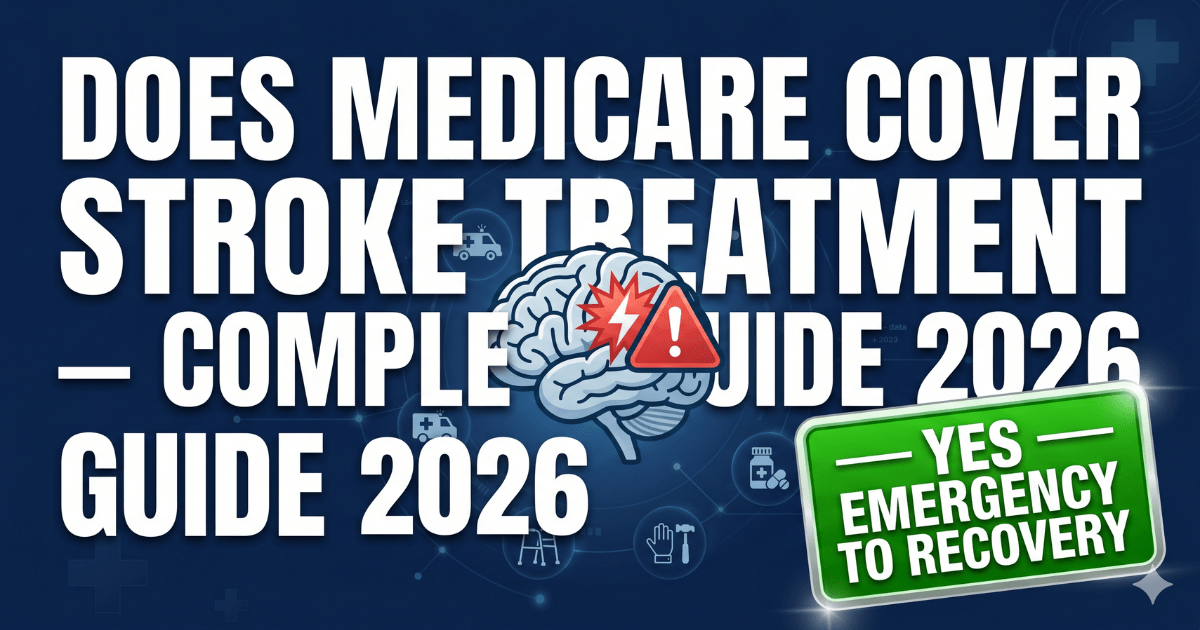
Does Medicare Cover Stroke Treatment — Complete Guide 2026
Does Medicare cover stroke treatment in 2026? Stroke is the fifth leading cause of death and the leading cause of long-term disability in the United States — affecting hundreds of thousands of Medicare beneficiaries every year. When a stroke occurs getting the right treatment immediately is critical — and understanding how Medicare covers stroke treatment helps you and your family navigate this medical emergency with confidence. The good news is that yes — Medicare does cover stroke treatment in 2026 and the coverage is comprehensive — from emergency treatment through acute hospital care, rehabilitation, and ongoing recovery. In this complete guide we explain exactly what Medicare covers for stroke treatment in 2026 — emergency care, acute stroke treatment, hospitalization, rehabilitation, and long-term recovery services. All information is sourced from Medicare.gov and CMS.gov.
Also Read —
- What Does Medicare Cover in 2026 — Complete Coverage Guide
- Does Medicare Cover Occupational Therapy 2026
- Does Medicare Cover Speech Therapy 2026
What You Will Learn — Does Medicare Cover Stroke Treatment
- Does Medicare cover stroke treatment in 2026
- Does Medicare cover emergency stroke treatment including tPA
- What Medicare covers during stroke hospitalization
- Does Medicare cover stroke rehabilitation
- Does Medicare cover speech therapy after stroke
- Does Medicare cover carotid artery surgery
- How much does stroke treatment cost with Medicare
- Does Medicare Advantage cover stroke treatment
- Frequently asked questions about Medicare stroke coverage 2026
Does Medicare Cover Stroke Treatment in 2026?
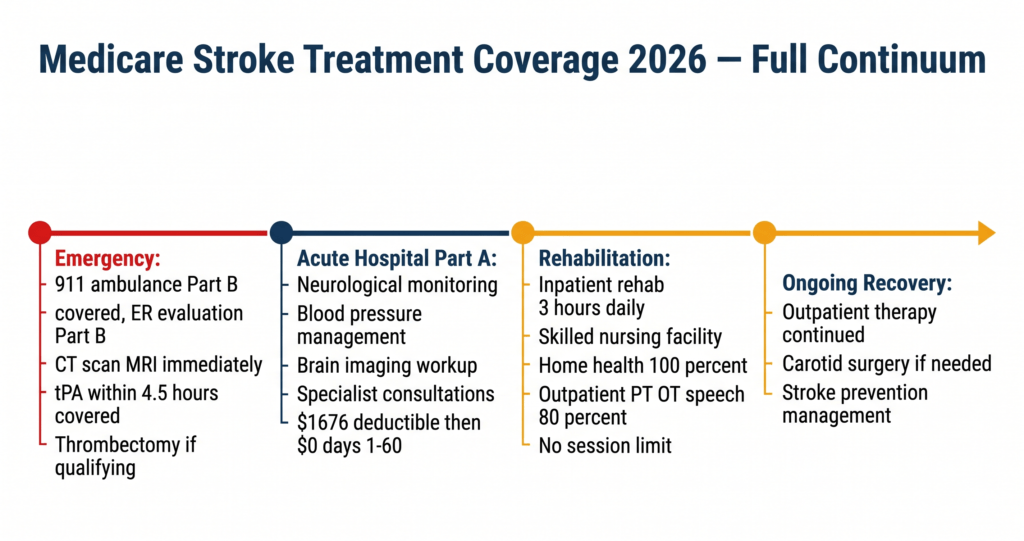
Yes — Medicare covers stroke treatment comprehensively in 2026. Medicare covers the full continuum of stroke care — from the moment of the emergency through acute treatment, hospitalization, and all forms of rehabilitation recovery. Stroke care is one of the most comprehensively covered medical events under Medicare because of the critical time-sensitive nature of stroke treatment and the extensive rehabilitation needs that follow.
Medicare stroke coverage in 2026 applies to both types of stroke — ischemic stroke (caused by a blood clot blocking blood flow to the brain accounting for approximately 87% of all strokes) and hemorrhagic stroke (caused by bleeding in or around the brain accounting for approximately 13% of strokes). Both types of stroke require emergency care and are covered by Medicare.
Medicare also covers treatment for transient ischemic attacks (TIAs) — often called mini-strokes — which are brief episodes of stroke-like symptoms caused by temporary disruption of blood flow to the brain. TIAs are medical emergencies requiring immediate evaluation and treatment to prevent a subsequent major stroke.
Does Medicare Cover Emergency Stroke Treatment?
Does Medicare cover emergency stroke treatment in 2026? Yes — emergency stroke treatment is among the highest priority covered services under Medicare because time is brain — the faster stroke treatment begins the better the outcome.
Emergency Ambulance Transportation
Medicare Part B covers emergency ambulance transportation to the nearest appropriate hospital when medically necessary. For stroke patients time is absolutely critical — calling 911 for ambulance transport is the right action and Medicare covers the cost at 80% after the Part B deductible.
Emergency Room Evaluation and Treatment
Medicare Part B covers emergency department evaluation and treatment for stroke. The emergency department evaluation — including neurological examination, brain imaging (CT scan or MRI), and initial stabilization — is covered at 80% after the deductible.
tPA — Tissue Plasminogen Activator
Does Medicare cover tPA for ischemic stroke in 2026? Yes — Medicare covers tPA (tissue plasminogen activator) — the clot-busting medication that is the primary treatment for acute ischemic stroke when administered within 4.5 hours of symptom onset. tPA is one of the most effective stroke treatments available and Medicare’s coverage ensures that financial concerns never delay this life-saving intervention.
tPA administered in the hospital setting is covered under Medicare Part A as part of the inpatient hospital stay or under Part B if administered in a hospital outpatient emergency setting.
Mechanical Thrombectomy
Medicare covers mechanical thrombectomy — a minimally invasive procedure that uses a catheter to physically remove a blood clot from a brain artery — for qualifying ischemic stroke patients with large vessel occlusions. Thrombectomy can be performed up to 24 hours after stroke onset in carefully selected patients and significantly improves outcomes. This procedure is covered under Medicare Part A as part of the hospitalization.
What Medicare Covers During Stroke Hospitalization
Medicare Part A — Inpatient Stroke Hospital Care
Most stroke patients require inpatient hospital admission following emergency treatment. Medicare Part A covers inpatient hospital care for stroke including:
- The hospital stay for acute stroke management
- Neurological monitoring and assessment
- Blood pressure management and cardiac monitoring
- Medications administered during the hospital stay including tPA anticoagulants and antiplatelets
- Brain imaging — CT scan, MRI, MRA — ordered during hospitalization
- Carotid ultrasound and cardiac echocardiogram for stroke workup
- Neurology and neurosurgery consultations
- Physical occupational and speech therapy initiated during hospitalization
- Swallowing evaluation and dysphagia management
Medicare Part A inpatient stroke hospital costs in 2026:
- Part A deductible — $1,676 per benefit period
- Days 1 to 60 — $0 after deductible
- Days 61 to 90 — $419 per day coinsurance
Medigap Plan G and Stroke Hospitalization
For stroke patients Medigap Plan G provides critical financial protection — covering the $1,676 Part A deductible and all daily coinsurance for extended hospital stays. Given that stroke patients may require extended hospitalization Plan G’s protection can save patients thousands of dollars.
Does Medicare Cover Stroke Rehabilitation?
Does Medicare cover stroke rehabilitation in 2026? Yes — stroke rehabilitation is one of the most important and most comprehensively covered aspects of Medicare stroke treatment. Medicare covers multiple forms of stroke rehabilitation:
Inpatient Rehabilitation Facility (IRF)
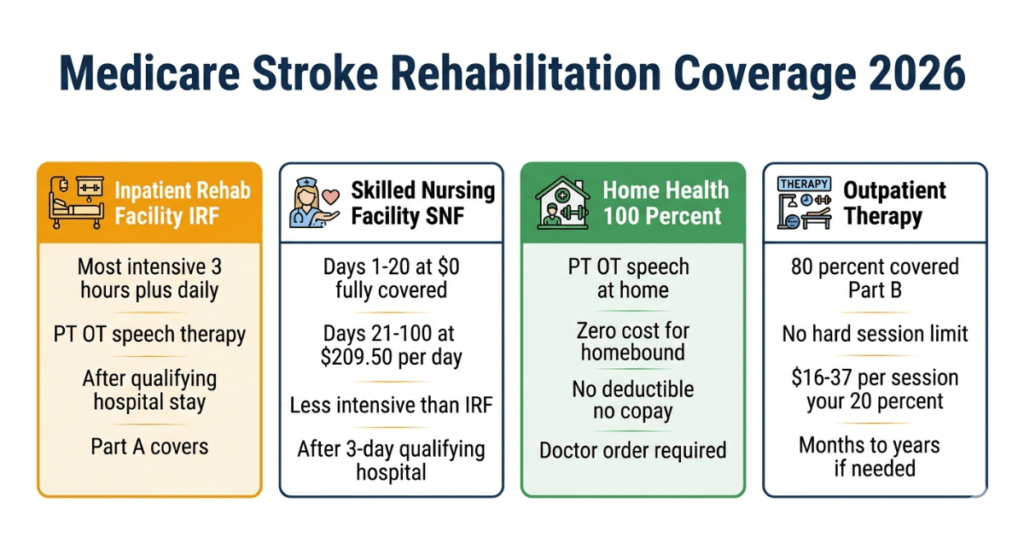
Medicare Part A covers inpatient rehabilitation facility care for stroke patients following a qualifying hospital stay. Inpatient rehabilitation provides the most intensive rehabilitation available — at least 3 hours per day of physical therapy, occupational therapy, and speech therapy combined.
Inpatient stroke rehabilitation is covered for patients who:
- Can tolerate at least 3 hours of intensive therapy per day
- Are expected to achieve functional improvement from intensive rehabilitation
- Have had a qualifying inpatient hospital stay
IRF care is covered under Part A with standard cost-sharing — included in the hospital benefit period.
Skilled Nursing Facility Rehabilitation
Medicare Part A covers skilled nursing facility rehabilitation for stroke patients following a qualifying 3-day inpatient hospital stay. SNF rehabilitation provides:
- Days 1 to 20 — $0 per day
- Days 21 to 100 — $209.50 per day coinsurance
- Maximum 100 days per benefit period
SNF rehabilitation is appropriate for stroke patients who need skilled rehabilitation but cannot tolerate the 3 hours per day of intensive therapy required for inpatient rehabilitation.
Home Health Rehabilitation
Medicare covers home health physical therapy, occupational therapy, and speech therapy for homebound stroke patients at 100% — no deductible or coinsurance. Home health rehabilitation is appropriate for stroke patients who are homebound — leaving home requires considerable effort — and need skilled therapy services.
Home health stroke rehabilitation is one of the most valuable Medicare benefits — covering skilled therapy in the patient’s home at absolutely no cost for qualifying homebound patients.
Outpatient Stroke Rehabilitation
Medicare Part B covers outpatient physical therapy, occupational therapy, and speech therapy for stroke rehabilitation at 80% after the $257 annual deductible. There is no hard session limit — Medicare covers therapy as long as it is medically necessary and showing measurable progress.
Does Medicare Cover Speech Therapy After Stroke?
Does Medicare cover speech therapy after stroke in 2026? Yes — speech therapy is one of the most critical rehabilitation services for stroke survivors and Medicare covers it comprehensively across all care settings.
Post-stroke speech therapy addresses:
- Aphasia — loss of language ability affecting speaking, understanding, reading, and writing
- Dysarthria — slurred or unclear speech from muscle weakness
- Apraxia of speech — difficulty coordinating the movements needed for speech
- Dysphagia — swallowing disorders extremely common after stroke
Medicare covers speech therapy for stroke survivors:
- In inpatient rehabilitation — as part of the intensive therapy program
- In skilled nursing facilities — included in daily SNF care
- At home — under home health benefit at 100% for homebound patients
- In outpatient settings — at 80% after Part B deductible with no session limit
Speech therapy after stroke can continue for months or years — and Medicare’s coverage without a hard session limit ensures stroke survivors can access therapy for as long as it is clinically beneficial.
Does Medicare Cover Carotid Artery Surgery?
Does Medicare cover carotid artery surgery in 2026? Yes — Medicare covers carotid endarterectomy (CEA) and carotid artery stenting when medically necessary for stroke prevention.
Carotid artery stenosis — narrowing of the carotid arteries that supply blood to the brain — is a leading cause of ischemic stroke. Surgery to remove plaque from the carotid artery (endarterectomy) or to open the artery with a stent (carotid stenting) can significantly reduce the risk of future stroke in patients with significant carotid stenosis.
Medicare covers:
- Carotid endarterectomy — surgical removal of carotid plaque — under Part A for inpatient procedures or Part B for outpatient
- Carotid artery stenting — under Medicare for qualifying patients at high surgical risk for endarterectomy
- Pre-operative evaluation and imaging
- Post-operative follow-up care
Stroke Prevention — Medicare Coverage
Does Medicare cover stroke prevention in 2026? Yes — Medicare covers several important stroke prevention services:
Aspirin Discussion
Medicare covers discussion of aspirin use for cardiovascular disease prevention — including stroke prevention — during the Welcome to Medicare visit and Annual Wellness Visit at $0.
Blood Pressure Monitoring
Medicare covers blood pressure monitoring and management — high blood pressure is the leading modifiable risk factor for stroke and Medicare covers evaluation and treatment.
Atrial Fibrillation Management
Medicare covers evaluation and treatment of atrial fibrillation — a heart rhythm disorder that significantly increases stroke risk. Anticoagulation therapy for atrial fibrillation is covered under Part D.
Carotid Ultrasound
Medicare covers carotid ultrasound when ordered to evaluate carotid stenosis in patients with stroke risk factors.
How Much Does Stroke Treatment Cost with Medicare in 2026?
Acute Stroke Hospitalization with Original Medicare
Part A costs:
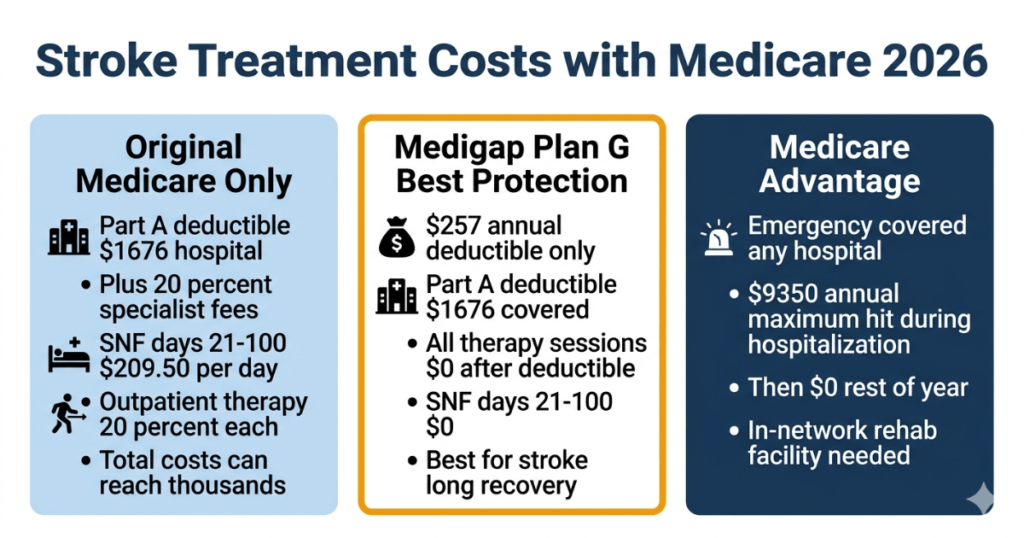
- Part A deductible — $1,676 per benefit period
- Days 1 to 60 — $0 after deductible
Part B costs during hospitalization:
- Surgeon and specialist fees — 20% coinsurance after Part B deductible
With Medigap Plan G
Medigap Plan G provides the most comprehensive financial protection for stroke treatment. After the $257 annual Part B deductible Plan G covers:
- The $1,676 Part A hospital deductible
- All daily coinsurance for extended hospital stays
- 20% coinsurance for all outpatient therapy sessions
- All SNF daily coinsurance for days 21 to 100
For a major stroke requiring extended hospitalization and months of rehabilitation Plan G can save patients $5,000 to $20,000 or more in out-of-pocket costs compared to Original Medicare alone.
With Medicare Advantage
Medicare Advantage plans cover stroke treatment with their own cost-sharing:
- Emergency care — covered immediately without prior authorization
- Inpatient stroke care — typically $250 to $500 per day for first few days
- All costs count toward $9,350 annual out-of-pocket maximum
The $9,350 annual maximum provides important financial protection for stroke patients who often reach this limit during the initial hospitalization.
Does Medicare Advantage Cover Stroke Treatment?
Does Medicare Advantage cover stroke treatment in 2026? Yes — all Medicare Advantage plans must cover stroke treatment as a Medicare-required emergency service. Important considerations:
Emergency stroke care — Medicare law requires Medicare Advantage plans to cover emergency care anywhere in the United States regardless of network status. You can receive emergency stroke treatment at any emergency room and Medicare Advantage must cover it.
Post-acute rehabilitation — confirm that inpatient rehabilitation facilities and skilled nursing facilities in your area are in your Medicare Advantage network before a stroke occurs if possible. Having this information in advance helps family members make informed placement decisions during a stressful emergency.
Out-of-pocket maximum — stroke treatment and rehabilitation costs count toward the $9,350 annual maximum. Most stroke patients reach this maximum during their acute hospitalization.
Frequently Asked Questions — Does Medicare Cover Stroke Treatment
Does Medicare cover stroke treatment in 2026?
Yes — Medicare covers comprehensive stroke treatment including emergency ambulance transport, emergency department care, tPA and thrombectomy for ischemic stroke, acute hospitalization, and all forms of rehabilitation including inpatient rehabilitation, skilled nursing facility care, home health therapy, and outpatient therapy. Medicare Part A covers hospitalization and Part B covers emergency services, physician fees, and outpatient therapy.
Does Medicare cover tPA for stroke?
Yes — Medicare covers tPA — the clot-busting medication used to treat ischemic stroke — as part of emergency stroke treatment. tPA must be administered within 4.5 hours of symptom onset for maximum benefit. Medicare covers tPA as part of the inpatient hospitalization under Part A.
How much does stroke treatment cost with Medicare?
With Original Medicare acute stroke hospitalization costs the $1,676 Part A deductible plus 20% coinsurance on physician services. With Medigap Plan G your effective cost after the $257 annual deductible is $0 for all Medicare-approved services. Medicare Advantage limits costs to the $9,350 annual maximum. Stroke rehabilitation adds additional costs under either plan type.
Does Medicare cover stroke rehabilitation?
Yes — Medicare covers comprehensive stroke rehabilitation including inpatient rehabilitation facility care, skilled nursing facility rehabilitation (days 1 to 20 at $0), home health therapy at 100%, and outpatient physical, occupational, and speech therapy at 80% with no session limit.
Does Medicare cover speech therapy after stroke?
Yes — Medicare covers speech therapy for stroke survivors across all care settings including inpatient rehabilitation, skilled nursing facilities, home health, and outpatient clinics. Post-stroke speech therapy addresses aphasia, dysarthria, and dysphagia with no hard session limit.
Summary — Does Medicare Cover Stroke Treatment 2026
Does Medicare cover stroke treatment in 2026? Yes — Medicare provides comprehensive coverage for the full continuum of stroke care from emergency treatment through acute hospitalization and all forms of rehabilitation. Emergency stroke treatment including tPA, mechanical thrombectomy, and emergency hospitalization are all fully covered.
For stroke patients Medigap Plan G provides the most comprehensive financial protection — covering the Part A deductible, all hospitalization coinsurance, and all therapy session coinsurance after the $257 annual deductible. Medicare Advantage provides an annual out-of-pocket maximum of $9,350 which most stroke patients reach during hospitalization.
For free help understanding your Medicare stroke coverage contact your State Health Insurance Assistance Program (SHIP) at shiphelp.org or call Medicare free at 1-800-633-4227.
This guide is for informational purposes only and is not medical advice. Always call 911 immediately for stroke symptoms — time is brain. Verify current Medicare coverage at Medicare.gov.
Sources: Medicare.gov | CMS.gov | SSA.gov | AARP.org
Last updated: April 2026 | Author: James Carter, Independent Medicare Research Analyst