
Does Medicare Cover Cataract Surgery 2026 — Complete Guide
Does Medicare cover cataract surgery in 2026? If you or a loved one has been diagnosed with cataracts and are wondering whether Medicare will pay for cataract surgery this complete guide has every answer you need. The good news is that yes — Medicare does cover cataract surgery in 2026. Cataract surgery is one of the most commonly performed surgical procedures among Medicare beneficiaries and Medicare Part B covers it as a medically necessary outpatient procedure. In this complete guide we explain exactly what Medicare covers for cataract surgery in 2026 — what is covered, what is not covered, how much you will pay, and how Medicare Advantage handles cataract surgery. All information is sourced from Medicare.gov and CMS.gov.
| Coverage Scenario | What You Pay |
|---|---|
| Part B deductible (2026) | $283 (once per year) |
| Your coinsurance after deductible | 20% of approved amount |
| Medicare pays | 80% of approved amount |
| ASC approved rate (2026) | ~$1,255 |
| Example: $2,000 surgery cost | You pay ~$400 + $283 deductible |
| With Medigap Plan G | You pay $0 after $283 deductible |
| Without any supplement | $283 + 20% coinsurance |
Also Read-Medicare Advantage vs Medigap — Which is Better in 2026? Also Read- Does Medicare Cover Dental and Vision — Complete Guide 2026
What You Will Learn — Does Medicare Cover Cataract Surgery
- Does Medicare cover cataract surgery in 2026
- Which part of Medicare covers cataract surgery
- What Medicare covers for cataract surgery in 2026
- How much does Medicare pay for cataract surgery
- What does cataract surgery cost with Medicare in 2026
- Does Medicare cover laser cataract surgery
- Does Medicare cover premium IOL lenses
- Does Medicare cover glasses after cataract surgery
- Does Medicare cover cataract surgery on both eyes
- Does Medicare Advantage cover cataract surgery
- Frequently asked questions about Medicare cataract surgery coverage 2026
Does Medicare Cover Cataract Surgery in 2026?
Yes — Medicare does cover cataract surgery in 2026. Cataract surgery is considered a medically necessary procedure when cataracts significantly impair your vision and affect your ability to perform daily activities. Medicare Part B covers cataract surgery as an outpatient procedure when it is deemed medically necessary by your doctor.
Cataracts are one of the leading causes of vision loss in Americans over 60. The American Academy of Ophthalmology estimates that more than half of all Americans will have cataracts or have had cataract surgery by age 80. Medicare covers cataract surgery because it restores vision and maintains functional independence for seniors — making it one of the most important Medicare-covered procedures.
Does Medicare cover cataract surgery for both eyes? Yes — Medicare covers cataract surgery for each eye separately when each eye has a cataract that is medically necessary to treat. However Medicare covers each eye as a separate procedure — not both eyes on the same day in most cases.
Which Part of Medicare Covers Cataract Surgery?
Understanding which part of Medicare covers cataract surgery helps you understand your costs and coverage. Medicare Part B — medical insurance — covers cataract surgery in 2026 as an outpatient procedure.
Medicare Part B covers cataract surgery because it is performed in an outpatient surgery center or hospital outpatient department — not as an inpatient hospital admission. Since cataract surgery is typically done on an outpatient basis it falls under Part B not Part A.
If you were admitted as an inpatient to a hospital for cataract surgery — which is rare — Medicare Part A would cover the hospital stay and Part B would cover the surgeon fees.
Does Medicare cover cataract surgery under Medicare Advantage? Yes — Medicare Advantage plans must cover everything Original Medicare covers including cataract surgery. If your Medicare Advantage plan covers outpatient surgery — which all plans must — it covers cataract surgery. However your costs will be based on your Medicare Advantage plan’s cost-sharing structure rather than Original Medicare’s 80/20 structure. To understand how Medicare Part B works in detail, read our complete guide → What Does Medicare Cover in 2026
What Does Medicare Cover for Cataract Surgery in 2026?
Medicare covers several components of cataract surgery in 2026. Here is exactly what Medicare does and does not cover for cataract surgery:
What Medicare Part B Covers for Cataract Surgery in 2026
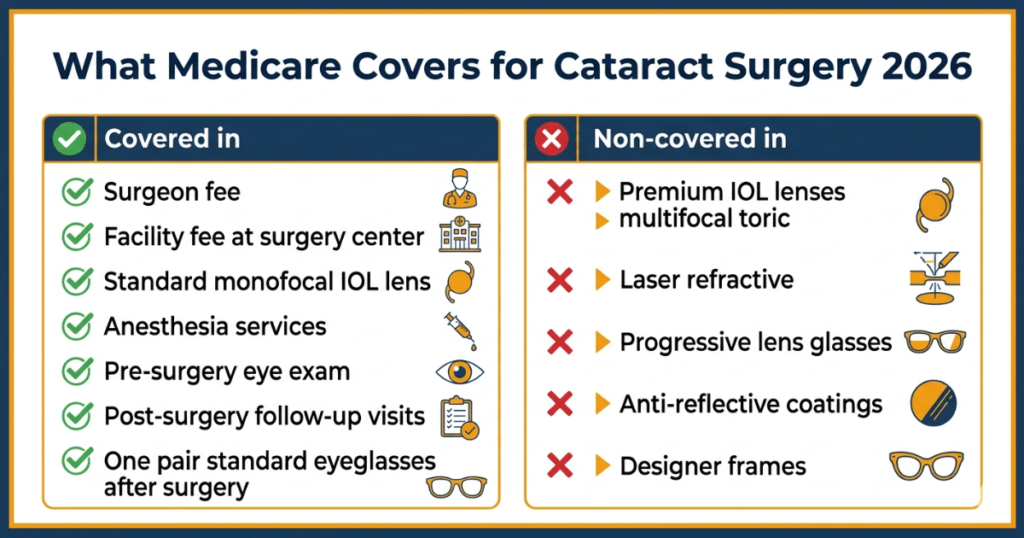
Pre-surgery eye examination — Medicare Part B covers the comprehensive eye examination your ophthalmologist performs to diagnose cataracts and determine the need for surgery. This includes visual acuity testing, slit-lamp examination, and measurements for intraocular lens (IOL) calculations.
The cataract surgery procedure — Medicare Part B covers the surgical removal of the cataract using phacoemulsification — the most common cataract surgery technique — or extracapsular extraction when medically necessary.
The surgeon fee — Medicare Part B covers the ophthalmologist’s professional fee for performing the cataract surgery.
The facility fee — Medicare Part B covers the ambulatory surgery center (ASC) or hospital outpatient department facility fee for the cataract surgery procedure.
Anesthesia — Medicare Part B covers anesthesia services for cataract surgery.
Standard intraocular lens (IOL) — Medicare Part B covers the cost of a standard monofocal intraocular lens implanted during cataract surgery. A standard monofocal IOL corrects vision at one distance — typically distance vision. After surgery most patients need glasses for reading or close work.
Post-surgery follow-up care — Medicare Part B covers the medically necessary follow-up visits after cataract surgery including the day-after appointment, one-week checkup, and one-month follow-up.
One pair of eyeglasses or contact lenses after surgery — this is one of the most important and often overlooked Medicare cataract surgery benefits. Medicare Part B covers one pair of standard eyeglasses or one set of contact lenses after each cataract surgery. This is the only time Medicare covers eyeglasses — it does not cover routine glasses for seniors who have not had cataract surgery.
What Medicare Does NOT Cover for Cataract Surgery in 2026
While Medicare does cover cataract surgery there are several cataract-related services that Medicare does not cover in 2026:
Premium Intraocular Lenses (IOLs)
Medicare covers the cost of a standard monofocal IOL but does not cover premium intraocular lenses. Premium IOLs include:
- Multifocal IOLs — allow clear vision at multiple distances reducing or eliminating the need for glasses after surgery
- Extended Depth of Focus (EDOF) IOLs — provide a range of clear vision
- Toric IOLs — correct astigmatism in addition to cataracts
- Accommodating IOLs — designed to provide some range of focus
If you choose a premium IOL instead of the standard lens Medicare will cover the portion of the cost equivalent to a standard monofocal IOL and you pay the difference. The additional cost for premium IOLs ranges from $1,000 to $3,000 per eye depending on the lens type and surgeon.
Laser Refractive Components of Cataract Surgery
Medicare covers standard cataract surgery but does not cover the refractive components of laser-assisted cataract surgery (LACS) that are designed to reduce dependence on glasses after surgery. Medicare covers the basic laser cataract surgery procedure but not the additional fees for using laser technology specifically to reduce astigmatism or provide premium vision outcomes.
Routine Post-Surgery Glasses
Medicare covers one pair of standard eyeglasses after cataract surgery. However if you want premium glasses — progressive lenses, anti-reflective coating, or designer frames — you pay the additional cost above the standard lens and frame allowance.
How Much Does Cataract Surgery Cost with Medicare in 2026?
The national Medicare payment rate for routine cataract surgery performed at an Ambulatory Surgical Center (ASC) is approximately $1,255 in 2026 as set by CMS. This is the Medicare-approved facility fee for a standard cataract procedure at an ASC. Your surgeon fee is billed separately and Medicare pays 80% of both amounts after you meet your annual $257 Part B deductible.
With Original Medicare (Parts A and B)
Annual Part B deductible — $257 per year. If you have not yet met your Part B deductible for the year you pay the first $257 of Medicare-approved costs.
After deductible — Medicare Part B pays 80% of the Medicare-approved amount for all covered cataract surgery services. You pay the remaining 20% coinsurance.
Typical Medicare-approved amounts for cataract surgery in 2026:
- Surgeon fee — Medicare-approved amount approximately $600 to $900 per eye
- ASC facility fee — Medicare-approved amount approximately $1,200 to $1,800 per eye
- Total Medicare-approved amount — approximately $1,800 to $2,700 per eye
Your 20% coinsurance with Original Medicare:
- Your share — 20% of $1,800 to $2,700 = approximately $360 to $540 per eye
Without a Medigap supplement you would pay approximately $360 to $540 per eye for cataract surgery under Original Medicare in 2026 — after meeting your annual Part B deductible.
With Medigap Plan G
If you have Medigap Plan G your costs are dramatically reduced. After paying your $257 annual Part B deductible Plan G covers 100% of the 20% coinsurance. Your total out-of-pocket cost for cataract surgery with Plan G is just the $257 annual deductible — then $0 for the surgery itself.
With Medicare Advantage
Medicare Advantage plans have their own cost-sharing for cataract surgery. Typical Medicare Advantage costs for cataract surgery in 2026:
- Surgeon fee copay — $0 to $50 per eye depending on plan
- ASC facility fee — $0 to $250 per eye depending on plan
- Total out-of-pocket — typically $0 to $300 per eye with Medicare Advantage
Most Medicare Advantage plans with $0 deductibles make cataract surgery very affordable for members. Learn how Medigap Plan G compares to other supplement options → Medicare Advantage vs Medigap — Which is Better in 2026
| Coverage Type | Deductible | Your Share | Est. Cost Per Eye |
|---|---|---|---|
| Original Medicare Only | $283/year | 20% coinsurance | $360 – $540 |
| Medigap Plan G | $283 once/year | $0 after deductible | $0 (after $283 deductible) |
| Medicare Advantage | Varies by plan | Copay or coinsurance | $0 – $300 |
Does Medicare Cover Laser Cataract Surgery?
Does Medicare cover laser cataract surgery in 2026? The answer requires understanding what Medicare covers and what it does not cover for laser cataract surgery.
Medicare does cover the basic cataract removal procedure whether performed with traditional phacoemulsification or laser-assisted cataract surgery (LACS) techniques. The fundamental cataract removal procedure is covered regardless of whether laser technology is used.
However Medicare does not cover the additional charges associated with using laser technology specifically for refractive purposes — meaning to reduce your dependence on glasses after surgery. If your surgeon uses a femtosecond laser to create a more precise incision or to pre-soften the cataract lens Medicare covers the cataract removal but may not cover the additional laser facility fee for the premium refractive components.
In practice most surgeons who perform laser cataract surgery charge an additional fee of $500 to $1,500 per eye for the laser technology beyond what Medicare covers. If you want laser cataract surgery you should ask your surgeon exactly what Medicare covers and what your out-of-pocket cost will be before proceeding.
Does Medicare Cover Premium IOL Lenses?
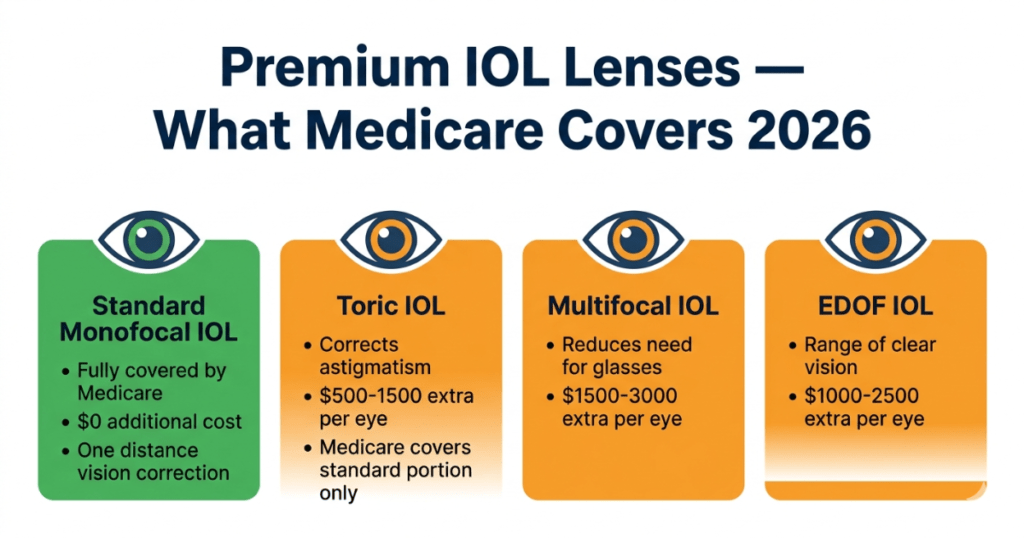
Does Medicare cover premium IOL lenses for cataract surgery? Medicare covers the cost of a standard monofocal intraocular lens but does not cover the additional cost of premium IOL lenses.
Here is how Medicare handles premium IOL costs:
Medicare pays its standard reimbursement for cataract surgery including the cost of a standard monofocal IOL. If you choose a premium IOL — multifocal, toric, EDOF, or accommodating — you pay the difference between what Medicare reimburses for the standard lens and the actual cost of the premium lens.
Additional costs for premium IOLs in 2026:
- Toric IOL (corrects astigmatism) — additional $500 to $1,500 per eye above Medicare coverage
- Multifocal IOL (reduces need for glasses) — additional $1,500 to $3,000 per eye above Medicare coverage
- EDOF IOL — additional $1,000 to $2,500 per eye above Medicare coverage
Whether to choose a premium IOL is a personal decision based on your vision goals, lifestyle, and budget. Discuss the options with your ophthalmologist to determine whether the additional out-of-pocket cost is worth the benefit for your situation.
Does Medicare Cover Glasses After Cataract Surgery?
Does Medicare cover glasses after cataract surgery? Yes — this is one of the most valuable and often overlooked Medicare cataract surgery benefits.
Medicare Part B covers one pair of eyeglasses OR one set of contact lenses after cataract surgery with IOL implantation. This is the only circumstance under which Medicare covers eyeglasses. Medicare does not cover routine eyeglasses for seniors who have not had cataract surgery.
The Medicare eyeglass benefit after cataract surgery covers one pair of standard eyeglasses including:
- Single vision, bifocal, or trifocal lenses
- Standard frames
- Basic lens options
Medicare does not cover:
- Progressive no-line bifocal lenses — you pay the additional cost above standard bifocals
- Anti-reflective or other premium coatings — you pay the additional cost
- Designer or premium frames — you pay the cost above the standard frame allowance
- Contact lens fitting fees
To receive Medicare-covered eyeglasses after cataract surgery you must purchase them from a supplier that accepts Medicare. Your eye care provider or surgeon can recommend Medicare-approved eyeglass suppliers in your area.
Does Medicare Cover Secondary Cataract Surgery (YAG Laser)?
Yes — Medicare covers secondary cataract surgery. After cataract surgery some patients develop posterior capsular opacification (PCO) — sometimes called a secondary cataract — where the lens capsule behind the IOL becomes cloudy and blurs vision again. PCO is treated with a quick outpatient procedure called YAG laser capsulotomy.
Medicare Part B covers YAG laser capsulotomy as a medically necessary procedure. The same cost-sharing applies — after meeting your $257 annual Part B deductible Medicare pays 80% and you pay 20%. The Medicare-approved amount for a YAG laser capsulotomy in 2026 is approximately $150 to $250. Your 20% coinsurance is typically $30 to $50.
No new IOL is required for YAG laser capsulotomy — the laser simply creates a small opening in the cloudy capsule to restore clear vision. The procedure takes only a few minutes and is performed in an outpatient setting.
Does Medicare Cover Cataract Surgery on Both Eyes?
Does Medicare cover cataract surgery on both eyes? Yes — Medicare covers cataract surgery on both eyes when each eye has a cataract that is medically necessary to treat. However Medicare covers each eye as a separate surgical procedure.
Cataract surgery on both eyes is typically performed on separate days — usually one to four weeks apart. Medicare covers each procedure separately with its own cost-sharing. You pay your coinsurance for the first eye and then your coinsurance for the second eye when that surgery is performed.
Since both cataract surgeries typically occur within the same calendar year and you have already met your annual Part B deductible after the first surgery your coinsurance for the second eye is simply 20% of the Medicare-approved amount — there is no second deductible.
Medicare also covers one pair of glasses after cataract surgery. If you have surgery on both eyes you receive one pair of glasses total — not one pair per eye.
Medicare Advantage and Cataract Surgery 2026
Does Medicare Advantage cover cataract surgery? Yes — all Medicare Advantage plans must cover cataract surgery because it is a Medicare-covered service. However the cost structure differs from Original Medicare.
Medicare Advantage cataract surgery coverage in 2026:
- Must cover all components that Original Medicare covers
- Uses plan-specific copays and coinsurance rather than 80/20 Original Medicare structure
- Out-of-pocket costs count toward your annual maximum — $9,350 in-network
- May have prior authorization requirements for surgery
- Must use plan network providers — confirm your surgeon and ASC are in-network
One important advantage of Medicare Advantage for cataract surgery is the annual out-of-pocket maximum. If you have already spent significant healthcare dollars earlier in the year your cataract surgery costs may be fully covered once you reach your plan’s out-of-pocket maximum.
Additionally many Medicare Advantage plans include vision benefits that go beyond what Original Medicare covers — such as annual eye exams and eyeglass allowances. These extra vision benefits complement the cataract surgery coverage and provide more comprehensive eye care overall.
How to Prepare for Cataract Surgery with Medicare in 2026
If you are planning cataract surgery with Medicare here are important steps to take before your procedure:
Step 1 — Confirm Medicare Coverage with Your Surgeon
Before scheduling cataract surgery confirm that your ophthalmologist and the surgery center accept Medicare assignment. A Medicare-participating provider accepts the Medicare-approved amount as payment in full. A non-participating provider can charge up to 15% above the Medicare-approved amount — called excess charges — which you would pay out of pocket unless you have Medigap Plan G.
Step 2 — Get a Written Cost Estimate
Ask your surgeon’s office for a written estimate of your expected out-of-pocket costs including whether you will be choosing a standard or premium IOL and what additional charges apply for premium options.
Step 3 — Understand Your Supplement Coverage
If you have Medigap Plan G your out-of-pocket costs after the $257 annual deductible are essentially zero for covered cataract surgery services. If you have Medicare Advantage confirm your surgeon is in-network and check your plan’s cost-sharing for outpatient surgery.
Step 4 — Check for Prior Authorization
If you have Medicare Advantage check whether your plan requires prior authorization for cataract surgery. Most plans do require this. Your surgeon’s office typically handles prior authorization but confirm this before your surgery date.
Frequently Asked Questions — Does Medicare Cover Cataract Surgery
Does Medicare cover cataract surgery in 2026?
Yes — Medicare does cover cataract surgery in 2026. Medicare Part B covers cataract surgery as a medically necessary outpatient procedure including the surgeon fee, facility fee, standard intraocular lens, anesthesia, and post-surgery follow-up care. After meeting your $257 annual Part B deductible Medicare pays 80% of the Medicare-approved amount and you pay 20%.
How much does cataract surgery cost with Medicare in 2026?
With Original Medicare and no supplement your out-of-pocket cost for cataract surgery is approximately $360 to $540 per eye after meeting the $283 annual Part B deductible. With Medigap Plan G your cost is just the $283 annual deductible — then $0. With Medicare Advantage your cost is typically $0 to $300 per eye depending on your plan’s cost-sharing.
Does Medicare cover laser cataract surgery?
Medicare covers the basic cataract removal procedure whether performed with traditional or laser-assisted techniques. However Medicare does not cover additional charges for refractive laser components designed to reduce dependence on glasses. You may pay an additional $500 to $1,500 per eye for the laser refractive component beyond Medicare coverage.
Does Medicare cover premium IOL lenses?
Medicare covers standard monofocal IOL lenses. Premium IOLs like multifocal, toric, and EDOF lenses are not fully covered. Medicare pays its standard reimbursement and you pay the additional cost of the premium lens — typically $1,000 to $3,000 per eye above Medicare coverage.
Does Medicare cover glasses after cataract surgery?
Yes — Medicare covers one pair of standard eyeglasses or one set of contact lenses after cataract surgery. This is the only time Medicare covers eyeglasses. You pay additional costs for premium lens options or designer frames above the standard Medicare allowance.
Does Medicare cover cataract surgery on both eyes?
Yes — Medicare covers cataract surgery on each eye separately when both eyes have medically necessary cataracts. Each procedure is covered with its own cost-sharing. You receive one pair of glasses after both surgeries are complete — not one pair per eye.
Does Medicare Advantage cover cataract surgery?
Yes — all Medicare Advantage plans must cover cataract surgery. Your costs depend on your plan’s specific cost-sharing structure. Always confirm your surgeon and surgery center are in your plan’s network before scheduling and check whether prior authorization is required.
Will Medicare cover my cataract surgery if my vision is only mildly affected?
Medicare covers cataract surgery only when it is deemed medically necessary — meaning your cataract must be significantly impairing your vision and affecting your ability to perform daily activities such as driving, reading, or watching television. If your cataract is mild and your doctor determines surgery is not yet medically necessary Medicare will not cover the procedure. Your ophthalmologist will document the medical necessity in your chart to support Medicare coverage.
What is the Medicare-approved amount for cataract surgery in 2026?
The national Medicare ASC payment rate for routine cataract surgery is approximately $1,255 in 2026 for the facility fee. The surgeon fee is billed separately with a Medicare-approved amount of approximately $600 to $900. Medicare pays 80% of both amounts after you meet your $257 annual Part B deductible. Looking for the best Medicare Advantage plan in your state? See our guide → Best Medicare Plans in Georgia 2026
Summary — Does Medicare Cover Cataract Surgery 2026
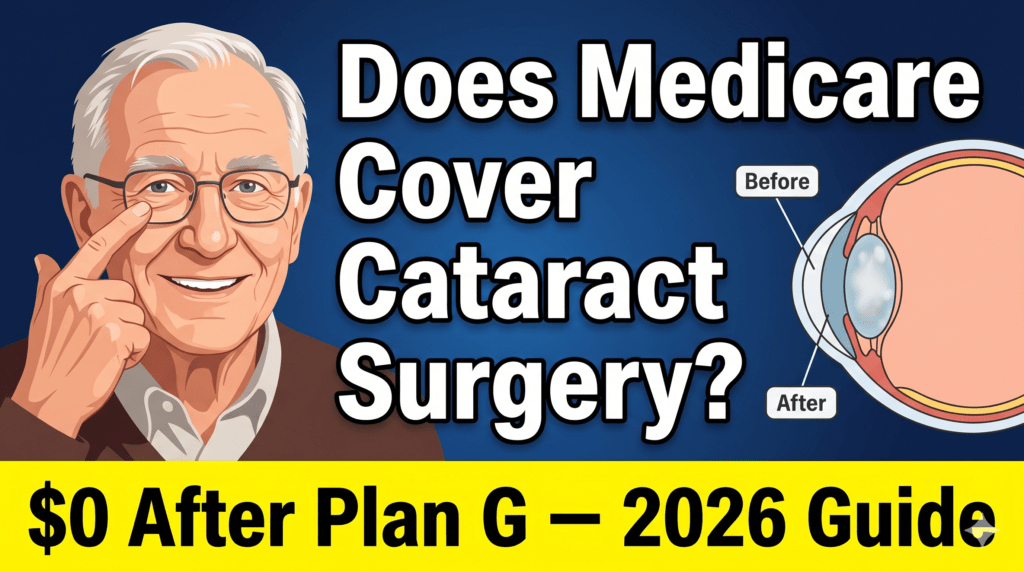
Does Medicare cover cataract surgery in 2026? Yes — Medicare Part B covers cataract surgery as a medically necessary procedure including the surgeon fee, facility fee, standard IOL, anesthesia, follow-up care, and one pair of eyeglasses after surgery. After meeting your $283 annual Part B deductible Medicare pays 80% and you pay 20% — approximately $360 to $540 per eye with Original Medicare alone.
To minimize your out-of-pocket costs for cataract surgery Medigap Plan G provides the most comprehensive protection — covering 100% of your costs after the $283 annual deductible. Medicare Advantage plans also cover cataract surgery with their own cost-sharing structures.
If you have questions about your specific Medicare coverage for cataract surgery contact your State Health Insurance Assistance Program (SHIP) counselor at shiphelp.org or call Medicare free at 1-800-633-4227.
This guide is for informational purposes only and is not medical advice. Always consult your ophthalmologist and verify current Medicare coverage details at Medicare.gov before making medical decisions.
Sources: Medicare.gov | CMS.gov | SSA.gov | AARP.org
Last updated: April 2026 | Author: James Carter, Independent Medicare Research Analyst
James Carter is an independent Medicare research analyst with over 12 years of experience helping Americans understand Medicare coverage, costs, and enrollment. James specializes in Medicare Part A, Part B, Medicare Advantage, and Medigap coverage analysis. All content on MedicareBuddyy.com is independently researched and sourced from Medicare.gov, CMS.gov, and SSA.gov.


2 Comments