Does Medicare Cover Dental Implants — Complete Guide 2026
Does Medicare cover dental implants in 2026? If you are a Medicare beneficiary considering dental implants this complete guide answers every question about Medicare dental implant coverage. The straightforward answer is that Original Medicare does not cover dental implants in 2026 — but there are important exceptions and alternatives that Medicare beneficiaries should know about. In this complete guide we explain exactly what Medicare covers for dental care in 2026, why Original Medicare excludes dental implants, when Medicare might cover dental procedures related to implants, what Medicare Advantage covers for dental implants, and what your options are if you need dental implants as a Medicare beneficiary. All information is sourced from Medicare.gov and CMS.gov.
Also Read —
- Does Medicare Cover Dental and Vision 2026
- Does Medicare Cover Hearing Aids 2026
- Medicare Advantage vs Original Medicare 2026
What You Will Learn — Does Medicare Cover Dental Implants
- Does Medicare cover dental implants in 2026
- Why Original Medicare excludes dental implants
- When Medicare might cover dental-related procedures
- Does Medicare Advantage cover dental implants
- How much do dental implants cost without Medicare
- How to get dental implant coverage as a Medicare beneficiary
- The best Medicare plans for dental implant coverage
- Alternatives to dental implants covered by Medicare
- Frequently asked questions about Medicare dental implant coverage 2026
Does Medicare Cover Dental Implants in 2026?
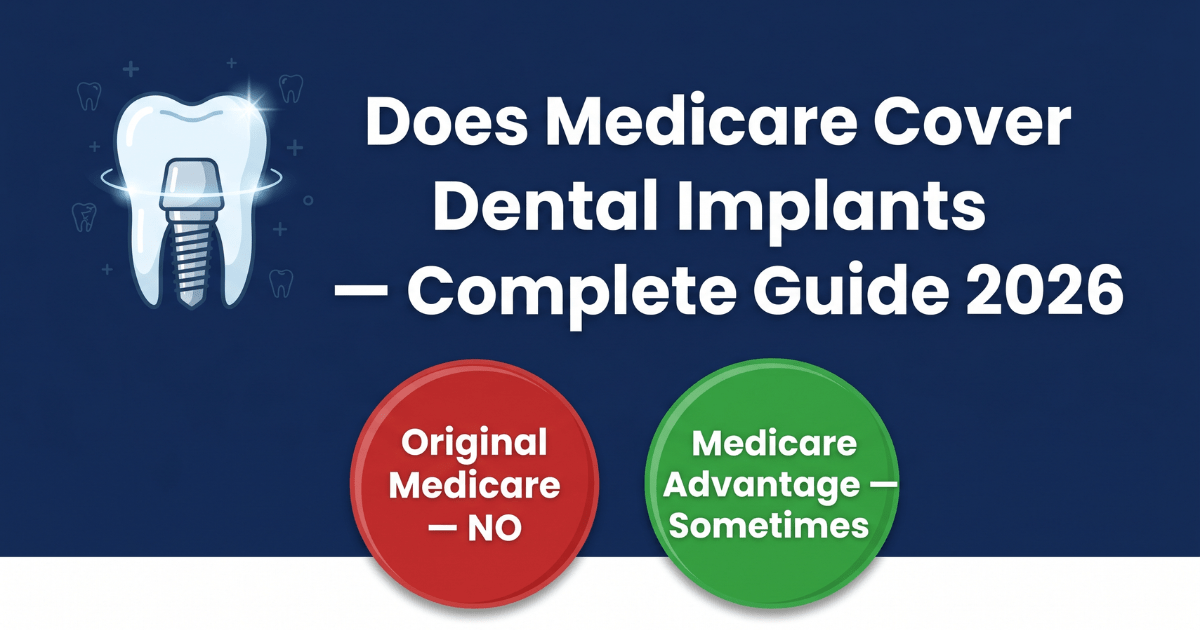
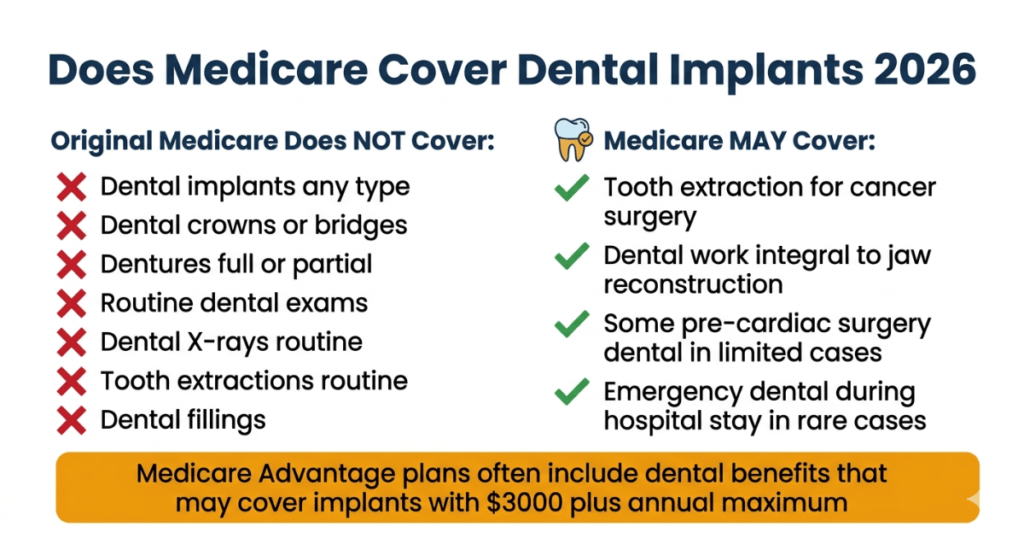
No — Original Medicare does not cover dental implants in 2026. This is one of the most significant dental coverage gaps in the Medicare program. Original Medicare Parts A and B explicitly exclude routine dental care including dental implants, crowns, bridges, dentures, and most other dental procedures.
This lack of dental implant coverage under Original Medicare surprises many seniors who assume their Medicare coverage includes comprehensive dental care. The exclusion of dental care from Original Medicare is the same exclusion that affects all routine dental services — dental implants are not singled out separately but fall under the broad dental exclusion in Medicare’s benefit structure.
However there are important nuances to understand. Medicare Advantage plans frequently include dental benefits that can cover some or all of the cost of dental implants. And in specific medical circumstances Original Medicare may cover dental procedures that are integral to a covered medical treatment — though direct coverage of dental implants themselves remains excluded.
Does Medicare ever cover any dental care? Yes — Original Medicare covers dental care in very limited medically necessary circumstances. We explain these exceptions below.
Why Does Original Medicare Not Cover Dental Implants?
Original Medicare does not cover dental implants for the same reason it does not cover other routine dental care — the Medicare program was designed in 1965 with an explicit exclusion for dental services that were considered routine or non-medical at the time.
When Congress created Medicare it excluded several categories of care including routine dental care, routine vision care, and hearing aids. Dental care including implants was viewed as a personal hygiene and maintenance issue rather than a medical necessity. This exclusion has remained despite numerous attempts to expand Medicare dental coverage.
The cost of adding comprehensive dental coverage to Medicare has been estimated at hundreds of billions of dollars over a decade. While the Inflation Reduction Act of 2022 included some Medicare drug price negotiation provisions it did not include the dental coverage expansion that advocates had sought.
Despite the dental exclusion the research on oral health and overall health has increasingly demonstrated that dental health is directly linked to systemic health — heart disease, diabetes management, pneumonia prevention, and cognitive health all have documented connections to oral health. This growing evidence base continues to build pressure for Medicare dental expansion.
When Might Medicare Cover Dental-Related Procedures?
While Original Medicare does not cover dental implants it does cover dental procedures in limited circumstances where the dental work is integral to a covered medical procedure. Understanding these limited exceptions helps Medicare beneficiaries identify situations where Medicare coverage may apply.
Dental Services Integral to a Covered Medical Procedure
Medicare may cover certain dental services when they are an integral part of a covered medical procedure. Examples include:
Jaw reconstruction surgery — if you need jaw reconstruction surgery following an accident or to treat cancer and the procedure requires tooth extraction or dental work as part of the reconstruction Medicare may cover the dental component as integral to the covered surgical procedure.
Oral cancer surgery — Medicare covers cancer surgery and may cover dental extractions or other oral procedures that are a necessary and integral part of the cancer surgery itself.
Cardiac surgery — some Medicare contractors have covered dental extractions prior to heart valve replacement surgery when a cardiologist certifies that the dental infection or disease poses a direct medical risk to the cardiac procedure. This coverage is not guaranteed and varies by Medicare contractor region.
Organ transplant preparation — similarly some Medicare contractors cover dental extractions or treatment when required as medical clearance before organ transplantation.
Important Limitation
Even in these limited exceptions Medicare does not cover dental implants specifically. Medicare may cover extractions, biopsies, or other dental procedures that are integral to covered medical procedures — but dental implants for tooth replacement are not covered even in medically complex situations.
Does Medicare Advantage Cover Dental Implants in 2026?
Does Medicare Advantage cover dental implants in 2026? Many Medicare Advantage plans include dental benefits that may cover some or all of the cost of dental implants. This is one of the primary reasons Medicare beneficiaries who need dental implants consider Medicare Advantage.
Medicare Advantage dental implant coverage varies significantly by plan and location. Here is what to look for when comparing Medicare Advantage plans for dental implant coverage:
Plans with Basic Dental Benefits
Basic dental benefits — typically $500 to $1,000 annual maximum — usually cover only preventive care such as exams, cleanings, and X-rays. These plans typically do not cover dental implants which are classified as major dental work.
Plans with Enhanced Dental Benefits
Enhanced dental benefit plans — typically $1,500 to $3,000 annual maximum — may cover some dental implant costs. These plans often cover:
- Dental implant crown — the visible tooth portion — at 50% after deductible
- Implant abutment — the connector piece — at 50%
- Implant fixture — the titanium post implanted in the bone — may or may not be covered
Plans with Comprehensive Dental Benefits
Some Medicare Advantage plans offer comprehensive dental benefits with higher annual maximums of $3,000 to $5,000 or more. These plans are more likely to include full dental implant coverage including the implant fixture, abutment, and crown.
Dental Implant Allowances
Some Medicare Advantage plans provide a specific dental implant allowance — a set dollar amount per implant — rather than a percentage of cost. Allowances typically range from $500 to $2,000 per implant depending on the plan.
What to Look for When Comparing Medicare Advantage Dental Benefits
When evaluating Medicare Advantage plans for dental implant coverage look for:
Annual maximum benefit — higher annual maximums provide more potential implant coverage.
Whether implant fixture is covered — some plans cover only the crown portion not the implant itself.
Waiting period — some plans have 12 to 24 month waiting periods before major dental benefits including implants become available.
Network dental providers — confirm that implant dentists and oral surgeons in your area are in the plan’s dental network.
Cost-sharing — what percentage does the plan pay versus what you pay for implants.
How Much Do Dental Implants Cost Without Medicare Coverage?
Understanding the cost of dental implants without Medicare coverage helps you appreciate the financial impact of this coverage gap for Medicare beneficiaries.
Single Dental Implant Cost in 2026
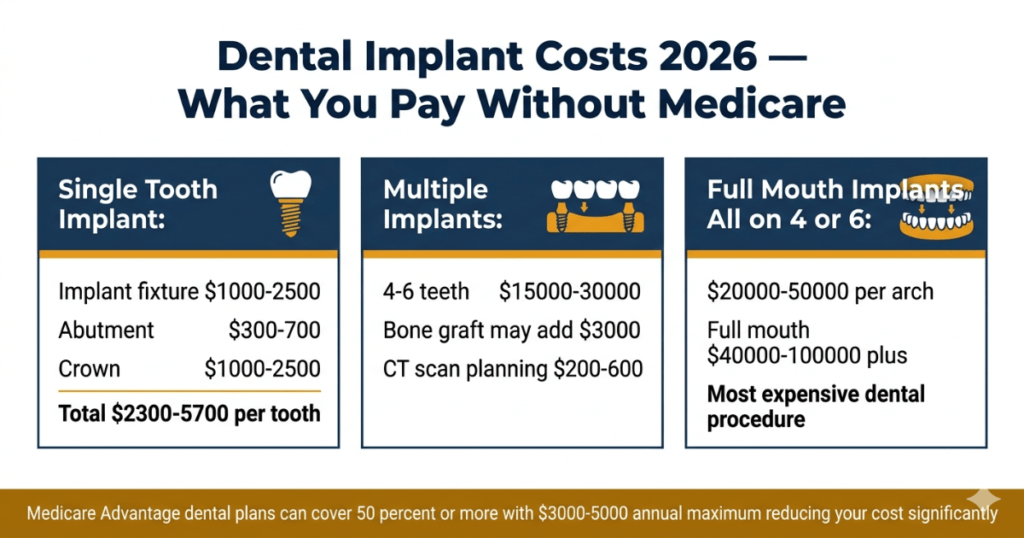
The cost of a single dental implant in 2026 includes three components:
Implant fixture — the titanium screw placed in the jawbone — $1,000 to $2,500 Abutment — the connector piece — $300 to $700 Crown — the visible artificial tooth — $1,000 to $2,500
Total cost for single dental implant in 2026 — $2,300 to $5,700 per tooth
Additional costs may include:
- Initial consultation and X-rays — $100 to $350
- CT scan for implant planning — $200 to $600
- Bone graft if needed — $300 to $3,000
- Tooth extraction if needed — $150 to $350
Multiple Teeth and Full Mouth Implants
Multiple implants — $5,000 to $30,000 depending on number of teeth
Implant-supported dentures — All-on-4 or All-on-6 — $20,000 to $50,000 per arch
Full mouth restoration with implants — $40,000 to $100,000 or more
These costs make dental implants one of the most expensive dental procedures — and the lack of Original Medicare coverage creates a significant financial burden for seniors who need this treatment.
How to Get Dental Implant Coverage as a Medicare Beneficiary
If you need dental implants and want coverage here are your main options as a Medicare beneficiary in 2026:
Option 1 — Enroll in Medicare Advantage with Strong Dental Benefits
The most comprehensive option for dental implant coverage is to enroll in a Medicare Advantage plan with strong dental benefits including implant coverage. During Medicare Open Enrollment (October 15 to December 7) compare Medicare Advantage plans specifically looking at:
- Annual dental maximum — look for $3,000 or higher
- Whether implant fixtures are covered or just crowns
- Waiting period for major dental work
- In-network implant dentists and oral surgeons in your area
- Percentage covered after deductible — look for 50% or higher
Use Medicare.gov plan finder and look at the dental details tab for each plan to compare implant coverage.
Option 2 — Purchase Standalone Dental Insurance
Seniors on Original Medicare can purchase standalone dental insurance to cover implants. Private dental insurance plans that cover implants typically:
- Cost $30 to $80 per month
- Have 12 to 24 month waiting periods for major work including implants
- Cover 50% of implant costs after the waiting period
- Have annual maximums of $1,500 to $3,000
Popular standalone dental insurance providers for seniors include Delta Dental, Cigna Dental, Guardian, and Humana Dental.
Option 3 — Dental Schools
Dental schools offer implant procedures performed by supervised dental students and residents at significantly reduced costs — typically 40% to 70% less than private dental offices. The treatment takes longer and requires multiple appointments but the quality is generally good under faculty supervision.
Option 4 — Dental Discount Plans
Dental discount plans are not insurance but provide access to reduced-fee dental care through participating dentists. Annual membership typically costs $100 to $200 and provides discounts of 20% to 60% on dental procedures including implants.
Option 5 — Medical Tourism
Some Medicare beneficiaries travel to countries like Mexico, Costa Rica, or Hungary for significantly lower-cost dental implants — often 50% to 70% less than US prices. This option requires careful research and selection of qualified dental providers.
Option 6 — Community Dental Clinics
Community health centers and federally qualified health centers offer dental services on a sliding fee scale based on income. These clinics can provide more affordable implant options for lower-income Medicare beneficiaries.
Best Medicare Advantage Plans for Dental Implants in 2026
When looking for the best Medicare Advantage plans for dental implants in 2026 these insurers tend to offer the most comprehensive dental benefits:
UnitedHealthcare AARP Medicare Advantage
UnitedHealthcare offers some Medicare Advantage plans with enhanced dental benefits including implant coverage. Some UnitedHealthcare plans offer annual dental maximums of $3,000 or more with implant fixture coverage. Check specific plans available in your zip code as dental benefits vary significantly by location.
Humana Medicare Advantage
Humana offers Medicare Advantage plans with enhanced dental benefits in many markets. Some Humana plans include implant coverage with allowances of $1,000 to $2,000 per implant. Humana’s dental network is extensive making it easier to find in-network implant providers.
Cigna Medicare Advantage
Cigna offers Medicare Advantage plans with strong dental benefits in select markets. Some Cigna plans offer higher annual dental maximums with implant coverage included.
Aetna Medicare Advantage
Aetna — through its CVS Health partnership — offers dental benefits on most Medicare Advantage plans. Enhanced dental plans from Aetna may include implant coverage in certain markets.
Important Note
Dental benefits vary dramatically by plan and by zip code. Always check the specific dental benefit details for each plan in your specific area before enrolling. Do not assume a plan covers implants based on the national brand name alone — always verify in the plan details.
Alternatives to Dental Implants That Medicare May Help Cover
If dental implant coverage is not available or affordable here are alternatives that may receive some Medicare coverage or be more affordable:
Dentures
Traditional dentures and partial dentures are less expensive than implants — $1,000 to $3,500 for a full set compared to $40,000+ for full mouth implants. Dentures are not covered by Original Medicare but are covered by many Medicare Advantage dental plans.
Dental Bridges
Dental bridges — which anchor artificial teeth to adjacent natural teeth — cost $2,500 to $7,000 for a three-tooth bridge. Bridges are not covered by Original Medicare but may be covered by Medicare Advantage dental plans.
Implant-Supported Dentures
Implant-supported dentures use 2 to 6 implants to anchor a full denture providing better stability than traditional dentures at lower cost than full implants. Cost ranges from $3,000 to $10,000 per arch — significantly less than individual implants for each tooth.
Frequently Asked Questions — Does Medicare Cover Dental Implants
Does Medicare cover dental implants in 2026?
No — Original Medicare (Parts A and B) does not cover dental implants in 2026. Dental implants fall under Medicare’s broad exclusion of routine dental care. However many Medicare Advantage plans include dental benefits that may cover some or all of dental implant costs. If dental implant coverage is important to you Medicare Advantage plans with strong dental benefits are worth considering seriously.
Does Medicare Advantage cover dental implants?
Many Medicare Advantage plans include dental benefits that cover dental implants — but coverage varies significantly by plan. Plans with enhanced dental benefits and annual maximums of $3,000 or more are more likely to cover implants including the implant fixture, abutment, and crown. Always verify the specific dental benefits of any Medicare Advantage plan before enrolling.
How much do dental implants cost without Medicare coverage?
A single dental implant costs approximately $2,300 to $5,700 in 2026 including the implant fixture, abutment, and crown. Full mouth implant restoration can cost $40,000 to $100,000 or more. The lack of Original Medicare coverage for implants makes standalone dental insurance or Medicare Advantage with strong dental benefits important considerations for seniors who need this treatment.
Can I get dental implants covered by Medicare if I need them for medical reasons?
Original Medicare may cover certain dental procedures — such as tooth extraction — when they are integral to a covered medical procedure such as cancer surgery or cardiac valve replacement. However Medicare does not cover dental implants even in these medically complex situations. Specific medical necessity exceptions are very limited and do not extend to implant placement.
What is the best Medicare Advantage plan for dental implants?
The best Medicare Advantage plan for dental implants depends on what is available in your specific zip code. Look for plans with annual dental maximums of $3,000 or higher, coverage for implant fixtures not just crowns, no or short waiting periods for major dental work, and in-network implant dentists in your area. Use Medicare.gov plan finder to compare dental benefits across all plans available in your area.
Does Medicaid cover dental implants?
Medicaid dental coverage varies significantly by state. Some states cover dental implants through Medicaid for qualifying low-income beneficiaries while others cover only emergency dental care. If you qualify for both Medicare and Medicaid — called dual eligible — contact your State Medicaid office to determine what dental benefits including implants are available in your state.
Summary — Does Medicare Cover Dental Implants 2026
Does Medicare cover dental implants in 2026? Original Medicare does not cover dental implants — one of the most significant dental coverage gaps affecting millions of Medicare beneficiaries. Medicare Advantage plans with enhanced dental benefits offer the best option for Medicare beneficiaries who need dental implant coverage — with some plans providing annual dental maximums of $3,000 to $5,000 or more with implant fixture coverage.
For Medicare beneficiaries who need dental implants the best strategy is to compare Medicare Advantage plans with strong dental benefits during Open Enrollment, consider standalone dental insurance if staying on Original Medicare, and explore dental schools and dental discount plans for more affordable implant options.
For free help understanding your Medicare dental coverage options contact your State Health Insurance Assistance Program (SHIP) counselor at shiphelp.org or call Medicare free at 1-800-633-4227.
This guide is for informational purposes only and is not dental or medical advice. Always verify current Medicare dental coverage at Medicare.gov before making dental treatment decisions.
Sources: Medicare.gov | CMS.gov | SSA.gov | AARP.org
Last updated: April 2026 | Author: James Carter, Independent Medicare Research Analyst