Does Medicare Cover GLP-1 Drugs and Ozempic — Complete Guide 2026
Does Medicare cover Ozempic in 2026? This is one of the most searched Medicare questions of 2025 and 2026 as GLP-1 receptor agonist medications have become some of the most prescribed drugs in America. Millions of Medicare beneficiaries are asking whether Medicare covers Ozempic, Wegovy, Mounjaro, Zepbound, and other GLP-1 drugs — and the answer depends critically on what condition the drug is being prescribed for. In this complete guide we explain exactly what Medicare covers for GLP-1 drugs in 2026 — when Medicare covers Ozempic, when it does not, how much GLP-1 drugs cost with Medicare, and what options are available for Medicare beneficiaries who need these medications. All information is sourced from Medicare.gov and CMS.gov.
Also Read —How Much Does Medicare Cost Per Month in 2026 — Complete Breakdown
What You Will Learn — Does Medicare Cover GLP-1 Drugs
- What GLP-1 drugs are and why they matter for Medicare
- Does Medicare cover Ozempic in 2026
- Does Medicare cover Wegovy in 2026
- Does Medicare cover Mounjaro in 2026
- Does Medicare cover GLP-1 drugs for diabetes
- Does Medicare cover GLP-1 drugs for weight loss
- How much do GLP-1 drugs cost with Medicare in 2026
- Does Medicare Advantage cover GLP-1 drugs
- The 2025 Medicare rule change for GLP-1 drugs
- Frequently asked questions about Medicare GLP-1 coverage 2026
What Are GLP-1 Drugs and Why Do They Matter for Medicare?
GLP-1 receptor agonists — commonly called GLP-1 drugs — are a class of medications that mimic the glucagon-like peptide-1 hormone in the body. GLP-1 drugs work by stimulating insulin secretion, reducing appetite, slowing gastric emptying, and reducing blood sugar levels. The most well-known GLP-1 drugs include:
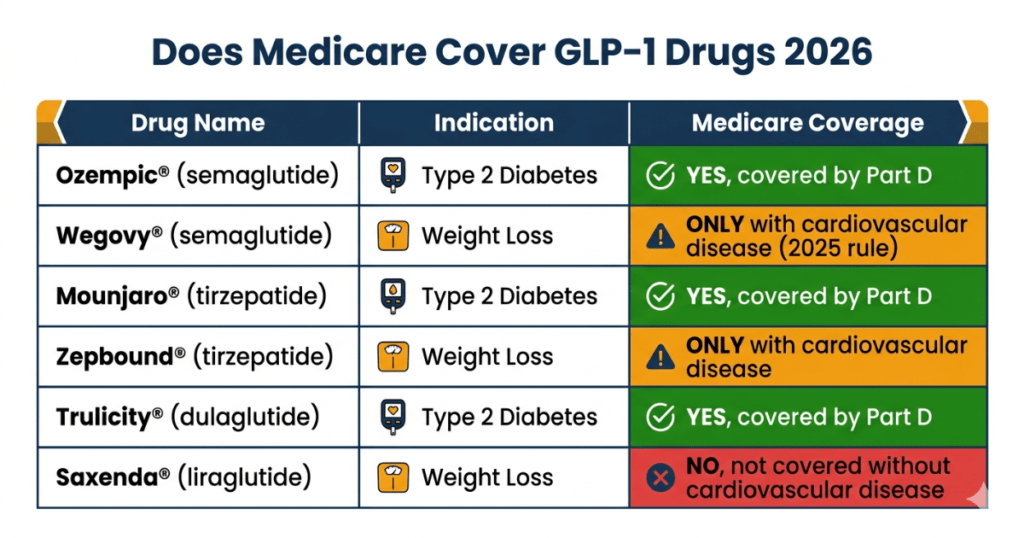
- Ozempic (semaglutide) — FDA approved for type 2 diabetes
- Wegovy (semaglutide) — FDA approved for chronic weight management
- Mounjaro (tirzepatide) — FDA approved for type 2 diabetes
- Zepbound (tirzepatide) — FDA approved for chronic weight management
- Trulicity (dulaglutide) — FDA approved for type 2 diabetes
- Victoza (liraglutide) — FDA approved for type 2 diabetes
- Saxenda (liraglutide) — FDA approved for chronic weight management
- Rybelsus (semaglutide oral) — FDA approved for type 2 diabetes
GLP-1 drugs matter enormously for Medicare because millions of Medicare beneficiaries have type 2 diabetes, obesity, or both — the conditions these drugs are designed to treat. The question of whether Medicare covers GLP-1 drugs affects tens of millions of seniors and represents one of the most significant Medicare drug coverage issues in recent years.
The key to understanding Medicare GLP-1 drug coverage is recognizing that the same active ingredient — semaglutide for example — can be FDA approved for different indications. Ozempic is FDA approved for diabetes. Wegovy contains the same ingredient but is FDA approved for weight loss. Medicare treats these differently even though they contain the same active ingredient.
Does Medicare Cover Ozempic in 2026?
Does Medicare cover Ozempic in 2026? Yes — Medicare does cover Ozempic when it is prescribed for type 2 diabetes. Ozempic (semaglutide) is FDA approved for the treatment of type 2 diabetes and is on the formulary of most Medicare Part D drug plans.
Medicare covers Ozempic for type 2 diabetes under Medicare Part D — the prescription drug benefit. Here is how Medicare covers Ozempic:
Medicare Part D covers Ozempic when prescribed for type 2 diabetes:
- Ozempic must be listed on your specific Part D plan’s formulary
- Most Part D plans place Ozempic on Tier 3 or Tier 4 — brand name drug tiers
- Your copay or coinsurance for Ozempic depends on your specific plan and tier placement
- Annual Part D out-of-pocket maximum — $2,000 in 2026 — applies
- Prior authorization is frequently required by Part D plans for Ozempic
Does Medicare cover Ozempic for weight loss? No — Medicare does not cover Ozempic when prescribed primarily for weight loss even though Ozempic is sometimes prescribed off-label for that purpose. Medicare Part D is prohibited by federal law from covering drugs used exclusively for weight loss or obesity treatment. However if you have type 2 diabetes and your doctor prescribes Ozempic for diabetes management Medicare Part D covers it.
How much does Ozempic cost with Medicare in 2026? The retail price of Ozempic is approximately $900 to $1,000 per month without insurance. With Medicare Part D coverage your cost depends on your specific plan’s tier placement and cost-sharing. With the $2,000 annual Part D out-of-pocket maximum you would never pay more than $2,000 per year for Ozempic and all other covered drugs combined under Medicare Part D in 2026.
Does Medicare Cover Wegovy in 2026?
Does Medicare cover Wegovy in 2026? This is more complicated than Ozempic. Wegovy (semaglutide) contains the same active ingredient as Ozempic but is FDA approved specifically for chronic weight management in adults with obesity or overweight with at least one weight-related health condition.
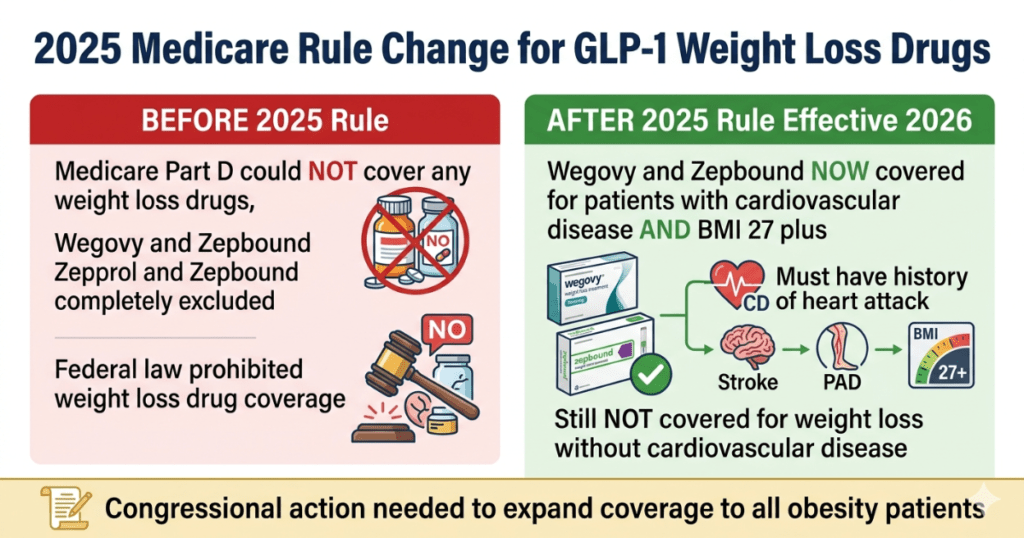
Historically Medicare did not cover Wegovy because federal law prohibited Medicare Part D from covering drugs used exclusively for weight loss. However there was a significant rule change in 2025 that affects Wegovy coverage in 2026.
The 2025 Rule Change for Wegovy
In late 2024 the Biden administration finalized a rule expanding Medicare Part D coverage to include certain anti-obesity medications — including Wegovy — when prescribed for patients who have cardiovascular disease and obesity. This rule change was based on clinical trial data showing that Wegovy reduces the risk of serious cardiovascular events — heart attack, stroke, and cardiovascular death — in patients with existing cardiovascular disease and obesity.
Under this rule change effective in 2026 Medicare Part D covers Wegovy when:
- The patient has established cardiovascular disease — history of heart attack, stroke, or peripheral artery disease
- The patient has a BMI of 27 or greater (overweight or obese)
- The Wegovy is prescribed for cardiovascular risk reduction
Medicare does NOT cover Wegovy in 2026 for patients who:
- Have obesity or overweight without cardiovascular disease
- Are seeking Wegovy purely for weight loss without cardiovascular disease
- Do not meet the specific criteria established by the 2025 rule change
This means millions of Medicare beneficiaries who want Wegovy for weight loss but do not have cardiovascular disease still cannot get Medicare to cover the drug in 2026. Congress would need to pass additional legislation to fully expand Medicare coverage to all anti-obesity medications.
Does Medicare Cover Mounjaro in 2026?
Does Medicare cover Mounjaro in 2026? Yes — Medicare covers Mounjaro (tirzepatide) when it is prescribed for type 2 diabetes. Mounjaro is FDA approved for the treatment of type 2 diabetes and is covered under Medicare Part D when prescribed for that indication.
Like Ozempic Medicare covers Mounjaro for diabetes under Part D with:
- Formulary coverage on most Part D plans
- Tier 3 or Tier 4 placement on most plans
- Prior authorization frequently required
- $2,000 annual out-of-pocket maximum applies
Does Medicare cover Mounjaro for weight loss? Mounjaro itself is not FDA approved for weight loss — its sister drug Zepbound is. Medicare does not cover Mounjaro when prescribed off-label for weight loss. For weight loss tirzepatide is covered under the brand name Zepbound only when the cardiovascular disease criteria are met under the 2025 rule change.
Does Medicare Cover GLP-1 Drugs for Diabetes?
Does Medicare cover GLP-1 drugs for diabetes in 2026? Yes — Medicare Part D covers GLP-1 drugs approved for type 2 diabetes treatment. Here is a complete list of GLP-1 drugs and their Medicare coverage status for diabetes in 2026:
Ozempic (semaglutide) — covered by Medicare Part D for type 2 diabetes ✅
Mounjaro (tirzepatide) — covered by Medicare Part D for type 2 diabetes ✅
Trulicity (dulaglutide) — covered by Medicare Part D for type 2 diabetes ✅
Victoza (liraglutide) — covered by Medicare Part D for type 2 diabetes ✅
Rybelsus (oral semaglutide) — covered by Medicare Part D for type 2 diabetes ✅
Bydureon BCise (exenatide extended release) — covered by Medicare Part D for type 2 diabetes ✅
Byetta (exenatide) — covered by Medicare Part D for type 2 diabetes ✅
For all these diabetes-approved GLP-1 drugs Medicare Part D coverage is subject to:
- The drug being on your specific plan’s formulary
- Prior authorization requirements — very common for GLP-1 drugs
- Step therapy requirements — your plan may require you to try less expensive diabetes drugs first
- Tier-based cost-sharing — most GLP-1 drugs are on higher cost tiers
Does Medicare Cover GLP-1 Drugs for Weight Loss?
Does Medicare cover GLP-1 drugs for weight loss in 2026? The answer is limited. Federal law — specifically Section 1927(d)(2) of the Social Security Act — prohibits Medicare Part D from covering drugs used exclusively for the treatment of obesity or weight gain. This prohibition has historically prevented Medicare from covering weight loss drugs including GLP-1 medications specifically approved for weight management.
However the 2025 rule change created a limited exception:
Medicare Part D now covers anti-obesity GLP-1 medications — including Wegovy and Zepbound — when prescribed for patients with established cardiovascular disease who meet the obesity criteria. This covers a subset of Medicare beneficiaries but not the broader population seeking GLP-1 drugs for weight loss alone.
For Medicare beneficiaries who do not have cardiovascular disease GLP-1 drugs for weight loss — Wegovy, Zepbound, Saxenda — remain uncovered by Medicare Part D in 2026. These patients pay full price out of pocket — $900 to $1,400 per month — unless they have other insurance coverage.
The full expansion of Medicare coverage to all anti-obesity medications would require Congressional action. Several bills have been introduced in Congress to expand Medicare coverage for anti-obesity medications but as of 2026 no comprehensive expansion has been enacted.
How Much Do GLP-1 Drugs Cost with Medicare in 2026?
Understanding how much GLP-1 drugs cost with Medicare in 2026 is critical for Medicare beneficiaries considering these medications.
GLP-1 Drugs Covered by Medicare for Diabetes
For GLP-1 drugs covered by Medicare Part D for diabetes treatment:
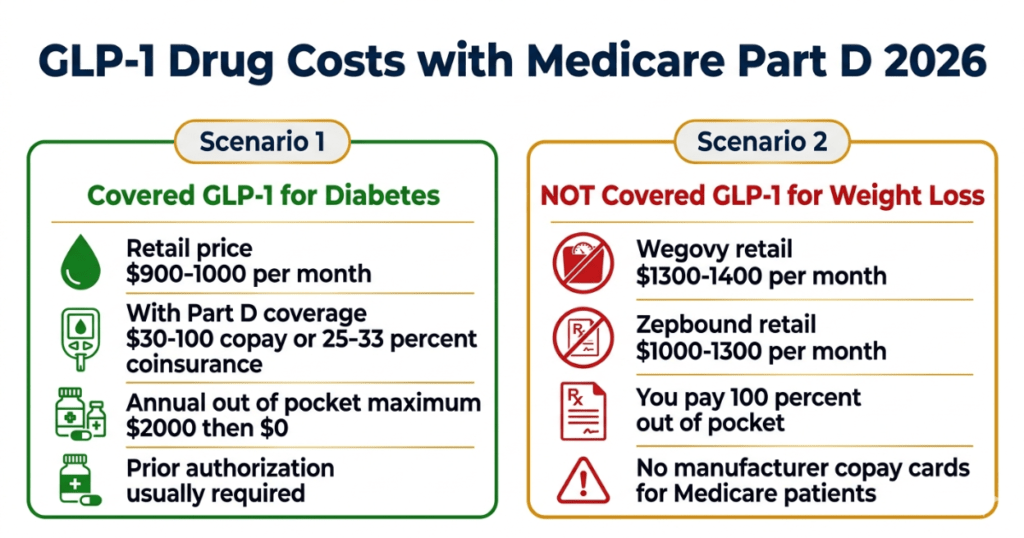
Initial coverage phase — after meeting your Part D deductible of up to $590 you pay your plan’s standard copay or coinsurance for the GLP-1 drug. Most GLP-1 diabetes drugs are on Tier 3 or Tier 4 of Part D formularies — copays of $30 to $100 or coinsurance of 25% to 33% depending on your plan.
After reaching $2,000 out-of-pocket maximum — Medicare pays 100% of all covered drug costs for the rest of the year including GLP-1 drugs. Given the high cost of GLP-1 medications many patients reach the $2,000 maximum relatively quickly in the year.
GLP-1 Drugs NOT Covered by Medicare for Weight Loss
For GLP-1 drugs not covered by Medicare — Wegovy or Zepbound for weight loss without cardiovascular disease — you pay 100% out of pocket:
- Wegovy — approximately $1,300 to $1,400 per month retail price
- Zepbound — approximately $1,000 to $1,300 per month retail price
- Saxenda — approximately $1,400 to $1,500 per month retail price
Manufacturer savings programs — Novo Nordisk and Eli Lilly offer savings cards and patient assistance programs for their GLP-1 medications. However these programs typically are not available to Medicare beneficiaries because federal law generally prohibits drug manufacturers from offering co-pay assistance to Medicare patients.
Does Medicare Advantage Cover GLP-1 Drugs in 2026?
Does Medicare Advantage cover GLP-1 drugs in 2026? Medicare Advantage plans with drug coverage — MAPDs — follow the same Part D coverage rules as standalone Part D plans. This means:
Medicare Advantage plans cover GLP-1 drugs for type 2 diabetes — subject to formulary placement, prior authorization, and cost-sharing requirements specific to each plan.
Medicare Advantage plans cover Wegovy and Zepbound for patients with cardiovascular disease under the 2025 rule change — same as standalone Part D plans.
Medicare Advantage plans do not cover GLP-1 drugs for weight loss without cardiovascular disease — same prohibition applies.
However some Medicare Advantage plans have begun offering supplemental benefits beyond standard Medicare coverage. A small number of Medicare Advantage plans in 2026 offer coverage for weight management medications as an enhanced supplemental benefit. This is not universal — only certain plans in certain markets — but it represents an expanding trend. Always check the specific drug formulary of any Medicare Advantage plan you are considering to see whether GLP-1 drugs are covered and under what conditions.
How to Get Medicare to Cover Your GLP-1 Drug in 2026
If you need a GLP-1 drug and want Medicare coverage here are practical steps to take:
Step 1 — Confirm your diagnosis and indication
Work with your doctor to confirm whether your GLP-1 drug is being prescribed for type 2 diabetes — which Medicare covers — or primarily for weight loss — which Medicare generally does not cover. Your doctor’s documentation of the indication is critical for Medicare coverage.
Step 2 — Check your Part D formulary
Use the Medicare plan finder at Medicare.gov to check whether your specific GLP-1 drug is on your plan’s formulary and what tier it is placed on. Different plans have different formularies — switching to a plan with better GLP-1 coverage during Open Enrollment may reduce your costs.
Step 3 — Request prior authorization
Most Part D plans require prior authorization for GLP-1 drugs. Your doctor must submit documentation of your diagnosis and medical necessity. Work closely with your doctor’s office to ensure prior authorization is submitted promptly and completely.
Step 4 — Appeal a denial
If your Part D plan denies coverage for your GLP-1 drug you have the right to appeal. Your doctor can request an exception based on medical necessity. Appeals are often successful when the medical documentation is strong.
Step 5 — Consider Open Enrollment plan switching
During Medicare Open Enrollment (October 15 to December 7) compare Part D plans based on GLP-1 drug coverage. Some plans have lower cost-sharing for specific GLP-1 drugs than others. Switching to a plan with better GLP-1 coverage could save you hundreds of dollars per year.
Frequently Asked Questions — Does Medicare Cover GLP-1 Drugs 2026
Does Medicare cover Ozempic in 2026?
Yes — Medicare Part D covers Ozempic (semaglutide) when prescribed for type 2 diabetes. Most Medicare Part D plans include Ozempic on their formulary at Tier 3 or Tier 4 with copays of $30 to $100 per month or coinsurance of 25% to 33%. Prior authorization is commonly required. Medicare does not cover Ozempic when prescribed for weight loss only.
Does Medicare cover Wegovy in 2026?
Medicare Part D covers Wegovy (semaglutide) in 2026 for patients with established cardiovascular disease and obesity under the 2025 rule change. Medicare does not cover Wegovy for patients who have obesity or overweight without cardiovascular disease. Patients without cardiovascular disease who want Wegovy for weight loss pay full price out of pocket — approximately $1,300 to $1,400 per month.
Does Medicare cover Mounjaro in 2026?
Yes — Medicare Part D covers Mounjaro (tirzepatide) when prescribed for type 2 diabetes. Medicare does not cover Mounjaro for weight loss. The weight loss version of tirzepatide — Zepbound — may be covered for patients with cardiovascular disease under the 2025 rule change.
How much does Ozempic cost with Medicare in 2026?
With Medicare Part D coverage your cost for Ozempic depends on your specific plan’s tier placement and cost-sharing. Most plans place Ozempic on Tier 3 or Tier 4 with copays of $30 to $100 per month or coinsurance of 25% to 33%. With the $2,000 annual Part D out-of-pocket maximum you will never pay more than $2,000 for all covered drugs combined in 2026.
Why does Medicare not cover GLP-1 drugs for weight loss?
Federal law — Section 1927(d)(2) of the Social Security Act — prohibits Medicare Part D from covering drugs used exclusively for weight loss or obesity treatment. This law predates GLP-1 medications and was written when weight loss drugs were considered lifestyle medications rather than treatments for serious health conditions. Congressional action would be needed to fully expand Medicare coverage for anti-obesity medications.
Does Medicare Advantage cover GLP-1 drugs?
Medicare Advantage plans with drug coverage follow the same Part D rules as standalone drug plans — covering GLP-1 drugs for diabetes and for cardiovascular risk reduction in qualifying patients but not for weight loss alone. Some Medicare Advantage plans offer GLP-1 weight loss drug coverage as a supplemental benefit but this is not available on most plans. Always check the specific formulary of any Medicare Advantage plan you consider.
Summary — Does Medicare Cover GLP-1 Drugs and Ozempic 2026
Does Medicare cover GLP-1 drugs like Ozempic in 2026? The answer depends on the indication. Medicare Part D covers GLP-1 drugs — including Ozempic, Mounjaro, Trulicity, and Victoza — when prescribed for type 2 diabetes. Medicare now covers Wegovy and Zepbound for patients with established cardiovascular disease and obesity under the 2025 rule change. Medicare does not cover GLP-1 drugs for weight loss in patients without cardiovascular disease.
The $2,000 annual Part D out-of-pocket maximum in 2026 provides important financial protection for Medicare beneficiaries who need expensive GLP-1 medications for diabetes treatment.
For free help understanding your Medicare drug coverage for GLP-1 medications contact your State Health Insurance Assistance Program (SHIP) counselor at shiphelp.org or call Medicare free at 1-800-633-4227.
This guide is for informational purposes only and is not medical advice. Always consult your doctor and verify current Medicare drug coverage at Medicare.gov before making medication decisions.
Sources: Medicare.gov | CMS.gov | SSA.gov | AARP.org
Last updated: April 2026 | Author: James Carter, Independent Medicare Research Analyst