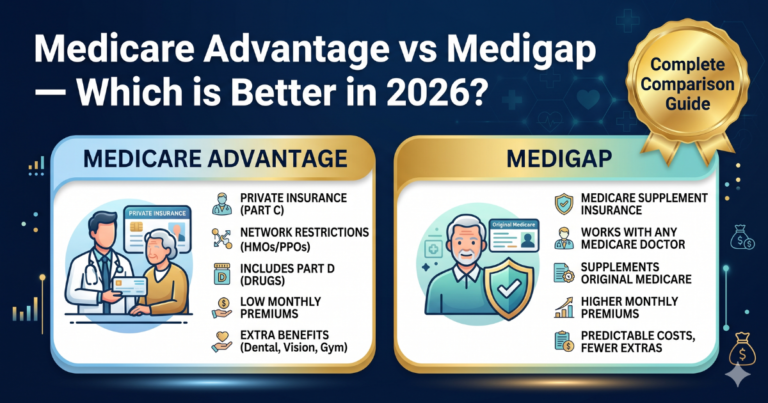
Medicare Advantage vs Medicare Supplement — Which Is Better 2026
Medicare Advantage vs Medicare Supplement — which is better in 2026? This is the single most important Medicare decision most beneficiaries will make — and it is a decision with significant financial, healthcare access, and quality-of-life consequences. Both Medicare Advantage and Medicare Supplement (Medigap) are excellent options for the right beneficiary in the right situation — but they work completely differently and serve different needs. In this complete comparison guide we break down every important difference between Medicare Advantage and Medicare Supplement in 2026 so you can make the most informed Medicare decision for your specific situation. All information is sourced from Medicare.gov and CMS.gov.
Also Read —
- Medicare Part D Drug Coverage Explained Simply 2026
- Best Medicare Supplement Plans 2026
- Medigap Plan G vs Plan N 2026
What You Will Learn — Medicare Advantage vs Medicare Supplement 2026
- How Medicare Advantage and Medicare Supplement work differently
- The key differences between Medicare Advantage and Medigap
- Costs comparison — Medicare Advantage vs Supplement
- Provider access — Medicare Advantage vs Supplement
- Extra benefits comparison
- Who should choose Medicare Advantage
- Who should choose Medicare Supplement
- Can you switch between Medicare Advantage and Medigap
- Frequently asked questions about Medicare Advantage vs Medicare Supplement 2026
How Medicare Advantage and Medicare Supplement Work Differently
Before comparing Medicare Advantage vs Medicare Supplement it is essential to understand how each works — because they are fundamentally different approaches to Medicare coverage.
How Medicare Advantage Works
Medicare Advantage — also called Medicare Part C — replaces your Original Medicare coverage. When you enroll in Medicare Advantage your coverage comes from a private insurance company that has contracted with Medicare rather than directly from the federal government. Your Medicare Advantage plan must cover everything Original Medicare covers plus usually significant additional benefits.
Medicare Advantage is an all-in-one plan — typically including medical coverage, hospital coverage, prescription drug coverage, and extra benefits like dental, vision, and hearing — usually for $0 additional monthly premium beyond the standard Part B premium.
Medicare Advantage plans use network restrictions — typically HMO or PPO structures — and often require referrals, prior authorizations, and in-network provider usage for full coverage.
How Medicare Supplement Works
Medicare Supplement — also called Medigap — works alongside Original Medicare rather than replacing it. When you have Medigap you have both Original Medicare Parts A and B and a supplemental insurance policy that covers some or all of the cost-sharing that Original Medicare does not pay — deductibles, coinsurance, and copays.
With Medigap Plan G — the most popular supplement — you pay the $257 annual Part B deductible and then Original Medicare plus your Medigap plan cover 100% of all Medicare-approved costs. You have virtually no out-of-pocket costs for covered services after the annual deductible.
Medicare Supplement does not include prescription drug coverage — you must purchase a separate Medicare Part D plan. It also does not include extra benefits like dental, vision, or hearing.
Key Differences — Medicare Advantage vs Medicare Supplement 2026
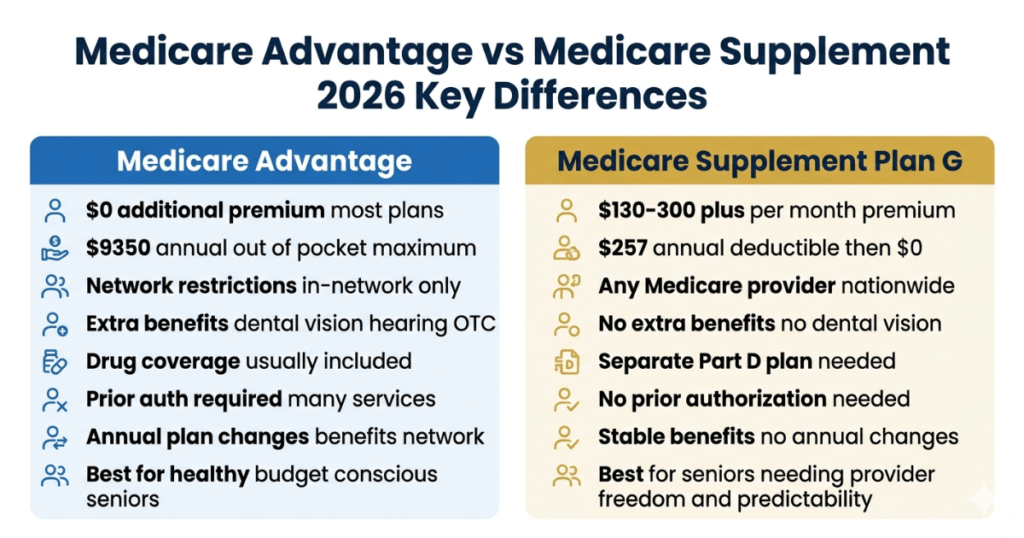
Here is a comprehensive side-by-side comparison of the key differences between Medicare Advantage and Medicare Supplement in 2026:
Monthly Premium
Medicare Advantage — most plans charge $0 additional monthly premium beyond the $185 Part B premium. Total monthly Medicare cost — $185 per month. Some plans even offer Part B premium reductions reducing the effective monthly cost below $185.
Medicare Supplement Plan G — monthly premium of $95 to $300+ depending on age, state, and company. Plus $185 Part B premium. Plus $46 average Part D premium. Total monthly cost — $326 to $531+ per month.
Annual Deductible
Medicare Advantage — many plans have $0 medical deductible.
Medicare Supplement Plan G — $257 annual Part B deductible. After that $0 deductible for most services.
Out-of-Pocket Maximum
Medicare Advantage — $9,350 annual in-network maximum. After reaching this limit plan pays 100%.
Medicare Supplement Plan G — effectively $0 after the $257 annual deductible for all Medicare-approved services. No annual maximum needed because cost-sharing is covered.
Provider Network
Medicare Advantage — network restrictions apply. HMO plans require in-network providers. PPO plans allow out-of-network at higher cost. Must verify doctors are in-network before enrolling.
Medicare Supplement — no network restrictions. Accepted by any Medicare-accepting provider anywhere in the United States and some international coverage. Complete freedom to see any doctor or go to any hospital.
Prescription Drug Coverage
Medicare Advantage — usually includes Part D drug coverage at no additional premium. Drug benefits vary by plan.
Medicare Supplement — does not include drug coverage. Requires a separate Part D plan at additional cost averaging $46 per month.
Extra Benefits
Medicare Advantage — comprehensive extra benefits including dental, vision, hearing, OTC allowances, fitness, transportation, and more.
Medicare Supplement — no extra benefits. Does not include dental, vision, hearing, or OTC allowances.
Prior Authorization
Medicare Advantage — prior authorization frequently required for specialist visits, surgeries, procedures, and medications.
Medicare Supplement — no prior authorization required. Original Medicare does not use prior authorization for most services.
Referrals Required
Medicare Advantage HMO — referrals typically required for specialist visits.
Medicare Supplement — no referrals needed. Direct access to any specialist or specialist center nationwide.
Geographic Coverage
Medicare Advantage — coverage limited to plan’s service area for non-emergency care. Problems can arise when traveling or living in multiple locations seasonally.
Medicare Supplement — nationwide coverage at any Medicare-accepting provider. Excellent for travelers and snowbirds.
Annual Plan Changes
Medicare Advantage — plans can change premiums, benefits, networks, and formularies annually on January 1. You must review your plan every year.
Medicare Supplement — standardized plans with consistent benefits. Premiums may increase with age and medical inflation but benefits are stable.
Enrollment Flexibility
Medicare Advantage — can switch plans annually during Open Enrollment October 15 to December 7. Generally not subject to medical underwriting when switching between Advantage plans.
Medicare Supplement — after the initial 6-month open enrollment period at age 65 switching Medigap plans requires medical underwriting in most states. Once enrolled in a good Medigap plan most beneficiaries keep it long-term.
Cost Comparison — Medicare Advantage vs Supplement 2026
Understanding the true cost comparison between Medicare Advantage and Medicare Supplement requires looking beyond monthly premiums to total annual costs.
Medicare Advantage True Annual Cost
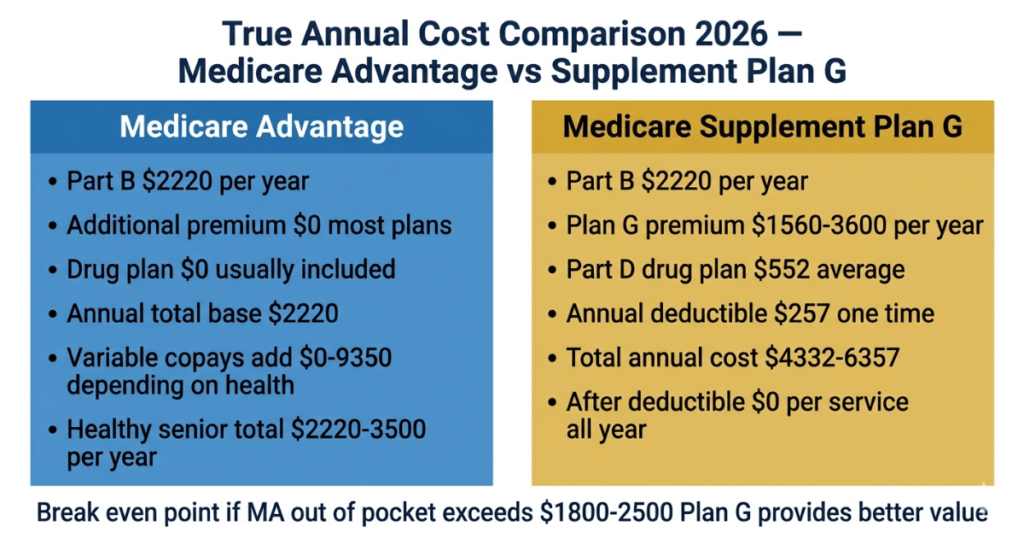
Monthly premiums — $185 per month Part B = $2,220 per year Plus average drug plan cost — $0 (usually included) Plus average out-of-pocket costs — varies widely by health usage Maximum possible out-of-pocket — $9,350
For a healthy senior with low healthcare usage:
- Total annual cost — $2,220 to $3,500 including typical copays
- Medicare Advantage is significantly less expensive than Supplement
For a senior with serious illness or high healthcare usage:
- Total annual cost could approach $9,350 maximum
- After reaching maximum — $0 additional cost
Medicare Supplement Plan G True Annual Cost
Monthly premiums — $185 Part B + $130 average Plan G + $46 Part D = $361 per month Annual total — $4,332 per year
After $257 annual deductible — $0 additional cost for virtually all Medicare-approved services
For any level of healthcare usage:
- Total annual cost — $4,332 to $4,589 maximum (premium plus deductible)
- Completely predictable costs regardless of health status
The Break-Even Analysis
Medicare Advantage vs Medicare Supplement break-even point in 2026:
If your total out-of-pocket Medicare Advantage costs — copays, coinsurance, drug costs — exceed the additional premium you would pay for Medigap Plan G then Medigap is the better financial choice.
The additional annual cost of Medigap Plan G over Medicare Advantage — approximately $1,800 to $2,500 per year.
If your annual out-of-pocket costs under Medicare Advantage exceed $1,800 to $2,500 Medigap Plan G is the better financial value. If they are below that threshold Medicare Advantage is less expensive.
For healthy beneficiaries with low healthcare usage Medicare Advantage is usually less expensive. For seniors with significant health conditions or high healthcare usage Medigap Plan G often provides better financial value.
Provider Access — Medicare Advantage vs Supplement
Medicare Supplement — Maximum Provider Freedom
One of the most significant advantages of Medicare Supplement over Medicare Advantage is complete provider freedom. With Medigap Plan G you can see any doctor, any specialist, or go to any hospital that accepts Medicare — anywhere in the United States — without any network restrictions, referrals, or prior authorizations.
This provider freedom is critically important for:
- Seniors who want access to top academic medical centers — Mayo Clinic, Johns Hopkins, MD Anderson, Cleveland Clinic
- Seniors with complex medical conditions requiring multiple specialists
- Snowbirds and travelers who spend time in multiple states
- Seniors in rural areas where Medicare Advantage networks may be very limited
- Seniors who have established relationships with specific doctors they do not want to lose
Medicare Advantage — Network Restrictions
Medicare Advantage plans restrict your provider access to their contracted network. While most plans include many local providers the network may not include:
- Specialized cancer centers
- Academic medical centers
- Certain specialists
- Hospitals in other states for non-emergency care
Before enrolling in any Medicare Advantage plan verify that all your current doctors — primary care, specialists, and hospitals — are in the plan’s network. Network changes happen annually — doctors can leave networks on January 1.
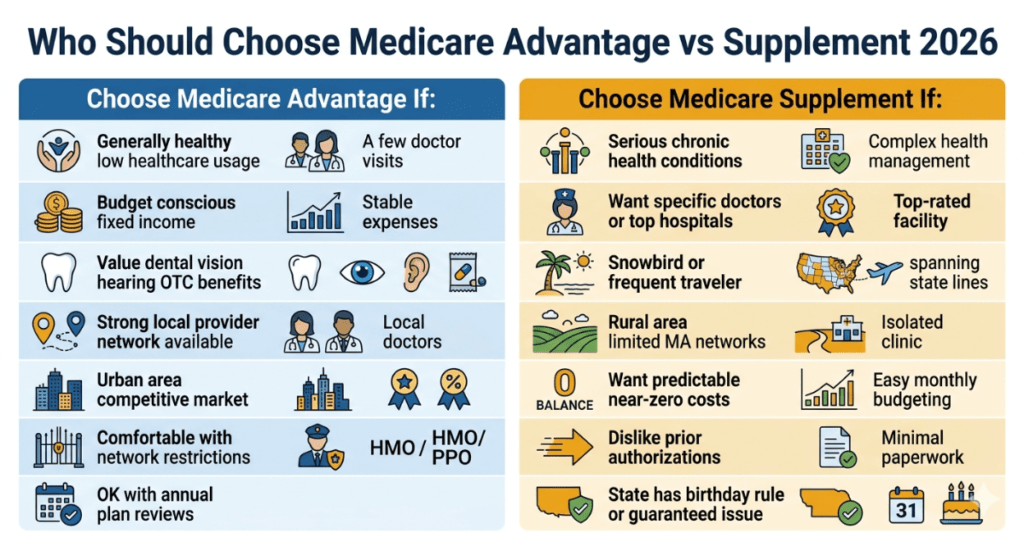
Who Should Choose Medicare Advantage?
Medicare Advantage is often the better choice for:
Generally Healthy Seniors
Seniors in good health who use healthcare infrequently — regular preventive care and occasional doctor visits — typically pay much less with Medicare Advantage than with Medigap. The low or $0 premium advantage is significant for low-utilization seniors.
Budget-Conscious Seniors
For seniors on fixed incomes the $0 premium Medicare Advantage plans provide essential coverage at the lowest possible monthly cost. The risk of higher out-of-pocket costs exists but the monthly savings are substantial — $130 to $300+ per month compared to Medigap.
Seniors Who Value Extra Benefits
Dental, vision, hearing, OTC allowances, fitness memberships, and transportation benefits are available through Medicare Advantage but not through Medicare Supplement. For seniors who heavily use these extra benefits Medicare Advantage provides significant additional value.
Urban Seniors with Good Networks
Seniors in major metropolitan areas with competitive Medicare Advantage markets often have access to high-rated plans with strong networks including most major local providers. In these markets Medicare Advantage can offer excellent coverage at low cost.
Who Should Choose Medicare Supplement?
Medicare Supplement is often the better choice for:
Seniors with Serious or Chronic Health Conditions
Seniors with cancer, heart disease, diabetes, COPD, or other significant chronic conditions typically use more healthcare — and the predictable near-zero cost structure of Medigap Plan G provides better financial protection than Medicare Advantage’s variable cost-sharing.
Seniors Who Want Specific Providers
If you want guaranteed access to specific doctors, specialists, or medical centers — particularly top academic medical centers like Mayo Clinic, Johns Hopkins, or Cleveland Clinic — Medicare Supplement is the only option that guarantees unrestricted access.
Snowbirds and Frequent Travelers
Seniors who spend significant time in multiple states or travel internationally need the nationwide provider freedom that Medicare Supplement provides. Medicare Advantage restricts non-emergency coverage to the plan’s service area.
Rural Seniors
Seniors in rural areas where Medicare Advantage networks are very limited or nonexistent have limited choice — Medicare Supplement with Original Medicare is often the only viable option for comprehensive coverage.
Seniors Who Dislike Uncertainty
Some seniors prefer the predictability of Medicare Supplement — knowing that their maximum annual out-of-pocket cost is $257 plus their monthly premium is psychologically and financially reassuring. Medicare Advantage’s variable cost-sharing creates unpredictability.
Seniors in States with Birthday Rules or Guaranteed Issue
Seniors in California, Oregon, Washington, New York, Massachusetts, and Connecticut — which have birthday rules or year-round guaranteed issue Medigap protections — have more flexibility to start with Medigap and switch if needed. These state protections make Medigap a lower-risk choice in these states.
Can You Switch Between Medicare Advantage and Medigap?
Can you switch from Medicare Advantage to Medicare Supplement or vice versa in 2026? Yes — but with important limitations that vary significantly by state.
Switching from Medigap to Medicare Advantage
Switching from Medicare Supplement to Medicare Advantage is straightforward — enroll in a Medicare Advantage plan during the Annual Election Period October 15 to December 7. No underwriting required. Your Medigap plan is cancelled and your Medicare Advantage coverage begins January 1.
Switching from Medicare Advantage to Medigap
Switching from Medicare Advantage back to Medicare Supplement is significantly more complex and potentially risky in most states. After the initial Medigap open enrollment period at age 65 most states allow Medigap companies to use medical underwriting — meaning they can deny you coverage or charge higher premiums based on your health conditions.
States with guaranteed issue protections:
- New York, Massachusetts, Connecticut — year-round guaranteed issue — no underwriting ever
- California, Oregon, Washington — birthday rule — annual 30-day window without underwriting
- Several other states — limited guaranteed issue rights in specific circumstances
In states without these protections switching from Medicare Advantage to Medigap after age 65 carries the real risk of being denied Medigap coverage due to health conditions. This risk should be carefully considered before initially choosing Medicare Advantage.
Frequently Asked Questions — Medicare Advantage vs Medicare Supplement 2026
Which is better — Medicare Advantage or Medicare Supplement in 2026?
Neither is universally better — the best choice depends entirely on your individual health status, budget, provider preferences, and geographic location. Medicare Advantage is typically better for healthy seniors on tight budgets who value extra benefits and have good local networks. Medicare Supplement is typically better for seniors with significant health conditions, those who want unrestricted provider access including top medical centers, rural seniors, and snowbirds.
Is Medicare Supplement Plan G worth the extra cost over Medicare Advantage?
Medigap Plan G is worth the additional monthly cost — approximately $130 to $300 per month above Medicare Advantage — if your annual out-of-pocket costs under Medicare Advantage would exceed that amount. For seniors with significant health conditions Plan G’s predictable near-zero cost after the $257 deductible often provides better financial value than Medicare Advantage’s variable cost-sharing up to $9,350.
Can I have both Medicare Advantage and Medicare Supplement?
No — you cannot use Medicare Supplement alongside Medicare Advantage. Medigap is designed to fill gaps in Original Medicare not Medicare Advantage. If you enroll in Medicare Advantage your Medigap plan provides no benefit. Medicare Supplement only works with Original Medicare Parts A and B.
What happens to my Medigap plan if I switch to Medicare Advantage?
When you switch to Medicare Advantage you should cancel your Medigap plan — it provides no benefit while you are in Medicare Advantage and you would continue paying the premium unnecessarily. Notify your Medigap insurer to cancel your policy when your Medicare Advantage coverage begins.
Is it hard to switch from Medicare Advantage to Medicare Supplement?
In most states switching from Medicare Advantage to Medicare Supplement after the initial open enrollment period at age 65 requires passing medical underwriting. You can be denied coverage or charged higher premiums based on health conditions. In states with birthday rules or guaranteed issue protections the switch is much easier. Always check your state’s Medigap rules before making the initial choice between Medicare Advantage and Medigap.
Summary — Medicare Advantage vs Medicare Supplement 2026
Medicare Advantage vs Medicare Supplement — which is better in 2026? The answer depends entirely on your individual situation. Medicare Advantage offers lower monthly costs, extra benefits, and an annual out-of-pocket maximum — at the cost of network restrictions, prior authorizations, and annual plan changes. Medicare Supplement Plan G offers predictable near-zero cost-sharing, complete provider freedom, and nationwide coverage — at a higher monthly premium.
For many healthy budget-conscious seniors in competitive metropolitan areas Medicare Advantage is an excellent and financially smart choice. For seniors with serious health conditions, those wanting access to top medical centers, rural seniors, and snowbirds Medicare Supplement Plan G provides superior protection and access — often worth the higher premium.
The most important advice — make this decision carefully before age 65 during your initial Medicare enrollment. Switching from Medicare Advantage to Medigap after age 65 is difficult in most states and may be impossible if health conditions develop.
For free personalized help choosing between Medicare Advantage and Medicare Supplement contact your State Health Insurance Assistance Program (SHIP) at shiphelp.org or call Medicare free at 1-800-633-4227.
This guide is for informational purposes only and is not medical or financial advice. Always verify current Medicare plan details at Medicare.gov before making enrollment decisions.
Sources: Medicare.gov | CMS.gov | SSA.gov | AARP.org
Last updated: April 2026 | Author: James Carter, Independent Medicare Research Analyst