
Medicare Star Ratings 2026 — Complete Guide
Medicare star ratings 2026 are one of the most important tools available to Medicare beneficiaries when comparing and choosing Medicare plans. Every Medicare Advantage plan and every Medicare Part D drug plan receives an annual star rating from the Centers for Medicare and Medicaid Services — ranging from 1 star (poor) to 5 stars (excellent). Understanding how Medicare star ratings work helps you identify high-quality plans, avoid poor-performing plans, and make smarter Medicare decisions during Open Enrollment. In this complete guide we explain everything about Medicare star ratings 2026 — how they are calculated, what they measure, how to find them, and why they matter for your healthcare. All information is sourced from Medicare.gov and CMS.gov.
Also Read —
- Medicare Open Enrollment 2026 Complete Guide
- Medicare Advantage vs Original Medicare 2026
- How to Switch Medicare Plans 2026
What You Will Learn — Medicare Star Ratings 2026
- What are Medicare star ratings 2026
- How Medicare star ratings are calculated
- What Medicare star ratings measure
- The Medicare star rating scale explained
- Why Medicare star ratings matter when choosing a plan
- How to find Medicare star ratings for plans in your area
- The 5-star Special Enrollment Period
- How Medicare star ratings affect plan payments
- Frequently asked questions about Medicare star ratings 2026
What Are Medicare Star Ratings 2026?
Medicare star ratings 2026 are annual quality scores assigned by the Centers for Medicare and Medicaid Services to every Medicare Advantage plan and Medicare Part D drug plan in the country. The star rating system uses a scale of 1 to 5 stars — with 5 stars representing the highest quality and 1 star representing the lowest quality.
Medicare star ratings give beneficiaries an objective, standardized way to compare the quality of Medicare plans regardless of what benefits or premiums the plan offers. A plan with a 5-star rating has demonstrated excellent quality across multiple measures of healthcare delivery and customer service. A plan with 2 stars or below has significant quality problems that may affect your healthcare experience.
The star rating system was created because Medicare realized that beneficiaries needed more than just premium and benefit comparisons — they needed to know which plans actually delivered quality care and service. Medicare star ratings provide that independent quality assessment.
CMS releases updated Medicare star ratings every fall — typically in October — just before Medicare Open Enrollment begins on October 15. This timing is intentional so beneficiaries can use the latest star ratings when comparing plans during the Open Enrollment window.
The Medicare Star Rating Scale Explained
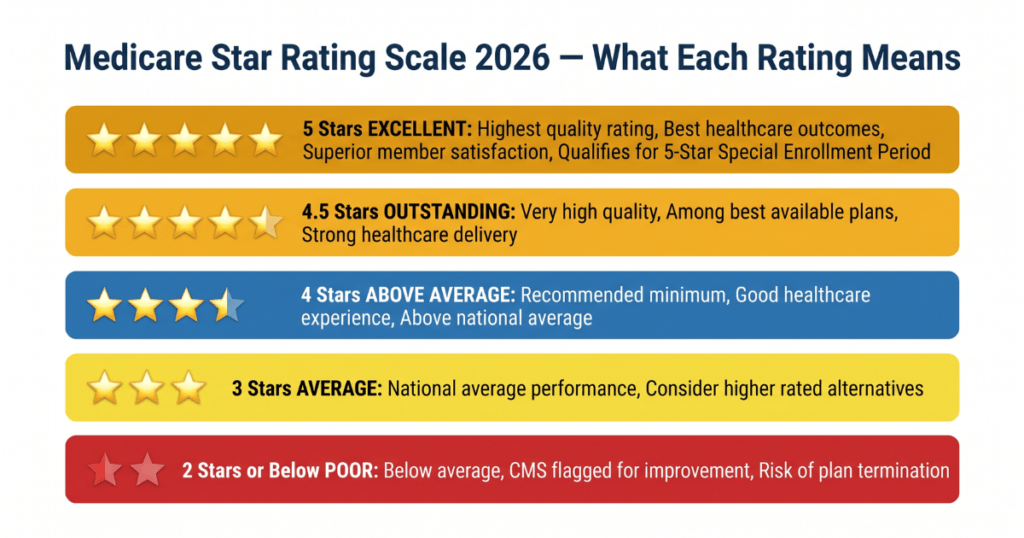
Medicare star ratings use a 1 to 5 star scale with half-star increments. Here is what each rating level means:
5 Stars — Excellent
A 5-star Medicare plan has achieved the highest possible quality rating from CMS. Five-star plans consistently deliver excellent healthcare outcomes, superior member satisfaction, and outstanding customer service. Only a small percentage of Medicare plans nationwide earn 5 stars in any given year. Five-star rated plans qualify for the 5-Star Special Enrollment Period allowing enrollment at any time of year.
4.5 Stars — Excellent to Outstanding
A 4.5-star Medicare plan is performing at a very high level across most quality measures. Plans in this range are among the best available and represent excellent choices for Medicare beneficiaries.
4 Stars — Above Average
A 4-star Medicare plan is performing above average across quality measures. Most Medicare experts recommend choosing plans with 4 stars or higher. Four-star plans generally deliver good healthcare experiences and member satisfaction.
3.5 Stars — Average to Above Average
A 3.5-star plan is performing at or slightly above the national average. These plans are acceptable but not outstanding. Beneficiaries should compare 3.5-star plans carefully against available 4-star alternatives.
3 Stars — Average
A 3-star Medicare plan is performing at the national average. While not necessarily a poor plan a 3-star rating indicates room for improvement. If higher-rated alternatives are available in your area 3-star plans should not be your first choice.
2.5 Stars and Below — Below Average to Poor
Plans with 2.5 stars or below are performing below the national average across quality measures. CMS flags these plans for improvement and beneficiaries should strongly consider alternatives. Plans receiving 2.5 stars or below for three consecutive years face potential termination from the Medicare program.
How Medicare Star Ratings Are Calculated
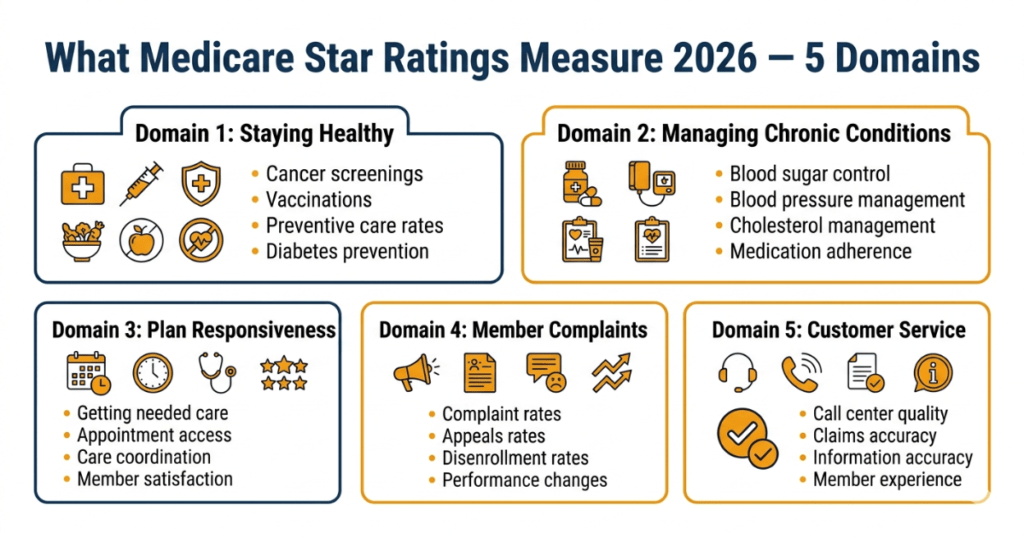
Medicare star ratings 2026 are calculated using up to 40 different quality measures across five domains. Understanding how star ratings are calculated helps you understand what they really measure.
Domain 1 — Staying Healthy: Screenings, Tests, and Vaccines
This domain measures how well a plan helps its members stay healthy through preventive care. Measures include:
- Rates of breast cancer screening among eligible women
- Colorectal cancer screening rates
- Annual flu vaccination rates
- Pneumococcal vaccination rates
- Cardiovascular care screenings
- Diabetes preventive care measures
Domain 2 — Managing Chronic Conditions
This domain measures how well a plan manages members with chronic health conditions. Measures include:
- Blood sugar control in diabetic members
- Cholesterol management for members with cardiovascular disease
- Controlling high blood pressure
- Medication adherence for chronic conditions
- Osteoporosis treatment rates
Domain 3 — Plan Responsiveness and Care
This domain measures how responsive the plan is to member needs and whether members feel their care is well-coordinated. Measures include:
- Getting needed care without difficulty
- Getting appointments and care quickly
- Overall member satisfaction with the plan
- Care coordination quality
- Complaints and problems with the plan
Domain 4 — Member Complaints and Changes in Performance
This domain measures complaint rates, appeals rates, and improvement or decline in performance over time. Measures include:
- Number of complaints filed with Medicare about the plan
- Rate of members choosing to leave the plan
- Appeals filed and decided in the member’s favor
- Adherence to CMS audit standards
Domain 5 — Health Plan Customer Service
This domain measures the quality of customer service provided by the plan. Measures include:
- Call center responsiveness and hold times
- Accuracy of information provided to members
- Claims processing accuracy and timeliness
- Member experience with the plan’s customer service
Weighted Scoring
Not all measures are weighted equally in the Medicare star rating calculation. Some measures — particularly those related to outcomes and member experience — receive more weight than process measures. CMS adjusts the weighting annually to reflect its current quality priorities.
Why Medicare Star Ratings Matter When Choosing a Plan
Medicare star ratings 2026 matter for several important reasons beyond simply indicating quality:
Quality Indicates Better Health Outcomes
Plans with higher star ratings have demonstrated better performance across healthcare quality measures. Members of 4 and 5-star plans tend to receive more appropriate preventive care, have their chronic conditions better managed, and experience fewer problems accessing care. Choosing a higher-rated plan is not just about customer service — it can directly affect your health outcomes.
Star Ratings Indicate Member Satisfaction
Member satisfaction is a significant component of Medicare star ratings. Plans with high ratings have fewer complaints, lower disenrollment rates, and better member experience scores. A 4 or 5-star rating is a strong signal that existing members are happy with the plan.
Star Ratings Affect Plan Benefits
CMS provides bonus payments to Medicare Advantage plans earning 4 stars or higher. These bonus payments — called Quality Bonus Payments — allow high-rated plans to reinvest in better benefits for members. This is one reason why 4 and 5-star plans often have more comprehensive dental, vision, hearing, and OTC benefits than lower-rated plans. The financial incentive for earning high star ratings creates a virtuous cycle of quality improvement.
Lower-Rated Plans May Face Termination
CMS can terminate Medicare contracts for plans that consistently receive low star ratings. Plans receiving below 3 stars for three or more consecutive years may lose their Medicare certification — leaving members needing to switch plans. Avoiding consistently low-rated plans reduces the risk of unexpected plan termination.
How to Find Medicare Star Ratings for Plans in Your Area
Finding Medicare star ratings 2026 for plans available in your area is straightforward:
Method 1 — Medicare Plan Finder
The easiest way to find Medicare star ratings is through Medicare.gov/plan-compare:
- Enter your zip code
- Browse available plans
- Star ratings are displayed prominently for each plan
- Filter results to show only 4 and 5-star plans
Method 2 — Medicare.gov Plan Details
Each plan’s individual page on Medicare.gov shows its star rating along with detail on which quality domains contributed to the rating.
Method 3 — Medicare and You Handbook
The annual Medicare and You handbook published each fall includes information about star ratings and how to use them when comparing plans.
Method 4 — Plan Materials
Medicare Advantage plans with strong star ratings prominently display them in their marketing materials, websites, and enrollment documents. If a plan does not prominently feature its star rating that may be a signal the rating is not favorable.
The 5-Star Special Enrollment Period
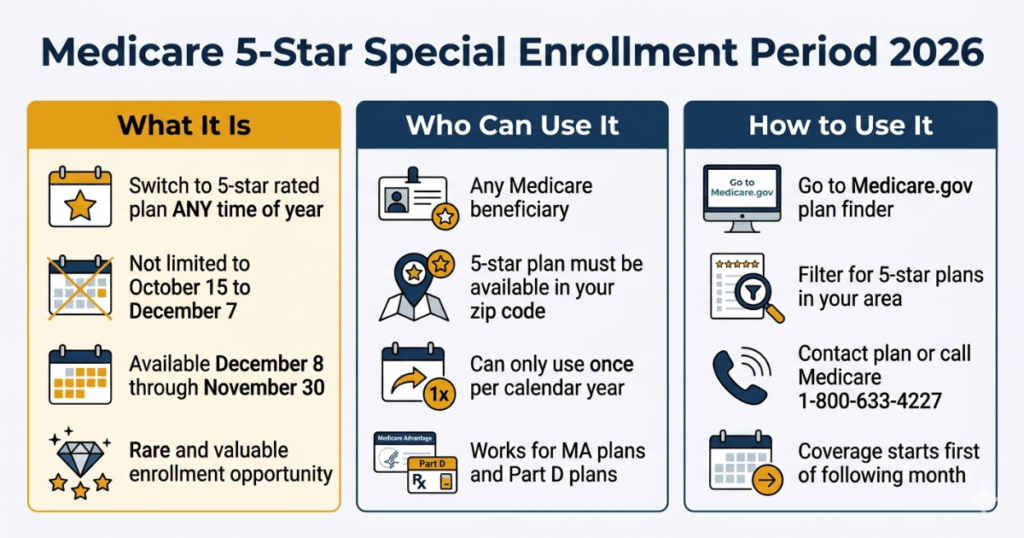
One of the most valuable — and least known — benefits of Medicare’s star rating system is the 5-Star Special Enrollment Period. This enrollment window is exclusively available for 5-star rated plans.
What Is the 5-Star Special Enrollment Period?
If a Medicare Advantage plan or Part D drug plan in your area earns a 5-star quality rating you can switch to that plan at any time of year — not just during the Annual Election Period or Medicare Advantage Open Enrollment Period. The 5-Star Special Enrollment Period runs from December 8 through November 30 of the following year.
You can use the 5-Star Special Enrollment Period once per calendar year to switch to a 5-star rated plan. This gives beneficiaries who discover a 5-star plan during the year an opportunity to access that higher quality coverage without waiting until Open Enrollment.
How to Use the 5-Star Special Enrollment Period
To use the 5-Star Special Enrollment Period:
- Confirm a 5-star rated Medicare Advantage or Part D plan is available in your area on Medicare.gov
- Contact the plan directly or call Medicare at 1-800-633-4227
- Enroll in the 5-star plan — your new coverage begins the first day of the following month
- You can only use this SEP once per calendar year
Medicare Star Ratings and Plan Payments
Medicare star ratings directly affect how much CMS pays Medicare Advantage plans — creating significant financial incentives for plans to earn high ratings.
Quality Bonus Payments
Medicare Advantage plans earning 4 stars or higher receive Quality Bonus Payments from CMS — additional per-member payments above the standard Medicare payment rate. Plans earning 5 stars receive the maximum bonus payment. These bonus payments can be used by plans to:
- Reduce member premiums including offering $0 premium plans
- Enhance extra benefits — dental, vision, hearing, OTC allowances
- Reduce copays and cost-sharing
- Invest in quality improvement programs
This is why high-rated plans often offer better benefits at lower costs than low-rated plans. The financial incentive of earning 4 or 5 stars motivates plans to continuously improve their quality scores.
Low Star Rating Consequences
Plans earning low star ratings face:
- Reduced CMS payments — less money to fund benefits
- Mandatory member notification that their plan received a low rating
- Potential CMS audit and corrective action requirements
- Risk of contract termination after three consecutive years below 3 stars
- Enrollment restrictions — CMS can limit enrollment in consistently low-rated plans
Medicare Star Ratings by Major Insurer 2026
Here is a general overview of how major Medicare Advantage insurers perform on star ratings nationally. Note that star ratings vary significantly by plan and geographic market — always check the specific plan in your area:
Kaiser Permanente Consistently earns 4.5 to 5 stars in most markets — particularly California, Colorado, Oregon, and Washington. Kaiser is the national leader in Medicare star ratings and is the benchmark other insurers strive to match.
UnitedHealthcare AARP Generally earns 4 to 4.5 stars in most markets. UnitedHealthcare has a large number of highly rated plans across the country making it one of the most consistently strong performers nationally.
Aetna Generally earns 3.5 to 4.5 stars in most markets. Aetna has improved its star ratings significantly in recent years.
Humana Generally earns 3.5 to 4 stars in most markets. Humana has some 4.5-star plans in select markets.
Anthem Blue Cross Blue Shield Generally earns 3.5 to 4 stars depending on state and specific plan.
Cigna Generally earns 3.5 to 4 stars in covered markets.
WellCare Generally earns 3 to 3.5 stars — below the national average in many markets.
Always verify the specific star rating for the plan in your zip code on Medicare.gov rather than relying on general national insurer averages.
Frequently Asked Questions — Medicare Star Ratings 2026
What are Medicare star ratings?
Medicare star ratings are annual quality scores assigned by CMS to every Medicare Advantage and Part D plan on a 1 to 5 star scale. Five stars is the highest rating indicating excellent quality care and service. Star ratings measure preventive care, chronic disease management, member satisfaction, complaint rates, and customer service. Plans with 4 stars or higher are generally recommended for Medicare beneficiaries.
How are Medicare star ratings calculated?
Medicare star ratings 2026 are calculated using up to 40 quality measures across five domains including preventive care screenings, chronic condition management, plan responsiveness, member complaint rates, and customer service quality. CMS weights each measure differently and releases updated ratings each fall before Medicare Open Enrollment.
Do higher star ratings mean better benefits?
Higher-rated plans often offer better benefits because CMS provides Quality Bonus Payments to plans earning 4 stars or higher. These bonus payments give high-rated plans more money to invest in better dental, vision, hearing, and OTC benefits and lower premiums. However benefits and star ratings are separate — always compare both when choosing a plan.
What is the 5-Star Special Enrollment Period?
The 5-Star Special Enrollment Period allows Medicare beneficiaries to switch to a 5-star rated Medicare Advantage or Part D plan at any time of year — not just during Open Enrollment. This SEP runs December 8 through November 30 and can be used once per calendar year. Check Medicare.gov to see if a 5-star rated plan is available in your area.
Where can I find Medicare star ratings for plans near me?
Find Medicare star ratings at Medicare.gov/plan-compare. Enter your zip code, browse available plans, and star ratings are displayed for each plan. You can filter results to show only 4 and 5-star plans.
Summary — Medicare Star Ratings 2026
Medicare star ratings 2026 are an essential tool for comparing Medicare plan quality during Open Enrollment. Plans earning 4 to 5 stars have demonstrated superior healthcare delivery, member satisfaction, and customer service — and often offer better benefits thanks to CMS Quality Bonus Payments. Always check star ratings on Medicare.gov when comparing plans and prioritize 4-star and 5-star options in your area.
For free help understanding Medicare star ratings and finding the best-rated plans in your area contact your State Health Insurance Assistance Program (SHIP) at shiphelp.org or call Medicare free at 1-800-633-4227.
This guide is for informational purposes only and is not medical or financial advice. Always verify current Medicare plan star ratings at Medicare.gov before making enrollment decisions.
Sources: Medicare.gov | CMS.gov | SSA.gov | AARP.org
Last updated: April 2026 | Author: James Carter, Independent Medicare Research Analyst