Does Medicare Cover Hip Replacement Surgery — Complete Guide 2026
Does Medicare cover hip replacement surgery in 2026? If you or a loved one is suffering from severe hip pain or has experienced a hip fracture and needs surgery this complete guide explains exactly how Medicare covers hip replacement. The answer is yes — Medicare does cover hip replacement surgery in 2026 including both elective total hip arthroplasty for arthritis and emergency hip fracture surgery. Hip replacement is one of the most commonly performed orthopedic surgeries among Medicare beneficiaries with over 450,000 procedures performed annually and Medicare covers the vast majority of these procedures. In this complete guide we break down everything you need to know about Medicare hip replacement coverage in 2026 — what is covered, who qualifies, how much hip replacement costs with Medicare, rehabilitation coverage, and how Medicare Advantage handles hip replacement surgery. All information is sourced from Medicare.gov and CMS.gov.
Also Read —
- Does Medicare Cover Knee Replacement Surgery 2026
- Does Medicare Cover Physical Therapy 2026
- Best Medicare Supplement Plans 2026
What You Will Learn — Does Medicare Cover Hip Replacement
- Does Medicare cover hip replacement surgery in 2026
- Who qualifies for Medicare hip replacement coverage
- Which part of Medicare covers hip replacement
- Does Medicare cover emergency hip fracture surgery
- What Medicare covers for hip replacement surgery
- How much does hip replacement cost with Medicare in 2026
- Does Medicare cover hip replacement rehabilitation
- Does Medicare Advantage cover hip replacement
- Frequently asked questions about Medicare hip replacement coverage 2026
Does Medicare Cover Hip Replacement Surgery in 2026?
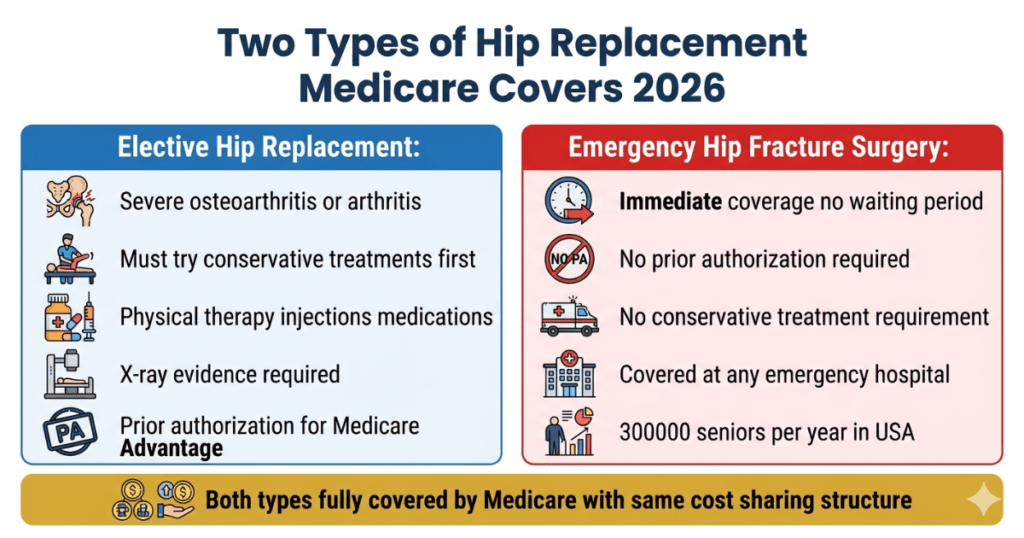
Yes — Medicare does cover hip replacement surgery in 2026. Medicare covers two main types of hip replacement surgery — elective total hip arthroplasty for end-stage hip arthritis and emergency hip fracture surgery for seniors who experience a hip fracture. Both types of hip replacement are covered by Medicare when medically necessary.
Hip replacement is one of the most important and most covered surgical procedures under Medicare because hip fractures are a leading cause of disability and death among seniors. According to the Centers for Disease Control and Prevention approximately 300,000 Americans aged 65 and older are hospitalized for hip fractures every year — and Medicare covers virtually all of these emergency hip procedures.
Does Medicare cover hip replacement for all Medicare beneficiaries? Medicare covers hip replacement for beneficiaries who meet the medical necessity criteria. For elective hip replacement you must meet specific diagnostic and treatment failure criteria. For emergency hip fracture surgery Medicare covers the procedure as medically necessary without the requirement to first try conservative treatments.
Who Qualifies for Medicare Hip Replacement Coverage?
Medicare hip replacement coverage in 2026 applies to two distinct categories of patients with different qualifying criteria.
Elective Hip Replacement — Arthritis and Degenerative Conditions
For elective hip replacement surgery Medicare requires documentation of medical necessity. Qualifying conditions include:
- Severe osteoarthritis of the hip — the most common indication
- Rheumatoid arthritis causing severe hip joint destruction
- Post-traumatic arthritis from previous hip injury
- Avascular necrosis of the femoral head
- Other conditions causing severe hip joint deterioration
For elective hip replacement Medicare also requires documentation of failed conservative treatments:
- Physical therapy — typically 6 to 12 weeks documented
- Anti-inflammatory medications
- Corticosteroid hip injections
- Activity modification
- Assistive devices such as a cane or walker
- Weight loss efforts if applicable
You must also have X-ray or imaging evidence of significant hip joint damage and significant functional impairment affecting your ability to perform daily activities.
Emergency Hip Fracture Surgery
For emergency hip fracture surgery Medicare coverage does not require prior failed conservative treatment. Hip fractures are medical emergencies and Medicare covers surgical treatment — whether hip replacement or other surgical repair — as medically necessary without the standard pre-authorization requirements that apply to elective procedures.
Medicare covers emergency hip fracture surgery including:
- Hemiarthroplasty — replacing only the ball portion of the hip joint — the most common hip fracture surgery
- Total hip arthroplasty — replacing both ball and socket — performed in some hip fracture cases
- ORIF — Open Reduction Internal Fixation — for fractures repaired with hardware rather than replacement
Which Part of Medicare Covers Hip Replacement Surgery?
Medicare Part A — Inpatient Hip Replacement
Hip replacement surgery — particularly emergency hip fracture surgery — is most commonly performed as an inpatient procedure requiring a hospital stay. Medicare Part A covers the hospital facility costs for inpatient hip replacement including the operating room, anesthesia, nursing care, and all hospital services.
Medicare Part A inpatient hip replacement costs:
- Part A deductible — $1,676 per benefit period
- Hospital days 1 to 60 — $0 after deductible
- Hospital days 61 to 90 — $419 per day coinsurance
Medicare Part B — Outpatient Hip Replacement and Surgeon Fee
Elective total hip arthroplasty is increasingly being performed on an outpatient basis for carefully selected patients. When performed outpatient Medicare Part B covers 80% of the Medicare-approved amount after your $257 annual Part B deductible.
Regardless of inpatient or outpatient setting Medicare Part B always covers the orthopedic surgeon’s professional fee at 80% after the Part B deductible.
Does Medicare Cover Emergency Hip Fracture Surgery?
Does Medicare cover emergency hip fracture surgery in 2026? Yes — Medicare provides comprehensive coverage for emergency hip fracture surgery. Hip fractures are among the most serious medical emergencies for seniors and Medicare covers the full range of surgical and post-surgical care.
Emergency hip fracture surgery coverage under Medicare in 2026 includes:
Immediate Emergency Care
Medicare Part B covers emergency ambulance transportation to the hospital — at 80% after deductible — if medically necessary. Medicare Part B covers the emergency room evaluation and stabilization.
Inpatient Surgical Care
Medicare Part A covers the inpatient hospital stay for hip fracture surgery including the operating room, anesthesia, surgical implants and hardware, and all inpatient nursing care. The Part A deductible of $1,676 applies per benefit period.
The Surgical Procedure
Medicare Part B covers the orthopedic surgeon’s fee for hip fracture surgery at 80% after the Part B deductible. The surgeon fee is always a Part B benefit even during an inpatient stay.
Post-Surgical Hospital Care
Medicare Part A covers continued inpatient care following hip fracture surgery for as long as medically necessary — with the standard Part A cost-sharing for days 1 to 60.
Hip fracture recovery is typically more complex than elective hip replacement recovery and Medicare covers the extended post-acute care that hip fracture patients often need.
What Does Medicare Cover for Hip Replacement Surgery?
Medicare covers a comprehensive range of services related to hip replacement surgery in 2026.
Pre-Surgery Services
Medicare covers all medically necessary pre-surgery evaluation and testing:
- Orthopedic surgeon consultation and evaluation
- Pre-operative medical clearance from primary care physician
- Pre-operative laboratory tests
- Pre-operative imaging — X-rays, MRI, CT scan if needed
- Cardiac evaluation if indicated by your health history
- Anesthesia pre-operative evaluation
The Surgery
Medicare covers the complete hip replacement surgical procedure:
- Orthopedic surgeon’s professional fee
- Hospital or surgical facility fees
- Anesthesia services
- Operating room and surgical staff
- Standard hip replacement implant — ball, socket, and stem components
Medicare covers a standard hip replacement implant. Premium implants — highly specialized or custom components that cost significantly above the standard implant — may result in additional out-of-pocket charges beyond the Medicare-approved amount.
Post-Surgical Hospital Care
Medicare Part A covers your inpatient stay following hip replacement. The typical hospital stay for elective hip replacement has shortened significantly — from 3 to 5 days historically to 1 to 2 days or outpatient for carefully selected patients today.
Post-Acute Care
Medicare covers comprehensive post-acute rehabilitation care following hip replacement including skilled nursing facility care, inpatient rehabilitation, home health physical therapy, and outpatient physical therapy — as described in detail below.
How Much Does Hip Replacement Cost with Medicare in 2026?
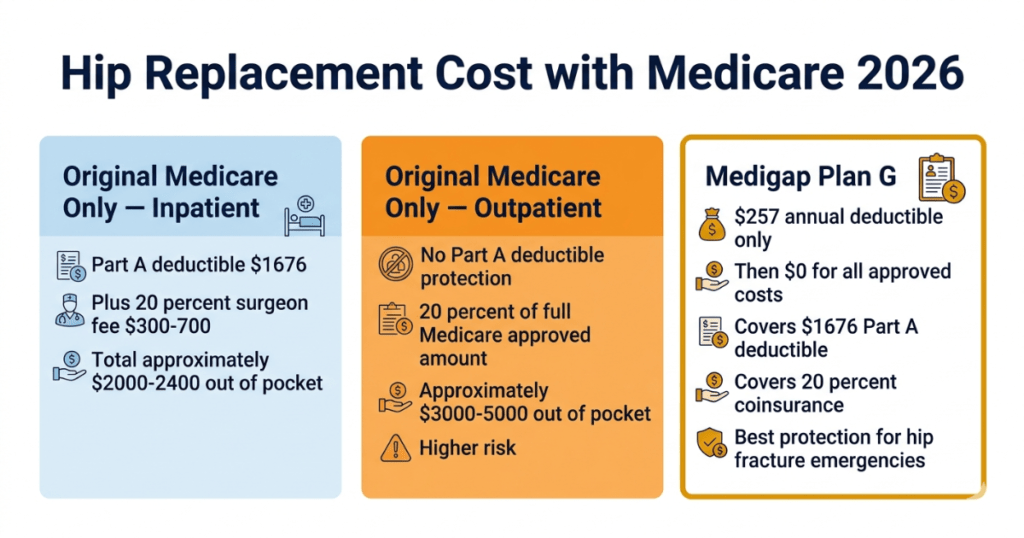
Inpatient Hip Replacement with Original Medicare
Part A costs:
- Part A deductible — $1,676 per benefit period
- Hospital days 1 to 60 — $0 after deductible
Part B costs:
- $257 annual Part B deductible if not yet met
- 20% coinsurance on surgeon fee — approximately $300 to $700
Total out-of-pocket for inpatient hip replacement with Original Medicare:
- Approximately $2,000 to $2,400 without a supplement
Outpatient Hip Replacement with Original Medicare
Part B costs:
- $257 annual Part B deductible
- 20% coinsurance on total Medicare-approved amount — surgeon plus facility
- Medicare-approved total for outpatient hip replacement — approximately $15,000 to $25,000
- Your 20% coinsurance — approximately $3,000 to $5,000
As with knee replacement outpatient hip replacement can cost significantly more out of pocket with Original Medicare than inpatient because Part B covers outpatient facility costs less comprehensively than Part A covers inpatient costs.
With Medigap Plan G
Medigap Plan G provides the most comprehensive financial protection for hip replacement surgery. After your $257 annual Part B deductible Plan G covers 100% of Medicare-approved cost-sharing for both inpatient and outpatient hip replacement. Your effective cost with Plan G after the annual deductible is $0 for all Medicare-approved services.
For patients having emergency hip fracture surgery Medigap Plan G is particularly valuable — it covers the Part A deductible of $1,676 and all coinsurance — providing complete financial protection during what is already a medically and emotionally difficult time.
With Medicare Advantage
Medicare Advantage plans cover hip replacement with their own cost-sharing:
- Prior authorization required for elective procedures
- Emergency hip fracture surgery — covered immediately as emergency care
- Inpatient hip replacement — typically $250 to $500 per day for first few days
- All costs count toward $9,350 annual out-of-pocket maximum
Does Medicare Cover Hip Replacement Rehabilitation?
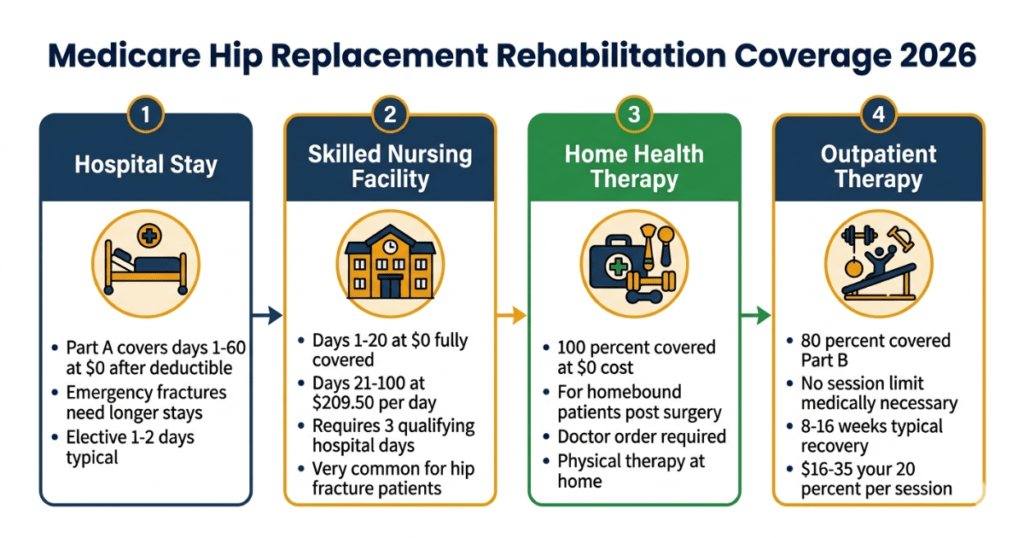
Does Medicare cover hip replacement rehabilitation in 2026? Yes — Medicare provides comprehensive rehabilitation coverage following hip replacement through multiple pathways that together provide a continuum of care from the hospital through full recovery.
Skilled Nursing Facility Rehabilitation
Medicare Part A covers skilled nursing facility care following a qualifying inpatient hospital stay of at least 3 consecutive days. SNF coverage provides:
- Days 1 to 20 — $0 per day — fully covered
- Days 21 to 100 — $209.50 per day coinsurance
- After 100 days — no Medicare coverage
For hip replacement and hip fracture patients SNF coverage is extremely valuable as many patients — particularly those with hip fractures — require several weeks of skilled rehabilitation before returning home.
Inpatient Rehabilitation Facility
For patients who need intensive rehabilitation Medicare Part A covers inpatient rehabilitation facility care following a qualifying hospital stay. IRF provides at least 3 hours per day of physical and occupational therapy — significantly more intensive than SNF rehabilitation.
Home Health Physical Therapy
For homebound patients Medicare covers home health physical therapy at 100% — no deductible or coinsurance. Home health is often used immediately following discharge from the hospital or SNF for patients who are not yet able to travel to outpatient physical therapy.
Outpatient Physical Therapy
Medicare Part B covers outpatient physical therapy rehabilitation at 80% after the $257 annual Part B deductible with no hard session limit. Most hip replacement patients require 8 to 16 weeks of outpatient physical therapy to achieve full recovery.
Does Medicare Advantage Cover Hip Replacement?
Does Medicare Advantage cover hip replacement in 2026? Yes — all Medicare Advantage plans must cover hip replacement as a Medicare-required service. Important Medicare Advantage considerations for hip replacement include:
Prior authorization for elective hip replacement — most plans require prior authorization several weeks before scheduled surgery. Your surgeon’s office handles this process but confirm it is completed early.
Emergency hip fracture — covered immediately as an emergency without prior authorization requirements.
Network requirements — confirm your orthopedic surgeon and the hospital or surgery center are in-network before scheduling elective surgery. For emergency hip fracture surgery Medicare law requires that Medicare Advantage plans cover emergency care at any facility regardless of network status.
Post-surgical care network — verify that your preferred SNF, IRF, or home health agency is in-network before your surgery to avoid unexpected costs during rehabilitation.
Out-of-pocket maximum — all hip replacement and rehabilitation costs count toward your $9,350 annual maximum. Many hip fracture patients reach this maximum during their hospitalization and rehabilitation — after which Medicare Advantage covers 100% of all covered services for the rest of the year.
Frequently Asked Questions — Does Medicare Cover Hip Replacement
Does Medicare cover hip replacement surgery in 2026?
Yes — Medicare covers both elective total hip arthroplasty for arthritis and emergency hip fracture surgery. Medicare Part A covers inpatient facility costs and Medicare Part B covers the surgeon fee and outpatient procedures. Your out-of-pocket costs with Original Medicare are approximately $2,000 to $2,400 for inpatient surgery or $3,000 to $5,000 for outpatient surgery without a supplement.
Does Medicare cover emergency hip fracture surgery?
Yes — Medicare covers emergency hip fracture surgery immediately as a medical emergency without requiring prior authorization or documentation of failed conservative treatments. Medicare Part A covers the hospital stay and Part B covers the surgeon fee. Medigap Plan G covers all Medicare-approved cost-sharing after the annual deductible — including the $1,676 Part A deductible — providing complete financial protection.
How much does hip replacement cost with Medicare in 2026?
With Original Medicare your out-of-pocket cost is approximately $2,000 to $2,400 for inpatient hip replacement or $3,000 to $5,000 for outpatient hip replacement. With Medigap Plan G your effective cost after the $257 annual deductible is $0 for all Medicare-approved costs. Medicare Advantage plans typically cost $250 to $500 per day for the first few hospital days with all costs counting toward your $9,350 annual maximum.
Does Medicare cover hip replacement rehabilitation?
Yes — Medicare covers comprehensive hip replacement rehabilitation including SNF care (days 1 to 20 at $0 then $209.50 per day to day 100), inpatient rehabilitation facility care, home health physical therapy at 100%, and outpatient physical therapy at 80% after deductible with no session limit.
Does Medicare require prior authorization for hip replacement?
Original Medicare does not require prior authorization for hip replacement — medical necessity is determined by your doctor’s documentation. Medicare Advantage plans virtually always require prior authorization for elective hip replacement. Emergency hip fracture surgery does not require prior authorization under any Medicare plan type.
Does Medicare Advantage cover hip replacement?
Yes — all Medicare Advantage plans cover hip replacement. Elective hip replacement requires prior authorization and in-network providers. Emergency hip fracture surgery is covered immediately at any emergency facility. All costs count toward your $9,350 annual out-of-pocket maximum. Confirm network status for your surgeon, hospital, and post-acute care facility before elective surgery.
Summary — Does Medicare Cover Hip Replacement 2026
Does Medicare cover hip replacement surgery in 2026? Yes — Medicare provides comprehensive coverage for both elective total hip arthroplasty and emergency hip fracture surgery. Medicare Part A covers inpatient facility costs and Part B covers surgeon fees and outpatient procedures. Rehabilitation coverage — SNF, home health, and outpatient physical therapy — is also comprehensive.
Medigap Plan G provides the most complete financial protection for hip replacement — covering all Medicare-approved cost-sharing after the $257 annual deductible and making your effective out-of-pocket cost $0. For emergency hip fracture patients this protection is particularly valuable as it covers the $1,676 Part A deductible and all subsequent coinsurance during what is often an extended hospitalization and rehabilitation period.
For free help understanding your Medicare hip replacement coverage contact your State Health Insurance Assistance Program (SHIP) counselor at shiphelp.org or call Medicare free at 1-800-633-4227.
This guide is for informational purposes only and is not medical advice. Always consult your orthopedic surgeon and verify current Medicare coverage at Medicare.gov before making surgical decisions.
Sources: Medicare.gov | CMS.gov | SSA.gov | AARP.org
Last updated: April 2026 | Author: James Carter, Independent Medicare Research Analyst