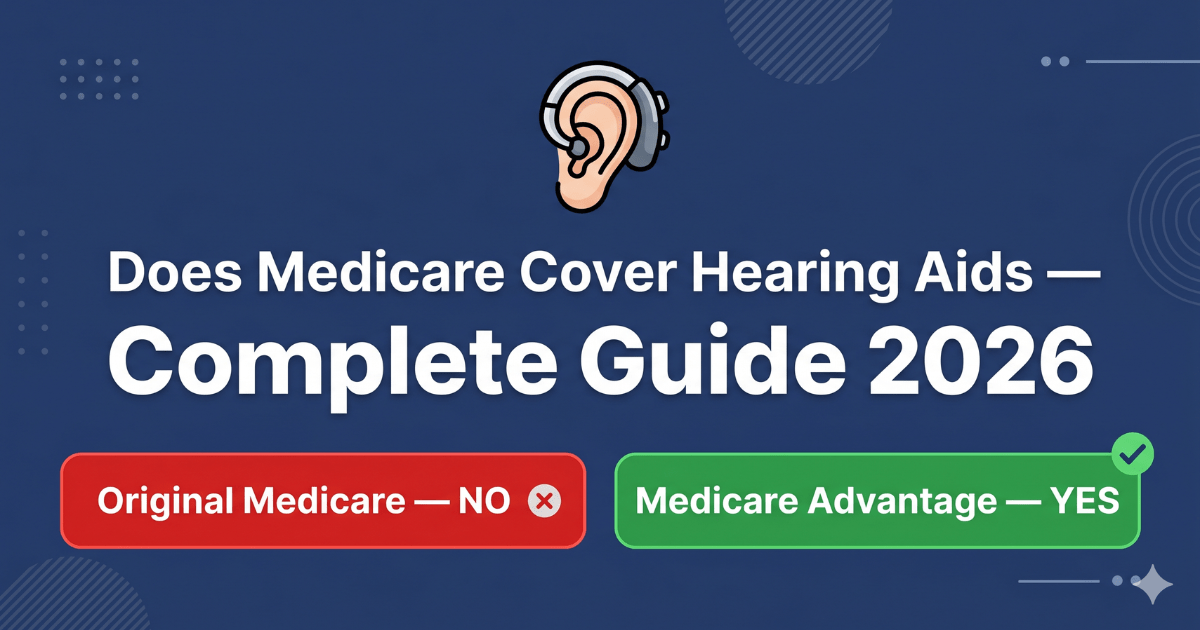
Does Medicare Cover Hearing Aids — Complete Guide 2026
Does Medicare cover hearing aids in 2026? If you are one of the millions of Medicare beneficiaries experiencing hearing loss this is one of the most important Medicare coverage questions you need answered. The answer is complex — Original Medicare does not cover hearing aids but Medicare Advantage plans often do provide hearing aid benefits. In this complete guide we explain exactly what Medicare covers for hearing aids in 2026 — what Original Medicare covers, what Medicare Advantage covers, how much hearing aids cost with Medicare, and what your options are if your Medicare plan does not cover hearing aids. All information is sourced from Medicare.gov and CMS.gov.
Also Read —Medicare Part A vs Part B — What Is the Difference in 2026? Also Read- Does Medicare Cover Dental and Vision — Complete Guide 2026
What You Will Learn — Does Medicare Cover Hearing Aids
- Does Medicare cover hearing aids in 2026
- Why Original Medicare does not cover hearing aids
- What Medicare does cover for hearing care
- Does Medicare cover hearing exams
- How much do hearing aids cost without Medicare coverage
- Does Medicare Advantage cover hearing aids
- How much hearing aid coverage do Medicare Advantage plans provide
- Over-the-counter hearing aids and Medicare
- How to get hearing aid coverage as a Medicare beneficiary
- Frequently asked questions about Medicare hearing aid coverage 2026
Does Medicare Cover Hearing Aids in 2026?
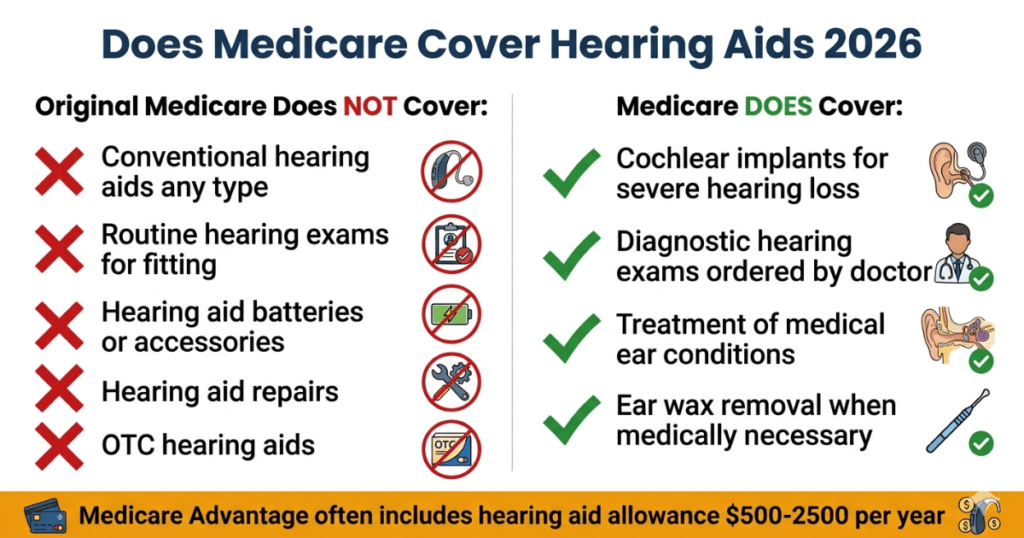
No — Original Medicare does not cover hearing aids in 2026. This is one of the most significant coverage gaps in the entire Medicare program and affects millions of seniors with hearing loss. Original Medicare Parts A and B do not cover the cost of hearing aids or the fittings for hearing aids regardless of the severity of your hearing loss.
This lack of hearing aid coverage under Original Medicare surprises many seniors turning 65 who assume their Medicare coverage will include hearing care. Hearing loss affects approximately two-thirds of Americans over 70 — making this coverage gap one of the most impactful for Medicare beneficiaries.
However there are important distinctions to understand about Medicare and hearing care. While Original Medicare does not cover hearing aids it does cover certain medically necessary hearing-related services. And Medicare Advantage plans — which replace Original Medicare — frequently include hearing aid benefits as extra coverage that Original Medicare does not provide.
Does Medicare Advantage cover hearing aids? Yes — most Medicare Advantage plans include some level of hearing aid benefit. This is one of the primary reasons many seniors with hearing loss choose Medicare Advantage over Original Medicare. We explain the details of Medicare Advantage hearing coverage below.
Why Does Original Medicare Not Cover Hearing Aids?
Original Medicare does not cover hearing aids because of how the Medicare program was designed when it was created in 1965. When Congress created Medicare it explicitly excluded several categories of care that were considered routine or non-medical — including dental care, routine vision care, and hearing aids. At the time hearing aids were considered a convenience item rather than a medical necessity.
This exclusion has remained in place despite numerous attempts over the decades to expand Medicare hearing coverage. The cost of adding comprehensive hearing coverage to Medicare has been estimated at hundreds of billions of dollars over a decade — making it a major policy challenge.
Despite the exclusion of hearing aids from Original Medicare coverage hearing loss is increasingly recognized as a serious public health issue. Research links untreated hearing loss to increased risk of cognitive decline, depression, social isolation, and falls — all conditions that significantly affect Medicare spending on other services. This growing evidence base has increased pressure on Congress to expand Medicare hearing coverage.
What Does Medicare Cover for Hearing Care in 2026?
While Original Medicare does not cover hearing aids it does cover certain hearing-related services in 2026. Understanding what Medicare does cover for hearing care helps you maximize your benefits.
Diagnostic Hearing Exams
Medicare Part B covers diagnostic hearing and balance exams in 2026 when ordered by a physician to determine whether you need medical treatment. The key requirement is that the exam must be ordered by a doctor and must be for diagnostic purposes — to determine a medical condition — not simply to fit you for hearing aids.
Medicare Part B covers the cost of diagnostic hearing exams at 80% after your $257 annual Part B deductible when:
- Your doctor orders the exam to diagnose a medical condition
- The exam is performed by a licensed audiologist or hearing specialist
- The purpose is to diagnose a medical condition — not for hearing aid fitting
Medicare does NOT cover routine hearing exams for hearing aid fitting purposes. If you visit an audiologist specifically to get tested for hearing aids and fitted for hearing aids Medicare does not cover that exam.
Treatment of Medical Hearing Conditions
Medicare covers medically necessary treatment for medical conditions that cause or affect hearing including:
- Treatment of ear infections
- Treatment of Meniere’s disease
- Removal of cerumen (ear wax) impaction when medically necessary
- Treatment of tinnitus through medical interventions
- Surgical treatment of otosclerosis
Cochlear Implants
Medicare Part B covers cochlear implant surgery and devices for patients with severe to profound sensorineural hearing loss who meet specific criteria. Cochlear implants are covered as medically necessary surgical procedures — not as hearing aids — which is why they fall outside the general hearing aid exclusion.
Medicare covers cochlear implants when:
- You have severe to profound hearing loss in both ears
- You receive limited benefit from conventional hearing aids
- You do not have medical contraindications to cochlear implantation
- You are enrolled in or willing to participate in aural rehabilitation
Cochlear implant surgery is covered under Medicare Part B at 80% after your Part B deductible. The cochlear implant device itself is covered as durable medical equipment. Post-implant rehabilitation is also covered.
How Much Do Hearing Aids Cost Without Medicare Coverage?
Understanding the cost of hearing aids without Medicare coverage helps you appreciate the financial impact of this coverage gap for Medicare beneficiaries.
Hearing aid costs in 2026:
- Basic hearing aids — $1,000 to $2,000 per pair
- Mid-range hearing aids — $2,000 to $4,000 per pair
- Premium hearing aids — $4,000 to $7,000 per pair
- Average cost of hearing aids — approximately $4,600 per pair
Additional hearing aid costs:
- Audiologist exam and fitting — $200 to $500
- Hearing aid batteries — $50 to $150 per year (for traditional battery models)
- Follow-up adjustments — $50 to $200 per visit
- Hearing aid repairs — $100 to $500 per repair
- Replacement every 5 to 7 years — full cost again
For a Medicare beneficiary with moderate to severe hearing loss the lifetime cost of hearing aids and related care can easily exceed $15,000 to $20,000 — all paid out of pocket under Original Medicare.
Does Medicare Advantage Cover Hearing Aids in 2026?
Does Medicare Advantage cover hearing aids in 2026? Yes — most Medicare Advantage plans include hearing aid benefits as extra coverage beyond what Original Medicare provides. This is one of the most important reasons seniors with hearing loss consider Medicare Advantage.
Medicare Advantage hearing aid coverage varies significantly by plan and location. Here is what typical Medicare Advantage hearing aid coverage looks like in 2026:
Annual Hearing Aid Allowance
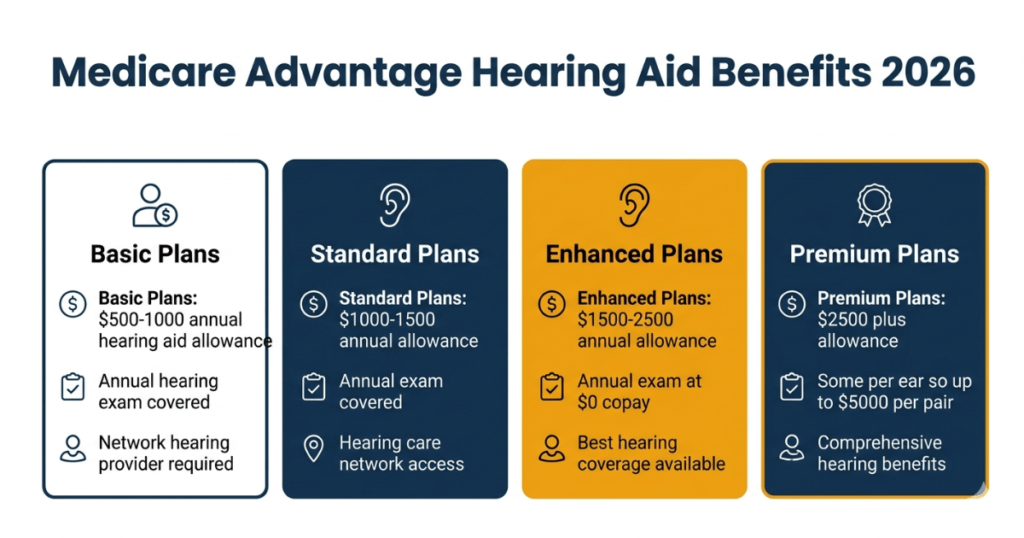
Most Medicare Advantage plans provide an annual or biennial hearing aid allowance — a dollar amount you can use toward the purchase of hearing aids. Typical Medicare Advantage hearing aid allowances in 2026:
- Basic hearing aid benefit — $500 to $1,000 per year
- Standard hearing aid benefit — $1,000 to $1,500 per year
- Enhanced hearing aid benefit — $1,500 to $2,500 per year
- Premium hearing aid benefit — $2,500 to $3,000 or more per year
Some Medicare Advantage plans provide the allowance per ear rather than per pair — meaning the total available benefit could be $2,000 to $6,000 per pair.
Hearing Exam Coverage
Most Medicare Advantage plans cover annual routine hearing exams for hearing aid fitting purposes — something Original Medicare does not cover. Annual hearing exams with Medicare Advantage typically have $0 to $40 copay.
Hearing Aid Network
Many Medicare Advantage plans provide hearing aid benefits through a network of hearing care providers — such as HearUSA, TruHearing, or Nations Hearing. Using network providers typically provides the best value — access to discounted hearing aids and services that maximize your hearing aid allowance.
Major Medicare Advantage Plans and Hearing Aid Benefits 2026
UnitedHealthcare AARP Medicare Advantage — hearing aid allowance typically $500 to $2,500 per year through UnitedHealthcare Hearing network. Annual hearing exam covered.
Humana Medicare Advantage — hearing aid allowance typically $500 to $2,000 per year. Annual hearing exam covered. Access to Humana hearing partner network.
Aetna Medicare Advantage — hearing aid allowance typically $500 to $2,000 per year. Annual hearing exam covered. Access to hearing care network.
Cigna Medicare Advantage — hearing aid allowance varies by plan. Annual hearing exam covered on most plans.
Over-the-Counter Hearing Aids and Medicare in 2026
In October 2022 the FDA approved over-the-counter (OTC) hearing aids for adults with mild to moderate hearing loss. OTC hearing aids can be purchased without a prescription at retailers like Walgreens, CVS, Best Buy, and Costco — and online.
OTC hearing aid costs in 2026:
- Basic OTC hearing aids — $200 to $500 per pair
- Mid-range OTC hearing aids — $500 to $1,000 per pair
- Premium OTC hearing aids — $1,000 to $1,500 per pair
Does Medicare cover OTC hearing aids? Original Medicare does not cover OTC hearing aids. Some Medicare Advantage plans apply their hearing aid allowance to OTC hearing aids while others restrict the benefit to prescription hearing aids through network providers. Check your specific Medicare Advantage plan’s hearing benefit terms to see whether OTC hearing aids qualify.
OTC hearing aids represent a significant cost savings opportunity for Medicare beneficiaries with mild to moderate hearing loss who cannot access Medicare Advantage hearing benefits or whose benefit does not cover full-price hearing aids.
How to Get Hearing Aid Coverage as a Medicare Beneficiary
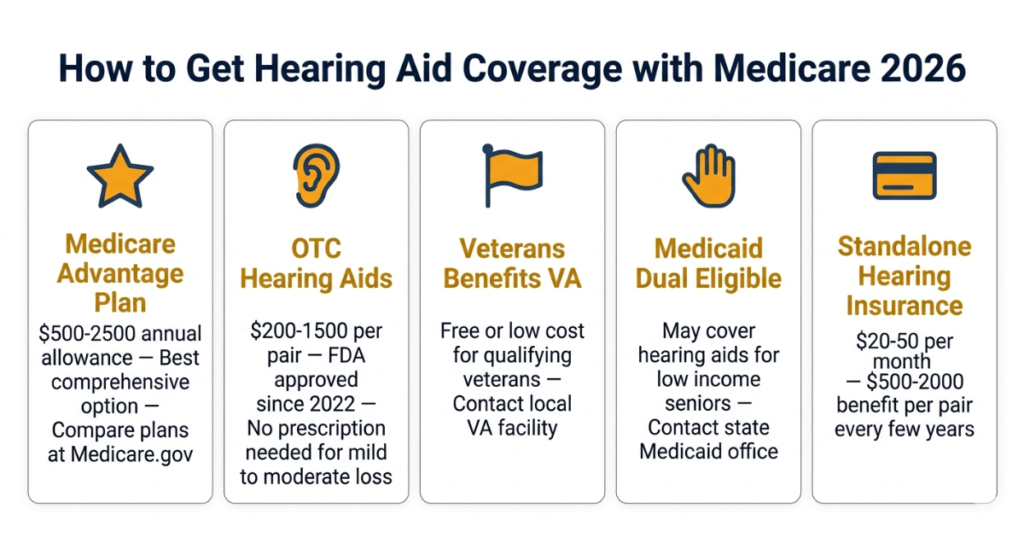
If you need hearing aids and want coverage here are your main options as a Medicare beneficiary in 2026:
Option 1 — Enroll in Medicare Advantage with Hearing Benefits
The most comprehensive option for hearing aid coverage is to enroll in a Medicare Advantage plan with strong hearing benefits. During Medicare Open Enrollment (October 15 to December 7) compare Medicare Advantage plans in your area specifically looking at:
- Annual hearing aid allowance amount
- Whether the allowance is per ear or per pair
- The hearing care provider network
- Whether OTC hearing aids qualify
- Annual hearing exam coverage
Use Medicare.gov plan finder to compare hearing benefits across Medicare Advantage plans in your zip code.
Option 2 — Purchase Standalone Hearing Aid Insurance
Some private insurers offer standalone hearing aid insurance plans that cover a portion of hearing aid costs. These plans typically cost $20 to $50 per month and provide benefits of $500 to $2,000 per pair every 3 to 5 years. Standalone hearing coverage can work alongside Original Medicare and Medigap.
Option 3 — Use OTC Hearing Aids
For mild to moderate hearing loss OTC hearing aids provide a significantly more affordable alternative to prescription hearing aids without requiring Medicare coverage. Brands like Jabra Enhance, Lexie, and Sony CRE Series offer OTC hearing aids at $200 to $1,500 per pair.
Option 4 — Veterans Benefits
If you are a veteran you may qualify for free or low-cost hearing aids through the VA. The VA provides hearing aids to qualifying veterans with service-connected or non-service-connected hearing loss. Contact your local VA facility or visit va.gov for details.
Option 5 — State Assistance Programs
Some states offer hearing aid assistance programs for low-income seniors. Contact your State Health Insurance Assistance Program (SHIP) counselor at shiphelp.org to learn about hearing aid assistance programs available in your state.
Option 6 — Medicaid
If you qualify for Medicaid in addition to Medicare — called dual eligible — Medicaid may cover hearing aids. Medicaid coverage for hearing aids varies by state. Contact your State Medicaid office to determine whether your state’s Medicaid program covers hearing aids.
Frequently Asked Questions — Does Medicare Cover Hearing Aids
Does Medicare cover hearing aids in 2026?
No — Original Medicare (Parts A and B) does not cover hearing aids in 2026. This is one of the most significant coverage gaps in Medicare. However most Medicare Advantage plans include hearing aid benefits with annual allowances of $500 to $2,500 or more toward the purchase of hearing aids. If hearing coverage is important to you Medicare Advantage is worth considering seriously.
Does Medicare cover hearing exams?
Medicare Part B covers diagnostic hearing exams ordered by a physician to diagnose a medical condition — at 80% after your Part B deductible. Medicare does not cover routine hearing exams for hearing aid fitting purposes. Most Medicare Advantage plans cover annual routine hearing exams for hearing aid purposes at $0 to $40 copay.
How much hearing aid coverage does Medicare Advantage provide?
Medicare Advantage hearing aid allowances in 2026 typically range from $500 to $2,500 per year depending on the plan. Some plans provide the allowance per ear — meaning up to $5,000 total for a pair. The allowance is usually available through the plan’s hearing care network. Check specific plans in your area using Medicare.gov plan finder.
Does Medicare cover cochlear implants?
Yes — Medicare Part B covers cochlear implant surgery and devices for patients with severe to profound hearing loss who meet the clinical criteria. Cochlear implants are covered as medically necessary surgical procedures — not as hearing aids — which is why they are covered while conventional hearing aids are not.
Should I choose Medicare Advantage for hearing aid coverage?
If hearing coverage is a significant priority for you Medicare Advantage plans with strong hearing benefits deserve serious consideration. The annual hearing aid allowance of $1,500 to $2,500 from a good Medicare Advantage plan can offset a significant portion of hearing aid costs. However consider the full picture — Medicare Advantage has network restrictions and other limitations compared to Original Medicare with Medigap.
Are OTC hearing aids covered by Medicare?
Original Medicare does not cover OTC hearing aids. Some Medicare Advantage plans apply their hearing aid allowance to OTC hearing aids while others restrict benefits to prescription hearing aids through network providers. OTC hearing aids are significantly more affordable — $200 to $1,500 per pair — than prescription hearing aids and represent a good option for Medicare beneficiaries with mild to moderate hearing loss.
Summary — Does Medicare Cover Hearing Aids 2026
Does Medicare cover hearing aids in 2026? Original Medicare does not cover hearing aids — one of the most impactful coverage gaps for the millions of Medicare beneficiaries experiencing hearing loss. Medicare does cover cochlear implants for severe hearing loss and diagnostic hearing exams ordered by a physician but does not cover conventional hearing aids or routine hearing exams for hearing aid fitting.
Most Medicare Advantage plans include hearing aid benefits with annual allowances of $500 to $2,500 or more — making Medicare Advantage the best option for Medicare beneficiaries who prioritize hearing coverage. OTC hearing aids approved by the FDA in 2022 provide a more affordable alternative for those with mild to moderate hearing loss.
For free help understanding your Medicare hearing coverage options contact your State Health Insurance Assistance Program (SHIP) counselor at shiphelp.org or call Medicare free at 1-800-633-4227.
This guide is for informational purposes only and is not medical advice. Always verify current Medicare hearing coverage at Medicare.gov before making healthcare decisions.
Sources: Medicare.gov | CMS.gov | SSA.gov | AARP.org
Last updated: April 2026 | Author: James Carter, Independent Medicare Research Analyst