How to Appeal a Medicare Denial — Complete Guide 2026
How to appeal a Medicare denial is one of the most important things every Medicare beneficiary needs to know. Medicare denies millions of claims and prior authorization requests every year — but many of these denials are wrong and can be successfully overturned through the Medicare appeals process. How to appeal a Medicare denial in 2026 follows a specific five-level process with strict deadlines and specific procedures at each step. The good news is that Medicare beneficiaries who appeal denials win a significant percentage of the time — particularly at the administrative law judge level. In this complete guide we explain exactly how to appeal a Medicare denial in 2026 — step by step through all five appeal levels. All information is sourced from Medicare.gov and CMS.gov.
Also Read —
- Medicare Enrollment Periods Explained 2026
- Medicare for People Under 65 with Disability — Complete Guide 2026
- Medicare Extra Help 2026
What You Will Learn — How to Appeal a Medicare Denial
- Why Medicare denies claims and why you should appeal
- The five levels of the Medicare appeals process
- Level 1 — Redetermination — how to file
- Level 2 — Reconsideration — QIC review
- Level 3 — Administrative Law Judge hearing
- Level 4 — Medicare Appeals Council review
- Level 5 — Federal District Court
- How to appeal Medicare Advantage denials
- How to appeal Medicare Part D denials
- Tips for winning Medicare appeals
- Frequently asked questions about how to appeal a Medicare denial 2026
Why Medicare Denies Claims and Why You Should Appeal
Understanding how to appeal a Medicare denial starts with understanding why Medicare denies claims in the first place — and why appealing is almost always worth doing.
Medicare denies claims for many reasons including:
- Missing or insufficient documentation of medical necessity
- Services not covered under Medicare as coded or billed
- Prior authorization not obtained or expired
- Provider billing errors — wrong codes, missing modifiers
- Duplicate claim submissions
- Services provided by non-enrolled providers
- Coverage limitations exceeded — frequency restrictions
- Services considered experimental or investigational
The critical point is that many Medicare denials are wrong — or are denials that can be overturned with better documentation. Studies consistently show that Medicare beneficiaries win between 40% and 80% of appeals when they pursue them — with win rates increasing at higher appeal levels.
Medicare beneficiaries have the legal right to appeal any denial of coverage — for services, supplies, prescriptions, and prior authorization requests. You do not need a lawyer to appeal — though legal assistance is available and sometimes helpful for complex cases.
The Five Levels of the Medicare Appeals Process
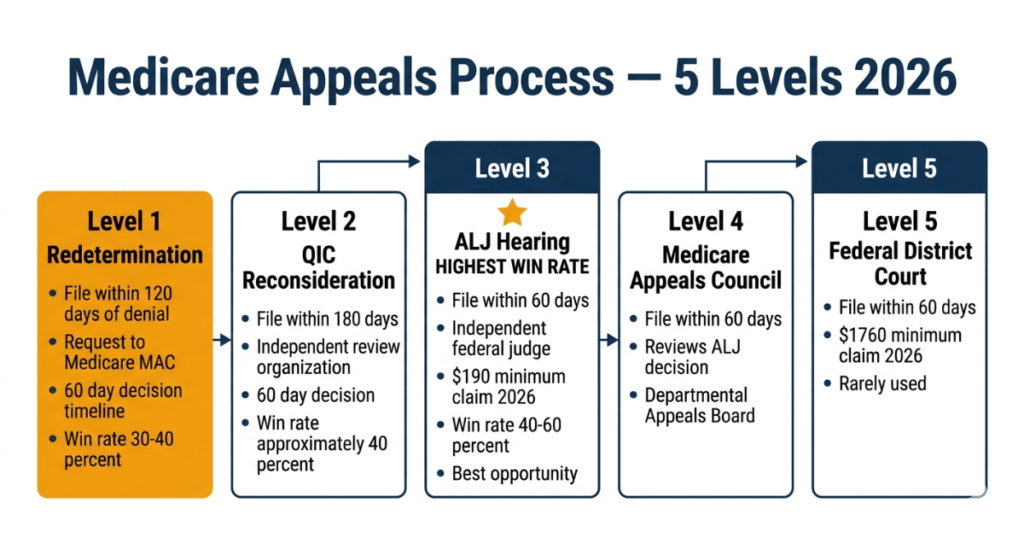
How to appeal a Medicare denial follows a structured five-level process. Each level has specific procedures, deadlines, and decision-makers. Appeals must generally be filed at Level 1 before advancing to Level 2 and so on.
Level 1 — Redetermination
What Is Redetermination?
Redetermination is the first level of the Medicare appeals process — a review of the denied claim by the Medicare Administrative Contractor (MAC) that processed the original claim. The MAC is a private company that processes Medicare claims on behalf of CMS in specific geographic regions.
Who Handles Redetermination?
The same MAC that denied the original claim handles redetermination — but a different person than the one who made the initial denial decision must review the appeal.
Deadline for Filing Redetermination
You must request redetermination within 120 days of receiving the Medicare Summary Notice (MSN) showing the denial. This is a firm deadline — missing it means you lose your right to appeal at this level.
How to File a Redetermination
Filing a redetermination appeal:
- Complete the CMS-20027 Redetermination Request Form — downloadable at CMS.gov
- Write a letter to the MAC — clearly identifying the denied service, claim number, and reason you believe the denial is wrong
- Include supporting documentation:
- Medical records supporting medical necessity
- Physician letter explaining clinical need
- Published clinical guidelines supporting the service
- Any additional documentation not in the original claim
Send to the MAC that processed the original claim — the address is on your MSN or Explanation of Benefits (EOB).
Redetermination Decision Timeline
For Part A and Part B claims — the MAC must make a redetermination decision within 60 days of receiving your request.
For expedited redetermination (for inpatient hospital discharge decisions) — decision within 72 hours.
What to Expect
If redetermination upholds the denial — you receive a Redetermination Notice explaining the decision and your right to appeal to Level 2.
If redetermination reverses the denial — Medicare pays the claim. No further appeal needed.
Level 2 — Reconsideration by Qualified Independent Contractor (QIC)
What Is QIC Reconsideration?
If redetermination upholds the denial you can request reconsideration from a Qualified Independent Contractor — an organization completely independent from the MAC that made the original denial and redetermination decisions.
Who Handles QIC Reconsideration?
A QIC — a CMS-contracted independent review organization — reviews the appeal fresh without deference to the MAC decision. This independent review is critically important — the QIC has no relationship with the MAC and applies a fresh clinical and coverage analysis.
Deadline for Filing QIC Reconsideration
You must request reconsideration within 180 days of receiving the redetermination notice.
How to File QIC Reconsideration
- Complete the CMS-20033 Reconsideration Request Form
- Explain why the redetermination was wrong — be specific
- Include all additional supporting documentation:
- Physician peer-reviewed clinical support letter
- Published guidelines — American College standards, Cochrane reviews
- Additional medical records
- Send to the QIC identified in the redetermination notice
QIC Reconsideration Decision Timeline
For Part A and Part B claims — QIC must decide within 60 days. For Part D drug appeals — QIC must decide within 7 days (standard) or 72 hours (expedited).
QIC Reconsideration Success Rate
QIC reconsideration overturns denial in approximately 40% of cases. A strong clinical documentation packet significantly improves success rates at this level.
Level 3 — Administrative Law Judge (ALJ) Hearing
What Is the ALJ Hearing?
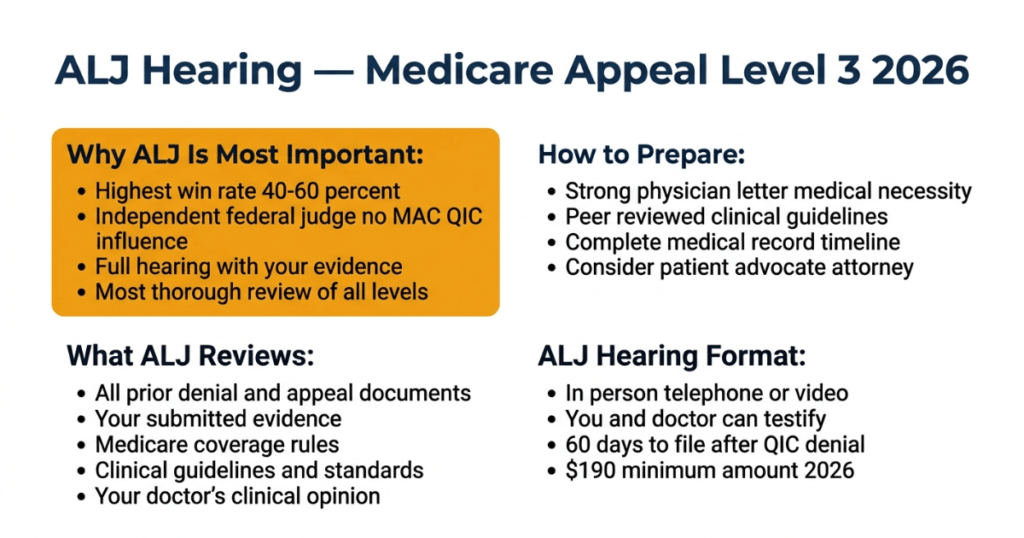
If QIC reconsideration upholds the denial you can request a hearing before an Administrative Law Judge — an independent federal judge who hears Medicare appeals. The ALJ hearing is considered the most important and most winnable level of the Medicare appeals process.
ALJ Success Rate
ALJ hearings have the highest success rates in the Medicare appeals process — beneficiaries win approximately 40% to 60% of ALJ hearings that proceed to hearing. The ALJ applies Medicare coverage rules independently and has the authority to reverse MAC and QIC decisions.
Minimum Amount in Controversy
To request an ALJ hearing the amount in controversy — the amount of the denied claim — must be at least $190 in 2026 (adjusted annually for inflation).
For Part D drug appeals the threshold may differ.
Deadline for Filing ALJ Request
You must request an ALJ hearing within 60 days of receiving the QIC reconsideration decision.
How to Request an ALJ Hearing
- Complete the CMS-20034A/B form — ALJ Hearing Request Form
- Submit to the Office of Medicare Hearings and Appeals (OMHA)
- Include all prior appeal documentation
- Request in-person, telephone, or video hearing
Preparing for the ALJ Hearing
The ALJ hearing is your best opportunity to win — thorough preparation is essential:
- Obtain a physician opinion letter — have your doctor write a detailed letter explaining medical necessity in plain clinical terms
- Gather peer-reviewed literature supporting the service
- Prepare a clear timeline of events and clinical history
- Consider engaging a patient advocate, attorney, or Medicare counselor
- Request all Medicare documentation related to the denial
ALJ Decision Timeline
The ALJ must issue a decision within 90 days of receiving the hearing request — though delays are common and actual timelines are often longer.
Level 4 — Medicare Appeals Council (MAC) Review
What Is Medicare Appeals Council Review?
If the ALJ rules against you or if the ALJ does not issue a decision within 90 days you can request review by the Medicare Appeals Council — part of the Departmental Appeals Board at the Department of Health and Human Services.
Deadline for Filing MAC Review
You must request MAC review within 60 days of receiving the ALJ decision.
Medicare Appeals Council Process
The Medicare Appeals Council reviews the ALJ decision for legal and procedural errors. The Council can:
- Affirm the ALJ decision
- Reverse the ALJ decision
- Modify the ALJ decision
- Remand back to the ALJ for further proceedings
Medicare Appeals Council Timeline
No specific statutory deadline — MAC review typically takes several months to over a year.
Level 5 — Federal District Court
What Is Federal Court Review?
If the Medicare Appeals Council upholds the denial — or if the Council fails to act within a reasonable time — you have the right to file a lawsuit in Federal District Court.
Minimum Amount in Controversy for Federal Court
The amount in controversy must be at least $1,760 in 2026 (adjusted annually) to file in Federal District Court.
Deadline for Filing
You must file in Federal District Court within 60 days of receiving the Medicare Appeals Council decision.
Federal Court Considerations
Federal court is rarely used for Medicare appeals — the cost of litigation typically exceeds the value of most denied Medicare claims. Federal court is most appropriate for:
- Large denied claims
- Systemic coverage policy disputes
- Cases with strong legal arguments about Medicare coverage rules
How to Appeal Medicare Advantage Denials
How to appeal a Medicare denial in Medicare Advantage plans follows a different process than Original Medicare.
Medicare Advantage Internal Appeal
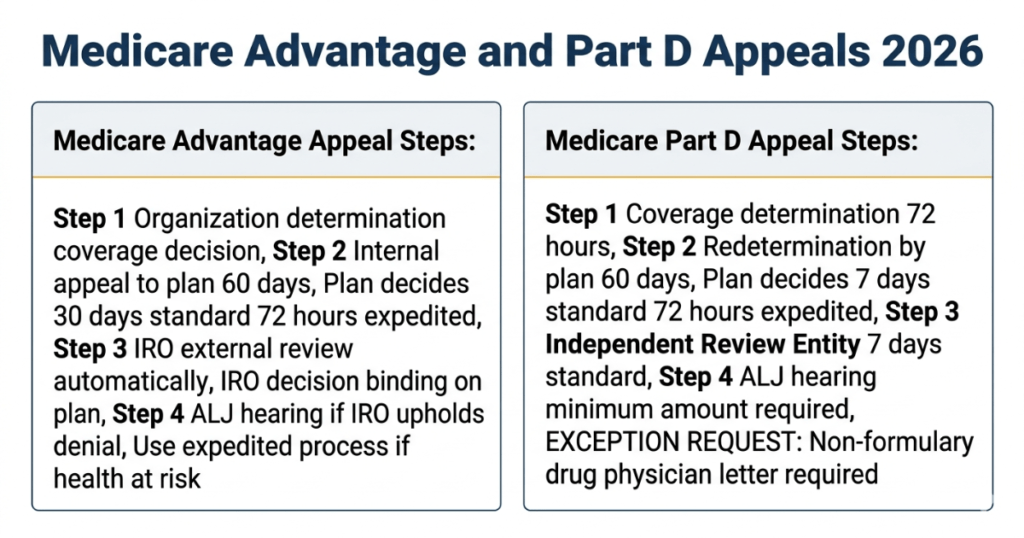
Step 1 — Organization Determination: Your Medicare Advantage plan must make a coverage decision — approving or denying a service or prior authorization. Request an organization determination in writing.
Step 2 — First Level Appeal (Internal): If denied you can file an internal appeal with the Medicare Advantage plan within 60 days of the denial. The plan must resolve standard appeals within 30 days and expedited appeals within 72 hours.
Step 3 — External Review by IRO: If the internal appeal is denied the plan must automatically send the case to an Independent Review Organization (IRO) for external review — an independent decision. The IRO decision is binding on the plan.
Step 4 — ALJ Hearing: If the IRO upholds denial you can request an ALJ hearing — following the same process as Original Medicare Level 3.
Expedited Medicare Advantage Appeals
When a delay would seriously jeopardize your health you have the right to request an expedited appeal — which the plan must resolve within 72 hours.
Prior Authorization Denials
For services requiring prior authorization — surgery, durable medical equipment, specialty drugs — appeal the prior authorization denial immediately following the plan’s appeal process. Do not wait for treatment to be denied after the fact.
How to Appeal Medicare Part D Denials
How to appeal a Medicare denial for Part D prescription drug coverage follows a specific process.
Coverage Determination
First — request a coverage determination from your Part D plan. The plan must decide within 72 hours (standard) or 24 hours (expedited).
Redetermination by Part D Plan
If denied — request plan redetermination within 60 days. Plan must decide within 7 days (standard) or 72 hours (expedited).
Independent Review Entity (IRE)
If redetermination upholds denial — IRE review. IRE must decide within 7 days (standard) or 72 hours (expedited).
ALJ Hearing
Amount in controversy must meet minimum threshold. Request within 60 days of IRE decision.
Exception Requests
For formulary exceptions — requesting coverage for a non-formulary drug or lower tier cost-sharing — submit with a physician supporting statement explaining why the formulary alternative is inappropriate for your specific condition.
Tips for Winning Medicare Appeals
Understanding how to appeal a Medicare denial is one thing — winning the appeal is another. Here are the most important tips for successful Medicare appeals:
Get Your Doctor Involved
A letter from your physician specifically addressing why the denied service is medically necessary for you — not just generally — is the single most important piece of evidence in any Medicare appeal. The letter should:
- Address the specific Medicare coverage criteria being disputed
- Explain your clinical history and why standard alternatives were tried and failed
- Reference published guidelines supporting the service
- Be on physician letterhead and signed
Act Quickly
Deadlines in the Medicare appeals process are strict — missing a deadline forfeits your appeal rights at that level. File as quickly as possible at each level.
Keep Copies of Everything
Keep copies of all appeal submissions and Medicare responses — track dates and document all communications.
Use Certified Mail
Send all appeal submissions via certified mail with return receipt — creating a documented record of filing dates.
Request Expedited Review When Appropriate
When your health or ability to regain function would be seriously jeopardized by waiting you have the right to request expedited review — which dramatically shortens decision timelines.
Contact SHIP for Free Help
State Health Insurance Assistance Program (SHIP) counselors provide free Medicare appeal assistance — including helping write appeal letters and understanding coverage rules.
Consider a Medicare Patient Advocate
Patient advocacy organizations and Medicare-specialized attorneys can assist with complex appeals — particularly at the ALJ level and above.
Frequently Asked Questions — How to Appeal a Medicare Denial
How do I appeal a Medicare denial in 2026?
The first step in how to appeal a Medicare denial is filing a redetermination request with the Medicare Administrative Contractor within 120 days of the denial. Include supporting documentation from your physician explaining medical necessity. If redetermination upholds the denial escalate to QIC reconsideration then ALJ hearing — where win rates are highest.
How long does the Medicare appeals process take?
Level 1 redetermination — 60 days. Level 2 QIC reconsideration — 60 days. Level 3 ALJ hearing — 90 days statutory but often longer. Total process through ALJ can take 6 to 18 months. Expedited appeals have much shorter timelines — 72 hours for urgent situations.
What is the success rate of Medicare appeals?
Medicare beneficiaries win approximately 40% of Level 2 QIC reconsiderations and 40% to 60% of Level 3 ALJ hearings when fully pursued. Overall appeal success rates are significantly higher than most beneficiaries expect — making appeal almost always worthwhile for significant denied claims.
Can I get free help with a Medicare appeal?
Yes — SHIP (State Health Insurance Assistance Program) counselors provide free Medicare appeal assistance in every state. Call 1-800-633-4227 to find your local SHIP or visit shiphelp.org.
How do I appeal a Medicare Advantage denial?
For Medicare Advantage denials — request an internal appeal from your plan within 60 days. If the internal appeal is denied the plan must send the case to an Independent Review Organization (IRO) for external review. If IRO upholds denial request an ALJ hearing following the standard Medicare appeals process.
Summary — How to Appeal a Medicare Denial 2026
How to appeal a Medicare denial in 2026 follows a structured five-level process — Redetermination, QIC Reconsideration, ALJ Hearing, Medicare Appeals Council, and Federal Court. Medicare beneficiaries win a significant percentage of appeals — particularly at the ALJ hearing level — making appeal almost always worth pursuing for significant denied claims.
The most important keys to successful Medicare appeals are acting quickly within deadlines, obtaining strong physician support documentation, being specific about why the denial is wrong, and escalating through all five levels when necessary. Free appeal assistance is available through SHIP counselors in every state.
For free help understanding your Medicare appeal rights contact your State Health Insurance Assistance Program (SHIP) at shiphelp.org or call Medicare free at 1-800-633-4227.
This guide is for informational purposes only and is not legal advice. For complex appeals consider consulting a Medicare-specialized attorney or patient advocate.
Sources: Medicare.gov | CMS.gov | SSA.gov | AARP.org
Last updated: April 2026 | Author: James Carter, Independent Medicare Research Analyst