
Does Medicare Cover Arthritis Treatment — Complete Guide 2026
Does Medicare cover arthritis treatment in 2026? Arthritis is the most common chronic condition affecting Medicare beneficiaries — with over 54 million Americans living with some form of arthritis. Arthritis encompasses hundreds of different joint conditions — from the most common osteoarthritis caused by wear and tear to the more aggressive rheumatoid arthritis, psoriatic arthritis, and other inflammatory forms. Managing arthritis effectively requires medications, physical therapy, joint injections, and sometimes surgery — and understanding your Medicare coverage for arthritis treatment is essential for accessing the care you need. The good news is that yes — Medicare does cover arthritis treatment in 2026 and the coverage is comprehensive. In this complete guide we explain exactly what Medicare covers for arthritis treatment in 2026. All information is sourced from Medicare.gov and CMS.gov.
Also Read —
- Does Medicare Cover Physical Therapy 2026
- Does Medicare Cover Knee Replacement Surgery 2026
- Does Medicare Cover Occupational Therapy 2026
What You Will Learn — Does Medicare Cover Arthritis Treatment
- Does Medicare cover arthritis treatment in 2026
- What types of arthritis does Medicare cover
- Does Medicare cover arthritis medications including biologics
- Does Medicare cover joint injections for arthritis
- Does Medicare cover physical therapy for arthritis
- Does Medicare cover rheumatologist visits
- Does Medicare cover infusion therapy for rheumatoid arthritis
- How much does arthritis treatment cost with Medicare
- Does Medicare Advantage cover arthritis treatment
- Frequently asked questions about Medicare arthritis coverage 2026
Does Medicare Cover Arthritis Treatment in 2026?
Yes — Medicare covers arthritis treatment comprehensively in 2026 across the full spectrum of arthritis care. Medicare Part B covers physician and specialist visits, joint injections, infusion therapy, physical and occupational therapy, and durable medical equipment. Medicare Part D covers arthritis medications including over-the-counter strength NSAIDs and powerful prescription biologics. Medicare Part A covers hospitalizations and joint replacement surgeries when medically necessary.
Arthritis treatment is one of the most commonly needed — and most extensively covered — healthcare categories in the Medicare program. Whether you have osteoarthritis requiring joint injections and physical therapy or rheumatoid arthritis requiring expensive biologic medications Medicare’s comprehensive coverage ensures you can access the treatments you need.
What Types of Arthritis Does Medicare Cover?
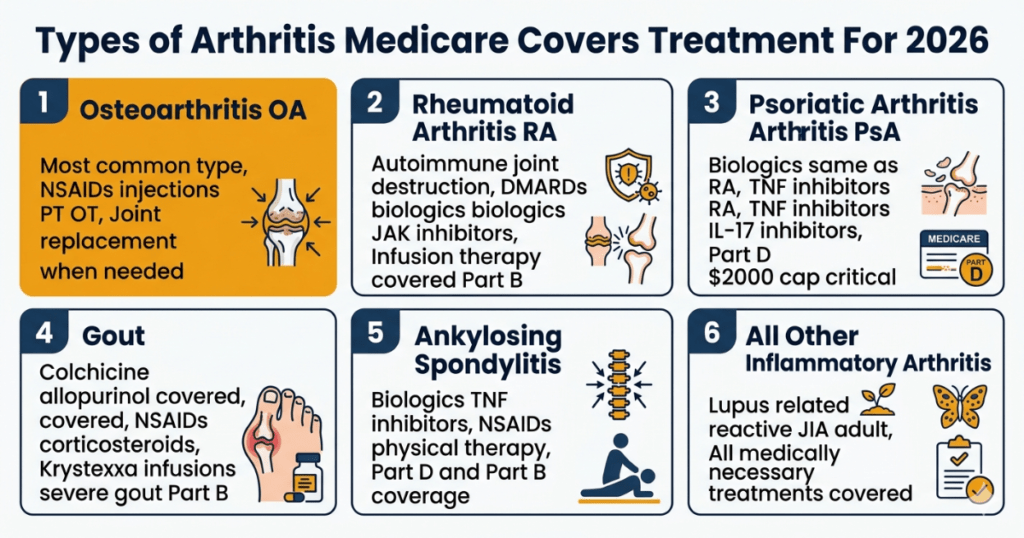
Medicare covers treatment for all forms of arthritis when medically necessary. The most common types of arthritis treated in the Medicare population include:
Osteoarthritis (OA)
The most common form of arthritis — caused by gradual breakdown of joint cartilage. Primarily affects knees, hips, hands, and spine. Treatment includes pain medications, joint injections, physical therapy, and joint replacement surgery when conservative treatment fails.
Rheumatoid Arthritis (RA)
An autoimmune inflammatory arthritis causing joint destruction, pain, and systemic inflammation. Requires disease-modifying medications — including biologics and JAK inhibitors — to prevent joint damage. Medicare covers the full range of RA treatments.
Psoriatic Arthritis
Inflammatory arthritis associated with psoriasis. Treated similarly to rheumatoid arthritis with disease-modifying medications including biologics.
Gout
A form of inflammatory arthritis caused by uric acid crystal deposition in joints. Treated with NSAIDs, colchicine, corticosteroids, and uric acid-lowering medications.
Ankylosing Spondylitis
Inflammatory arthritis primarily affecting the spine. Treated with NSAIDs and biologics.
Other Inflammatory Arthritis
Medicare covers treatment for all other forms of inflammatory arthritis including lupus-related arthritis, reactive arthritis, and juvenile idiopathic arthritis persisting into adulthood.
Does Medicare Cover Arthritis Medications?
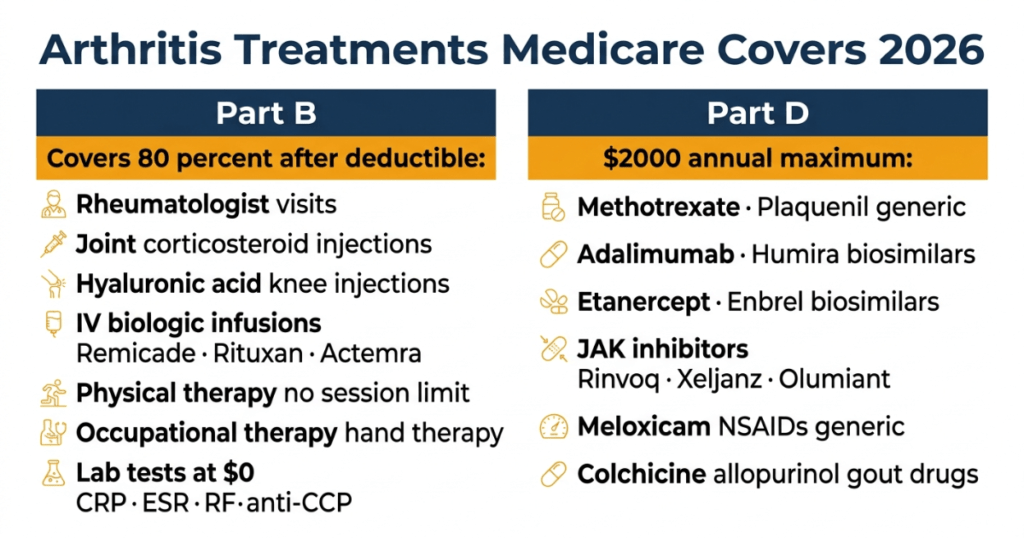
Does Medicare cover arthritis medications in 2026? Yes — Medicare Part D covers arthritis medications and Medicare Part B covers certain medications administered in clinical settings.
Arthritis Medications Covered Under Medicare Part D
Non-steroidal anti-inflammatory drugs (NSAIDs):
- Naproxen — generic available — typically Tier 1 or 2
- Ibuprofen — generic available
- Meloxicam (Mobic) — generic available — very common for OA
- Diclofenac (Voltaren oral) — generic available
- Celecoxib (Celebrex) — generic available
DMARDs — disease-modifying antirheumatic drugs for RA and inflammatory arthritis:
- Methotrexate — generic available — very common RA treatment — typically Tier 1
- Hydroxychloroquine (Plaquenil) — generic available
- Sulfasalazine — generic available
- Leflunomide (Arava) — generic available
Biologic DMARDs — targeted therapies for moderate to severe RA and inflammatory arthritis:
- Adalimumab (Humira and biosimilars) — covered under Part D — TNF inhibitor
- Etanercept (Enbrel and biosimilars) — covered under Part D
- Abatacept (Orencia subcutaneous) — covered under Part D
- Secukinumab (Cosentyx) — covered under Part D
- Ixekizumab (Taltz) — covered under Part D
- Upadacitinib (Rinvoq) — JAK inhibitor — covered under Part D
- Tofacitinib (Xeljanz) — JAK inhibitor — covered under Part D
- Baricitinib (Olumiant) — JAK inhibitor — covered under Part D
Gout medications:
- Colchicine (Colcrys) — covered under Part D
- Allopurinol — generic — covered under Part D
- Febuxostat (Uloric) — covered under Part D
- Probenecid — generic — covered under Part D
The $2,000 annual Part D out-of-pocket maximum in 2026 is critically important for arthritis patients taking expensive biologics. Biologic drugs for RA and inflammatory arthritis can cost $25,000 to $60,000 per year at retail prices — the $2,000 annual cap provides enormous financial protection.
Arthritis Medications Covered Under Medicare Part B
Certain biologic infusions administered in a physician’s office or outpatient setting are covered under Medicare Part B rather than Part D:
- Infliximab (Remicade) infusions — IV biologic for RA and other inflammatory conditions
- Abatacept (Orencia IV) infusions — IV biologic for RA
- Rituximab (Rituxan) infusions — for RA after TNF inhibitor failure
- Tocilizumab (Actemra IV) infusions — for RA
- Sarilumab (Kevzara IV) — for RA in infusion settings
- Pegloticase (Krystexxa) infusions — for chronic gout refractory to standard therapy
These IV infusions are covered under Part B at 80% after the Part B deductible. With Medigap Plan G your effective cost for these infusions is $0 after the annual deductible — potentially saving thousands of dollars per year for patients requiring regular biologic infusions.
Does Medicare Cover Joint Injections for Arthritis?
Does Medicare cover joint injections for arthritis in 2026? Yes — Medicare Part B covers joint injections for arthritis as medically necessary procedures when ordered by a physician.
Types of Joint Injections Medicare Covers
Corticosteroid injections — injections of anti-inflammatory corticosteroids directly into arthritic joints to reduce inflammation and pain. Covered for:
- Knee joint injections for osteoarthritis and inflammatory arthritis
- Hip joint injections
- Shoulder joint injections
- Finger and wrist joint injections for RA and OA
Hyaluronic acid injections (viscosupplementation) — injections of hyaluronic acid into the knee joint for osteoarthritis. Medicare covers hyaluronic acid knee injections when medically ordered. Coverage varies — Medicare may require documentation of medical necessity and prior failure of other treatments.
Platelet-rich plasma (PRP) injections — currently Medicare does not cover PRP injections for arthritis as they are considered experimental.
Joint Injection Costs with Medicare
Joint injections are covered under Medicare Part B at 80% after the $257 annual deductible:
- Office visit for injection — approximately $60 to $120 Medicare-approved
- Injection procedure itself — approximately $80 to $200 Medicare-approved
- Corticosteroid medication — included
- Your 20% coinsurance — approximately $28 to $64 per injection visit
With Medigap Plan G — $0 per injection after annual deductible.
Does Medicare Cover Physical Therapy for Arthritis?
Does Medicare cover physical therapy for arthritis in 2026? Yes — Medicare Part B covers physical therapy for arthritis as a medically necessary rehabilitation service at 80% after the $257 annual Part B deductible.
Physical Therapy for Arthritis
Physical therapy for arthritis focuses on:
- Strengthening muscles around arthritic joints to reduce joint load
- Range of motion exercises to maintain joint flexibility
- Gait training for lower extremity arthritis
- Balance training to prevent falls
- Pain management through therapeutic modalities
- Home exercise program development
No Session Limit for Arthritis PT
Medicare covers physical therapy for arthritis with no predetermined session limit — therapy continues as long as it is medically necessary and showing measurable progress or maintaining function. For arthritis patients who need ongoing maintenance therapy the Jimmo v. Sebelius standard allows continued coverage.
Physical Therapy Costs for Arthritis with Medicare
With Original Medicare — $16 to $35 per session (20% coinsurance) after $257 annual deductible With Medigap Plan G — $0 per session after annual deductible
Does Medicare Cover Rheumatologist Visits?
Does Medicare cover rheumatologist visits in 2026? Yes — Medicare Part B covers rheumatology specialist visits at 80% after the $257 annual Part B deductible.
Rheumatologists are specialists in inflammatory arthritis and autoimmune conditions — including rheumatoid arthritis, psoriatic arthritis, lupus, and gout. Regular rheumatology visits are essential for managing inflammatory arthritis and Medicare covers these specialist visits at standard Part B rates.
Laboratory Tests for Arthritis Monitoring — Covered
Medicare covers laboratory tests for arthritis monitoring at $0 — no deductible or coinsurance for diagnostic lab tests. Covered arthritis monitoring tests include:
- Rheumatoid factor (RF)
- Anti-CCP antibody
- C-reactive protein (CRP)
- Erythrocyte sedimentation rate (ESR)
- Complete blood count — important for monitoring methotrexate toxicity
- Liver function tests — for methotrexate monitoring
- Uric acid level — for gout management
- Comprehensive metabolic panel
Does Medicare Cover Infusion Therapy for Rheumatoid Arthritis?
Does Medicare cover infusion therapy for rheumatoid arthritis in 2026? Yes — Medicare Part B covers IV biologic infusions for rheumatoid arthritis and other inflammatory arthritis conditions administered in physician offices or hospital outpatient infusion centers.
RA Infusions Medicare Part B Covers
Infliximab (Remicade) — one of the most commonly infused biologics for RA. Given every 4 to 8 weeks in an outpatient infusion setting. Medicare covers infliximab infusions under Part B at 80% after the deductible.
Rituximab (Rituxan) — used for RA after failure of TNF inhibitors. Typically given in two infusions 2 weeks apart every 6 months. Medicare covers rituximab for RA under Part B.
Tocilizumab IV (Actemra) — an IL-6 inhibitor given monthly by IV infusion. Medicare covers tocilizumab IV infusions under Part B.
Abatacept IV (Orencia) — given monthly after an initial loading dose series. Medicare covers abatacept IV infusions under Part B.
Infusion Therapy Costs with Medicare
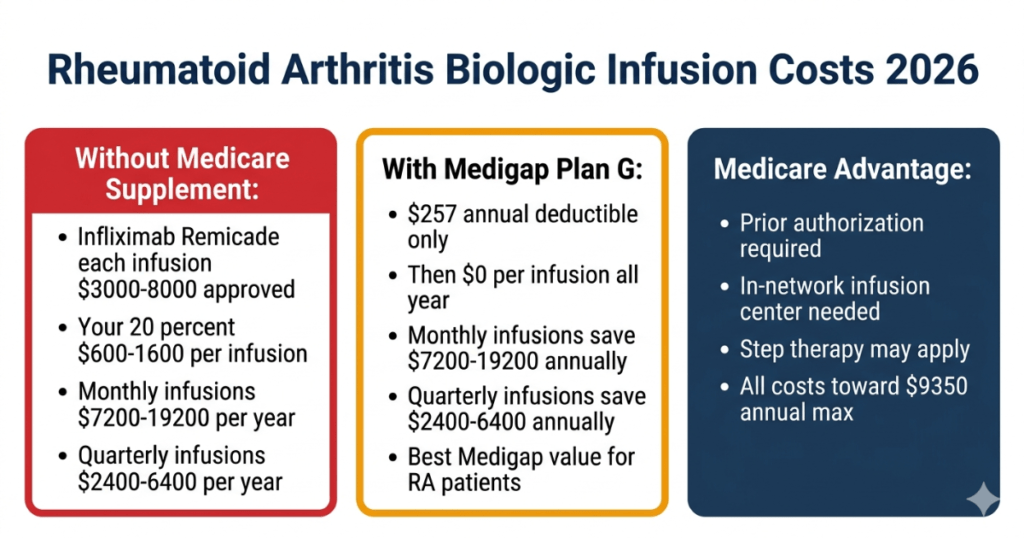
Biologic infusions are expensive — infliximab infusions can cost $3,000 to $8,000 per infusion at Medicare-approved rates. With Original Medicare your 20% coinsurance per infusion can be $600 to $1,600.
With Medigap Plan G — $0 per infusion after the $257 annual deductible. For RA patients requiring monthly or every-8-week infusions Plan G can save $7,000 to $20,000 per year compared to Original Medicare alone. This is one of the most financially significant Medigap Plan G savings available for any Medicare condition.
Does Medicare Cover Occupational Therapy for Arthritis?
Does Medicare cover occupational therapy for arthritis in 2026? Yes — Medicare Part B covers occupational therapy for arthritis patients at 80% after the annual deductible.
OT for arthritis focuses on:
- Joint protection techniques to reduce stress on arthritic joints
- Adaptive equipment training — splints, jar openers, ergonomic tools
- Hand therapy for RA and OA affecting hand and wrist function
- Energy conservation for RA patients with fatigue
- Home modification recommendations for safety
- Strategies for maintaining work and daily activity participation
How Much Does Arthritis Treatment Cost with Medicare in 2026?
Arthritis Medications Under Part D
Generic medications — methotrexate, hydroxychloroquine, meloxicam — typically $5 to $30 per month Biologic medications under Part D — $2,000 annual out-of-pocket maximum is critically important Without Part D and the $2,000 cap biologic costs can reach $25,000 to $60,000 per year
Joint Injections
With Original Medicare — approximately $28 to $64 per injection visit (20% coinsurance) With Medigap Plan G — $0 per injection after annual deductible
Physical and Occupational Therapy
With Original Medicare — $16 to $35 per session With Medigap Plan G — $0 per session
Biologic Infusions Under Part B
With Original Medicare — $600 to $1,600 per infusion (20% coinsurance) With Medigap Plan G — $0 per infusion after annual deductible Annual savings with Plan G for monthly infusion patients — $7,000 to $20,000
With Medicare Advantage
Medicare Advantage plans cover arthritis treatment with their own cost-sharing:
- Prior authorization required for biologic medications and infusions
- In-network rheumatologist and infusion center required
- All costs count toward $9,350 annual out-of-pocket maximum
Does Medicare Advantage Cover Arthritis Treatment?
Does Medicare Advantage cover arthritis treatment in 2026? Yes — all Medicare Advantage plans must cover arthritis treatment as Medicare-required services. Important considerations for arthritis patients:
Prior authorization for biologics — most Medicare Advantage plans require prior authorization for biologic medications and infusion therapy. Your rheumatologist typically handles the authorization process but delays can occur. Ensure authorization is obtained before starting or continuing biologic therapy.
In-network infusion centers — verify that your preferred infusion center is in your plan’s network before scheduling infusions.
Step therapy requirements — some Medicare Advantage plans require that patients try less expensive medications before approving expensive biologics. Your rheumatologist can request step therapy exemptions if clinically appropriate.
Out-of-pocket maximum — all arthritis treatment costs count toward the $9,350 annual maximum. RA patients with expensive infusion regimens often reach this maximum early in the year.
Frequently Asked Questions — Does Medicare Cover Arthritis Treatment
Does Medicare cover arthritis treatment in 2026?
Yes — Medicare covers comprehensive arthritis treatment including physician and rheumatologist visits, all FDA-approved arthritis medications under Part D with a $2,000 annual maximum, biologic infusions under Part B, joint injections, physical and occupational therapy, and joint replacement surgery. Medicare covers all forms of arthritis — osteoarthritis, rheumatoid arthritis, psoriatic arthritis, gout, and others.
Does Medicare cover biologic medications for rheumatoid arthritis?
Yes — Medicare Part D covers self-injectable biologic medications including adalimumab (Humira), etanercept (Enbrel), and JAK inhibitors like upadacitinib (Rinvoq). The $2,000 annual Part D out-of-pocket maximum is critically important for RA patients taking biologics costing $25,000 to $60,000 per year at retail. Medicare Part B covers IV biologic infusions like infliximab and rituximab administered in outpatient settings.
Does Medicare cover joint injections for arthritis?
Yes — Medicare Part B covers corticosteroid joint injections and hyaluronic acid knee injections when medically necessary at 80% after the $257 annual deductible. With Medigap Plan G joint injections cost $0 after the annual deductible.
How much does rheumatoid arthritis infusion therapy cost with Medicare?
With Original Medicare biologic infusions cost 20% coinsurance — approximately $600 to $1,600 per infusion. For patients receiving monthly infusions this can total $7,000 to $20,000 per year in coinsurance. With Medigap Plan G all infusion costs are $0 after the $257 annual deductible — making Plan G one of the most financially valuable supplements for RA infusion patients.
Does Medicare cover physical therapy for arthritis?
Yes — Medicare Part B covers physical therapy for arthritis at 80% after the $257 annual deductible with no predetermined session limit. With Medigap Plan G physical therapy costs $0 per session after the annual deductible.
Summary — Does Medicare Cover Arthritis Treatment 2026
Does Medicare cover arthritis treatment in 2026? Yes — Medicare provides comprehensive coverage for all forms of arthritis treatment including medications, biologics, joint injections, physical and occupational therapy, infusion therapy, specialist visits, and joint replacement surgery. The $2,000 annual Part D out-of-pocket maximum is particularly important for RA patients taking expensive biologic medications.
For rheumatoid arthritis patients requiring regular biologic infusions Medigap Plan G provides extraordinary financial protection — covering the 20% Part B coinsurance on infusions that can total $7,000 to $20,000 per year without a supplement. This makes Plan G one of the most financially valuable Medigap options for RA infusion patients.
For free help understanding your Medicare arthritis treatment coverage contact your State Health Insurance Assistance Program (SHIP) at shiphelp.org or call Medicare free at 1-800-633-4227.
This guide is for informational purposes only and is not medical advice. Always consult your rheumatologist and verify current Medicare coverage at Medicare.gov before making treatment decisions.
Sources: Medicare.gov | CMS.gov | SSA.gov | AARP.org
Last updated: April 2026 | Author: James Carter, Independent Medicare Research Analyst