
Does Medicare Cover Kidney Disease Treatment — Complete Guide 2026
Does Medicare cover kidney disease treatment in 2026? Kidney disease — including chronic kidney disease (CKD) and end-stage renal disease (ESRD) — affects millions of Medicare beneficiaries and requires ongoing and often expensive medical treatment. Medicare has some of the most comprehensive and unique coverage provisions for kidney disease of any condition — including a special Medicare eligibility pathway for people under 65 with end-stage renal disease requiring dialysis or transplant. In this complete guide we explain exactly what Medicare covers for kidney disease treatment in 2026 — chronic kidney disease management, dialysis coverage, kidney transplant coverage, immunosuppressive drug coverage, and how Medicare Advantage handles kidney disease. All information is sourced from Medicare.gov and CMS.gov.
Also Read —
- Does Medicare Cover Cancer Treatment 2026
- Does Medicare Cover Diabetes Supplies 2026
- Medicare Late Enrollment Penalty — How to Avoid It in 2026
What You Will Learn — Does Medicare Cover Kidney Disease
- Does Medicare cover kidney disease treatment in 2026
- Medicare coverage for chronic kidney disease (CKD)
- Medicare ESRD — special eligibility for under 65
- Does Medicare cover dialysis
- Does Medicare cover kidney transplant
- Does Medicare cover immunosuppressive drugs after transplant
- How much does kidney disease treatment cost with Medicare
- Does Medicare Advantage cover kidney disease
- Frequently asked questions about Medicare kidney disease coverage 2026
Does Medicare Cover Kidney Disease Treatment in 2026?
Yes — Medicare covers kidney disease treatment comprehensively in 2026. Medicare provides coverage for the full spectrum of kidney disease — from early-stage chronic kidney disease management through end-stage renal disease requiring dialysis or kidney transplantation.
Medicare kidney disease coverage in 2026 is unique in several important ways:
First Medicare has a special eligibility pathway — called the ESRD Medicare benefit — that allows people under age 65 with end-stage renal disease to qualify for Medicare regardless of their age or disability status. This is one of the most important Medicare eligibility provisions in the entire program — making Medicare the primary payer for kidney failure treatment for Americans of all ages.
Second Medicare Part B covers a comprehensive Kidney Disease Education program for patients with Stage 4 chronic kidney disease — helping patients understand their condition and prepare for future treatment decisions.
Third Medicare covers immunosuppressive drugs after kidney transplantation under a special lifetime benefit — recognizing that transplant patients must take these drugs permanently to prevent organ rejection.
Medicare Coverage for Chronic Kidney Disease (CKD)
Chronic kidney disease — also called CKD — is a progressive condition in which the kidneys gradually lose their ability to filter waste from the blood. CKD is staged from Stage 1 (mild kidney damage with normal or near-normal function) through Stage 5 (kidney failure requiring dialysis or transplant).
Physician Care for CKD — Covered
Medicare Part B covers nephrology visits and primary care visits for CKD management at 80% after the $257 annual Part B deductible. Regular monitoring by a nephrologist — a kidney specialist — is an essential component of CKD management covered by Medicare.
Laboratory Tests for CKD Monitoring — Covered
Medicare Part B covers laboratory tests for CKD monitoring at $0 — with no deductible or coinsurance for diagnostic lab tests. CKD monitoring tests covered at $0 include:
- Serum creatinine and estimated GFR
- Blood urea nitrogen (BUN)
- Urine albumin-to-creatinine ratio
- Complete metabolic panel
- Hemoglobin for anemia monitoring
- Parathyroid hormone (PTH) for bone disease monitoring
- Phosphorus and calcium levels
Kidney Disease Education — Covered
Medicare Part B covers Kidney Disease Education (KDE) services for patients with Stage 4 chronic kidney disease (GFR 15 to 29). Coverage includes up to 6 hours of education sessions from a qualified kidney disease educator. KDE is covered at 80% after the Part B deductible.
KDE sessions help patients understand:
- How kidneys work and how CKD progresses
- Treatment options for kidney failure — dialysis and transplant
- How to delay CKD progression through diet and lifestyle
- Vascular access options for hemodialysis
- How to manage CKD-related complications
Medications for CKD — Covered Under Part D
Medications used to manage CKD and its complications are covered under Medicare Part D including:
- Erythropoiesis-stimulating agents (ESAs) for anemia — in some settings under Part B
- Phosphate binders for phosphorus management
- Vitamin D analogs for bone disease
- Blood pressure medications
- Other CKD-related medications
Durable Medical Equipment for CKD — Covered
Medicare Part B covers blood pressure monitors and certain other DME used by CKD patients at home at 80% after the Part B deductible.
Medicare ESRD — Special Eligibility for Under 65
One of the most important and unique aspects of Medicare kidney disease coverage is the End-Stage Renal Disease (ESRD) Medicare benefit — which allows Americans under age 65 to qualify for Medicare when they require dialysis or kidney transplantation.
Who Qualifies for ESRD Medicare Under 65?
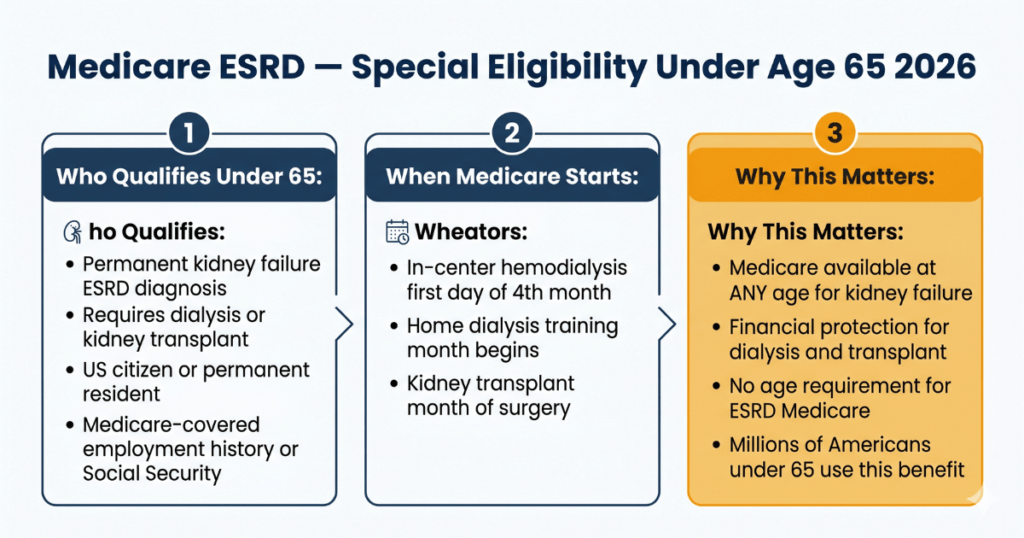
To qualify for Medicare under the ESRD pathway you must:
- Have permanent kidney failure — end-stage renal disease — requiring regular dialysis or a kidney transplant to survive
- Be a US citizen or permanent resident
- Have worked long enough in Medicare-covered employment (or your spouse or parent has) OR be receiving Social Security or Railroad Retirement benefits
If you meet these criteria you can enroll in Medicare regardless of your age — including if you are in your 20s, 30s, 40s, or 50s.
When Does ESRD Medicare Begin?
The start date for ESRD Medicare coverage depends on your treatment:
For in-center hemodialysis — Medicare coverage begins on the first day of the 4th month of dialysis treatment. During the first 3 months of dialysis your other insurance (if you have it) remains primary.
For home dialysis — if you plan to do home dialysis and receive training before beginning home dialysis Medicare coverage can begin earlier — on the first day of the month in which home dialysis training begins.
For kidney transplant recipients — Medicare begins the month of the transplant surgery or if you are already on dialysis it begins when your nephrologist certifies you are being evaluated for transplant.
Does Medicare Cover Dialysis?
Does Medicare cover dialysis in 2026? Yes — Medicare provides comprehensive coverage for dialysis — the treatment that filters waste and excess fluid from the blood when the kidneys can no longer do so.
Types of Dialysis Medicare Covers
Hemodialysis — the most common form of dialysis in which blood is filtered through a machine outside the body. Hemodialysis is typically performed three times per week — each session lasting 3 to 5 hours.
Peritoneal dialysis — dialysis performed using the lining of the abdomen (peritoneum) as a filter. Peritoneal dialysis can be performed at home — either manually (CAPD) or using a machine at night (APD/CCPD).
In-Center Hemodialysis Coverage
Medicare covers in-center hemodialysis at a Medicare-certified dialysis facility — called an ESRD facility or dialysis center. Coverage under the ESRD composite rate includes:
- The dialysis treatments themselves
- Nursing and technical staff services
- Dialysis supplies and equipment used at the facility
- Certain routine lab tests performed as part of dialysis care
- Some medications administered during dialysis
Medicare pays the dialysis facility a bundled payment rate per treatment — called the ESRD Prospective Payment System (PPS) bundle — that covers most services associated with dialysis.
Home Dialysis Coverage
Medicare covers home dialysis for patients who are able and willing to perform dialysis at home with appropriate training. Home dialysis coverage includes:
- Dialysis equipment for home use — the machine, supplies, and accessories
- Training for you and your home helper
- Regular nurse visits to support home dialysis
- Laboratory testing associated with home dialysis monitoring
Home dialysis offers significant quality-of-life advantages — allowing more flexible treatment schedules and the comfort of home. Medicare covers home dialysis comprehensively making it a financially viable option for qualifying patients.
Dialysis Cost with Medicare
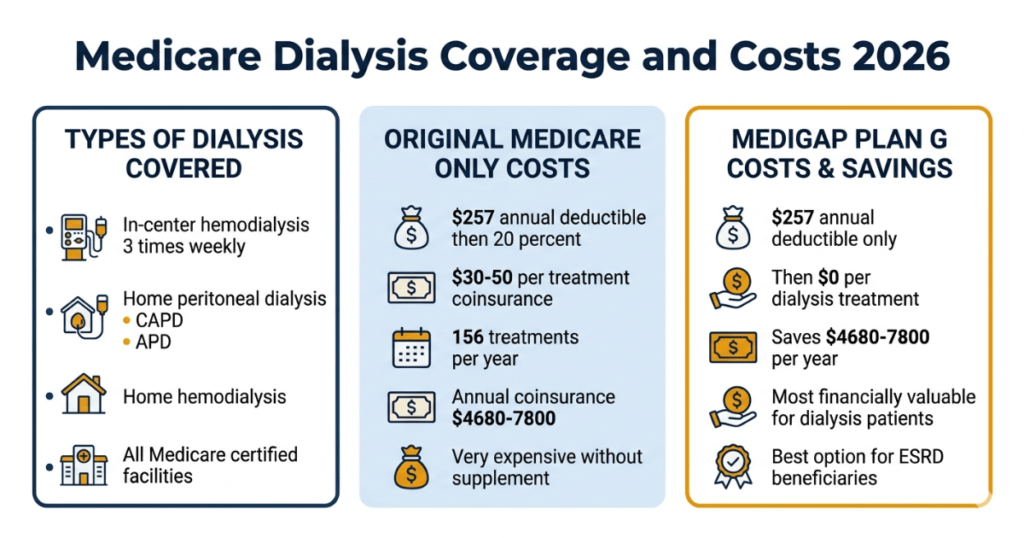
Dialysis is covered under Medicare Part B at 80% after the Part B deductible for outpatient dialysis services. For ESRD beneficiaries Medicare Part B covers:
Standard 2026 cost for dialysis:
- Medicare pays 80% of the Medicare-approved amount per treatment
- You pay 20% coinsurance per treatment after the $257 annual deductible
- Three treatments per week — approximately 156 treatments per year
- 20% coinsurance per treatment — approximately $30 to $50 per treatment
- Annual coinsurance without supplement — approximately $4,680 to $7,800
With Medigap Plan G your effective coinsurance for dialysis after the annual deductible is $0 — potentially saving $4,000 to $7,000 per year. This makes Medigap Plan G one of the most financially valuable supplements for ESRD dialysis patients.
Does Medicare Cover Kidney Transplant?
Does Medicare cover kidney transplant in 2026? Yes — Medicare covers kidney transplantation comprehensively for qualifying ESRD patients.
Medicare Kidney Transplant Coverage Includes:
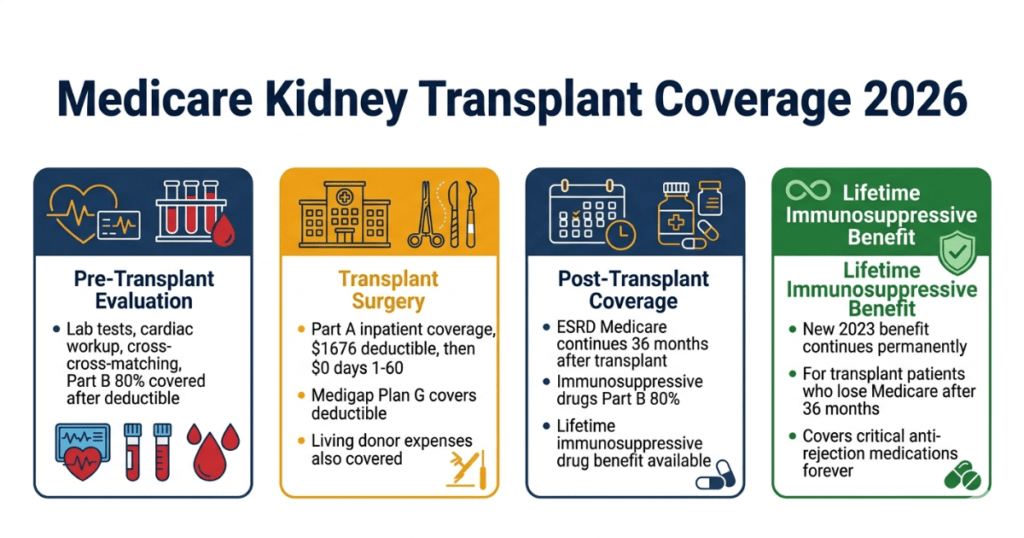
Pre-transplant evaluation — Medicare covers the comprehensive evaluation required before being listed for a kidney transplant including laboratory tests, cardiac evaluation, cross-matching, and other required workup. This is covered under Part B at 80% after the deductible.
Transplant surgery — Medicare Part A covers the kidney transplant surgery as an inpatient procedure. The $1,676 Part A deductible applies. Days 1 to 60 are covered at $0 after the deductible.
Living donor expenses — Medicare covers certain costs for a living kidney donor including:
- Medical evaluation for the donor
- Surgery for the donor to remove the kidney
- Follow-up care for the donor for up to 2 years after donation
This living donor coverage by Medicare is unique and important — removing financial barriers to living donation which is one of the best outcomes for kidney failure patients.
Post-Transplant ESRD Medicare Coverage
After a successful kidney transplant the patient may no longer need dialysis. However Medicare coverage for ESRD patients after transplant has specific rules:
Medicare coverage continues for 36 months after a successful kidney transplant for beneficiaries who were only eligible for Medicare because of ESRD.
If you are Medicare-eligible for another reason — age 65 or older or disability — your Medicare continues indefinitely after transplant.
After 36 months if you do not have other Medicare eligibility your Medicare coverage ends unless you have another qualifying reason for Medicare enrollment.
Does Medicare Cover Immunosuppressive Drugs After Transplant?
Does Medicare cover immunosuppressive drugs after kidney transplant in 2026? Yes — Medicare covers immunosuppressive medications after kidney transplant through a special dedicated benefit.
Immunosuppressive Drug Benefit
Medicare Part B covers immunosuppressive drugs for transplant patients who:
- Had a Medicare-covered transplant
- Were enrolled in Medicare at the time of the transplant
Medicare covers immunosuppressive drugs at 80% after the annual Part B deductible.
The Lifetime Immunosuppressive Drug Benefit
Starting in 2023 a new Medicare benefit provides lifetime coverage for immunosuppressive drugs for kidney transplant recipients — regardless of other Medicare eligibility. This lifetime benefit is specifically for:
- Medicare beneficiaries who lose Medicare coverage 36 months after transplant (when ESRD-only Medicare ends)
- Who need to continue taking immunosuppressive drugs to prevent transplant rejection
This lifetime immunosuppressive drug benefit can be enrolled in through a dedicated Part D-like program for immunosuppressive drugs — ensuring transplant patients are never without coverage for these critical medications.
Does Medicare Advantage Cover Kidney Disease?
Does Medicare Advantage cover kidney disease treatment in 2026? All Medicare Advantage plans must cover kidney disease treatment including dialysis and kidney transplant as required Medicare services. However there are important considerations for ESRD patients choosing Medicare Advantage.
Prior ESRD and Medicare Advantage Enrollment
Historically Medicare Advantage plans could deny enrollment to ESRD beneficiaries — but the 21st Century Cures Act changed this. As of January 2021 Medicare Advantage plans must accept ESRD beneficiaries who want to enroll.
Network Dialysis Facilities
Medicare Advantage plans may restrict coverage to in-network dialysis facilities. For ESRD patients requiring dialysis three times per week the dialysis facility network is critically important — ensure your dialysis center is in-network before enrolling in Medicare Advantage.
For ESRD Patients — Original Medicare Considerations
Many dialysis specialists recommend Original Medicare with Medigap Plan G for ESRD patients requiring dialysis because:
- Any Medicare-certified dialysis facility is covered without network restrictions
- The 20% dialysis coinsurance — potentially $4,000 to $7,000 per year — is completely covered by Plan G after the annual deductible
- No prior authorization delays for dialysis treatments
- Complete provider freedom for nephrology care
Frequently Asked Questions — Does Medicare Cover Kidney Disease
Does Medicare cover kidney disease treatment in 2026?
Yes — Medicare covers the full spectrum of kidney disease treatment including chronic kidney disease management, kidney disease education, dialysis, kidney transplantation, and lifetime immunosuppressive drug coverage after transplant. Medicare also has a unique ESRD eligibility pathway allowing Americans under 65 to qualify for Medicare when they require dialysis or transplant.
Does Medicare cover dialysis?
Yes — Medicare Part B covers dialysis at 80% after the $257 annual deductible for both in-center hemodialysis and home dialysis. The 20% coinsurance for dialysis — approximately $30 to $50 per treatment — can add up to $4,680 to $7,800 per year without a supplement. Medigap Plan G covers this coinsurance making dialysis effectively free after the annual deductible.
Does Medicare cover kidney transplant?
Yes — Medicare covers kidney transplantation comprehensively including pre-transplant evaluation, the transplant surgery under Part A, living donor expenses, and post-transplant immunosuppressive medications. Medicare ESRD coverage continues for 36 months after a successful transplant.
Can someone under 65 get Medicare for kidney disease?
Yes — the ESRD Medicare benefit allows Americans of any age to qualify for Medicare when they have end-stage renal disease requiring dialysis or transplant. Medicare ESRD coverage typically begins at the start of the 4th month of dialysis treatment.
Does Medicare cover immunosuppressive drugs after kidney transplant?
Yes — Medicare covers immunosuppressive medications after kidney transplant through a dedicated benefit. A lifetime immunosuppressive drug benefit also provides coverage for transplant patients who lose standard Medicare coverage 36 months after transplant.
Does Medicare Advantage cover dialysis?
Yes — Medicare Advantage must cover dialysis as a required Medicare service. However ESRD patients should verify that their dialysis center is in the MA plan’s network before enrolling. Many dialysis specialists recommend Original Medicare with Medigap Plan G for ESRD patients due to complete provider freedom and elimination of the 20% dialysis coinsurance.
Summary — Does Medicare Cover Kidney Disease 2026
Does Medicare cover kidney disease treatment in 2026? Yes — Medicare provides comprehensive coverage for the full spectrum of kidney disease from CKD management through dialysis and kidney transplantation. Medicare’s unique ESRD eligibility pathway makes Medicare the primary payer for kidney failure treatment for Americans of all ages.
For dialysis patients Medigap Plan G provides exceptional financial protection — eliminating the 20% coinsurance on dialysis treatments that can total $4,000 to $7,000 or more per year without a supplement. The lifetime immunosuppressive drug benefit ensures transplant patients maintain coverage for critical medications permanently.
For free help understanding your Medicare kidney disease coverage contact your State Health Insurance Assistance Program (SHIP) at shiphelp.org or call Medicare free at 1-800-633-4227.
This guide is for informational purposes only and is not medical advice. Always consult your nephrologist and verify current Medicare kidney disease coverage at Medicare.gov.
Sources: Medicare.gov | CMS.gov | SSA.gov | AARP.org
Last updated: April 2026 | Author: James Carter, Independent Medicare Research Analyst