
Medicare Advantage Vision Benefits 2026 — Complete Guide
Medicare Advantage vision benefits in 2026 are one of the most important and most valuable extra benefits that Medicare Advantage plans offer over Original Medicare. Original Medicare does not cover routine vision care — routine eye exams, eyeglasses, or contact lenses — leaving Medicare beneficiaries to pay 100% out of pocket for these services. Medicare Advantage vision benefits in 2026 fill this significant gap — providing annual eye exams at $0 and meaningful allowances toward eyeglasses or contact lenses. In this complete guide we explain everything about Medicare Advantage vision benefits in 2026 — what is covered, how vision allowances work, how to compare vision benefits across plans, and which Medicare Advantage plans offer the best vision coverage. All information is sourced from Medicare.gov and CMS.gov.
Also Read —
- Medicare Advantage Dental Benefits 2026
- Medicare Advantage Hearing Benefits 2026
- Medicare Deductible 2026 — Complete Breakdown
What You Will Learn — Medicare Advantage Vision Benefits 2026
- Why Medicare Advantage vision benefits matter so much
- What Original Medicare does and does not cover for vision
- What Medicare Advantage vision benefits typically include in 2026
- How vision allowances for eyeglasses work
- How to compare Medicare Advantage vision benefits
- Which Medicare Advantage plans have the best vision benefits 2026
- Medicare Advantage vision networks — what to know
- Frequently asked questions about Medicare Advantage vision benefits 2026
Why Medicare Advantage Vision Benefits Matter So Much
Medicare Advantage vision benefits in 2026 are financially significant because vision care is one of the largest out-of-pocket healthcare expenses for Medicare beneficiaries — and one that Original Medicare completely ignores.
Original Medicare — Parts A and B — explicitly excludes routine vision care. This means Medicare beneficiaries on Original Medicare pay 100% out of pocket for:
- Annual comprehensive eye exams
- Eyeglass frames and prescription lenses
- Contact lenses
- Reading glasses
The financial impact is meaningful. The average American spends $300 to $600 per year on vision care including eye exams and eyewear. Seniors who need bifocals, progressive lenses, or premium frames can spend $500 to $1,500 or more per year. Over a 20-year retirement the cumulative vision cost without coverage can reach $6,000 to $30,000.
Medicare Advantage vision benefits address this gap directly — providing annual eye exams at no cost and meaningful allowances toward eyeglasses or contacts as part of the Medicare Advantage plan. This is why vision benefits — alongside dental and hearing — are consistently cited as top reasons seniors choose Medicare Advantage over Original Medicare with Medigap.
One important distinction — Medicare Part B does cover certain medically necessary eye services including treatment for glaucoma, diabetic retinopathy, macular degeneration, and post-cataract surgery eyeglasses. Medicare Advantage vision benefits go beyond these medical eye services to cover routine vision care that Original Medicare excludes.
What Original Medicare Covers vs Does Not Cover for Vision
Understanding the baseline is important before evaluating Medicare Advantage vision benefits.
Original Medicare DOES Cover — Medical Eye Services
- Glaucoma screening at $0 for high-risk beneficiaries
- Diabetic retinopathy eye exam at $0 for diabetic patients
- Treatment for glaucoma, macular degeneration, diabetic eye disease
- Cataract surgery — at 80% after deductible
- One pair of eyeglasses or contacts after cataract surgery — at 80% after deductible
- Cornea transplants and other medical eye procedures
Original Medicare Does NOT Cover — Routine Vision
- Annual comprehensive eye exam for glasses prescription
- Eyeglasses frames and lenses (except post-cataract)
- Contact lenses (except post-cataract)
- Reading glasses
- Sunglasses
- Vision therapy
Medicare Advantage Vision Benefits Fill the Gap
Medicare Advantage vision benefits cover most or all of what Original Medicare excludes — annual comprehensive exams and eyewear allowances — while the plan also covers all the medical eye services Original Medicare provides.
What Medicare Advantage Vision Benefits Typically Include in 2026
Most Medicare Advantage plans include vision benefits as part of their extra benefits package. Here is what Medicare Advantage vision benefits typically include across plan tiers:
Annual Comprehensive Eye Exam — Almost Universally Covered
The cornerstone of Medicare Advantage vision benefits — the annual comprehensive eye exam:
- Covered at $0 on most Medicare Advantage plans
- Includes refraction — the test to determine glasses prescription
- Includes dilated eye exam on many plans
- Covered once per year
- Performed by an optometrist or ophthalmologist in the plan’s vision network
The annual $0 eye exam alone saves $100 to $250 per year compared to paying out of pocket.
Eyeglasses and Contact Lens Allowance
The most financially significant Medicare Advantage vision benefit — an annual allowance toward eyeglasses or contact lenses:
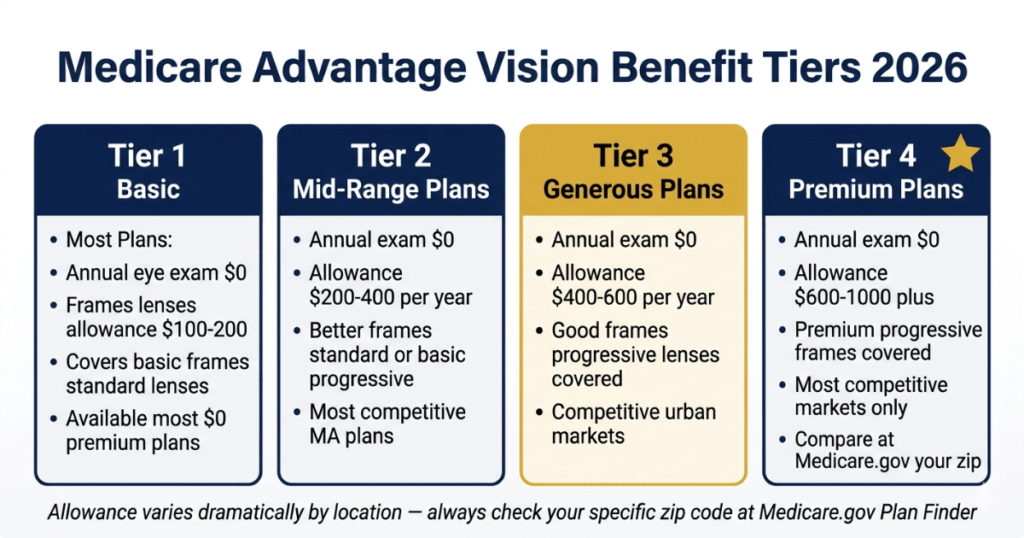
Basic vision benefit — $100 to $200 per year:
- Covers basic frames and standard lenses
- Available on most $0 premium Medicare Advantage plans
- Sufficient for purchasing basic eyeglasses from plan network providers
Mid-range vision benefit — $200 to $400 per year:
- Covers better quality frames and standard or basic progressive lenses
- Available on many competitive Medicare Advantage plans
- Meaningful coverage for most eyewear needs
Generous vision benefit — $400 to $600 per year:
- Covers good quality frames and progressive lenses
- Available on more generous Medicare Advantage plans in competitive markets
- Covers a complete set of prescription eyeglasses at no or minimal cost
Premium vision benefit — $600 to $1,000 or more per year:
- Available on the most generous Medicare Advantage plans
- May cover premium progressive lenses and better quality frames
- Available primarily in highly competitive markets
How Vision Allowances Work in Medicare Advantage
Understanding exactly how Medicare Advantage vision allowances work is essential for getting maximum value from vision benefits.
Allowance Application
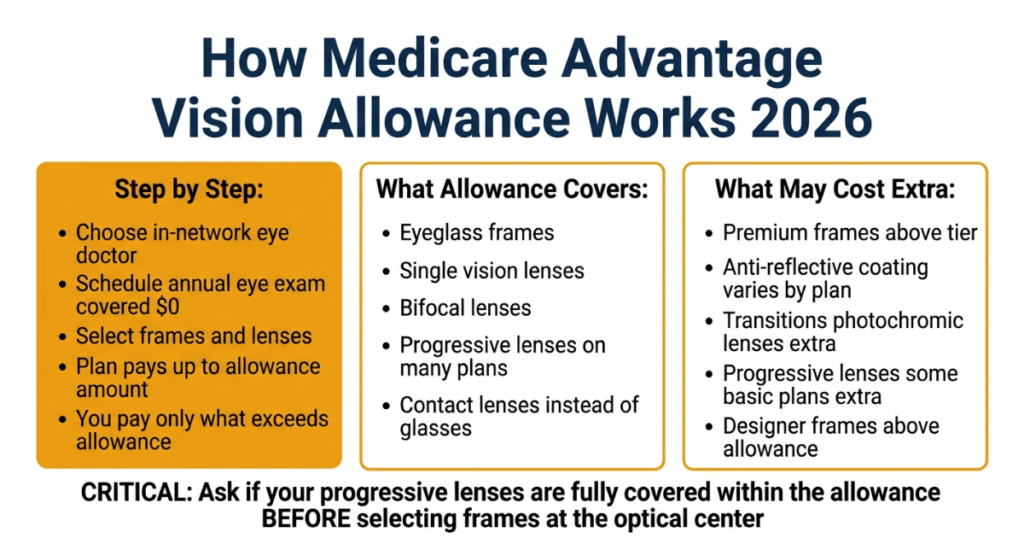
The vision allowance is a dollar amount the plan contributes toward your eyewear purchase. When you buy eyeglasses or contacts from a network provider:
- The plan pays up to the allowance amount
- You pay any amount above the allowance
In-Network vs Out-of-Network Vision
Most Medicare Advantage plans have vision networks — partnering with vision care chains and independent optometrists. In-network vision care provides the best value:
- Eye exam covered at $0
- Allowance applied at full value toward eyeglasses or contacts
- Discounts may further reduce costs beyond the allowance
Out-of-network vision:
- Some plans provide reduced out-of-network benefits
- Others provide no out-of-network vision coverage
- Always check whether your optometrist or ophthalmologist is in-network
Vision Networks
Medicare Advantage plans typically use one of these major vision networks:
- VSP (Vision Service Plan) — the largest vision network in the US
- EyeMed — major national vision network
- Davis Vision — large vision care network
- Superior Vision — national vision network
When evaluating Medicare Advantage vision benefits check which vision network the plan uses and whether your current eye doctor participates.
Allowance Frequency
Most Medicare Advantage vision allowances are annual — resetting January 1 each year. Some plans provide biennial allowances — every two years. Annual allowances provide more frequent coverage for patients who need prescription updates or replace eyewear more often.
What Counts Against the Allowance
Vision allowances typically apply to:
- Eyeglass frames
- Prescription lenses — single vision, bifocal, progressive
- Contact lenses — instead of glasses
What may NOT count against the allowance:
- Lens upgrades — anti-reflective coating, transitions, photochromic
- Premium frames above standard tier
- Reading glasses in some cases
Always ask the optical provider how the allowance applies before selecting frames and lenses.
How to Compare Medicare Advantage Vision Benefits
When comparing Medicare Advantage vision benefits during Open Enrollment October 15 to December 7 use this systematic approach:
Step 1 — Check the Annual Eye Exam Benefit
Verify the annual eye exam is covered at $0. Most plans cover this but check for any copays.
Step 2 — Check the Eyewear Allowance Amount
Find the annual eyewear allowance — the dollar amount toward frames and lenses. Higher is better. Compare plans by allowance amount — differences of $200 to $400 can mean the difference between full coverage and significant out-of-pocket costs.
Step 3 — Check Allowance Frequency
Annual vs biennial allowance — annual provides more frequent access. Patients who need progressive lenses updated annually need annual allowances.
Step 4 — Check What the Allowance Covers
Does the allowance cover progressive lenses specifically? Some basic allowances cover only single vision lenses — leaving progressive lens users with significant out-of-pocket costs. If you wear progressive lenses confirm the allowance explicitly covers them.
Step 5 — Verify Your Eye Doctor Is In-Network
Call your optometrist or ophthalmologist to confirm they participate in the plan’s vision network. This is critical — out-of-network vision care may not be covered or may provide significantly reduced benefits.
Step 6 — Check Lens Upgrade Coverage
Some plans include anti-reflective coating or other lens upgrades in the allowance — others treat these as extra costs. If you regularly purchase lens upgrades this distinction matters.
Step 7 — Consider Total Plan Value
Do not select a Medicare Advantage plan solely for vision benefits. Evaluate the complete plan including medical coverage, drug coverage, dental, hearing, network, premium, and out-of-pocket maximum alongside vision benefits.
Which Medicare Advantage Plans Have the Best Vision Benefits in 2026?
The Medicare Advantage plans with the best vision benefits vary by location. In competitive markets plans offer more generous vision allowances. Here are the insurers that tend to offer the most competitive vision benefits nationally:
UnitedHealthcare AARP Medicare Advantage
UnitedHealthcare consistently offers some of the most generous vision benefits nationally — with annual allowances of $200 to $400 or more on many plans and comprehensive exam coverage at $0. UnitedHealthcare uses a broad vision network providing wide provider access.
Humana Medicare Advantage
Humana offers competitive vision benefits on most Medicare Advantage plans — typically $150 to $300 annual allowance with comprehensive exam at $0 and access to broad vision networks.
Aetna Medicare Advantage
Aetna offers vision benefits including $0 annual exam and $150 to $300 eyewear allowance on competitive plans — leveraging EyeMed and other major vision networks.
Anthem Blue Cross Blue Shield Medicare Advantage
Anthem offers vision benefits with $0 annual exam and $150 to $400 eyewear allowance on competitive plans — with VSP and EyeMed network access in many markets.
Cigna Medicare Advantage
Cigna offers vision benefits including $0 annual exam and $150 to $300 allowance on most plans.
Important — Benefits Vary by Location
Vision benefit generosity varies dramatically by market. The same insurer may offer a $400 annual allowance in a competitive urban market and $150 in a less competitive market. Always check the specific vision benefits for plans in your zip code at Medicare.gov Plan Finder.
Medicare Advantage Vision Benefits vs Standalone Vision Insurance
Some Medicare beneficiaries wonder whether to use Medicare Advantage vision benefits or purchase standalone vision insurance separately. Here is how they compare:
Medicare Advantage Vision Benefits
- Included in the Medicare Advantage plan — no additional premium
- Annual eye exam at $0
- Allowance of $100 to $1,000 depending on plan and market
- Must use plan’s vision network
Standalone Vision Insurance
- Separate monthly premium — typically $15 to $25 per month
- Additional annual cost of $180 to $300 per year
- Annual eye exam typically at $10 to $20 copay
- Allowance of $100 to $200 typically
- May have broader provider network
For most Medicare beneficiaries with Medicare Advantage the built-in vision benefit provides better value than purchasing standalone vision insurance separately — particularly since the Medicare Advantage benefit has no additional premium.

Medicare Advantage OTC Vision Products
Some Medicare Advantage plans include over-the-counter (OTC) vision-related products in their OTC allowances — such as artificial tears, eye drops, and reading glasses. Check your specific plan’s OTC benefit catalog to determine if vision-related OTC products are included.
Frequently Asked Questions — Medicare Advantage Vision Benefits 2026
Do all Medicare Advantage plans include vision benefits?
Most Medicare Advantage plans include at minimum a $0 annual eye exam. Eyewear allowances — the dollar benefit toward frames and lenses — vary significantly by plan from $0 (preventive exam only) to $1,000 or more. Always check the vision benefits section specifically at Medicare.gov Plan Finder for your zip code.
How much is the vision allowance on Medicare Advantage plans?
Medicare Advantage vision allowances in 2026 typically range from $100 to $600 per year depending on plan and market. UnitedHealthcare and Humana consistently offer competitive allowances nationally. In highly competitive markets allowances of $400 to $1,000 are available on some plans.
Does Medicare Advantage cover progressive lenses?
Some Medicare Advantage plans cover progressive lenses within the standard allowance — others cover only single vision or bifocal lenses at the standard rate and charge extra for progressives. If you wear progressive lenses specifically confirm progressive lens coverage before enrolling.
Can I use any eye doctor with Medicare Advantage vision benefits?
Medicare Advantage vision benefits typically require in-network providers for the best coverage. Check that your current optometrist or ophthalmologist participates in the plan’s vision network — VSP, EyeMed, or other network — before enrolling. Some PPO-style plans offer out-of-network vision coverage at reduced rates.
How do Medicare Advantage vision benefits compare to Original Medicare?
Original Medicare covers only medically necessary eye services — glaucoma screening, treatment for eye disease, and post-cataract surgery glasses. Original Medicare provides zero coverage for routine eye exams, eyeglasses, or contacts. Medicare Advantage vision benefits fill this gap by covering annual exams at $0 and providing eyewear allowances.
Summary — Medicare Advantage Vision Benefits 2026
Medicare Advantage vision benefits in 2026 represent one of the most valuable financial advantages of Medicare Advantage over Original Medicare — covering annual comprehensive eye exams at $0 and providing meaningful allowances toward eyeglasses or contacts that Original Medicare completely excludes.
The most important factors when comparing Medicare Advantage vision benefits are the annual allowance amount — look for $200 or higher for meaningful eyewear coverage — whether the allowance covers progressive lenses, the frequency of the allowance, and whether your eye doctor is in-network.
Use Medicare.gov Plan Finder during Open Enrollment October 15 to December 7 and review the vision benefits section carefully for each plan you consider. Do not select a plan solely for vision — evaluate total plan value including medical coverage, dental, hearing, and drug coverage alongside vision benefits.
For free help comparing Medicare Advantage vision benefits contact your State Health Insurance Assistance Program (SHIP) at shiphelp.org or call Medicare free at 1-800-633-4227.
This guide is for informational purposes only. Always verify current Medicare Advantage vision benefits at Medicare.gov before making enrollment decisions.
Sources: Medicare.gov | CMS.gov | SSA.gov | AARP.org
Last updated: April 2026 | Author: James Carter, Independent Medicare Research Analyst