Does Medicare Cover Shingles Vaccine — Complete Guide 2026
Does Medicare cover the shingles vaccine in 2026? Shingles — also called herpes zoster — is a painful and potentially debilitating condition that affects approximately one in three Americans during their lifetime and becomes increasingly common with age. The Shingrix shingles vaccine is strongly recommended for all adults aged 50 and older — and understanding how Medicare covers this important vaccine is essential for every Medicare beneficiary. In this complete guide we explain exactly what Medicare covers for the shingles vaccine in 2026 — which part of Medicare covers Shingrix, how much the shingles vaccine costs with Medicare, where to get your vaccine, and how Medicare Advantage handles shingles vaccine coverage. All information is sourced from Medicare.gov and CMS.gov.
Also Read —
- Medicare Late Enrollment Penalty — How to Avoid It in 2026
- Does Medicare Cover Preventive Care 2026
- Medicare Part D Drug Coverage Explained 2026
What You Will Learn — Does Medicare Cover Shingles Vaccine
- Does Medicare cover the shingles vaccine in 2026
- Which part of Medicare covers Shingrix
- Why the shingles vaccine is covered under Part D not Part B
- How much does the shingles vaccine cost with Medicare
- Where to get your Shingrix vaccine with Medicare
- Does Medicare cover both doses of Shingrix
- Does Medicare Advantage cover the shingles vaccine
- What to do if your pharmacy charges for Shingrix
- Frequently asked questions about Medicare shingles vaccine coverage 2026
Does Medicare Cover the Shingles Vaccine in 2026?
Yes — Medicare covers the shingles vaccine in 2026. Specifically Medicare covers Shingrix — the recombinant zoster vaccine that is the only shingles vaccine recommended by the CDC for adults aged 50 and older.
However there is an important distinction about how Medicare covers Shingrix that every Medicare beneficiary needs to understand — the shingles vaccine is covered under Medicare Part D rather than Medicare Part B. This is different from flu shots and pneumococcal vaccines which are covered under Part B.
Because Shingrix is covered under Medicare Part D the cost-sharing depends on your specific Part D plan’s formulary and cost-sharing structure. However under the Inflation Reduction Act’s provisions that took effect starting in 2023 Medicare Part D must cover all ACIP-recommended vaccines — including Shingrix — at $0 cost-sharing for Medicare beneficiaries.
This means in 2026 you should pay $0 for your Shingrix vaccine under Medicare Part D — just like you pay $0 for flu shots under Part B. The $0 cost-sharing for ACIP-recommended vaccines under Part D is one of the most significant improvements to Medicare vaccine coverage in recent years.
Which Part of Medicare Covers Shingrix?
Shingrix is Covered Under Medicare Part D — Not Part B
This is the most important distinction about Medicare shingles vaccine coverage — Shingrix is covered under Medicare Part D prescription drug plans rather than Medicare Part B preventive services.
Why does this matter? Because the coverage pathway affects where you get vaccinated and how the claim is processed:
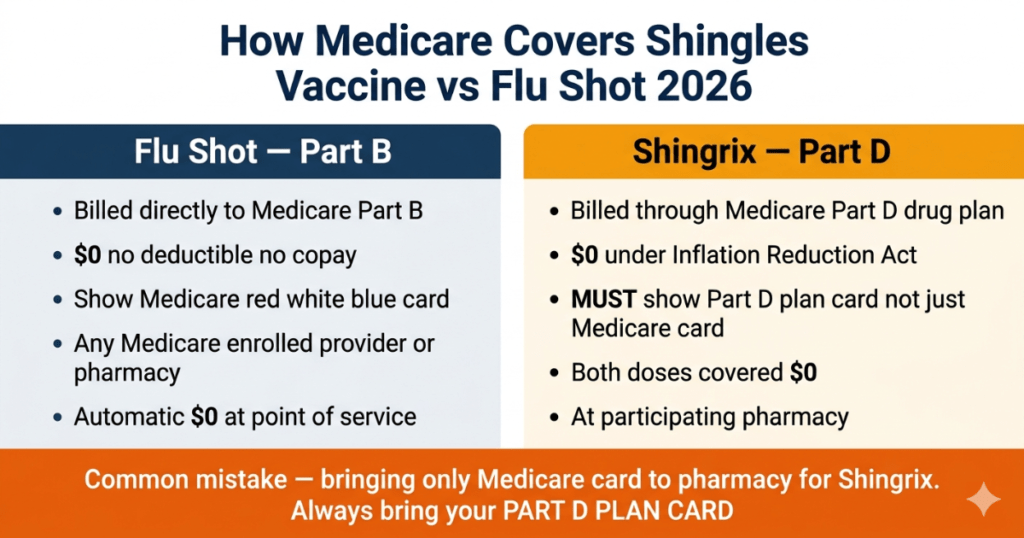
Under Part B (flu shots, pneumococcal, COVID-19, Hepatitis B) — the vaccine is billed directly to Medicare Part B at the point of service with $0 cost to you automatically.
Under Part D (Shingrix) — the vaccine is billed through your Medicare Part D plan at the pharmacy. The claim goes through your drug plan’s system rather than Part B.
The $0 Shingrix Requirement Under Part D
The Inflation Reduction Act of 2022 mandated that Medicare Part D plans cover all ACIP-recommended vaccines — including Shingrix — with $0 cost-sharing starting in 2023. This requirement continues in 2026.
This means:
- Your Medicare Part D plan must cover Shingrix at $0
- The $0 applies regardless of which coverage phase you are in
- Your Part D deductible does not apply to Shingrix
- You do not need to reach any spending threshold before Shingrix is free
If you have Medicare Part D or a Medicare Advantage plan with Part D coverage (MA-PD) your Shingrix vaccine should cost $0.
Why Is Shingrix Covered Under Part D Instead of Part B?
The distinction between Part B and Part D vaccine coverage can seem confusing — so here is a clear explanation of why Shingrix falls under Part D.
Medicare Part B covers vaccines that are administered by a healthcare provider — physician, nurse, or pharmacist — when the vaccine is considered a medical service provided in a physician-administered context. The vaccines covered under Part B include flu, pneumococcal, COVID-19, and Hepatitis B.
Medicare Part D covers prescription drugs including vaccines that are typically obtained from a pharmacy and self-administered or pharmacy-administered. Shingrix falls into the Part D category because it is dispensed and administered through pharmacies like a prescription medication.
This Part B vs Part D distinction is a quirk of Medicare’s historical coverage structure — not a reflection of the clinical importance of the vaccine. Shingrix is just as important and strongly recommended as the vaccines covered under Part B — it simply runs through a different billing pathway.
How Much Does the Shingles Vaccine Cost with Medicare in 2026?
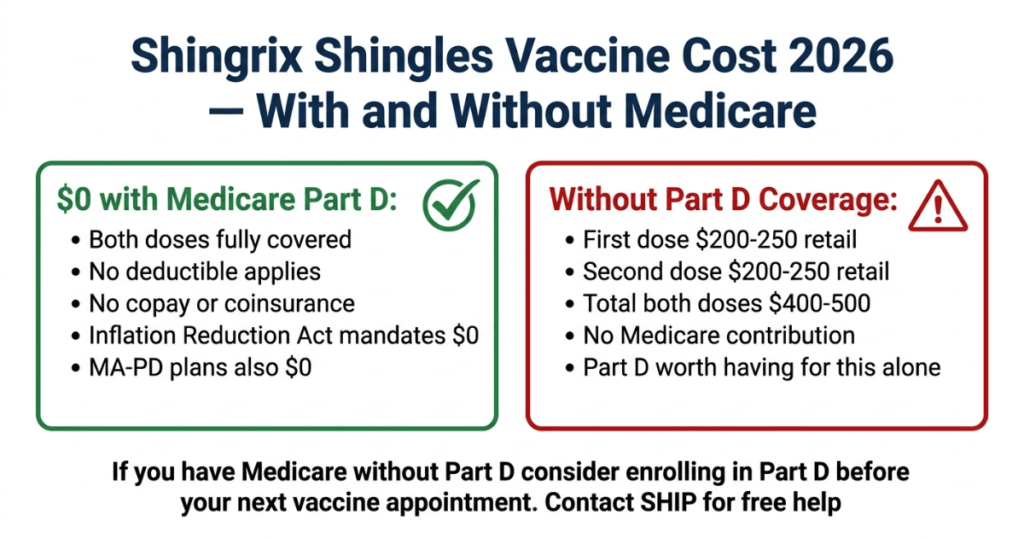
With Medicare Part D — $0
Under the Inflation Reduction Act all Medicare Part D plans must cover Shingrix at $0 in 2026. This means:
- No Part D deductible for Shingrix
- No copay or coinsurance for Shingrix
- $0 regardless of your coverage phase
Without Medicare Part D — Expensive
If you do not have Medicare Part D coverage and need to pay out of pocket for Shingrix the cost is significant:
- Shingrix retail price — approximately $200 to $250 per dose
- Two doses required — total retail cost approximately $400 to $500
This substantial out-of-pocket cost is one of the primary reasons why having Medicare Part D coverage is so important — the vaccine cost alone can justify the monthly Part D premium for many seniors.
With Medicare Advantage (MA-PD)
Medicare Advantage plans with drug coverage must also cover Shingrix at $0 as required by the Inflation Reduction Act. If you have a Medicare Advantage plan with drug coverage your Shingrix vaccine costs $0.
What If You Have Original Medicare Without Part D?
If you have Original Medicare Parts A and B but no Medicare Part D plan you do not have Medicare coverage for Shingrix. In this situation you would pay the full retail price — approximately $200 to $250 per dose.
This is a strong reason to ensure you have Medicare Part D coverage — even if you take few medications the shingles vaccine benefit alone can provide significant value.
Does Medicare Cover Both Doses of Shingrix?
Does Medicare cover both doses of the Shingrix shingles vaccine in 2026? Yes — Medicare Part D covers both doses of Shingrix at $0.
Shingrix requires two doses for complete protection:
- First dose — initial vaccination
- Second dose — given 2 to 6 months after the first dose
Both doses are covered at $0 under Medicare Part D. The $0 requirement under the Inflation Reduction Act applies to each dose individually — so both vaccinations are free.
It is critically important to complete both doses of Shingrix for full protection. Clinical studies show that Shingrix is approximately 97% effective against shingles when both doses are received — and effectiveness remains strong even in adults aged 70 and older.
Where to Get Your Shingrix Vaccine with Medicare
Because Shingrix is covered under Medicare Part D rather than Part B the process for getting vaccinated is slightly different from getting a flu shot.
Pharmacies — Most Common Location
Pharmacies are the most common and most convenient location to receive Shingrix with Medicare coverage. Major pharmacy chains that administer Shingrix under Medicare Part D include:
- CVS Pharmacy
- Walgreens
- Rite Aid
- Walmart Pharmacy
- Kroger affiliate pharmacies
- Publix Pharmacy
- Costco Pharmacy
- Most independent community pharmacies
When you go to the pharmacy for Shingrix bring your Medicare Part D plan card — not just your Medicare card. The pharmacy needs your Part D plan information to bill Shingrix correctly at $0.
Important — Bring Your Part D Card
This is one of the most common Shingrix billing problems — Medicare beneficiaries bring their Medicare (red white and blue) card but not their Part D plan card. Without your Part D card the pharmacy cannot bill Shingrix through your drug plan and may attempt to charge you the full retail price. Always bring your Part D plan card when getting Shingrix.
Doctor’s Offices and Clinics
Some physician offices and clinics administer Shingrix. However the billing process may be more complex because physician offices typically bill under Part B — and Shingrix is a Part D benefit. Some physician offices may bill Shingrix through Part D using your pharmacy benefit or may have alternative billing arrangements.
Ask your doctor’s office in advance whether they administer Shingrix and how they bill it to ensure you receive the $0 benefit.
What to Do If You Are Charged for Shingrix
If a pharmacy or provider attempts to charge you for Shingrix when you have Medicare Part D coverage take these steps:
Step 1 — Confirm you provided your Part D plan card not just your Medicare card
Step 2 — Ask the pharmacy to reprocess the claim using your Part D plan information
Step 3 — Contact your Part D plan directly and request assistance with the billing
Step 4 — If the issue is not resolved call Medicare at 1-800-633-4227 for assistance
Under the Inflation Reduction Act you are legally entitled to $0 cost-sharing for Shingrix — any charge is a billing error that should be corrected.
Shingles — Why Getting Vaccinated Matters
Understanding why Shingrix is so important helps reinforce the value of using your Medicare coverage to get vaccinated.
What Is Shingles?
Shingles is caused by the varicella-zoster virus — the same virus that causes chickenpox. After you recover from chickenpox the virus remains dormant in your nervous system and can reactivate decades later as shingles — causing a painful blistering rash typically on one side of the body.
Why Is Shingles Dangerous for Seniors?
Shingles becomes more common and more severe with age:
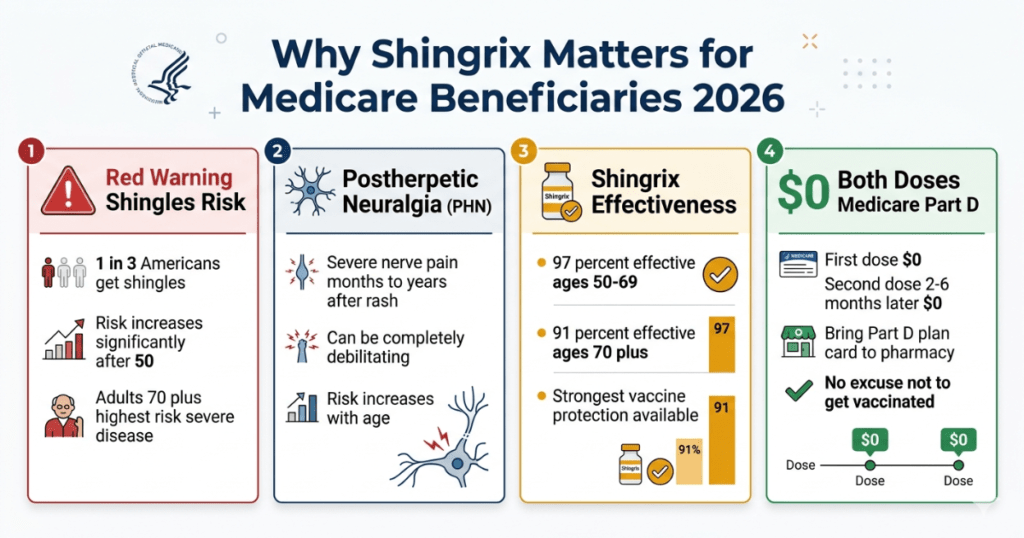
- One in three Americans develops shingles during their lifetime
- Risk increases significantly after age 50
- Adults aged 60 and older have the highest risk of severe complications
Postherpetic Neuralgia
The most serious complication of shingles is postherpetic neuralgia (PHN) — severe nerve pain that persists for months or years after the rash heals. PHN can be debilitating — causing constant burning or stabbing pain that significantly reduces quality of life. The risk of PHN increases with age — adults aged 70 and older are at highest risk.
Shingrix Effectiveness
Shingrix is approximately 97% effective against shingles in adults aged 50 to 69 and 91% effective in adults aged 70 and older. This extraordinary effectiveness makes Shingrix one of the most effective vaccines available for any condition.
Getting both doses of Shingrix through your Medicare Part D coverage at $0 is one of the best healthcare decisions a Medicare beneficiary can make.
Does Medicare Advantage Cover the Shingles Vaccine?
Does Medicare Advantage cover the shingles vaccine in 2026? Yes — Medicare Advantage plans with prescription drug coverage (MA-PD) must cover Shingrix at $0 as required by the Inflation Reduction Act.
With Medicare Advantage coverage for Shingrix:
- Present your Medicare Advantage plan card at the pharmacy
- The pharmacy bills your MA-PD plan for Shingrix
- Your cost should be $0
- In-network pharmacy preferred for seamless billing
Some Medicare Advantage plans may have preferred pharmacy networks — using a preferred pharmacy in your plan’s network ensures the smoothest billing process. However all pharmacies in your plan’s network should be able to process Shingrix at $0.
Frequently Asked Questions — Does Medicare Cover Shingles Vaccine
Does Medicare cover the Shingrix shingles vaccine in 2026?
Yes — Medicare Part D covers Shingrix at $0 in 2026 under the Inflation Reduction Act requirement that all ACIP-recommended vaccines be covered without cost-sharing. Both doses of Shingrix are covered at $0. If you have Original Medicare without Part D you do not have Medicare coverage for Shingrix and would pay the full retail price of approximately $200 to $250 per dose.
Which part of Medicare covers Shingrix?
Shingrix is covered under Medicare Part D — not Medicare Part B. This is different from flu shots and pneumococcal vaccines which are covered under Part B. To receive $0 coverage for Shingrix you must have Medicare Part D or a Medicare Advantage plan with drug coverage (MA-PD) and present your Part D or MA-PD plan card at the pharmacy.
How much does Shingrix cost with Medicare?
With Medicare Part D or Medicare Advantage with drug coverage Shingrix costs $0 — no deductible, no copay, no coinsurance. Without any Part D coverage the retail price is approximately $200 to $250 per dose — approximately $400 to $500 for both required doses.
Do I need a prescription for Shingrix?
You do not need a physician’s prescription to receive Shingrix at most pharmacies — pharmacists can administer the vaccine under standing orders in most states. Simply bring your Part D plan card to a participating pharmacy and the vaccine is administered and billed at $0.
Does Medicare cover both shots of Shingrix?
Yes — Medicare Part D covers both required doses of Shingrix at $0. The first dose and second dose — administered 2 to 6 months after the first — are both covered at no cost.
What if the pharmacy charges me for Shingrix?
If the pharmacy charges you for Shingrix first ensure you presented your Part D plan card — not just your Medicare card. Ask the pharmacy to reprocess the claim with your Part D information. If the issue persists contact your Part D plan directly or call Medicare at 1-800-633-4227.
Summary — Does Medicare Cover Shingles Vaccine 2026
Does Medicare cover the shingles vaccine in 2026? Yes — Medicare Part D covers Shingrix at $0 for all Medicare beneficiaries with Part D coverage under the Inflation Reduction Act. Both required doses are covered at no cost — making Shingrix one of the most valuable free preventive benefits available to Medicare beneficiaries.
Shingrix is approximately 91% to 97% effective against shingles — one of the most effective vaccines available. With Medicare covering both doses at $0 there is no financial barrier to receiving this important protection against a potentially debilitating condition.
If you have not yet received Shingrix visit your local pharmacy with your Part D plan card and get vaccinated today. If you have received only the first dose schedule your second dose — both are covered at $0 and both are needed for full protection.
For free help understanding your Medicare shingles vaccine coverage contact your State Health Insurance Assistance Program (SHIP) at shiphelp.org or call Medicare free at 1-800-633-4227.
This guide is for informational purposes only and is not medical advice. Always follow your physician’s vaccination recommendations and verify current Medicare shingles vaccine coverage at Medicare.gov.
Sources: Medicare.gov | CMS.gov | CDC.gov | AARP.org
Last updated: April 2026 | Author: James Carter, Independent Medicare Research Analyst