Does Medicare Cover Palliative Care — Complete Guide 2026
Does Medicare cover palliative care in 2026? Palliative care is one of the most misunderstood Medicare benefits — and one of the most important for Medicare beneficiaries living with serious illness, chronic conditions, or significant pain. Many people confuse palliative care with hospice care — but they are very different services with different Medicare coverage rules. In this complete guide we explain exactly what Medicare covers for palliative care in 2026 — what palliative care is, how it differs from hospice, what Medicare covers, who qualifies, how much palliative care costs with Medicare, and how Medicare Advantage handles this benefit. All information is sourced from Medicare.gov and CMS.gov.
Also Read —
- Medicare Part D Drug Coverage Explained Simply 2026
- Does Medicare Cover Home Health Care 2026
- Medicare Advantage vs Original Medicare 2026
What You Will Learn — Does Medicare Cover Palliative Care
- What is palliative care and how does it differ from hospice
- Does Medicare cover palliative care in 2026
- What palliative care services Medicare covers
- Who qualifies for Medicare palliative care coverage
- Does Medicare cover palliative care at home
- How much does palliative care cost with Medicare
- The difference between Medicare palliative care and Medicare hospice
- Does Medicare Advantage cover palliative care
- Frequently asked questions about Medicare palliative care coverage 2026
What Is Palliative Care and How Does It Differ from Hospice?
Before understanding Medicare palliative care coverage it is essential to understand what palliative care is — and critically how it differs from hospice care. Many Medicare beneficiaries and their families confuse these two terms and this confusion can lead to misunderstanding of Medicare coverage.
What Is Palliative Care?
Palliative care is specialized medical care focused on providing relief from the symptoms, pain, and stress of a serious illness. The goal of palliative care is to improve quality of life for both the patient and their family — regardless of whether the patient is pursuing curative treatment.
Palliative care can be provided:
- At any stage of illness — not just end of life
- Alongside curative or active treatment — you do not have to stop treatment to receive palliative care
- For any serious condition — cancer, heart failure, COPD, kidney disease, dementia, and many others
- By a palliative care specialist or by your primary treating physician
- In any setting — hospital, outpatient clinic, home, nursing facility
What Is Hospice Care?
Hospice care is a specific Medicare benefit for patients who are terminally ill with a life expectancy of 6 months or less if the illness runs its normal course and who have chosen to focus on comfort rather than curative treatment. When you elect the Medicare hospice benefit you agree to forego curative treatment for the terminal illness.
The Critical Difference
Palliative care and hospice care are fundamentally different in these key ways:
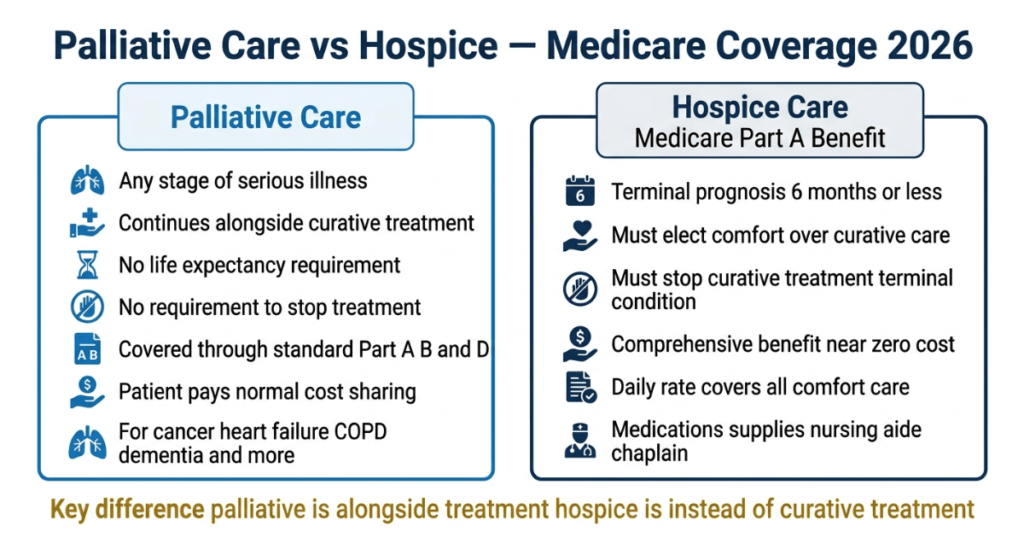
Palliative care — for any stage of serious illness, continues alongside curative treatment, no life expectancy requirement, no requirement to stop curative treatment.
Hospice care — for terminal illness with 6-month prognosis, requires forgoing curative treatment, patient elects comfort focus over cure, covered under its own specific Medicare hospice benefit.
Understanding this distinction is essential because Medicare covers palliative care and hospice care through completely different coverage pathways — and the coverage rules are very different.
Does Medicare Cover Palliative Care in 2026?
Yes — Medicare does cover palliative care in 2026 but the coverage works differently from what most people expect. There is no single Medicare palliative care benefit — instead palliative care services are covered through the existing Medicare Part A and Part B benefits depending on the type of service and setting.
This means Medicare covers palliative care services as part of existing coverage categories:
Palliative care provided by physicians in any setting — covered under Medicare Part B physician services
Pain management and symptom control — covered under Medicare Part B when medically necessary
Palliative care consultations — covered under Medicare Part B as physician consultations
Medications for pain and symptom management — covered under Medicare Part D
Palliative care provided during inpatient hospital stays — covered under Medicare Part A
Home-based palliative care services — covered under the Medicare home health benefit when eligibility requirements are met
The absence of a dedicated Medicare palliative care benefit means that coverage depends on the specific services provided and whether they meet Medicare’s existing coverage criteria for the relevant benefit category.
What Palliative Care Services Does Medicare Cover?
Physician Palliative Care Consultations — Covered
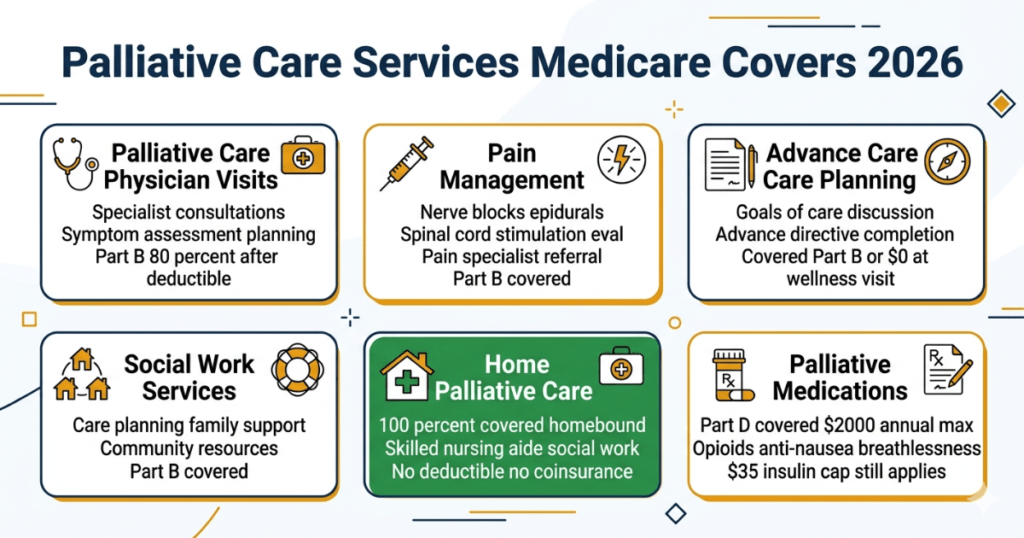
Medicare Part B covers palliative care specialist consultations — visits by physicians who specialize in palliative medicine to evaluate symptoms, develop pain management plans, and coordinate palliative care. These consultations are covered as physician evaluation and management services at 80% after the $257 annual Part B deductible.
Palliative care physician visits are covered for patients with any serious illness — cancer, advanced heart failure, COPD, kidney disease, dementia, ALS, or other conditions causing significant symptoms and functional limitations.
Pain Management — Covered
Medicare Part B covers medically necessary pain management services including:
- Physician evaluation and management for pain assessment and treatment planning
- Pain management procedures — nerve blocks, epidural injections, spinal cord stimulation evaluation
- Referrals for pain specialist consultations
Palliative Care During Hospitalization — Covered
Medicare Part A covers inpatient hospital care including palliative care services provided during a hospital stay. When a patient is hospitalized for any reason palliative care consultations and services provided during that hospitalization are covered under Part A as part of the overall hospital stay.
Home Health Palliative Care — Covered for Homebound Patients
Palliative care services provided through the Medicare home health benefit are covered at 100% for homebound patients. Skilled nursing visits for pain management, wound care, and symptom management — as well as social work services for palliative care support — are covered under the home health benefit for qualifying homebound patients.
Social Work Services — Covered
Medicare Part B covers medical social worker services for patients with serious illness — including assistance with care planning, advance directive completion, family counseling related to serious illness, and community resource coordination. Social work is a critical component of palliative care and is covered as a Part B service.
Advance Care Planning — Covered
Medicare Part B covers advance care planning discussions between a physician and patient — covering goals of care, completion of advance directives, and discussion of end-of-life preferences. These conversations are covered as a separate billable service at 80% after the Part B deductible.
Advance care planning is covered:
- As a standalone visit of any length when the primary purpose is advance care planning
- As additional time during a Medicare annual wellness visit at $0 cost
Prescription Medications for Symptom Management — Covered Under Part D
Medicare Part D covers prescription medications used for palliative symptom management including:
- Opioid pain medications
- Anti-nausea medications
- Medications for breathlessness
- Antidepressants and anxiolytics for symptom management
- Steroids for pain and inflammation
- Other symptom management medications
Under the $2,000 annual Part D out-of-pocket maximum in 2026 the cost of palliative medications is capped — providing important financial protection for patients with serious illness who may take multiple symptom management medications.
Who Qualifies for Medicare Palliative Care Coverage?
Unlike hospice — which has specific eligibility criteria including a 6-month terminal prognosis — palliative care has no unique Medicare eligibility requirements. Any Medicare beneficiary with a serious illness causing pain, distressing symptoms, or functional limitations can receive Medicare-covered palliative care services through the standard Part A and Part B benefits.
Conditions that commonly benefit from palliative care and for which Medicare covers palliative services include:
- Cancer at any stage
- Advanced heart failure
- Chronic obstructive pulmonary disease (COPD)
- Chronic kidney disease and end-stage renal disease
- Dementia including Alzheimer’s disease
- Parkinson’s disease
- ALS — amyotrophic lateral sclerosis
- Multiple sclerosis
- Stroke with significant disability
- HIV/AIDS
- Any other serious chronic or life-limiting condition
You do not need a terminal diagnosis to receive Medicare-covered palliative care. Palliative care is appropriate for any serious illness causing symptoms and functional limitations — regardless of prognosis.
Does Medicare Cover Palliative Care at Home?
Does Medicare cover palliative care at home in 2026? Yes — Medicare covers home-based palliative care services for homebound patients through the Medicare home health benefit at 100% — no cost to qualifying patients.
Home palliative care services covered under the Medicare home health benefit include:
- Skilled nursing visits for pain assessment, medication management, and wound care
- Medical social worker visits for care planning and family support
- Home health aide services when concurrent skilled care is being provided
- Physical, occupational, and speech therapy as needed for palliative goals
To qualify for home palliative care coverage under the home health benefit you must be homebound and have a physician order for home care services. The services must be medically necessary — not solely for custodial support.
For patients who are not homebound outpatient palliative care clinic visits are covered under Medicare Part B at 80% after the annual deductible.
The Difference Between Medicare Palliative Care and Medicare Hospice
Understanding the difference between Medicare palliative care coverage and Medicare hospice coverage is critical for patients and families facing serious illness.
Medicare Palliative Care Coverage Summary
- Covered through standard Part A, Part B, and Part D benefits
- No specific eligibility criteria beyond having a serious illness
- Can be provided alongside curative treatment
- No life expectancy requirement
- Patient pays standard Medicare cost-sharing — 20% coinsurance under Part B
- No requirement to stop any treatments
Medicare Hospice Coverage Summary
- Covered through a specific Medicare Part A hospice benefit
- Requires terminal prognosis of 6 months or less
- Requires patient to elect comfort-focused care and forego curative treatment for terminal condition
- Comprehensive benefit including all comfort care — nearly all costs covered at $0
- Provides nursing, aide, social work, chaplain, medications, and bereavement support
- Paid at daily rate covering all hospice-related services
The key decision point — when should a patient transition from Medicare-covered palliative care to Medicare hospice? When a terminal prognosis of 6 months or less becomes the medical reality and the patient is ready to focus exclusively on comfort rather than curative treatment the Medicare hospice benefit often provides more comprehensive and cost-effective coverage than continuing under standard Medicare benefits.
However many patients with serious illness benefit from palliative care for months or years before reaching the point where hospice is appropriate — and Medicare covers these palliative services throughout that period.
How Much Does Palliative Care Cost with Medicare in 2026?
Palliative Care Physician Visits with Original Medicare
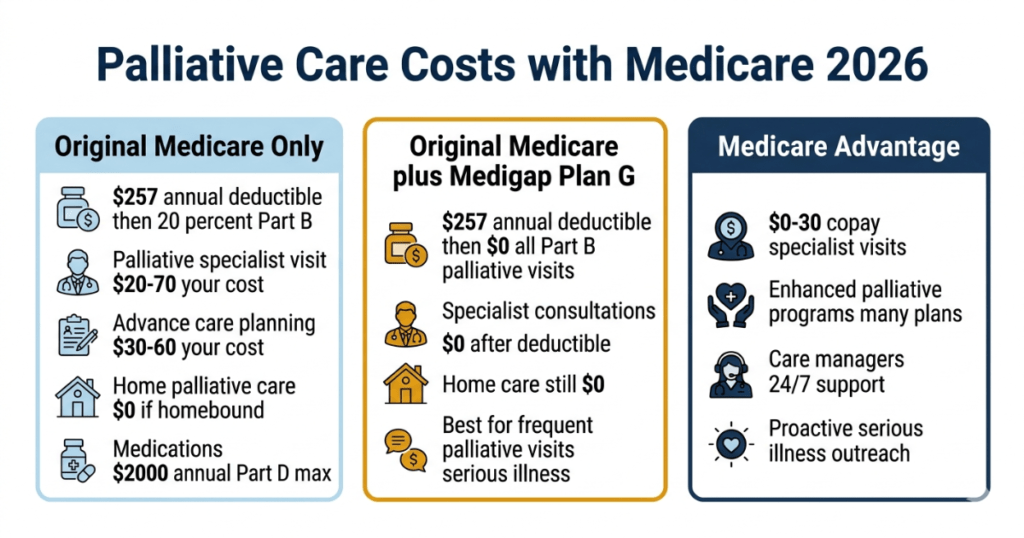
Palliative care specialist consultations are covered under Medicare Part B at 80% after the $257 annual deductible.
Typical costs:
- Initial palliative care consultation — approximately $150 to $350 Medicare-approved — your 20% is $30 to $70
- Follow-up palliative care visit — approximately $100 to $250 Medicare-approved — your 20% is $20 to $50
- Advance care planning visit — approximately $150 to $300 Medicare-approved — your 20% is $30 to $60
Pain Management Procedures
More complex pain management procedures covered under Part B have higher approved amounts and corresponding 20% coinsurance.
Palliative Medications Under Part D
Palliative medications are covered under Part D subject to the $2,000 annual out-of-pocket maximum. Opioid pain medications for serious illness can be expensive — the $2,000 cap provides important financial protection for patients managing pain with prescription medications.
With Medigap Plan G
Medigap Plan G covers the 20% coinsurance for all Medicare Part B palliative care services after the $257 annual deductible. With Plan G palliative care physician visits and consultations cost $0 after the annual deductible — an important benefit for patients with serious illness who may require frequent palliative care visits.
Home Palliative Care Costs
Home health palliative care services are covered at 100% — $0 cost — for qualifying homebound patients.
With Medicare Advantage
Medicare Advantage plans cover palliative care services with their own cost-sharing. Many plans offer:
- $0 to $30 copay for specialist palliative care visits
- Enhanced care coordination programs for serious illness
- Some plans offer specific palliative care programs as enhanced benefits beyond Original Medicare
Does Medicare Advantage Cover Palliative Care?
Does Medicare Advantage cover palliative care in 2026? Yes — Medicare Advantage plans must cover all medically necessary palliative care services covered by Original Medicare. Additionally many Medicare Advantage plans offer enhanced palliative care programs beyond what Original Medicare provides.
Enhanced Medicare Advantage palliative care programs may include:
- Dedicated palliative care care managers and nurse coordinators
- Proactive outreach to members with serious illness
- 24/7 telephonic palliative care support
- Coordination between palliative care providers and primary treating physicians
- Home visits from palliative care teams for non-homebound members
These enhanced programs represent some of the most clinically valuable benefits Medicare Advantage offers for members with serious illness — going beyond the coverage available under Original Medicare.
Network palliative care specialists — Medicare Advantage plans require you to use in-network palliative care providers. Verify that palliative care specialists at your preferred hospital or clinic are in-network before scheduling consultations.
Frequently Asked Questions — Does Medicare Cover Palliative Care
Does Medicare cover palliative care in 2026?
Yes — Medicare covers palliative care services through standard Part A, Part B, and Part D benefits. Part B covers palliative care physician consultations, pain management, advance care planning, and social work services at 80% after the $257 annual deductible. Home palliative care is covered at 100% for homebound patients. Part D covers palliative medications under the $2,000 annual maximum.
What is the difference between palliative care and hospice under Medicare?
Palliative care is covered through standard Medicare Part A, B, and D benefits — for any serious illness at any stage alongside curative treatment with no life expectancy requirement. Hospice is a specific Medicare Part A benefit for terminally ill patients with a 6-month prognosis who elect comfort-focused care and forego curative treatment. Hospice provides more comprehensive coverage at near-zero cost but requires meeting specific eligibility criteria.
Does Medicare cover palliative care alongside cancer treatment?
Yes — Medicare covers palliative care alongside active cancer treatment. Palliative care can be provided simultaneously with chemotherapy, radiation, immunotherapy, and other cancer treatments. Research shows that cancer patients who receive palliative care alongside treatment have better symptom management and quality of life.
How much does palliative care cost with Medicare?
With Original Medicare palliative care specialist visits cost approximately $20 to $70 per visit (20% coinsurance) after the $257 annual Part B deductible. With Medigap Plan G palliative care visits cost $0 after the annual deductible. Home palliative care for homebound patients is covered at 100%.
Does Medicare cover advance care planning?
Yes — Medicare Part B covers advance care planning discussions with a physician as a separate billable service at 80% after the Part B deductible. Advance care planning can also be provided at no additional cost during the Medicare annual wellness visit.
Does Medicare Advantage cover palliative care?
Yes — all Medicare Advantage plans cover palliative care services. Many plans offer enhanced palliative care programs with dedicated care managers, 24/7 support, and proactive outreach to members with serious illness — going beyond what Original Medicare provides.
Summary — Does Medicare Cover Palliative Care 2026
Does Medicare cover palliative care in 2026? Yes — Medicare covers palliative care services through standard Medicare Part A, Part B, and Part D benefits for patients with serious illness at any stage of disease. Palliative care specialist consultations, pain management, advance care planning, social work, and home-based palliative services are all covered under existing Medicare benefits.
Unlike hospice — which requires a terminal prognosis and election of comfort-focused care — palliative care can be received alongside curative treatment at any stage of serious illness. Medicare’s coverage of palliative care reflects the strong clinical evidence that palliative care improves quality of life, reduces hospitalizations, and helps patients and families navigate serious illness.
For patients whose condition progresses to meet hospice eligibility criteria the Medicare hospice benefit provides even more comprehensive and cost-effective coverage — covering virtually all comfort care at near-zero cost.
For free help understanding your Medicare palliative care coverage contact your State Health Insurance Assistance Program (SHIP) at shiphelp.org or call Medicare free at 1-800-633-4227.
This guide is for informational purposes only and is not medical advice. Always consult your physician and verify current Medicare coverage at Medicare.gov before making care decisions.
Sources: Medicare.gov | CMS.gov | SSA.gov | AARP.org
Last updated: April 2026 | Author: James Carter, Independent Medicare Research Analyst