
Does Medicare Cover Knee Replacement Surgery — Complete Guide 2026
Does Medicare cover knee replacement surgery in 2026? If you or a loved one is suffering from severe knee pain and considering knee replacement surgery this complete guide explains exactly how Medicare covers this procedure. The good news is that yes — Medicare does cover knee replacement surgery in 2026 when it is deemed medically necessary. Knee replacement — also called total knee arthroplasty — is one of the most commonly performed orthopedic surgeries in the United States with over 700,000 procedures performed annually and Medicare covers the majority of these surgeries for qualifying beneficiaries. In this complete guide we break down everything you need to know about Medicare knee replacement coverage in 2026 — what is covered, who qualifies, how much knee replacement costs with Medicare, what the recovery process looks like with Medicare coverage, and how Medicare Advantage handles knee replacement. All information is sourced from Medicare.gov and CMS.gov.
Also Read —
- Does Medicare Cover Physical Therapy 2026
- Does Medicare Cover Weight Loss Surgery 2026
- Medicare Advantage vs Original Medicare 2026
What You Will Learn — Does Medicare Cover Knee Replacement
- Does Medicare cover knee replacement surgery in 2026
- Who qualifies for Medicare knee replacement coverage
- Which part of Medicare covers knee replacement
- What Medicare covers for knee replacement surgery
- Does Medicare cover partial knee replacement
- How much does knee replacement cost with Medicare in 2026
- Does Medicare cover knee replacement rehabilitation
- Does Medicare cover both knees replaced at the same time
- Does Medicare Advantage cover knee replacement
- Frequently asked questions about Medicare knee replacement coverage 2026
Does Medicare Cover Knee Replacement Surgery in 2026?
Yes — Medicare does cover knee replacement surgery in 2026 when it is medically necessary. Knee replacement surgery is covered by Medicare as a medically necessary procedure for patients whose knee pain and disability have not responded adequately to conservative treatments and who meet the clinical criteria for surgery.
Medicare knee replacement coverage in 2026 applies to the most common type of knee replacement — total knee arthroplasty — as well as partial knee replacement and revision knee replacement surgery. Medicare views knee replacement as an appropriate surgical intervention for end-stage knee arthritis and other qualifying knee conditions when less invasive treatments have failed.
Does Medicare cover knee replacement for all Medicare beneficiaries? Medicare covers knee replacement for beneficiaries who meet the medical necessity criteria. You cannot simply request a knee replacement and have Medicare cover it — your doctor must document that your condition meets Medicare’s medical necessity standards and that conservative treatments have been tried without adequate results.
Who Qualifies for Medicare Knee Replacement Coverage?
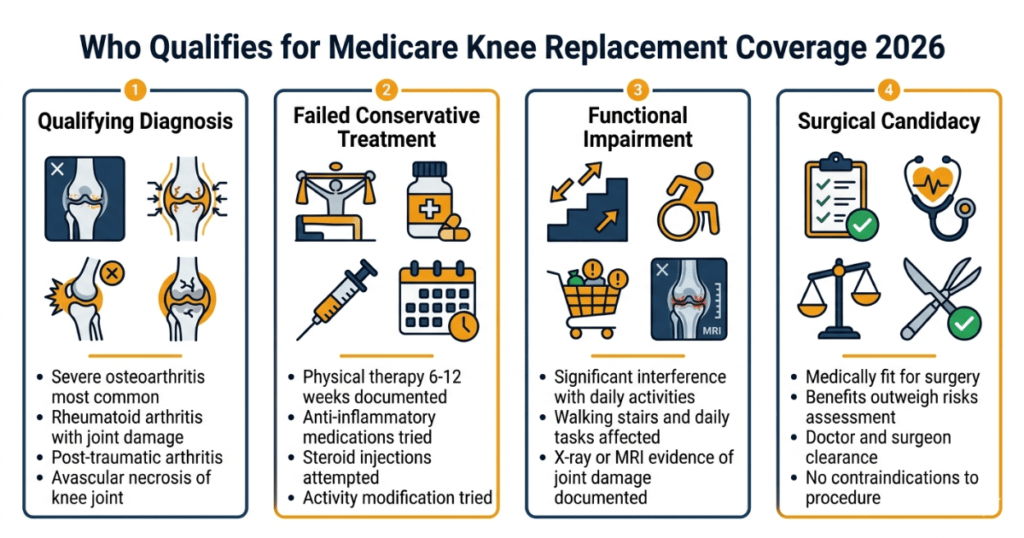
For Medicare to cover knee replacement surgery in 2026 you must meet specific medical necessity criteria. Here is what Medicare requires for knee replacement coverage:
Diagnosis Requirements
You must have a documented diagnosis of a condition causing severe knee pain and disability. Qualifying diagnoses for Medicare knee replacement coverage include:
- Severe osteoarthritis of the knee — the most common reason for knee replacement
- Rheumatoid arthritis of the knee causing severe joint damage
- Post-traumatic arthritis from a previous knee injury
- Avascular necrosis of the knee joint
- Other conditions causing severe knee joint deterioration
Conservative Treatment Requirements
Medicare requires documentation that you have tried conservative treatments without adequate relief before approving knee replacement surgery. Conservative treatments that should be documented include:
- Physical therapy — typically 6 to 12 weeks of documented physical therapy
- Anti-inflammatory medications — NSAIDs and other pain medications
- Corticosteroid injections into the knee joint
- Hyaluronic acid (gel) injections
- Weight loss efforts if applicable
- Activity modification
- Use of assistive devices such as a cane or knee brace
Functional Impairment
Medicare requires that your knee condition causes significant functional impairment — meaning it interferes significantly with your ability to perform daily activities such as walking, climbing stairs, or getting in and out of chairs.
Imaging Evidence
Your doctor must document radiographic evidence — X-rays or MRI — showing significant joint space narrowing, bone-on-bone arthritis, or other structural damage consistent with the need for knee replacement.
Surgical Candidacy
You must be medically fit for surgery. Your doctor and surgeon must determine that the benefits of knee replacement outweigh the surgical risks given your overall health status including any cardiovascular conditions, diabetes, obesity, or other factors that affect surgical risk.
Which Part of Medicare Covers Knee Replacement Surgery?
Understanding which part of Medicare covers knee replacement surgery helps you understand your costs and coverage.
Medicare Part A — Inpatient Knee Replacement
Traditionally knee replacement surgery was performed as an inpatient procedure with a hospital stay of several days. When performed as an inpatient procedure Medicare Part A covers the hospital facility costs including the operating room, anesthesia administered by a hospital-based anesthesiologist, nursing care, and all hospital services during your admission.
Medicare Part A inpatient knee replacement costs:
- Part A deductible — $1,676 per benefit period
- Hospital days 1 to 60 — $0 after deductible
- Hospital days 61 to 90 — $419 per day coinsurance
Medicare Part B — Outpatient Knee Replacement
In recent years knee replacement surgery has increasingly been performed as an outpatient procedure — same-day surgery where you go home the same day or after one overnight stay — rather than a traditional multi-day inpatient hospital stay. When performed as an outpatient procedure Medicare Part B covers the surgeon’s fee and the facility fee.
When performed outpatient:
- Medicare Part B covers 80% of Medicare-approved costs
- You pay 20% coinsurance after your $257 annual Part B deductible
Surgeon Fee — Medicare Part B
Regardless of whether knee replacement is performed inpatient or outpatient Medicare Part B covers the orthopedic surgeon’s professional fee at 80% after the Part B deductible. The surgeon fee is always a Part B benefit even during an inpatient stay.
What Does Medicare Cover for Knee Replacement Surgery?
Medicare covers a comprehensive range of services related to knee replacement surgery in 2026. Here is exactly what is covered:
Pre-Surgery Services
Medicare covers pre-surgery evaluation and testing including:
- Orthopedic surgeon consultation and evaluation
- Pre-operative medical clearance from your primary care physician
- Pre-operative laboratory tests — blood work, urinalysis
- Pre-operative imaging — X-rays, MRI if needed
- Anesthesia pre-operative evaluation
- Physical therapy pre-surgical evaluation in some cases
The Surgery Itself
Medicare covers the knee replacement surgical procedure including:
- The orthopedic surgeon’s fee for performing the surgery
- Surgical facility fees — hospital or outpatient surgery center
- Anesthesia services
- Operating room costs
- The knee replacement implant — the artificial joint components
Note about the implant — Medicare covers a standard knee replacement implant. If you and your surgeon choose a premium implant — such as a customized or gender-specific knee implant that costs significantly more than the standard implant — Medicare covers its standard reimbursement amount and you may be responsible for the additional cost.
Post-Surgery Hospital Care
If you stay in the hospital after knee replacement Medicare Part A covers your inpatient hospital care as described above.
Post-Acute Care Following Knee Replacement
Medicare covers several types of post-acute care following knee replacement surgery:
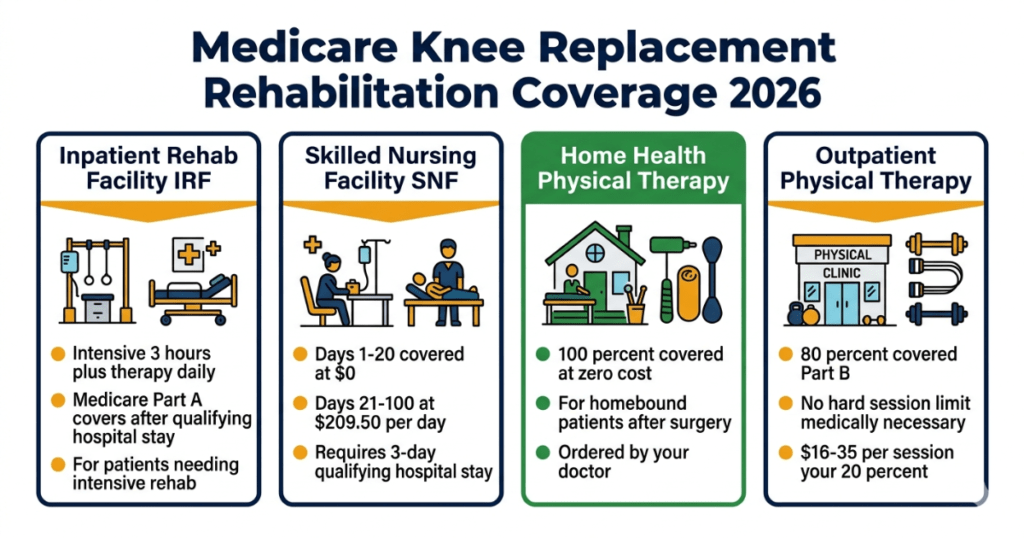
Skilled Nursing Facility (SNF) care — if you need skilled nursing or rehabilitation care after a qualifying inpatient hospital stay of at least 3 days Medicare Part A covers skilled nursing facility care up to 100 days per benefit period. The first 20 days are covered at $0. Days 21 to 100 require $209.50 per day coinsurance.
Home health care — if you are homebound after knee replacement surgery Medicare covers home health physical therapy and skilled nursing visits at 100% with no deductible or coinsurance.
Outpatient physical therapy — Medicare Part B covers outpatient physical therapy rehabilitation following knee replacement. There is no hard limit on the number of covered sessions as long as therapy is medically necessary and showing progress.
Does Medicare Cover Partial Knee Replacement?
Does Medicare cover partial knee replacement surgery in 2026? Yes — Medicare covers partial knee replacement — also called unicompartmental knee replacement or unicondylar knee replacement — when it is medically necessary. Partial knee replacement replaces only the damaged portion of the knee joint rather than the entire joint.
Medicare covers partial knee replacement under the same medical necessity criteria as total knee replacement. Your orthopedic surgeon must document that partial knee replacement is medically appropriate for your specific pattern of knee arthritis and that conservative treatments have been tried without adequate relief.
The coverage process and cost-sharing for partial knee replacement is the same as for total knee replacement — Medicare Part A for inpatient procedures and Part B for outpatient procedures and surgeon fees.
How Much Does Knee Replacement Cost with Medicare in 2026?
Understanding how much knee replacement surgery costs with Medicare in 2026 is essential for planning and budgeting. Here is the complete cost breakdown:
Inpatient Knee Replacement with Original Medicare
If your knee replacement is performed as an inpatient hospital procedure:
Part A costs:
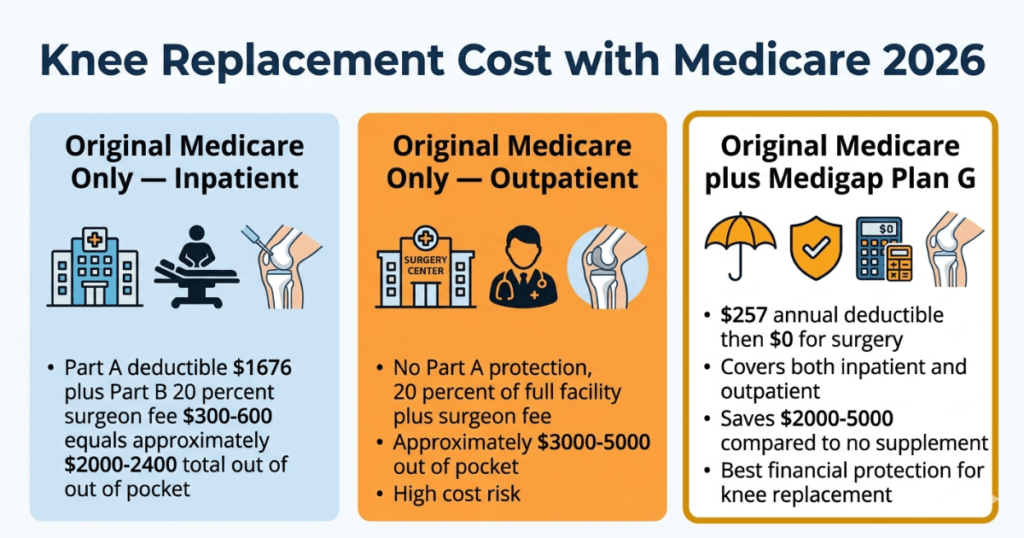
- Part A deductible — $1,676 per benefit period
- Days 1 to 60 inpatient stay — $0 after deductible
Part B costs for surgeon fee:
- $257 annual Part B deductible if not yet met
- 20% coinsurance on Medicare-approved surgeon fee — approximately $300 to $600
Total out-of-pocket for inpatient knee replacement with Original Medicare:
- Approximately $2,000 to $2,400 without a supplement
- This does not include any skilled nursing facility costs if applicable
Outpatient Knee Replacement with Original Medicare
If your knee replacement is performed as an outpatient procedure:
Part B costs:
- $257 annual Part B deductible
- 20% coinsurance on total Medicare-approved amount — surgeon plus facility
- Medicare-approved total for outpatient knee replacement approximately $15,000 to $25,000
- Your 20% coinsurance — approximately $3,000 to $5,000
Note — outpatient knee replacement can cost significantly more out of pocket with Original Medicare than inpatient because Part A covers inpatient facility costs more comprehensively than Part B covers outpatient facility costs. This is a critical difference that many patients do not realize.
With Medigap Plan G
If you have Medigap Plan G your knee replacement costs are dramatically reduced. After your $257 annual Part B deductible Plan G covers 100% of Medicare-approved cost-sharing for both inpatient and outpatient knee replacement. Your effective out-of-pocket cost for knee replacement with Plan G after the annual deductible is $0 for all Medicare-approved costs.
Given that outpatient knee replacement can cost $3,000 to $5,000 out of pocket without a supplement Medigap Plan G provides enormous financial protection for knee replacement surgery.
With Medicare Advantage
Medicare Advantage plans cover knee replacement with their own cost-sharing structure:
- Prior authorization is almost always required
- Inpatient knee replacement — typically $250 to $500 per day for first few days then $0
- Outpatient knee replacement — typically $250 to $500 copay or coinsurance
- All costs count toward your $9,350 annual out-of-pocket maximum
Does Medicare Cover Knee Replacement Rehabilitation?
Does Medicare cover knee replacement rehabilitation in 2026? Yes — Medicare covers comprehensive rehabilitation following knee replacement surgery through multiple pathways.
Inpatient Rehabilitation Facility (IRF)
If you need intensive inpatient rehabilitation after knee replacement Medicare Part A covers inpatient rehabilitation facility care following a qualifying hospital stay. Inpatient rehab provides intensive therapy — at least 3 hours per day of physical and occupational therapy. Your doctor must certify that you need and can tolerate intensive inpatient rehabilitation.
Skilled Nursing Facility Rehabilitation
If you need skilled care and rehabilitation in a less intensive setting Medicare Part A covers skilled nursing facility care following a qualifying 3-day inpatient hospital stay — up to 100 days per benefit period.
Home Health Rehabilitation
If you are homebound after knee replacement Medicare Part A covers home health physical therapy and nursing visits at 100% — no cost to you — when ordered by your doctor.
Outpatient Physical Therapy
Once you are able to travel to a physical therapy clinic Medicare Part B covers outpatient physical therapy at 80% after your $257 annual Part B deductible. There is no hard session limit — Medicare covers as many sessions as are medically necessary and showing measurable progress.
Does Medicare Cover Both Knees Replaced at the Same Time?
Does Medicare cover bilateral knee replacement — both knees replaced at the same time — in 2026? Medicare does cover bilateral simultaneous knee replacement in certain circumstances but with important considerations.
Bilateral simultaneous knee replacement — replacing both knees in a single surgical procedure — requires separate documentation of medical necessity for each knee. Medicare covers bilateral knee replacement when both knees have conditions that independently meet the medical necessity criteria for knee replacement.
However bilateral simultaneous knee replacement has higher surgical risks than sequential single-knee replacement — more blood loss, longer anesthesia, greater cardiovascular stress. Many Medicare Advantage plans have specific prior authorization requirements for bilateral simultaneous knee replacement. Medicare fee-for-service may require additional documentation and review for bilateral procedures.
Many surgeons recommend sequential knee replacement — replacing one knee at a time with several months between procedures — rather than simultaneous bilateral replacement. Medicare covers sequential knee replacement as two separate procedures.
Does Medicare Advantage Cover Knee Replacement?
Does Medicare Advantage cover knee replacement in 2026? Yes — all Medicare Advantage plans must cover knee replacement because it is a Medicare-covered procedure. However Medicare Advantage knee replacement coverage has important differences from Original Medicare.
Prior authorization — virtually all Medicare Advantage plans require prior authorization for knee replacement surgery. Your surgeon’s office typically handles this process but always confirm authorization is obtained weeks before your surgery date. Failure to obtain prior authorization can result in denied coverage.
Network requirements — Medicare Advantage requires you to use in-network orthopedic surgeons and in-network hospitals or surgery centers. Always verify that your surgeon and the facility are in your plan’s network before scheduling surgery.
Post-surgical care network — confirm that your preferred rehabilitation facility or home health agency is also in your Medicare Advantage plan’s network before surgery. Out-of-network post-surgical care can result in significant unexpected costs.
Out-of-pocket maximum — all Medicare Advantage costs for knee replacement and rehabilitation count toward your annual out-of-pocket maximum of $9,350. Once you reach this limit your plan covers 100% of all covered services for the rest of the year.
Frequently Asked Questions — Does Medicare Cover Knee Replacement
Does Medicare cover knee replacement surgery in 2026?
Yes — Medicare covers knee replacement surgery in 2026 when it is medically necessary. You must have a qualifying diagnosis such as severe osteoarthritis, documented failure of conservative treatments including physical therapy and injections, and medical clearance for surgery. Medicare Part A covers inpatient knee replacement facility costs and Medicare Part B covers the surgeon fee and outpatient procedures.
How much does knee replacement cost with Medicare in 2026?
With Original Medicare your out-of-pocket cost varies significantly depending on whether surgery is inpatient or outpatient. Inpatient knee replacement costs approximately $2,000 to $2,400 out of pocket with Original Medicare. Outpatient knee replacement can cost $3,000 to $5,000 out of pocket. With Medigap Plan G your effective cost after the $257 annual deductible is $0 for all Medicare-approved costs — making Plan G extremely valuable for knee replacement.
Does Medicare cover knee replacement rehabilitation?
Yes — Medicare covers comprehensive knee replacement rehabilitation through skilled nursing facility care, inpatient rehabilitation facilities, home health physical therapy at 100%, and outpatient physical therapy at 80% after the Part B deductible. There is no hard limit on outpatient physical therapy sessions as long as therapy is medically necessary and showing progress.
Does Medicare require prior authorization for knee replacement?
Original Medicare (Parts A and B) does not require prior authorization for knee replacement surgery — medical necessity is determined by your doctor’s documentation. Medicare Advantage plans virtually always require prior authorization. If you have Medicare Advantage confirm prior authorization is obtained well before your surgery date.
Does Medicare cover both knees at the same time?
Medicare can cover bilateral simultaneous knee replacement when both knees independently meet medical necessity criteria. However bilateral surgery has higher risks and Medicare Advantage plans may have specific prior authorization requirements. Many surgeons recommend sequential single-knee replacement several months apart rather than simultaneous bilateral replacement.
Does Medicare Advantage cover knee replacement surgery?
Yes — all Medicare Advantage plans must cover knee replacement. Prior authorization and in-network providers are required. Costs count toward your $9,350 annual out-of-pocket maximum. Always confirm prior authorization and network status for both your surgeon and the facility before scheduling surgery.
Summary — Does Medicare Cover Knee Replacement 2026
Does Medicare cover knee replacement surgery in 2026? Yes — Medicare provides comprehensive coverage for medically necessary knee replacement including the surgery itself, the implant, hospital care, and all forms of post-surgical rehabilitation. Your out-of-pocket costs depend significantly on whether surgery is performed inpatient or outpatient — with outpatient surgery potentially costing $3,000 to $5,000 without a supplement.
Medigap Plan G provides the most comprehensive financial protection for knee replacement surgery — covering all Medicare-approved cost-sharing after the $257 annual deductible and making your effective out-of-pocket cost $0. Medicare Advantage plans also cover knee replacement with their own cost-sharing structures and annual out-of-pocket maximums.
For free help understanding your Medicare knee replacement coverage contact your State Health Insurance Assistance Program (SHIP) counselor at shiphelp.org or call Medicare free at 1-800-633-4227.
This guide is for informational purposes only and is not medical advice. Always consult your orthopedic surgeon and verify current Medicare coverage at Medicare.gov before making surgical decisions.
Sources: Medicare.gov | CMS.gov | SSA.gov | AARP.org
Last updated: April 2026 | Author: James Carter, Independent Medicare Research Analyst