Medicare Plan Changes 2026 — What Is New and Different
What are the Medicare plan changes for 2026? Every year Medicare updates its benefits, costs, and coverage rules — and 2026 brings some of the most significant Medicare changes in recent years. Understanding what changed in Medicare 2026 is critical for every Medicare beneficiary during Open Enrollment — knowing the new rules helps you make smarter plan decisions and avoid unexpected costs. In this complete guide we break down every important Medicare plan change for 2026 — Part A and Part B cost changes, the historic Medicare Part D out-of-pocket maximum change, Medicare Advantage updates, new drug coverage rules, and important policy changes that affect millions of Medicare beneficiaries. All information is sourced from Medicare.gov and CMS.gov.
Also Read —
- Medicare Open Enrollment 2026 Complete Guide
- Medicare Open Enrollment Checklist 2026
- How to Switch Medicare Plans 2026
What You Will Learn — Medicare Plan Changes 2026
- Medicare Part A cost changes 2026
- Medicare Part B premium changes 2026
- The historic Medicare Part D $2,000 out-of-pocket maximum change
- Medicare Advantage changes 2026
- New Medicare drug pricing changes from the Inflation Reduction Act
- Insulin cap changes 2026
- Changes to Medicare coverage and benefits 2026
- What these changes mean for you during Open Enrollment
- Frequently asked questions about Medicare plan changes 2026
Why Medicare Plan Changes 2026 Matter for Open Enrollment
Understanding what changed in Medicare 2026 is essential for making smart decisions during Medicare Open Enrollment. Here is why these changes matter:
The Medicare Part D changes in 2026 are historic — the $2,000 annual out-of-pocket maximum for prescription drugs is one of the most significant improvements to Medicare drug coverage since the program began. This change affects every Medicare beneficiary who takes prescription medications and may dramatically reduce your drug costs compared to previous years.
Medicare Part B premiums and deductibles change every year — knowing the new amounts helps you accurately calculate your total Medicare costs and budget appropriately.
Medicare Advantage plan changes are happening across the country — some plans are reducing benefits while others are adding new coverage. Understanding the landscape of Medicare Advantage changes in 2026 helps you evaluate whether your current plan is still competitive.
Medicare Part A Changes 2026
Medicare Part A — hospital insurance — has the following cost changes in 2026:
Medicare Part A Hospital Deductible 2026
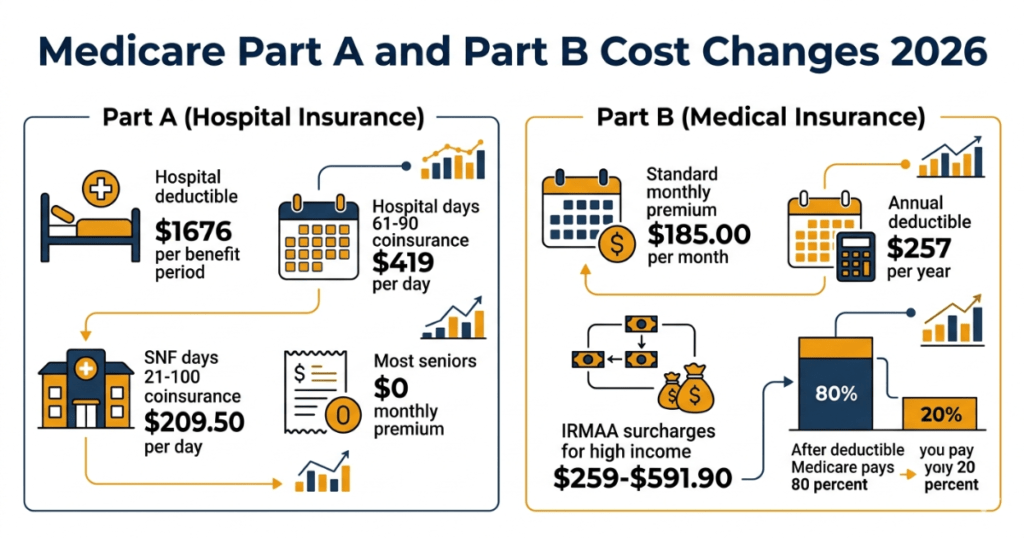
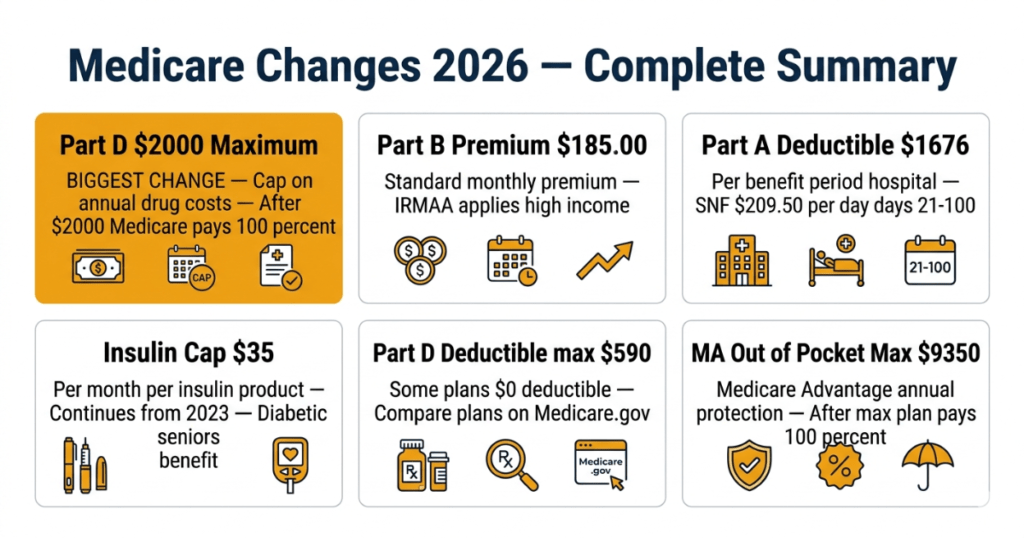
The Medicare Part A inpatient hospital deductible increased to $1,676 per benefit period in 2026. This is an increase from the 2025 deductible.
The Part A deductible applies each time you start a new benefit period — when you are admitted to a hospital or skilled nursing facility. A new benefit period begins after you have been out of the hospital and SNF for at least 60 consecutive days.
Medicare Part A Daily Coinsurance 2026
Hospital days 61 to 90 — $419 per day coinsurance in 2026 Hospital lifetime reserve days 91 to 150 — $838 per day in 2026 Skilled nursing facility days 21 to 100 — $209.50 per day in 2026
Medicare Part A Premium 2026
Most Medicare beneficiaries pay $0 for Medicare Part A because they or their spouse worked and paid Medicare taxes for at least 10 years (40 quarters). For those who do not qualify for premium-free Part A the 2026 premiums are:
- Less than 30 quarters of work — $518 per month
- 30 to 39 quarters of work — $284 per month
Medicare Part B Changes 2026
Medicare Part B Standard Premium 2026
The Medicare Part B standard monthly premium is $185.00 per month in 2026. This represents an increase from the 2025 standard premium.
The $185.00 standard premium applies to most Medicare beneficiaries. Higher-income beneficiaries pay more through the Income-Related Monthly Adjustment Amount (IRMAA) — additional premiums based on your income from two years prior.
Medicare Part B IRMAA Surcharges 2026
High-income Medicare beneficiaries pay additional amounts above the $185.00 standard premium:
Individual income up to $106,000 / Married filing jointly up to $212,000 — $185.00 per month (standard) Individual $106,001 to $133,000 / Married $212,001 to $266,000 — $259.00 per month Individual $133,001 to $167,000 / Married $266,001 to $334,000 — $370.00 per month Individual $167,001 to $200,000 / Married $334,001 to $400,000 — $480.90 per month Individual above $200,000 / Married above $400,000 — $591.90 per month
Medicare Part B Annual Deductible 2026
The Medicare Part B annual deductible is $257 per year in 2026. After meeting this deductible Medicare Part B pays 80% of approved costs and you pay 20% coinsurance.
Medicare Part B Late Enrollment Penalty 2026
The Part B late enrollment penalty remains 10% per 12-month period you delayed enrollment without qualifying coverage. This penalty is added to your Part B premium for as long as you have Medicare.
The Historic Medicare Part D $2,000 Out-of-Pocket Maximum — 2026
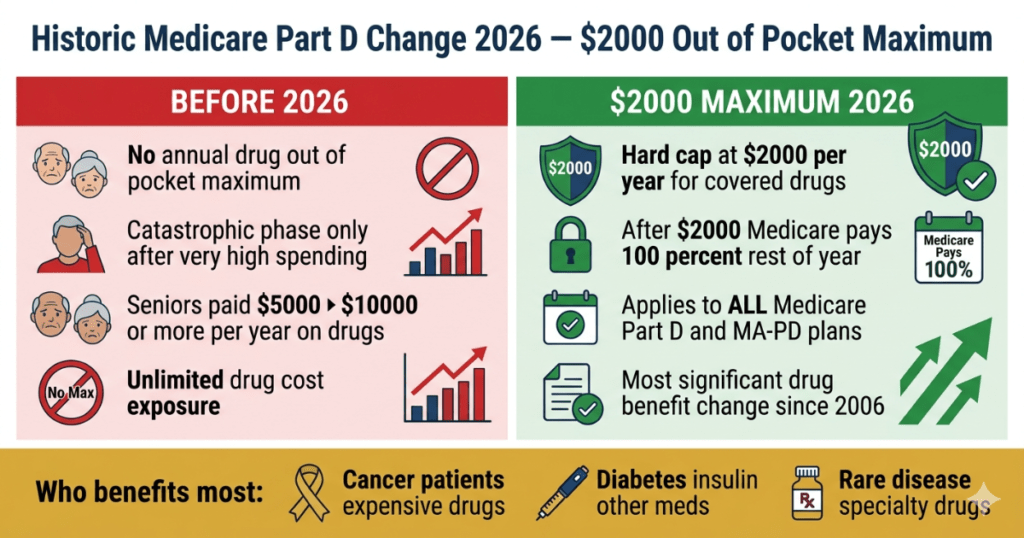
The most significant Medicare change in 2026 is the implementation of the $2,000 annual out-of-pocket maximum for Medicare Part D prescription drug coverage. This is the most important Medicare drug benefit improvement since Part D was created in 2006.
What Changed
Before 2026 Medicare Part D had no annual out-of-pocket maximum. Drug costs could theoretically be unlimited — though the catastrophic coverage phase provided some protection after very high spending. Many Medicare beneficiaries taking expensive brand-name or specialty medications faced drug costs of $5,000, $10,000, or even $20,000 or more per year.
Starting in 2026 Medicare Part D has a hard annual out-of-pocket maximum of $2,000. Once you spend $2,000 out of pocket on covered Part D drugs in a calendar year Medicare Part D covers 100% of your covered drug costs for the rest of the year.
What Counts Toward the $2,000 Maximum
All of the following count toward the $2,000 annual Part D out-of-pocket maximum:
- Your annual Part D deductible (up to $590 in 2026)
- Your copays and coinsurance for covered drugs throughout the year
- Costs during the initial coverage phase
- Any manufacturer price concessions that count toward the maximum
What Does NOT Count Toward the $2,000 Maximum
- Your monthly Part D premium
- Costs for drugs not on your plan’s formulary
- Costs for drugs purchased without using your Part D benefit
Who Benefits Most from the $2,000 Maximum
The $2,000 Part D out-of-pocket maximum in 2026 most significantly benefits:
- Medicare beneficiaries taking expensive brand-name medications
- Seniors with cancer taking oral chemotherapy drugs
- Diabetics taking insulin and other expensive diabetes medications
- Beneficiaries with rare diseases requiring specialty drugs
- Anyone who previously exceeded $2,000 in annual drug costs
The Medicare Prescription Payment Plan
Related to the $2,000 maximum the Inflation Reduction Act also allows Medicare beneficiaries to spread their Part D out-of-pocket costs throughout the year in monthly installments — called the Medicare Prescription Payment Plan. This optional program helps beneficiaries manage cash flow for expensive medications rather than paying large costs early in the year. Contact your Part D plan to learn about this payment smoothing option.
Medicare Part D Premium Changes 2026
Average Part D Premium 2026
The average Medicare Part D premium in 2026 is approximately $46.50 per month — though actual premiums vary significantly by plan and location. Part D premiums can range from under $10 per month for basic plans to over $100 per month for enhanced plans with broader formularies.
Part D Deductible 2026
The maximum Part D deductible in 2026 is $590 — an increase from the 2025 maximum. Plans can have deductibles anywhere from $0 to $590. Some plans charge $0 deductible for generics while applying the maximum deductible to brand-name drugs.
Part D IRMAA Surcharges 2026
High-income beneficiaries pay additional Part D premiums through IRMAA:
Individual income up to $106,000 / Married up to $212,000 — standard premium only Individual $106,001 to $133,000 / Married $212,001 to $266,000 — add $13.70 per month Individual $133,001 to $167,000 / Married $266,001 to $334,000 — add $35.30 per month Individual $167,001 to $200,000 / Married $334,001 to $400,000 — add $57.00 per month Individual above $200,000 / Married above $400,000 — add $85.80 per month
Insulin Cap Changes 2026
The insulin price cap continues in 2026. Medicare caps insulin costs at $35 per month per covered insulin product under Medicare Part D and Medicare Advantage drug plans. This insulin cap was first implemented in 2023 and remains in effect in 2026.
The $35 monthly insulin cap applies regardless of which coverage phase you are in — including the deductible phase. You never pay more than $35 per month for each covered insulin product under Medicare Part D.
This cap affects hundreds of thousands of diabetic Medicare beneficiaries and represents a significant and permanent reduction in insulin costs for seniors.
Medicare Advantage Changes 2026
Medicare Advantage plans continue to evolve in 2026 with some important market-wide trends:
Medicare Advantage Enrollment
Medicare Advantage enrollment continues to grow — more than 50% of all Medicare beneficiaries are now enrolled in Medicare Advantage plans. This continued growth means more competition in most markets resulting in better plan benefits and lower or zero premiums in many areas.
Changes in Medicare Advantage Benefits
While many Medicare Advantage plans continue to offer comprehensive extra benefits some plans have adjusted their offerings in 2026. Common changes across the Medicare Advantage market include:
Some plans reduced OTC allowances — over-the-counter product allowances have been reduced on some plans due to regulatory changes requiring more specific health-related products Some plans adjusted dental benefits — annual dental maximums changed on some plans Some plans reduced supplemental benefits — fitness benefits, transportation, and meal delivery benefits changed on some plans
This is why reading your Annual Notice of Change carefully is essential — your specific plan’s benefits may have changed significantly from 2025 to 2026.
Medicare Advantage Out-of-Pocket Maximum 2026
The maximum out-of-pocket limit for in-network services under Medicare Advantage plans remains $9,350 in 2026. Once you reach this limit your Medicare Advantage plan covers 100% of covered in-network costs for the rest of the year.
Medicare Advantage Prior Authorization Changes
The Improving Seniors’ Timely Access to Care Act continues to be implemented in 2026. This law requires Medicare Advantage plans to streamline prior authorization processes and implement electronic prior authorization for more services. Medicare Advantage plans are required to:
- Process standard prior authorization requests within 7 days
- Process urgent prior authorization requests within 72 hours
- Provide specific reasons for prior authorization denials
- Implement electronic prior authorization for more service types
These changes are designed to reduce administrative delays in accessing care under Medicare Advantage.
New Medicare Drug Pricing Changes 2026
The Inflation Reduction Act continues to reshape Medicare drug pricing in 2026 with historic changes:
Medicare Drug Price Negotiation
The Centers for Medicare and Medicaid Services (CMS) continues negotiating directly with pharmaceutical companies for lower drug prices under the Inflation Reduction Act. In 2026 the first drugs subject to negotiated prices include several high-cost medications commonly used by Medicare beneficiaries. These negotiated prices are expected to generate significant savings for Medicare drug plans and beneficiaries.
Inflation Rebate Penalties for Drug Companies
Drug companies must pay rebates to Medicare if they raise prices faster than inflation. This penalty began in 2023 and continues in 2026 — designed to slow the rate of drug price increases for Medicare beneficiaries.
What These Medicare Plan Changes 2026 Mean for You
Here is how the Medicare changes in 2026 should affect your Open Enrollment decisions:
The $2,000 Part D Maximum Is a Game Changer
If you take expensive medications you may have reached the old catastrophic threshold in previous years and paid thousands of dollars for drugs. The new $2,000 maximum means your annual drug costs are capped — compare plans based on which reaches the $2,000 cap fastest for your specific medications.
Recheck Your Part D Plan
Drug prices change significantly under the new Inflation Reduction Act pricing. The best Part D plan for your medications in 2026 may be different from 2025. Always enter your medications into Medicare.gov Plan Finder during Open Enrollment to find the best Part D plan for your specific drugs.
Review Your Medicare Advantage Benefits
Some Medicare Advantage plans reduced supplemental benefits in 2026. If your current plan’s dental, OTC, or other benefits were reduced compare alternative plans that may offer better supplemental benefits at similar or lower cost.
Consider the Part B Premium Increase
The Part B premium increase from 2025 to 2026 adds to your total Medicare cost. If you are in Medicare Advantage consider whether any plans in your area offer a Part B premium reduction (giveback benefit) that could offset some of this increase.
Frequently Asked Questions — Medicare Plan Changes 2026
What are the biggest Medicare changes in 2026?
The biggest Medicare change in 2026 is the implementation of the $2,000 annual out-of-pocket maximum for Medicare Part D prescription drugs. This is the most significant improvement to Medicare drug coverage since Part D began in 2006 — capping what any Medicare beneficiary pays for covered drugs at $2,000 per year. Other significant changes include the Medicare Part B premium increase to $185.00 per month and the continuation of the insulin cap at $35 per month.
What is the Medicare Part B premium in 2026?
The Medicare Part B standard monthly premium is $185.00 per month in 2026. Higher-income beneficiaries pay more through IRMAA surcharges ranging from $259.00 to $591.90 per month depending on income level. The Part B annual deductible is $257 in 2026.
What is the Medicare Part D out-of-pocket maximum in 2026?
Starting in 2026 Medicare Part D has a $2,000 annual out-of-pocket maximum. Once you spend $2,000 out of pocket on covered Part D drugs in a calendar year Medicare covers 100% of your remaining covered drug costs for the rest of the year. This is a historic change — previously there was no hard cap on Part D out-of-pocket drug costs.
Did the insulin cap change in 2026?
The insulin cap remains at $35 per month per covered insulin product under Medicare Part D in 2026. This cap has been in effect since 2023 and provides significant savings for diabetic Medicare beneficiaries who use insulin.
How do Medicare Advantage benefits change in 2026?
Medicare Advantage plans across the country made various benefit changes for 2026 — some reduced OTC allowances and supplemental benefits while others maintained or enhanced their benefit packages. Your specific plan’s changes are detailed in your Annual Notice of Change sent before October 15. Always read your ANOC to understand what changed about your specific plan.
How does the $2,000 Part D maximum affect which plan I should choose?
The $2,000 Part D out-of-pocket maximum makes it more important than ever to compare plans based on your specific medications. Enter your medications into Medicare.gov Plan Finder to see which plans reach the $2,000 maximum fastest for your drugs — a plan with higher early-year copays may actually be cheaper overall if it gets you to the $2,000 cap sooner.
Summary — Medicare Plan Changes 2026
Medicare plan changes for 2026 include the historic $2,000 annual Part D out-of-pocket maximum — the most significant drug coverage improvement since Medicare Part D began — along with the $185.00 Part B standard premium, the $1,676 Part A deductible, the $257 Part B deductible, continued insulin cap at $35 per month, and ongoing Medicare Advantage benefit adjustments across the country.
The $2,000 Part D maximum is the change that most directly affects Medicare beneficiaries who take expensive medications — if you pay more than $2,000 per year for prescription drugs this change provides significant financial relief starting in 2026.
Use Medicare Open Enrollment — October 15 to December 7 — to compare how these changes affect your current plan versus available alternatives. Use Medicare.gov Plan Finder to compare plans with your specific medications entered for the most accurate cost comparison.
For free help understanding the Medicare plan changes 2026 and their effect on your coverage contact your State Health Insurance Assistance Program (SHIP) at shiphelp.org or call Medicare free at 1-800-633-4227.
This guide is for informational purposes only and is not medical or financial advice. Always verify current Medicare plan details and costs at Medicare.gov.
Sources: Medicare.gov | CMS.gov | SSA.gov | AARP.org
Last updated: April 2026 | Author: James Carter, Independent Medicare Research Analyst