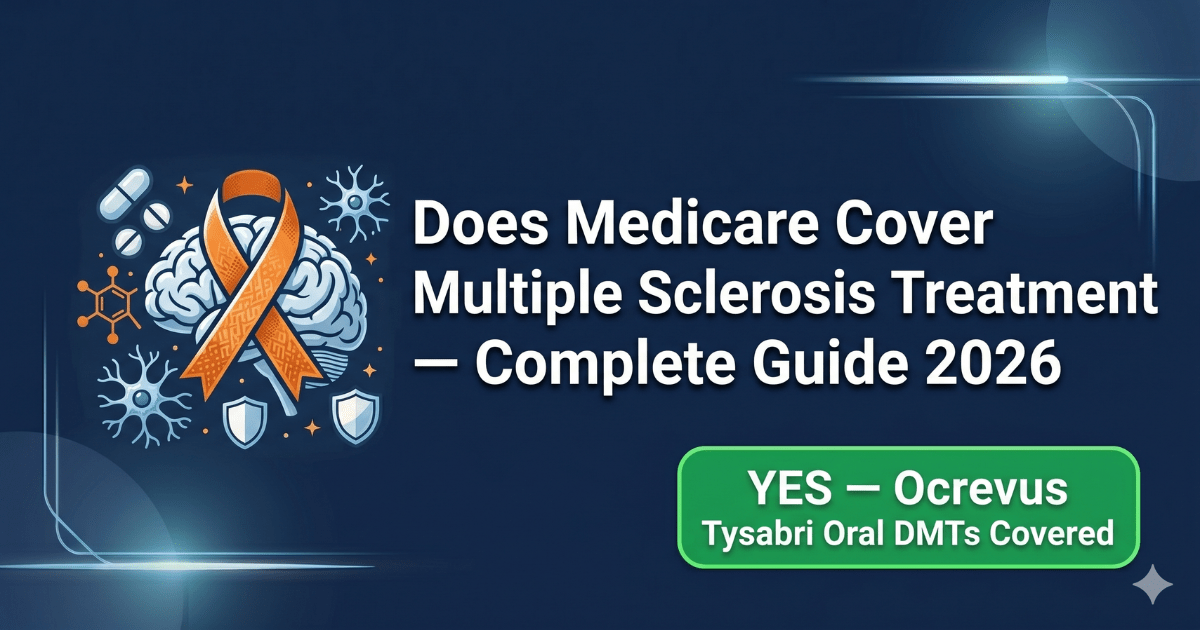
Does Medicare Cover Multiple Sclerosis Treatment — Complete Guide 2026
Does Medicare cover multiple sclerosis treatment in 2026? Multiple sclerosis — MS — is a chronic neurological condition affecting approximately 1 million Americans — and while MS is most commonly diagnosed in younger adults many people with MS live into their Medicare-eligible years with ongoing treatment needs. The good news is that yes — does Medicare cover multiple sclerosis treatment in 2026 — comprehensively across all major MS treatment modalities including disease-modifying therapies, infusion treatments, rehabilitation, and symptomatic management. In this complete guide we explain exactly what Medicare covers for multiple sclerosis treatment in 2026. All information is sourced from Medicare.gov and CMS.gov.
Also Read —
- Does Medicare Cover Physical Therapy 2026
- Does Medicare Cover Occupational Therapy 2026
- Medicare Income Limits and IRMAA Surcharges 2026 — Complete Guide
What You Will Learn — Does Medicare Cover Multiple Sclerosis
- Does Medicare cover multiple sclerosis treatment in 2026
- Does Medicare cover MS disease-modifying therapies
- Does Medicare cover MS infusion treatments — Ocrevus Tysabri
- Does Medicare cover oral MS medications
- Does Medicare cover physical therapy for MS
- Does Medicare cover occupational therapy for MS
- Does Medicare cover speech therapy for MS
- How much does MS treatment cost with Medicare
- Does Medicare Advantage cover multiple sclerosis
- Frequently asked questions about Medicare MS coverage 2026
Does Medicare Cover Multiple Sclerosis Treatment in 2026?
Yes — does Medicare cover multiple sclerosis treatment in 2026 — comprehensively across all treatment categories. Medicare Part B covers physician and neurologist visits, MRI imaging, and most importantly the IV infusion disease-modifying therapies that are increasingly the standard of care for MS. Medicare Part D covers oral disease-modifying therapies and symptomatic medications. Medicare Part B also covers physical therapy, occupational therapy, and speech therapy which are essential components of MS rehabilitation.
Multiple sclerosis treatment has been transformed over the past two decades with the development of highly effective disease-modifying therapies (DMTs) that slow disease progression and reduce relapses. Medicare covers the full range of these DMTs — from older injectable medications through modern high-efficacy oral and infusion therapies. Understanding does Medicare cover multiple sclerosis treatment across all these options helps MS patients access the most appropriate therapy for their disease without financial barriers.
Does Medicare Cover MS Disease-Modifying Therapies?
Does Medicare cover MS disease-modifying therapies in 2026? Yes — and the coverage pathway depends on whether the DMT is administered by infusion (Part B) or taken as an oral medication or self-injection (Part D).
IV Infusion MS DMTs — Part B
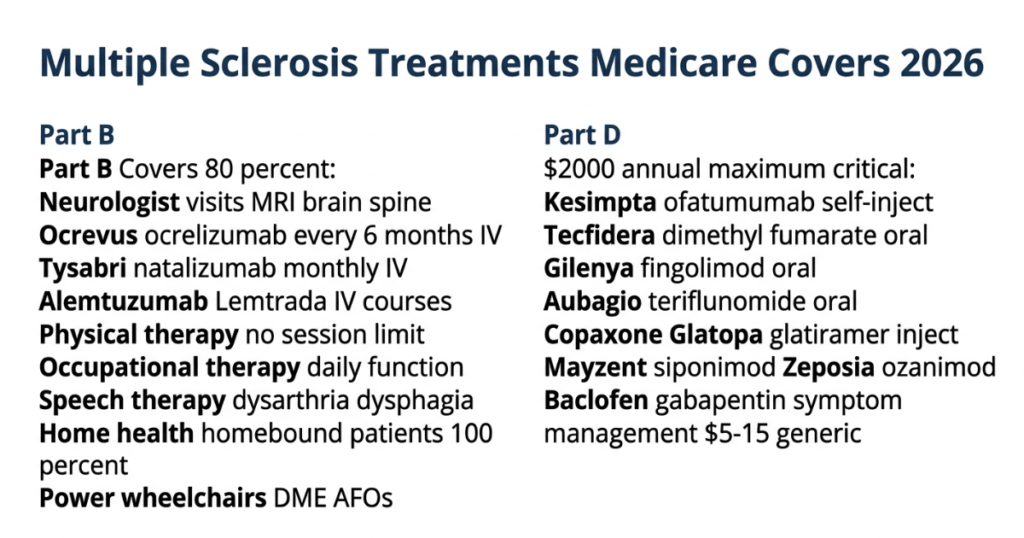
The highest-efficacy MS disease-modifying therapies are administered by IV infusion in clinical settings — covered under Medicare Part B at 80% after the $257 annual Part B deductible:
Ocrelizumab (Ocrevus) — one of the most important and most used high-efficacy MS DMTs. Ocrevus is FDA-approved for both relapsing MS and primary progressive MS — the only approved therapy for PPMS. Administered as IV infusions every 6 months. Medicare Part B covers Ocrevus at 80% after the deductible.
Medicare-approved amount per Ocrevus infusion — approximately $20,000 to $25,000. Your 20% coinsurance without supplement — approximately $4,000 to $5,000 per infusion. Two infusions per year — your annual coinsurance without supplement — approximately $8,000 to $10,000.
With Medigap Plan G — Ocrevus costs $0 after the $257 annual Part B deductible — saving $8,000 to $10,000 per year. This is one of the most significant Plan G financial benefits for any Medicare condition.
Natalizumab (Tysabri) — high-efficacy IV infusion given monthly — covered Part B at 80%. Medicare-approved approximately $7,000 to $9,000 per infusion monthly. Your 20% — approximately $1,400 to $1,800 per infusion — $16,800 to $21,600 annually without supplement. With Medigap Plan G — $0 after annual deductible — saving $16,800 to $21,600 per year.
Alemtuzumab (Lemtrada) — high-efficacy IV infusion given in annual courses — covered Part B.
Mitoxantrone — IV infusion used for aggressive MS — covered Part B.
Self-Injectable MS DMTs — Part D
Older injectable MS medications self-administered at home — covered under Medicare Part D:
- Interferon beta-1a (Avonex, Rebif) — covered Part D — $35 monthly insulin-class cap does NOT apply — subject to formulary tier and $2,000 annual maximum
- Interferon beta-1b (Betaseron, Extavia) — covered Part D
- Glatiramer acetate (Copaxone, Glatopa generic) — covered Part D — generic available reduces cost significantly
- Peginterferon beta-1a (Plegridy) — covered Part D
Self-Injectable High-Efficacy DMT — Part D
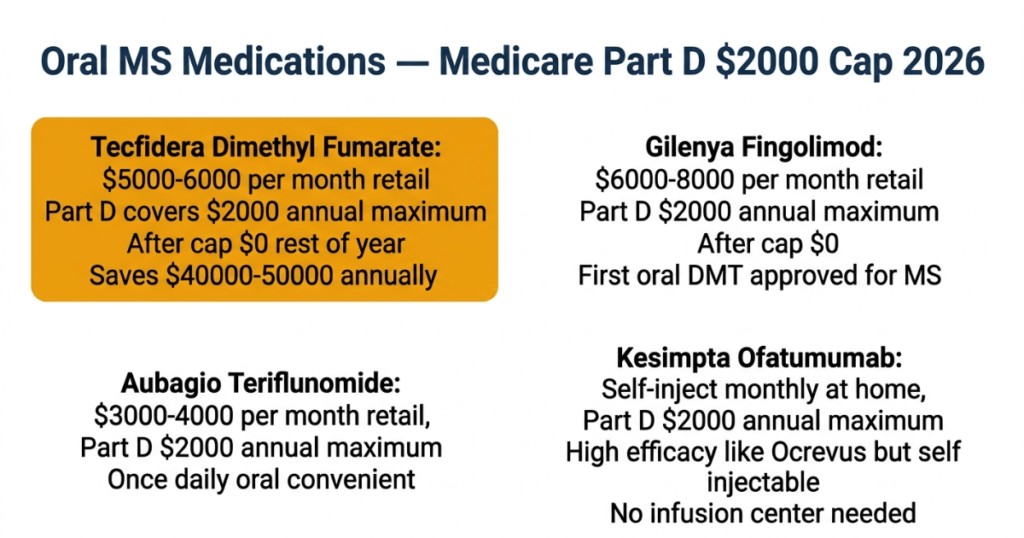
Ofatumumab (Kesimpta) — a subcutaneous self-injection B-cell depleting therapy — covered Part D. Unlike Ocrevus which requires IV infusion Kesimpta can be self-injected monthly at home — covered under Part D subject to $2,000 annual maximum.
Does Medicare Cover Oral MS Medications?
Does Medicare cover oral MS disease-modifying therapies in 2026? Yes — Medicare Part D covers all FDA-approved oral MS medications — and anticonvulsants are a protected drug class which means MS-related oral medications that fall into protected categories must be covered.
Oral MS DMTs — Part D
- Dimethyl fumarate (Tecfidera, Vumerity) — covered Part D
- Diroximel fumarate (Vumerity) — covered Part D
- Monomethyl fumarate (Bafiertam) — covered Part D
- Fingolimod (Gilenya) — covered Part D — first oral DMT approved for MS
- Siponimod (Mayzent) — covered Part D — for secondary progressive MS
- Ozanimod (Zeposia) — covered Part D
- Ponesimod (Ponvory) — covered Part D
- Teriflunomide (Aubagio) — covered Part D
- Cladribine (Mavenclad) — covered Part D
Oral MS DMTs are expensive — typically $5,000 to $8,000 per month at retail. The $2,000 annual Part D out-of-pocket maximum is critically important for MS patients taking oral DMTs — providing financial protection from unlimited drug costs.
Does Medicare Cover MS Symptomatic Medications?
Does Medicare cover medications for managing MS symptoms in 2026? Yes — Medicare Part D covers the full range of medications used to manage MS symptoms.
Spasticity Medications — Covered
- Baclofen — generic — very affordable — Tier 1
- Tizanidine — generic — very affordable
- Dalfampridine (Ampyra) — for walking improvement — covered Part D — $2,000 cap applies
- Dantrolene — covered
Fatigue Management — Covered
- Amantadine — generic — very affordable
- Modafinil — generic available — covered Part D
Pain Medications — Covered
- Gabapentin — generic — very affordable
- Pregabalin (Lyrica) — generic available — covered Part D
- Amitriptyline — generic — very affordable
Bladder Medications — Covered
- Oxybutynin — generic — very affordable
- Tolterodine — generic available
- Solifenacin (Vesicare) — covered Part D
Depression Medications — Covered
Antidepressants — protected drug class — all covered Part D at very affordable generic prices.
Does Medicare Cover MS MRI Imaging?
Does Medicare cover MRI imaging for multiple sclerosis in 2026? Yes — Medicare Part B covers brain and spinal cord MRI for MS monitoring and evaluation at 80% after the $257 annual Part B deductible.
MS MRI Coverage
Brain MRI — covered for MS diagnosis and monitoring disease activity and new lesions. Spinal cord MRI — covered for evaluating MS lesions affecting the spine. MRI with gadolinium contrast — covered for detecting active inflammation.
Most MS patients require annual or more frequent MRI monitoring. The recurring cost of MRI monitoring makes Medigap Plan G particularly valuable for MS patients — eliminating the 20% coinsurance on each MRI study throughout the year.
MRI costs with Original Medicare — approximately $100 to $250 your 20% per study. With Medigap Plan G — $0 per MRI after annual deductible.
Does Medicare Cover Physical Therapy for MS?
Does Medicare cover physical therapy for multiple sclerosis in 2026? Yes — Medicare Part B covers physical therapy for MS as a medically necessary rehabilitation service at 80% after the annual deductible.
Physical therapy for MS addresses:
- Gait and mobility impairment — one of the most disabling MS symptoms
- Balance and fall prevention — critical for MS patient safety
- Spasticity management through stretching and exercise
- Strength maintenance and building
- Energy conservation techniques
- Assistive device training — canes walkers wheelchairs
Medicare covers PT for MS with no predetermined session limit — therapy continues as long as medically necessary. The Jimmo v. Sebelius maintenance therapy standard allows ongoing PT even when improvement is not expected — particularly important for MS patients with stable but significant disability.
With Medigap Plan G — all PT sessions cost $0 after the annual deductible.
Does Medicare Cover Occupational Therapy for MS?
Does Medicare cover occupational therapy for multiple sclerosis in 2026? Yes — Medicare Part B covers occupational therapy for MS at 80% after the annual deductible.
OT for MS addresses:
- Upper extremity function — arm hand and finger coordination
- Activities of daily living adaptation — dressing bathing cooking
- Fatigue management and energy conservation
- Cognitive compensation strategies
- Home safety assessment and modification
- Adaptive equipment training
With Medigap Plan G — all OT sessions cost $0 after the annual deductible.
Does Medicare Cover Speech Therapy for MS?
Does Medicare cover speech therapy for multiple sclerosis in 2026? Yes — Medicare Part B covers speech therapy for MS patients experiencing communication and swallowing difficulties at 80% after the annual deductible.
MS can cause dysarthria — slurred speech — dysphagia — swallowing difficulties — and cognitive-communication disorders. Medicare covers SLP services for all of these MS-related communication impairments.
With Medigap Plan G — all speech therapy sessions cost $0 after the annual deductible.
Does Medicare Cover Home Health for MS?
Does Medicare cover home health care for homebound MS patients in 2026? Yes — Medicare covers home physical therapy, occupational therapy, speech therapy, skilled nursing, and social work at 100% for homebound MS patients.
As MS progresses many patients become homebound — leaving home requires considerable effort due to mobility and fatigue limitations. Home health coverage at 100% is one of the most valuable Medicare benefits for homebound MS patients — providing skilled therapy and nursing at no cost.
Does Medicare Cover Durable Medical Equipment for MS?
Does Medicare cover durable medical equipment for MS patients in 2026? Yes — Medicare Part B covers DME for MS patients at 80% after the deductible including:
- Power wheelchairs — for patients with significant mobility limitation
- Manual wheelchairs — when appropriate
- Walkers and rollators — for ambulatory patients with balance issues
- Ankle-foot orthoses (AFOs) — for foot drop — very common in MS
- Hospital beds — for patients with significant disability
- Nebulizers and other equipment as needed
With Medigap Plan G — all covered DME costs $0 after the annual deductible.
How Much Does MS Treatment Cost with Medicare in 2026?
MS Infusion Therapies — Most Expensive
Ocrevus two infusions per year: Without supplement — approximately $8,000 to $10,000 your 20% annually With Medigap Plan G — $0 after $257 annual deductible — saves $8,000 to $10,000
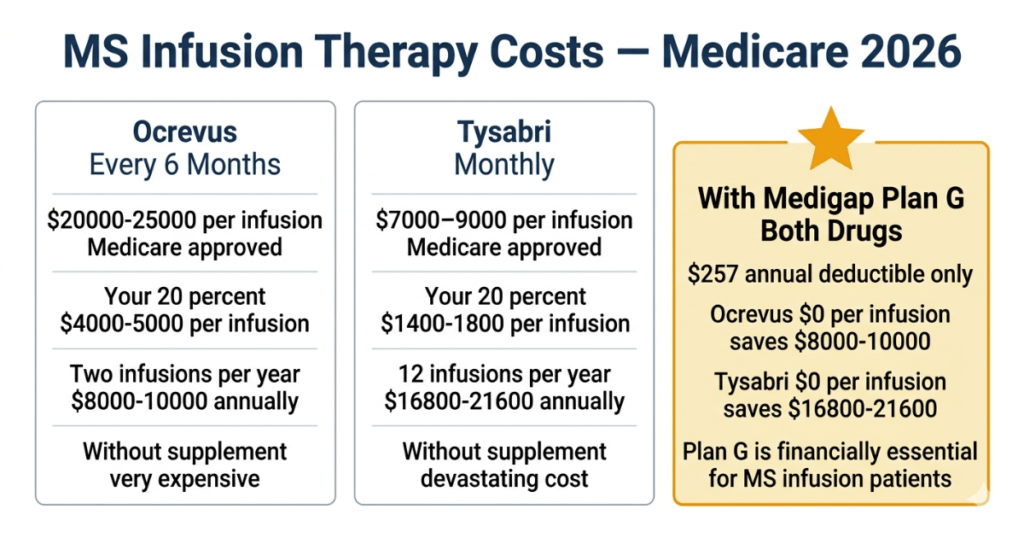
Tysabri monthly infusions: Without supplement — approximately $16,800 to $21,600 your 20% annually With Medigap Plan G — $0 after annual deductible — saves up to $21,600 per year
Oral MS DMTs — Part D
Tecfidera Gilenya Aubagio — $2,000 annual Part D maximum applies — saves $58,000 to $94,000 at retail prices
Kesimpta self-injection — $2,000 annual Part D maximum — saves significantly
Glatiramer acetate generic — More Affordable
Generic Glatopa — approximately $1,500 to $3,000 per month After $2,000 Part D cap — $0 rest of year
Physical Occupational Speech Therapy
Each session — approximately $16 to $37 your 20% Multiple sessions weekly — can add up significantly With Medigap Plan G — all sessions $0 after annual deductible
MRI Monitoring
Each MRI — approximately $100 to $250 your 20% Annual or biannual monitoring — $100 to $500 annually without supplement With Medigap Plan G — $0 per MRI after annual deductible
Does Medicare Advantage Cover Multiple Sclerosis?
Does Medicare Advantage cover multiple sclerosis treatment in 2026? Yes — all Medicare Advantage plans must cover MS treatment as Medicare-required services.
Prior authorization — virtually all Medicare Advantage plans require prior authorization for MS DMTs — particularly expensive infusion therapies like Ocrevus and Tysabri. Your neurologist handles authorization but delays can sometimes occur.
In-network MS neurologist and infusion center — verify before scheduling treatment.
Annual maximum $9,350 — MS patients receiving IV infusions may reach this quickly — particularly Tysabri patients who receive monthly infusions.
Part D $2,000 maximum — same protection for oral DMTs.
Enhanced MS programs — some Medicare Advantage plans offer specialized MS care management programs and disease monitoring benefits.
Frequently Asked Questions — Does Medicare Cover Multiple Sclerosis
Does Medicare cover multiple sclerosis treatment in 2026?
Yes — does Medicare cover multiple sclerosis comprehensively in 2026 including neurologist visits, brain and spinal cord MRI monitoring, all major IV infusion DMTs including Ocrevus and Tysabri at 80% under Part B, oral DMTs including Tecfidera and Gilenya under Part D with $2,000 annual cap, self-injectable Kesimpta under Part D, and physical occupational and speech therapy. With Medigap Plan G most MS treatment costs $0 after the annual deductible.
Does Medicare cover Ocrevus for MS?
Yes — Medicare Part B covers ocrelizumab (Ocrevus) infusions at 80% after the $257 annual deductible. Without a supplement two annual Ocrevus infusions cost approximately $8,000 to $10,000 in 20% coinsurance. With Medigap Plan G Ocrevus costs $0 after the annual deductible — one of the most significant Plan G savings for any Medicare condition.
Does Medicare cover Tysabri for MS?
Yes — Medicare Part B covers natalizumab (Tysabri) monthly infusions at 80% after the annual deductible. Without a supplement annual Tysabri coinsurance can reach $16,800 to $21,600. With Medigap Plan G Tysabri costs $0 after the annual deductible.
Does Medicare cover oral MS medications like Tecfidera and Gilenya?
Yes — Medicare Part D covers oral MS disease-modifying therapies including dimethyl fumarate (Tecfidera), fingolimod (Gilenya), siponimod (Mayzent), teriflunomide (Aubagio), and others. The $2,000 annual Part D out-of-pocket maximum protects MS patients from the extremely high retail costs of these medications.
How much does Ocrevus cost with Medicare?
Without Medigap Plan G Ocrevus infusions cost approximately $8,000 to $10,000 per year in 20% Part B coinsurance. With Medigap Plan G Ocrevus costs $0 after the $257 annual deductible — potentially saving $8,000 to $10,000 annually. Medigap Plan G is essentially essential for Medicare beneficiaries receiving Ocrevus therapy.
Summary — Does Medicare Cover Multiple Sclerosis 2026
Does Medicare cover multiple sclerosis treatment in 2026? Yes — Medicare provides comprehensive MS coverage including all major disease-modifying therapies through Part B and Part D, MRI monitoring, physical and occupational therapy, speech therapy, home health, and durable medical equipment.
The financial case for Medigap Plan G is extraordinarily compelling for MS patients — Ocrevus patients save $8,000 to $10,000 annually and Tysabri patients save up to $21,600 annually with Plan G compared to Original Medicare alone. The $2,000 Part D maximum protects oral DMT patients from unlimited drug costs. MS patients are among those who benefit most dramatically from comprehensive Medicare coverage with Medigap Plan G.
For free help understanding your Medicare MS coverage contact your State Health Insurance Assistance Program (SHIP) at shiphelp.org or call Medicare free at 1-800-633-4227.
This guide is for informational purposes only. Always consult your neurologist and verify current Medicare coverage at Medicare.gov.
Sources: Medicare.gov | CMS.gov | SSA.gov | AARP.org
Last updated: April 2026 | Author: James Carter, Independent Medicare Research Analyst