
Does Medicare Cover Lymphoma Treatment — Complete Guide 2026
Does Medicare cover lymphoma treatment in 2026? Lymphoma — cancer of the lymphatic system — is one of the most common blood cancers affecting Medicare beneficiaries with approximately 89,000 new cases diagnosed annually in the United States. Lymphoma encompasses two main categories — Hodgkin lymphoma and non-Hodgkin lymphoma — with dozens of subtypes each requiring specific treatment approaches. The good news is that yes — does Medicare cover lymphoma treatment in 2026 — comprehensively across all lymphoma types including chemotherapy, immunotherapy, targeted therapy, CAR-T cell therapy, and stem cell transplantation. In this complete guide we explain exactly what Medicare covers for lymphoma treatment in 2026. All information is sourced from Medicare.gov and CMS.gov.
Also Read —
- Does Medicare Cover Leukemia Treatment 2026
- Does Medicare Cover Cancer Treatment 2026
- Medicare Part B vs Part D Drug Coverage 2026
What You Will Learn — Does Medicare Cover Lymphoma
- Does Medicare cover lymphoma treatment in 2026
- Does Medicare cover Rituxan and rituximab for lymphoma
- Does Medicare cover chemotherapy for lymphoma
- Does Medicare cover CAR-T cell therapy for lymphoma
- Does Medicare cover targeted therapy for lymphoma
- Does Medicare cover radiation therapy for lymphoma
- Does Medicare cover stem cell transplant for lymphoma
- How much does lymphoma treatment cost with Medicare
- Does Medicare Advantage cover lymphoma
- Frequently asked questions about Medicare lymphoma coverage 2026
Does Medicare Cover Lymphoma Treatment in 2026?
Yes — does Medicare cover lymphoma treatment in 2026 — comprehensively across all major lymphoma types and treatment modalities. Medicare Part B covers rituximab and other IV monoclonal antibody infusions, IV chemotherapy, bispecific antibody therapy, and CAR-T cell therapy administration. Medicare Part D covers oral targeted therapies including BTK inhibitors, PI3K inhibitors, and BCL-2 inhibitors. Medicare Part A covers intensive inpatient chemotherapy and stem cell transplantation.
Lymphoma treatment has been transformed by the development of rituximab-based immunochemotherapy — the combination of rituximab with standard chemotherapy that dramatically improved outcomes for B-cell lymphomas. More recently CAR-T cell therapy has provided new options for relapsed and refractory lymphoma. Understanding does Medicare cover lymphoma across all these treatment generations helps lymphoma patients access the most effective therapy available.

Does Medicare Cover Rituximab for Lymphoma?
Does Medicare cover rituximab (Rituxan) for lymphoma in 2026? Yes — and this is one of the most important Medicare lymphoma coverage questions because rituximab is used in the majority of B-cell lymphoma treatment regimens.
Rituximab Coverage — Part B
Rituximab — an anti-CD20 monoclonal antibody — is administered by IV infusion in physician offices or infusion centers and covered under Medicare Part B at 80% after the $257 annual Part B deductible.
Rituximab is used across multiple lymphoma types:
- Diffuse large B-cell lymphoma (DLBCL) — R-CHOP standard of care
- Follicular lymphoma — R-CHOP R-CVP R-Bendamustine
- Mantle cell lymphoma — R-CHOP R-Bendamustine
- Marginal zone lymphoma — rituximab monotherapy or combination
- CLL — rituximab combination regimens
- Other B-cell lymphomas — multiple indications
Rituximab Cost with Medicare
Medicare-approved rituximab per infusion — approximately $3,000 to $6,000. Your 20% coinsurance — approximately $600 to $1,200 per infusion. R-CHOP cycle — 6 cycles — rituximab component your 20% — approximately $3,600 to $7,200.
With Medigap Plan G — all rituximab infusions cost $0 after the $257 annual deductible — saving $3,600 to $7,200 for a standard R-CHOP course.
Biosimilar Rituximab — Covered
Multiple rituximab biosimilars are FDA-approved and covered under Medicare Part B — often at lower cost to the Medicare program:
- Rituxan Hycela (rituximab plus hyaluronidase subcutaneous) — covered Part B
- Truxima — rituximab biosimilar — covered Part B
- Ruxience — rituximab biosimilar — covered Part B
Does Medicare Cover Chemotherapy for Lymphoma?
Does Medicare cover chemotherapy for lymphoma in 2026? Yes — Medicare covers all major lymphoma chemotherapy regimens.
DLBCL Standard Chemotherapy — Covered
R-CHOP — the standard first-line regimen for DLBCL — all components covered:
- Rituximab — covered Part B
- Cyclophosphamide — covered Part B
- Doxorubicin (Adriamycin) — covered Part B
- Vincristine (Oncovin) — covered Part B
- Prednisone — oral — covered Part D at very low cost
Salvage Chemotherapy — Covered
Second-line salvage regimens for relapsed DLBCL:
- R-ICE — rituximab ifosfamide carboplatin etoposide — covered Part B
- R-DHAP — rituximab cisplatin cytarabine dexamethasone — covered Part B
- R-GDP — rituximab gemcitabine dexamethasone cisplatin — covered Part B
Hodgkin Lymphoma Chemotherapy — Covered
- ABVD — doxorubicin bleomycin vinblastine dacarbazine — covered Part B
- BEACOPP — escalated regimen — covered Part B
- AVD plus brentuximab vedotin (A+AVD) — covered Part B
Follicular Lymphoma Chemotherapy — Covered
- R-Bendamustine — rituximab plus bendamustine — covered Part B
- R-CHOP and R-CVP — covered Part B
Mantle Cell Lymphoma Regimens — Covered
- R-CHOP and R-Bendamustine — covered Part B
- VR-CAP — bortezomib rituximab cyclophosphamide doxorubicin prednisone — covered Part B
With Medigap Plan G — all IV chemotherapy costs $0 after the annual deductible.
Does Medicare Cover Targeted Therapy for Lymphoma?
Does Medicare cover targeted therapy for lymphoma in 2026? Yes — Medicare covers the full range of targeted therapies for lymphoma through Part B and Part D depending on administration route.
Brentuximab Vedotin (Adcetris) — Part B
Antibody-drug conjugate targeting CD30 — covered Part B at 80% after deductible:
- Hodgkin lymphoma after failure of ABVD — covered
- A+AVD first-line Hodgkin — covered
- Systemic anaplastic large cell lymphoma — covered
Polatuzumab Vedotin (Polivy) — Part B
Antibody-drug conjugate for DLBCL — covered Part B:
- Pola-R-CHP — polatuzumab plus rituximab cyclophosphamide doxorubicin prednisone — new standard of care for certain DLBCL patients — covered Part B at 80%
Loncastuximab Tesirine (Zynlonta) — Part B
CD19-targeted antibody-drug conjugate for relapsed DLBCL — covered Part B.
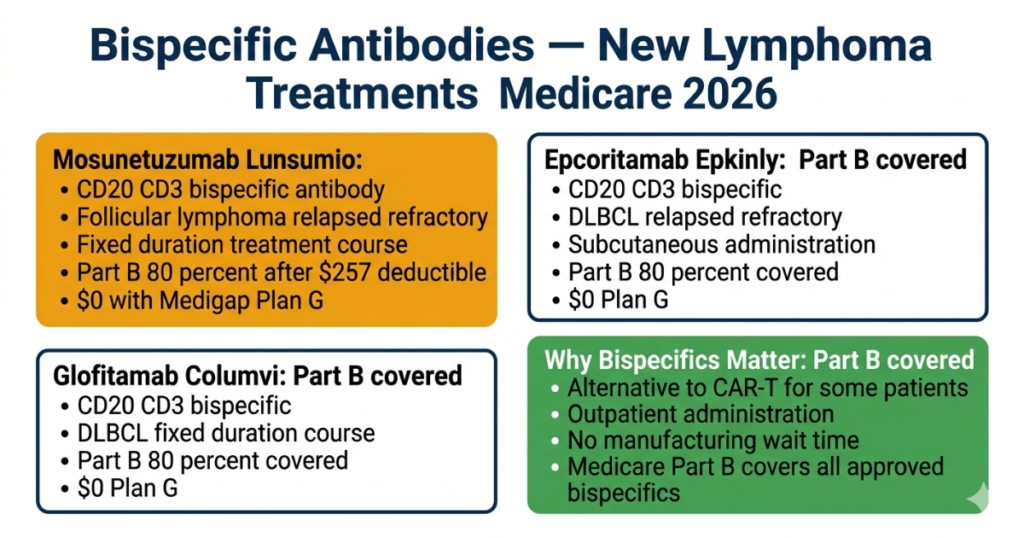
Bispecific Antibodies — Part B
Revolutionary new treatments for lymphoma — covered Part B:
- Mosunetuzumab (Lunsumio) — CD20/CD3 bispecific — covered for relapsed follicular lymphoma
- Epcoritamab (Epkinly) — CD20/CD3 bispecific — covered for relapsed DLBCL
- Glofitamab (Columvi) — CD20/CD3 bispecific — covered for relapsed DLBCL
- Odronextamab — CD20/CD3 bispecific — covered
BTK Inhibitors for Lymphoma — Part D
- Ibrutinib (Imbruvica) — covered Part D for mantle cell lymphoma and other B-cell lymphomas — $2,000 annual cap
- Acalabrutinib (Calquence) — covered Part D for mantle cell lymphoma — $2,000 annual cap
- Zanubrutinib (Brukinsa) — covered Part D for mantle cell lymphoma — $2,000 annual cap
- Pirtobrutinib (Jaypirca) — covered Part D — non-covalent BTK inhibitor — $2,000 annual cap
BCL-2 Inhibitor — Part D
- Venetoclax (Venclexta) — covered Part D for certain lymphomas — $2,000 annual cap
PI3K Inhibitors — Part D
- Idelalisib (Zydelig) — covered Part D for follicular lymphoma — $2,000 annual cap
- Copanlisib (Aliqopa) — covered Part B — IV PI3K inhibitor for follicular lymphoma
- Umbralisib (Ukoniq) — covered Part D
mTOR Inhibitor — Part D
- Everolimus (Afinitor) — covered Part D for certain lymphomas — $2,000 annual cap
Lenalidomide (Revlimid) — Part D
- Covered Part D for follicular lymphoma and mantle cell lymphoma maintenance — generic becoming available — $2,000 annual cap critical
Pembrolizumab (Keytruda) for Hodgkin — Part B
Keytruda for relapsed/refractory classical Hodgkin lymphoma — covered Part B at 80% after deductible. Same extraordinary savings as other Keytruda indications — $35,000 to $87,000 annually without supplement — $0 with Medigap Plan G.
Nivolumab (Opdivo) for Hodgkin — Part B
Nivolumab for Hodgkin lymphoma — covered Part B at 80%.
Does Medicare Cover CAR-T Cell Therapy for Lymphoma?
Does Medicare cover CAR-T cell therapy for lymphoma in 2026? Yes — Medicare covers FDA-approved CAR-T cell therapies for qualifying lymphoma patients — and lymphoma has the most CAR-T approvals of any cancer indication.

CAR-T Therapies for Lymphoma — Covered
- Axicabtagene ciloleucel (Yescarta) — covered for relapsed/refractory DLBCL and follicular lymphoma
- Tisagenlecleucel (Kymriah) — covered for relapsed/refractory DLBCL
- Lisocabtagene maraleucel (Breyanzi) — covered for relapsed/refractory DLBCL
- Idecabtagene vicleucel (Abecma) — covered for multiple myeloma
CAR-T Cell Therapy Cost
CAR-T cell therapy costs $400,000 to $600,000 per treatment course — among the most expensive treatments in medicine. Medicare covers CAR-T at Medicare-approved CAR-T treatment centers.
With Medigap Plan G — CAR-T cell therapy costs $0 after the $257 annual deductible — one of the most extraordinary financial protections in all of Medicare. Does Medicare cover lymphoma CAR-T generously — absolutely yes with Plan G.
CAR-T Administration Setting
CAR-T is administered in an outpatient or inpatient setting depending on the specific product. Coverage pathway is Part B for outpatient administration and Part A for inpatient. Medigap Plan G covers both pathways.
Does Medicare Cover Radiation Therapy for Lymphoma?
Does Medicare cover radiation therapy for lymphoma in 2026? Yes — Medicare Part B covers radiation therapy for lymphoma at 80% after the annual deductible.
Involved Site Radiation Therapy (ISRT) — Covered
Modern radiation for lymphoma — targeting only involved lymphoma sites — covered at 80%.
Involved Field Radiation — Covered
Traditional larger field radiation — covered.
Consolidation Radiation After Chemotherapy — Covered
Radiation given after chemotherapy for Hodgkin lymphoma consolidation — covered.
Palliative Radiation — Covered
Radiation for symptom relief in bulky or recurrent lymphoma — covered.
With Medigap Plan G — all radiation therapy costs $0 after the annual deductible.
Does Medicare Cover Stem Cell Transplant for Lymphoma?
Does Medicare cover stem cell transplantation for lymphoma in 2026? Yes — Medicare covers both autologous and allogeneic stem cell transplantation for qualifying lymphoma patients at Medicare-approved transplant centers.
Autologous Stem Cell Transplant — Covered
Autologous transplant using the patient’s own stem cells — the most commonly used transplant for lymphoma — covered under Medicare Part A for inpatient hospitalization. Standard of care for relapsed DLBCL after achieving second remission.
Allogeneic Stem Cell Transplant — Covered
Allogeneic transplant for certain high-risk lymphoma subtypes — covered.
With Medigap Plan G — the entire stem cell transplant hospitalization costs $0 after the annual deductible — potentially saving $150,000 to $400,000 in hospitalization costs.
How Much Does Lymphoma Treatment Cost with Medicare in 2026?
R-CHOP Chemotherapy
Rituximab component — approximately $3,600 to $7,200 your 20% for 6 cycles Cyclophosphamide doxorubicin vincristine — additional 20% each With Medigap Plan G — entire R-CHOP course $0 after annual deductible
Bispecific Antibodies
Each infusion — approximately $3,000 to $8,000 Medicare-approved Your 20% — approximately $600 to $1,600 per infusion With Medigap Plan G — $0 after annual deductible
CAR-T Cell Therapy
$400,000 to $600,000 total — covered Medicare With Medigap Plan G — $0 after annual deductible — most extraordinary Plan G savings
Keytruda for Hodgkin
Without supplement — $35,000 to $87,000 annually your 20% With Medigap Plan G — $0 after annual deductible
Oral BTK Inhibitors Part D
Imbruvica Calquence Brukinsa — $2,000 annual Part D maximum
Stem Cell Transplant
Part A deductible $1,676 plus potential extended stay costs With Medigap Plan G — $0 entire hospitalization
Does Medicare Advantage Cover Lymphoma?
Does Medicare Advantage cover lymphoma treatment in 2026? Yes — all Medicare Advantage plans must cover lymphoma treatment.
Prior authorization — required for CAR-T therapy rituximab biosimilars and oral targeted agents. In-network lymphoma specialist and treatment center — verify CAR-T center network before treatment. Annual maximum $9,350 — lymphoma patients on active treatment reach this quickly. Part D $2,000 maximum — same protection for oral BTK inhibitors.
Frequently Asked Questions — Does Medicare Cover Lymphoma
Does Medicare cover lymphoma treatment in 2026?
Yes — does Medicare cover lymphoma comprehensively in 2026 including rituximab and biosimilars at 80% under Part B, R-CHOP and all major chemotherapy regimens, bispecific antibodies including mosunetuzumab and epcoritamab, CAR-T cell therapy including Yescarta and Kymriah, Keytruda for Hodgkin lymphoma, oral BTK inhibitors under Part D with $2,000 annual cap, and stem cell transplantation. With Medigap Plan G most lymphoma treatment costs $0 after the annual deductible.
Does Medicare cover CAR-T cell therapy for lymphoma?
Yes — Medicare covers FDA-approved CAR-T cell therapies including Yescarta, Kymriah, and Breyanzi for qualifying lymphoma patients at Medicare-approved treatment centers. CAR-T costs $400,000 to $600,000 per course. With Medigap Plan G CAR-T costs $0 after the annual deductible — one of the most extraordinary financial protections in all of Medicare.
Does Medicare cover Rituxan rituximab for lymphoma?
Yes — Medicare Part B covers rituximab and all FDA-approved rituximab biosimilars for lymphoma at 80% after the $257 annual deductible. Rituximab is the most widely used drug in B-cell lymphoma treatment. With Medigap Plan G all rituximab infusions cost $0 after the annual deductible.
Does Medicare cover ibrutinib Imbruvica for lymphoma?
Yes — Medicare Part D covers ibrutinib (Imbruvica) for mantle cell lymphoma and other B-cell lymphomas. Imbruvica costs approximately $14,000 to $17,000 per month at retail. The $2,000 annual Part D cap saves lymphoma patients $166,000 to $202,000 annually.
Does Medicare cover Keytruda for Hodgkin lymphoma?
Yes — Medicare Part B covers pembrolizumab (Keytruda) for relapsed and refractory classical Hodgkin lymphoma at 80% after the annual deductible. Without a supplement annual Keytruda coinsurance can reach $35,000 to $87,000. With Medigap Plan G Keytruda costs $0 after the annual deductible.
Summary — Does Medicare Cover Lymphoma 2026
Does Medicare cover lymphoma treatment in 2026? Yes — Medicare provides extraordinary comprehensive lymphoma coverage from rituximab-based chemotherapy through bispecific antibodies, CAR-T cell therapy, oral BTK inhibitors, Keytruda for Hodgkin, and stem cell transplantation.
The financial case for Medigap Plan G is among the most compelling for lymphoma patients — CAR-T cell therapy costing $400,000 to $600,000 per course costs $0 with Plan G after the annual deductible, Keytruda saves $35,000 to $87,000 annually, and R-CHOP chemotherapy costs $0 after the deductible. The $2,000 Part D cap protects patients taking oral BTK inhibitors from $166,000 to $202,000 in annual drug costs.
For free help understanding your Medicare lymphoma coverage contact your State Health Insurance Assistance Program (SHIP) at shiphelp.org or call Medicare free at 1-800-633-4227.
This guide is for informational purposes only. Always consult your hematologist and oncologist and verify current Medicare coverage at Medicare.gov.
Sources: Medicare.gov | CMS.gov | SSA.gov | AARP.org
Last updated: April 2026 | Author: James Carter, Independent Medicare Research Analyst