
Does Medicare Cover Bladder Cancer Treatment — Complete Guide 2026
Does Medicare cover bladder cancer treatment in 2026? Bladder cancer is the sixth most common cancer in the United States — with approximately 82,000 new cases diagnosed annually — and it disproportionately affects older adults with the majority of diagnoses occurring in people over 65. Bladder cancer also has the highest recurrence rate of any cancer — requiring ongoing surveillance and treatment for many years. The good news is that yes — does Medicare cover bladder cancer treatment in 2026 — comprehensively across all stages including surveillance cystoscopy, BCG immunotherapy, surgery, and systemic treatment for advanced disease. In this complete guide we explain exactly what Medicare covers for bladder cancer treatment in 2026. All information is sourced from Medicare.gov and CMS.gov.
Also Read —
- Does Medicare Cover Cancer Treatment 2026
- Does Medicare Cover Prostate Cancer Treatment 2026
- Medicare Income Limits and IRMAA Surcharges 2026 — Complete Guide
What You Will Learn — Does Medicare Cover Bladder Cancer
- Does Medicare cover bladder cancer treatment in 2026
- Does Medicare cover cystoscopy for bladder cancer
- Does Medicare cover TURBT surgery
- Does Medicare cover BCG treatment for bladder cancer
- Does Medicare cover bladder cancer surgery — cystectomy
- Does Medicare cover immunotherapy for bladder cancer
- Does Medicare cover chemotherapy for bladder cancer
- How much does bladder cancer treatment cost with Medicare
- Does Medicare Advantage cover bladder cancer
- Frequently asked questions about Medicare bladder cancer coverage 2026
Does Medicare Cover Bladder Cancer Treatment in 2026?
Yes — does Medicare cover bladder cancer treatment in 2026 — comprehensively across all stages of bladder cancer management. Medicare Part B covers cystoscopy for surveillance and diagnosis, transurethral resection of bladder tumor (TURBT), intravesical BCG immunotherapy instillations, radical cystectomy surgery, and systemic immunotherapy and chemotherapy infusions. Medicare Part D covers oral medications used in bladder cancer management.
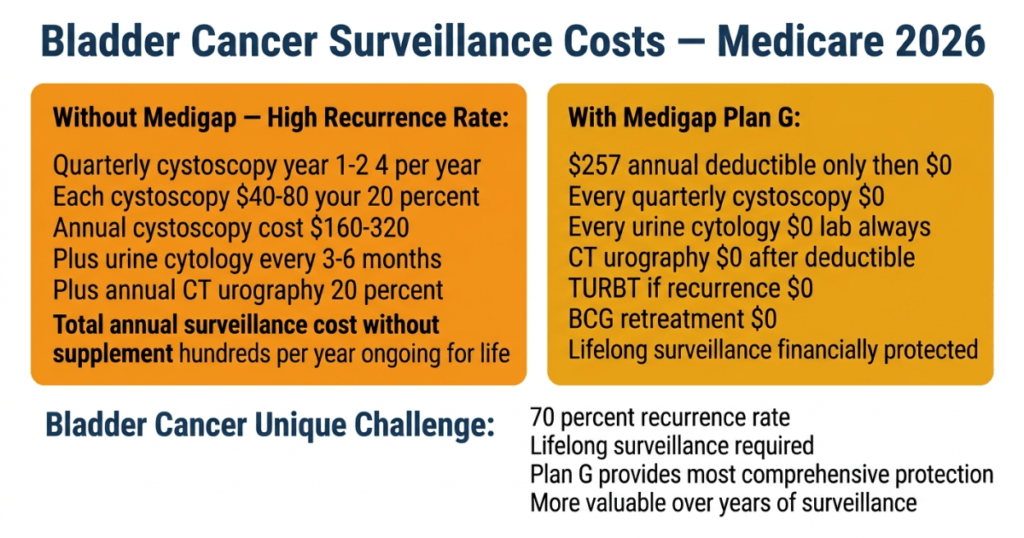
Bladder cancer is unique among cancers because of its extraordinarily high recurrence rate — approximately 70% of non-muscle invasive bladder cancers recur after initial treatment. This means bladder cancer patients require lifelong surveillance with regular cystoscopy — often every 3 months initially — and potentially ongoing BCG instillations for years. Understanding does Medicare cover bladder cancer surveillance and treatment across this entire long-term management journey is critically important for Medicare beneficiaries with this condition.

Does Medicare Cover Cystoscopy for Bladder Cancer?
Does Medicare cover cystoscopy for bladder cancer surveillance and diagnosis in 2026? Yes — Medicare Part B covers cystoscopy at 80% after the $257 annual Part B deductible.
Diagnostic Cystoscopy — Covered
Initial diagnostic cystoscopy to evaluate hematuria (blood in urine) or other bladder cancer symptoms — covered at 80% after the deductible.
Surveillance Cystoscopy — Covered
Regular surveillance cystoscopy after bladder cancer treatment — covered as medically necessary for cancer monitoring:
- Every 3 months for the first 2 years after diagnosis
- Every 6 months for years 3 and 4
- Annually thereafter
The frequency and duration of surveillance cystoscopy creates significant recurring costs for bladder cancer patients. With Original Medicare the 20% coinsurance on each cystoscopy adds up rapidly — making Medigap Plan G particularly valuable for bladder cancer survivors.
Flexible vs Rigid Cystoscopy — Covered
Both flexible office cystoscopy and rigid cystoscopy under anesthesia — covered at 80% after deductible.
Cystoscopy with Biopsy — Covered
When suspicious lesions are identified during surveillance cystoscopy biopsy specimens are taken — covered including pathological examination at $0 as diagnostic lab.
Enhanced Cystoscopy — Blue Light Cystoscopy — Covered
Blue light cystoscopy using hexaminolevulinate (Cysview) — a photosensitizer that makes bladder tumors more visible under blue light — is covered by Medicare as an enhanced cystoscopy technique.
Cystoscopy Costs with Medicare
Office cystoscopy — Medicare-approved approximately $200 to $400 Your 20% — approximately $40 to $80 per cystoscopy Quarterly cystoscopy — approximately $160 to $320 per year your cost With Medigap Plan G — $0 per cystoscopy after annual deductible — significant savings for patients requiring quarterly surveillance
Does Medicare Cover TURBT Surgery?
Does Medicare cover transurethral resection of bladder tumor (TURBT) for bladder cancer in 2026? Yes — Medicare Part B covers TURBT at 80% after the $257 annual Part B deductible.
What Is TURBT?
TURBT — transurethral resection of bladder tumor — is the primary surgical treatment for non-muscle invasive bladder cancer (NMIBC). The procedure uses a resectoscope passed through the urethra to remove visible bladder tumors and is typically performed under general or spinal anesthesia in an outpatient or short-stay setting.
TURBT Coverage
Medicare covers TURBT as an outpatient surgical procedure at 80% after the deductible including:
- The surgical procedure
- Anesthesia
- Facility fee
- Pathological examination of resected tissue at $0 as diagnostic lab
Repeat TURBT — Covered
For high-grade non-muscle invasive bladder cancers a second TURBT — restaging resection — is often performed 4 to 6 weeks after the initial resection to ensure complete tumor removal. Medicare covers the repeat TURBT as medically necessary.
TURBT Costs with Medicare
Outpatient TURBT — Medicare-approved total approximately $2,000 to $5,000 Your 20% coinsurance — approximately $400 to $1,000 With Medigap Plan G — $0 after the annual deductible
Does Medicare Cover BCG Treatment for Bladder Cancer?
Does Medicare cover BCG intravesical immunotherapy for bladder cancer in 2026? Yes — and this is one of the most important Medicare bladder cancer coverage questions.
What Is BCG Treatment?
BCG (Bacillus Calmette-Guérin) — the tuberculosis vaccine — is used as an intravesical immunotherapy instilled directly into the bladder through a catheter to prevent bladder cancer recurrence and progression. BCG is the most effective intravesical treatment for high-risk non-muscle invasive bladder cancer.
How Medicare Covers BCG
BCG instillation is a physician-administered treatment — instilled by a urologist or nurse in a clinical setting. This administration pathway means BCG is covered under Medicare Part B at 80% after the $257 annual Part B deductible.
BCG Induction Course — Covered
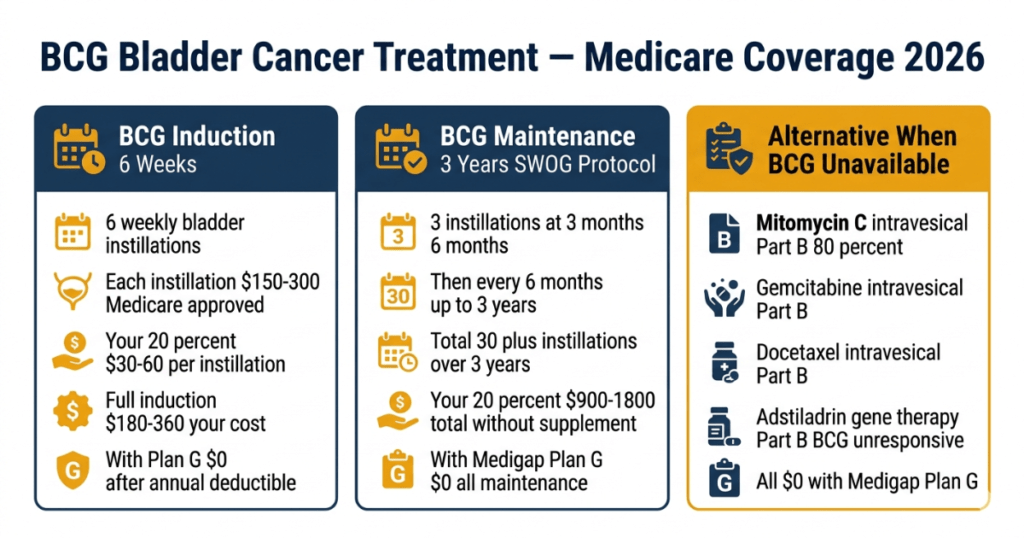
Standard BCG induction — 6 weekly instillations — covered at 80% after deductible.
BCG Maintenance — Covered
BCG maintenance therapy — reducing recurrence in high-risk bladder cancer — covered. SWOG maintenance protocol involves:
- 3 weekly instillations at 3 months
- 3 weekly instillations at 6 months
- Then 3 weekly instillations every 6 months for up to 3 years
Medicare covers all BCG maintenance instillations as medically necessary.
BCG Costs with Medicare
Each BCG instillation — Medicare-approved approximately $150 to $300 Your 20% — approximately $30 to $60 per instillation Full induction course (6 instillations) — approximately $180 to $360 your 20% Full 3-year maintenance — approximately $1,620 to $3,240 your total 20% With Medigap Plan G — all BCG instillations $0 after annual deductible
Alternative Intravesical Therapies — Covered
For patients who cannot receive BCG or when BCG is unavailable:
- Mitomycin C intravesical — covered Part B at 80%
- Gemcitabine intravesical — covered Part B at 80%
- Docetaxel intravesical — covered Part B at 80%
- Valrubicin (Valstar) — covered Part B at 80%
Nadofaragene Firadenovec (Adstiladrin) — Covered
Adstiladrin — a gene therapy instilled into the bladder for BCG-unresponsive high-risk NMIBC — is covered under Medicare Part B at 80% after the deductible as a physician-administered intravesical therapy.
Does Medicare Cover Bladder Cancer Surgery?
Does Medicare cover bladder cancer surgery in 2026? Yes — Medicare covers both partial and radical cystectomy for muscle-invasive bladder cancer.
Partial Cystectomy — Covered
Partial cystectomy — surgical removal of the portion of the bladder containing the tumor — covered for select patients with muscle-invasive bladder cancer amenable to partial removal.
Radical Cystectomy — Covered
Radical cystectomy — complete surgical removal of the bladder along with regional lymph nodes — is the standard treatment for muscle-invasive bladder cancer. Medicare covers radical cystectomy as a major surgical procedure under Part A for inpatient cases.
Radical cystectomy includes:
- Removal of the bladder
- Pelvic lymph node dissection
- Urinary diversion — ileal conduit, Indiana pouch, or neobladder reconstruction
Urinary Diversion — Covered
All forms of urinary diversion following cystectomy are covered:
- Ileal conduit — urostomy — covered including stoma creation
- Continent cutaneous diversion — Indiana pouch — covered
- Orthotopic neobladder — covered
Urostomy Supplies — Covered Part B
Ostomy supplies for patients with urostomies — covered under Medicare Part B as medical supplies at 80% after the deductible.
Radical Cystectomy Costs with Medicare
Major inpatient surgery:
- Part A deductible — $1,676 per benefit period
- Days 1 to 60 — $0 after deductible
- Surgeon fee — 20% Part B coinsurance
- Total without supplement — approximately $2,000 to $4,000
With Medigap Plan G — radical cystectomy costs $0 after the $257 annual Part B deductible.
Does Medicare Cover Immunotherapy for Bladder Cancer?
Does Medicare cover immunotherapy for bladder cancer in 2026? Yes — Medicare covers checkpoint inhibitor immunotherapy for advanced bladder cancer.
PD-1/PD-L1 Checkpoint Inhibitors — Part B
All FDA-approved checkpoint inhibitors for bladder cancer are covered under Medicare Part B at 80% after the deductible:
- Pembrolizumab (Keytruda) — covered Part B — first-line for cisplatin-ineligible advanced bladder cancer and second-line after platinum chemotherapy
- Atezolizumab (Tecentriq) — covered Part B
- Nivolumab (Opdivo) — covered Part B — adjuvant after radical cystectomy for high-risk muscle-invasive bladder cancer
- Avelumab (Bavencio) — covered Part B — maintenance after platinum chemotherapy
Erdafitinib (Balversa) — Part D
Erdafitinib — targeted oral therapy for FGFR-mutant bladder cancer — covered under Part D with $2,000 annual maximum.
Enfortumab Vedotin (Padcev) — Part B
Enfortumab vedotin — antibody-drug conjugate for advanced bladder cancer — covered Part B at 80%.
Sacituzumab Govitecan (Trodelvy) — Part B
Sacituzumab govitecan — antibody-drug conjugate — covered Part B at 80%.
Keytruda Cost with Medicare for Bladder Cancer
Keytruda for advanced bladder cancer — same extraordinary financial considerations as for lung cancer and melanoma: Without supplement — $35,000 to $87,000 annually your 20% coinsurance With Medigap Plan G — $0 after the annual deductible — saves $35,000 to $87,000
Does Medicare Cover Chemotherapy for Bladder Cancer?
Does Medicare cover chemotherapy for bladder cancer in 2026? Yes — Medicare covers all major chemotherapy regimens for bladder cancer.
Neoadjuvant Chemotherapy — Covered
Pre-surgical chemotherapy to downstage muscle-invasive bladder cancer before cystectomy — covered:
- Gemcitabine plus cisplatin (GC) — standard regimen — covered Part B
- MVAC — methotrexate vinblastine doxorubicin cisplatin — covered Part B
- Dose-dense MVAC — covered Part B
Adjuvant Chemotherapy — Covered
Post-surgical chemotherapy after cystectomy — covered Part B at 80%.
Systemic Chemotherapy for Metastatic Disease — Covered
- Gemcitabine — covered Part B
- Cisplatin — covered Part B
- Carboplatin — covered Part B for cisplatin-ineligible patients
- Paclitaxel — covered Part B
- Docetaxel — covered Part B
With Medigap Plan G — all IV chemotherapy costs $0 after the annual deductible.
Does Medicare Cover Bladder Cancer Lab Monitoring?
Does Medicare cover laboratory monitoring for bladder cancer in 2026? Yes — Medicare covers bladder cancer laboratory tests at $0.
Urine Cytology — Covered at $0
Urine cytology — examining shed bladder cells in urine for cancer cells — is a standard surveillance test for bladder cancer. Covered as a diagnostic laboratory service at $0.
Urine Biomarker Tests — Covered
- BTA stat and BTA TRAK — urine bladder tumor antigen tests — covered
- NMP22 — nuclear matrix protein 22 urine test — covered
- UroVysion FISH — fluorescence in situ hybridization urine test — covered
Standard Lab Monitoring — Covered at $0
Complete blood count, comprehensive metabolic panel, and other standard monitoring labs — covered at $0 as diagnostic laboratory tests.
How Much Does Bladder Cancer Treatment Cost with Medicare in 2026?
Surveillance Cystoscopy
Each cystoscopy — approximately $40 to $80 your 20% Quarterly first 2 years — approximately $160 to $320 per year With Medigap Plan G — $0 per cystoscopy
TURBT Surgery
With Original Medicare — approximately $400 to $1,000 your 20% With Medigap Plan G — $0 after annual deductible
BCG Instillations
Full induction — approximately $180 to $360 your 20% 3-year maintenance total — approximately $1,620 to $3,240 your 20% With Medigap Plan G — $0 all BCG instillations after annual deductible
Radical Cystectomy
With Original Medicare — approximately $2,000 to $4,000 your total cost With Medigap Plan G — $0 after annual deductible
Immunotherapy — Keytruda
Without supplement — $35,000 to $87,000 annually your 20% With Medigap Plan G — $0 after annual deductible
Does Medicare Advantage Cover Bladder Cancer?
Does Medicare Advantage cover bladder cancer treatment in 2026? Yes — all Medicare Advantage plans must cover bladder cancer treatment.
Prior authorization — required for immunotherapy, antibody-drug conjugates, and major surgery. In-network urologist and oncologist — verify before scheduling. Annual maximum $9,350 — advanced bladder cancer patients reach this quickly. Part D $2,000 maximum — same protection for erdafitinib oral targeted therapy.
Frequently Asked Questions — Does Medicare Cover Bladder Cancer
Does Medicare cover bladder cancer treatment in 2026?
Yes — does Medicare cover bladder cancer comprehensively in 2026 including cystoscopy surveillance, TURBT surgery, BCG intravesical immunotherapy, radical cystectomy, systemic immunotherapy including Keytruda at 80%, chemotherapy, and antibody-drug conjugates. With Medigap Plan G most bladder cancer treatment costs $0 after the annual deductible.
Does Medicare cover BCG treatment for bladder cancer?
Yes — Medicare Part B covers BCG intravesical instillations at 80% after the $257 annual deductible — both induction (6 weekly instillations) and maintenance therapy. With Medigap Plan G all BCG instillations cost $0 after the annual deductible — critical for patients requiring 3 years of maintenance BCG.
Does Medicare cover cystoscopy for bladder cancer surveillance?
Yes — Medicare Part B covers surveillance cystoscopy at 80% after the annual deductible. For bladder cancer patients requiring quarterly cystoscopy the 20% coinsurance adds up to $160 to $320 per year without a supplement. With Medigap Plan G all surveillance cystoscopies cost $0 after the annual deductible.
Does Medicare cover Keytruda for bladder cancer?
Yes — Medicare Part B covers pembrolizumab (Keytruda) for advanced bladder cancer at 80% after the annual deductible. Without a supplement annual Keytruda coinsurance can reach $35,000 to $87,000. With Medigap Plan G Keytruda costs $0 after the annual deductible.
Does Medicare cover radical cystectomy for bladder cancer?
Yes — Medicare covers radical cystectomy including urinary diversion for muscle-invasive bladder cancer. The $1,676 Part A deductible applies for inpatient surgery. With Medigap Plan G the entire cystectomy and reconstruction costs $0 after the annual deductible.
Summary — Does Medicare Cover Bladder Cancer 2026
Does Medicare cover bladder cancer treatment in 2026? Yes — Medicare provides extraordinary comprehensive bladder cancer coverage from cystoscopy surveillance through TURBT surgery, BCG immunotherapy, radical cystectomy, and advanced immunotherapy. Bladder cancer’s high recurrence rate makes ongoing surveillance costs particularly significant — and Medigap Plan G eliminates these recurring cystoscopy costs entirely.
For advanced bladder cancer patients requiring Keytruda immunotherapy Medigap Plan G provides the same extraordinary savings as for other immunotherapy-treated cancers — eliminating $35,000 to $87,000 in annual coinsurance. Bladder cancer patients represent one of the largest and most financially impacted groups of Medicare beneficiaries who benefit dramatically from Medigap Plan G.
For free help understanding your Medicare bladder cancer coverage contact your State Health Insurance Assistance Program (SHIP) at shiphelp.org or call Medicare free at 1-800-633-4227.
This guide is for informational purposes only. Always consult your urologist and oncologist and verify current Medicare coverage at Medicare.gov.
Sources: Medicare.gov | CMS.gov | SSA.gov | AARP.org
Last updated: April 2026 | Author: James Carter, Independent Medicare Research Analyst