Does Medicare Cover Thyroid Disease Treatment — Complete Guide 2026
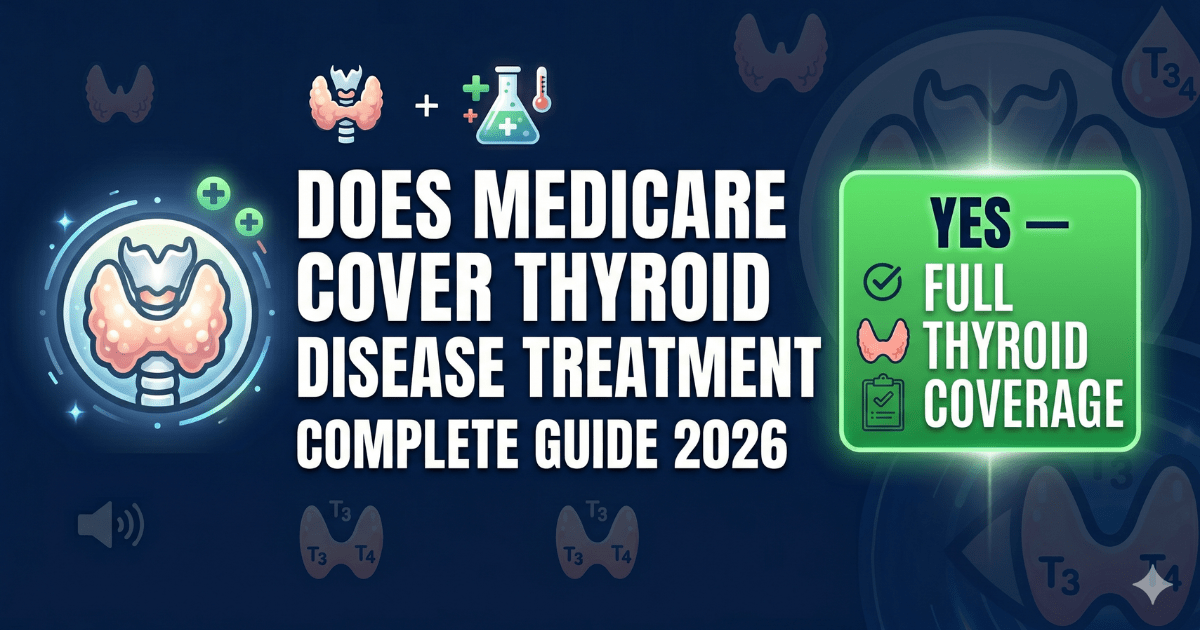
Does Medicare cover thyroid disease treatment in 2026? Thyroid disease — including hypothyroidism, hyperthyroidism, thyroid nodules, and thyroid cancer — is one of the most common conditions affecting Medicare beneficiaries. An estimated 20 million Americans have some form of thyroid disease and the condition becomes increasingly prevalent with age. The good news is that yes — does Medicare cover thyroid disease treatment in 2026 — and the coverage is comprehensive across the full spectrum of thyroid conditions from medication management through surgery and cancer treatment. In this complete guide we explain exactly what Medicare covers for thyroid disease in 2026. All information is sourced from Medicare.gov and CMS.gov.
Also Read —
- Does Medicare Cover Cancer Treatment 2026
- Does Medicare Cover Lab Tests 2026
- Medicare Part D Drug Coverage Explained 2026
What You Will Learn — Does Medicare Cover Thyroid Disease
- Does Medicare cover thyroid disease treatment in 2026
- Does Medicare cover thyroid medications including levothyroxine
- Does Medicare cover thyroid blood tests
- Does Medicare cover thyroid ultrasound
- Does Medicare cover thyroid surgery
- Does Medicare cover radioactive iodine treatment
- Does Medicare cover thyroid cancer treatment
- How much does thyroid treatment cost with Medicare
- Does Medicare Advantage cover thyroid disease
- Frequently asked questions about Medicare thyroid coverage 2026
Does Medicare Cover Thyroid Disease Treatment in 2026?
Yes — does Medicare cover thyroid disease treatment in 2026 — comprehensively across all major thyroid conditions. Medicare Part B covers physician visits, laboratory testing, diagnostic imaging, and surgical procedures for thyroid disease. Medicare Part D covers thyroid medications including levothyroxine — the most commonly prescribed medication in the United States. Medicare Part A covers inpatient hospitalization when thyroid conditions require hospital-level care.
Thyroid disease encompasses a wide spectrum of conditions that require different treatment approaches. Hypothyroidism — underactive thyroid — is the most common thyroid condition affecting approximately 5% of Americans over 65 and requires daily thyroid hormone replacement medication. Hyperthyroidism — overactive thyroid — requires medication or radioactive iodine treatment or surgery. Thyroid nodules require monitoring and sometimes biopsy or surgery. Thyroid cancer — though relatively rare — requires surgery, radioactive iodine treatment, and ongoing monitoring.
Understanding does Medicare cover thyroid disease across all these conditions helps Medicare beneficiaries access the comprehensive thyroid care they need.
Does Medicare Cover Thyroid Medications?
Does Medicare cover thyroid medications in 2026? Yes — Medicare Part D covers the full range of thyroid medications including the most commonly prescribed drug in the entire United States.

Levothyroxine — Covered Under Part D
Levothyroxine — brand names Synthroid, Levoxyl, Tirosint, Unithroid — is the standard treatment for hypothyroidism and is one of the most prescribed medications in the world. Medicare Part D covers levothyroxine comprehensively:
- Generic levothyroxine — typically Tier 1 under most Part D plans — approximately $5 to $15 per month — extraordinarily affordable
- Brand Synthroid — typically Tier 2 or 3 — higher cost than generic
- Tirosint gel caps — covered under Part D for patients who cannot tolerate standard levothyroxine
Levothyroxine is one of the most affordable medications available under Medicare Part D — most hypothyroid patients pay virtually nothing for their thyroid hormone replacement when using the generic formulation.
Hyperthyroidism Medications — Covered Under Part D
Antithyroid medications for hyperthyroidism including Graves’ disease:
- Methimazole (Tapazole) — generic available — very affordable — Tier 1 most plans
- Propylthiouracil (PTU) — generic available — covered under Part D
- Propranolol and other beta-blockers for symptom management — generic covered
Thyroid Cancer Medications — Covered Under Part D and Part B
For thyroid cancer patients requiring targeted therapy:
- Lenvatinib (Lenvima) — oral targeted therapy for radioiodine-refractory thyroid cancer — covered under Part D subject to $2,000 annual maximum
- Sorafenib (Nexavar) — covered under Part D
- Cabozantinib — covered under Part D
- Selpercatinib (Retevmo) — for RET-mutant thyroid cancer — covered under Part D
The $2,000 annual Part D out-of-pocket maximum is particularly important for thyroid cancer patients taking expensive targeted therapy drugs — providing critical financial protection.
Does Medicare Cover Thyroid Blood Tests?
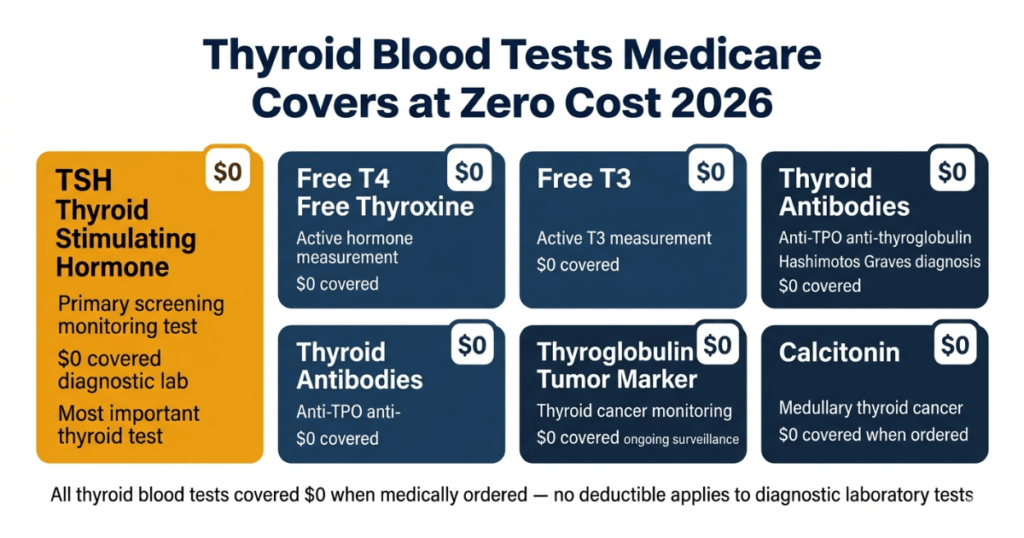
Does Medicare cover thyroid blood tests in 2026? Yes — Medicare Part B covers thyroid laboratory testing at $0 — no deductible and no coinsurance — for diagnostic tests ordered by a physician.
Thyroid Tests Medicare Covers at $0
TSH (Thyroid Stimulating Hormone) — the primary screening and monitoring test for thyroid function. Covered at $0 as a diagnostic laboratory test ordered by a physician.
Free T4 (Free Thyroxine) — measures the active thyroid hormone. Covered at $0 when medically ordered.
Free T3 (Free Triiodothyronine) — measures the active T3 hormone. Covered at $0.
Total T4 and Total T3 — covered at $0 when medically ordered.
Thyroid antibody tests — including anti-TPO, anti-thyroglobulin, and TSH receptor antibodies — covered at $0 for diagnosis of Hashimoto’s thyroiditis, Graves’ disease, and other autoimmune thyroid conditions.
Thyroglobulin — the tumor marker used to monitor thyroid cancer recurrence — covered at $0 as a diagnostic laboratory test.
Calcitonin — used for medullary thyroid cancer screening — covered at $0.
The $0 cost for thyroid blood tests is one of Medicare’s most valuable benefits for thyroid disease patients who require regular monitoring — most hypothyroid patients have TSH levels checked every 6 to 12 months and the $0 cost makes this ongoing monitoring completely affordable.
Does Medicare Cover Thyroid Ultrasound?
Does Medicare cover thyroid ultrasound in 2026? Yes — Medicare Part B covers thyroid ultrasound at 80% after the $257 annual Part B deductible when medically ordered by a physician.
When Thyroid Ultrasound Is Covered
Medicare covers thyroid ultrasound as a medically necessary diagnostic imaging study when ordered to:
- Evaluate thyroid nodules detected on physical examination or incidentally
- Monitor known thyroid nodules for changes over time
- Guide fine needle aspiration biopsy of thyroid nodules
- Evaluate thyroid enlargement (goiter)
- Monitor thyroid cancer patients after treatment
Thyroid Ultrasound Costs with Medicare
With Original Medicare — approximately $25 to $50 your 20% after the $257 annual deductible With Medigap Plan G — $0 after the annual deductible
Does Medicare Cover Thyroid Fine Needle Aspiration Biopsy?
Does Medicare cover thyroid fine needle aspiration (FNA) biopsy in 2026? Yes — Medicare Part B covers thyroid FNA biopsy at 80% after the Part B deductible.
Thyroid FNA biopsy — using a thin needle to obtain cells from a thyroid nodule for pathological examination — is the gold standard diagnostic procedure for evaluating thyroid nodules. Medicare covers both:
- The FNA biopsy procedure itself
- Ultrasound guidance for the biopsy
- Cytopathology laboratory analysis of the specimen
With Medigap Plan G — thyroid FNA biopsy costs $0 after the annual deductible.
Does Medicare Cover Thyroid Surgery?
Does Medicare cover thyroid surgery in 2026? Yes — Medicare covers thyroid surgery as a medically necessary surgical procedure at 80% after the Part B deductible for outpatient procedures or under Part A for inpatient.
Types of Thyroid Surgery Medicare Covers
Thyroidectomy — total or partial surgical removal of the thyroid gland — covered for:
- Thyroid cancer requiring surgical removal
- Large goiters causing compression symptoms
- Hyperthyroidism not responding to medical treatment
- Thyroid nodules with concerning or indeterminate cytology on FNA
Parathyroid surgery — surgery for hyperparathyroidism often performed by the same surgeons — covered by Medicare when medically necessary.
Thyroid Surgery Costs with Medicare
Most thyroid surgery is performed as an outpatient or 23-hour stay procedure:
With Original Medicare outpatient — approximately $400 to $800 your 20% coinsurance after deductible Inpatient thyroid surgery — $1,676 Part A deductible applies
With Medigap Plan G — thyroid surgery costs $0 after the $257 annual deductible — making Plan G particularly valuable for thyroid cancer patients who require thyroidectomy.
Does Medicare Cover Radioactive Iodine Treatment?
Does Medicare cover radioactive iodine (RAI) treatment for thyroid disease in 2026? Yes — Medicare covers radioactive iodine treatment for both hyperthyroidism and thyroid cancer.
RAI for Hyperthyroidism — Graves’ Disease
Radioactive iodine-131 ablation for hyperthyroidism — the most common definitive treatment for Graves’ disease and toxic nodular goiter — is covered by Medicare Part B at 80% after the annual deductible when administered by a nuclear medicine physician or endocrinologist.
RAI for Thyroid Cancer — Remnant Ablation
Following total thyroidectomy for thyroid cancer radioactive iodine is used to ablate any remaining thyroid tissue and treat metastatic disease. Medicare covers RAI thyroid cancer treatment at 80% after the deductible.
RAI for thyroid cancer is typically administered in a hospital inpatient setting when high doses are used — Medicare Part A covers inpatient RAI hospitalization.
With Medigap Plan G — outpatient RAI treatment costs $0 after the annual deductible.
Does Medicare Cover Thyroid Cancer Treatment?
Does Medicare cover thyroid cancer treatment in 2026? Yes — Medicare covers the full spectrum of thyroid cancer treatment including surgery, radioactive iodine, external beam radiation, targeted therapy, and ongoing monitoring.
Comprehensive Thyroid Cancer Coverage
Surgery — total thyroidectomy covered under Part B or Part A
Radioactive iodine ablation — covered under Part B or Part A depending on dose and setting
External beam radiation — covered under Part B for thyroid cancers requiring radiation therapy
Targeted therapy — lenvatinib, sorafenib, cabozantinib covered under Part D subject to $2,000 annual maximum
Thyroglobulin monitoring — covered at $0 as diagnostic laboratory testing
Whole body RAI scan — covered under Part B for monitoring after thyroid cancer treatment
Neck ultrasound surveillance — covered at 80% under Part B
For thyroid cancer patients Medigap Plan G provides exceptional financial protection — covering the 20% Part B coinsurance on surgery, radiation, RAI treatment, and all surveillance imaging — making ongoing thyroid cancer monitoring and treatment effectively free after the annual deductible.
How Much Does Thyroid Disease Treatment Cost with Medicare in 2026?
Thyroid Medications Under Part D
Generic levothyroxine — approximately $5 to $15 per month — minimal cost Methimazole for hyperthyroidism — approximately $5 to $15 per month — minimal cost Targeted thyroid cancer drugs — $2,000 annual Part D maximum protects patients
Thyroid Blood Tests
All TSH and thyroid function tests — $0 — covered as diagnostic laboratory
Thyroid Ultrasound
With Original Medicare — approximately $25 to $50 your 20% With Medigap Plan G — $0 after annual deductible
Thyroid Surgery
With Original Medicare outpatient — approximately $400 to $800 your 20% With Medigap Plan G — $0 after annual deductible
RAI Treatment
With Original Medicare outpatient — approximately $100 to $300 your 20% With Medigap Plan G — $0 after annual deductible

Does Medicare Advantage Cover Thyroid Disease?
Does Medicare Advantage cover thyroid disease treatment in 2026? Yes — all Medicare Advantage plans must cover thyroid disease treatment as Medicare-required services.
Prior authorization — Medicare Advantage plans may require prior authorization for thyroid surgery, RAI treatment, and certain diagnostic procedures. Your endocrinologist or surgeon typically handles authorization.
In-network endocrinologists and surgeons — verify your thyroid specialists are in-network before scheduling procedures.
Thyroid cancer drugs under Part D — the $2,000 annual cap protects thyroid cancer patients taking expensive targeted therapies.
Frequently Asked Questions — Does Medicare Cover Thyroid Disease
Does Medicare cover thyroid disease treatment in 2026?
Yes — does Medicare cover thyroid disease comprehensively in 2026 including levothyroxine and other thyroid medications under Part D, thyroid blood tests at $0, thyroid ultrasound and FNA biopsy at 80% after deductible, thyroid surgery, radioactive iodine treatment, and thyroid cancer treatment. With Medigap Plan G most thyroid treatment costs $0 after the $257 annual deductible.
Does Medicare cover levothyroxine for hypothyroidism?
Yes — Medicare Part D covers generic levothyroxine at Tier 1 for approximately $5 to $15 per month — making it one of the most affordable medications in the Medicare drug benefit. Brand-name Synthroid is covered at higher tiers with more significant cost-sharing.
Does Medicare cover thyroid blood tests?
Yes — thyroid blood tests including TSH, free T4, free T3, and thyroid antibodies are covered at $0 under Medicare as diagnostic laboratory tests when medically ordered by a physician. This $0 coverage applies regardless of whether you have met your annual Part B deductible.
Does Medicare cover thyroid surgery?
Yes — Medicare covers thyroidectomy for thyroid cancer, large goiters, and hyperthyroidism at 80% after the $257 annual Part B deductible for outpatient procedures. With Medigap Plan G thyroid surgery costs $0 after the annual deductible.
Does Medicare cover radioactive iodine treatment?
Yes — Medicare covers radioactive iodine treatment for both hyperthyroidism and thyroid cancer at 80% after the annual deductible. High-dose RAI for thyroid cancer requiring inpatient stay is covered under Medicare Part A.
Summary — Does Medicare Cover Thyroid Disease 2026
Does Medicare cover thyroid disease treatment in 2026? Yes — Medicare provides comprehensive coverage for all aspects of thyroid disease management including affordable medications under Part D, free thyroid blood tests, diagnostic imaging and biopsy at 80%, surgery and radioactive iodine treatment at 80%, and comprehensive thyroid cancer care.
For thyroid disease patients Medigap Plan G provides excellent financial protection — covering the 20% Part B coinsurance on ultrasound, biopsy, surgery, and RAI treatment — making most thyroid care effectively free after the $257 annual deductible. Thyroid cancer patients particularly benefit from Plan G’s elimination of coinsurance on surgery, RAI, and surveillance imaging combined with the Part D $2,000 annual maximum for expensive targeted therapy drugs.
For free help understanding your Medicare thyroid disease coverage contact your State Health Insurance Assistance Program (SHIP) at shiphelp.org or call Medicare free at 1-800-633-4227.
This guide is for informational purposes only. Always consult your endocrinologist and verify current Medicare coverage at Medicare.gov.
Sources: Medicare.gov | CMS.gov | SSA.gov | AARP.org
Last updated: April 2026 | Author: James Carter, Independent Medicare Research Analyst