Does Medicare Cover Depression Treatment — Complete Guide 2026
Does Medicare cover depression treatment in 2026? Depression is one of the most common and most undertreated conditions affecting Medicare beneficiaries — with approximately 20% of adults over 65 experiencing clinically significant depression. Despite its prevalence depression is frequently underdiagnosed and undertreated among seniors — often because patients and families do not realize how comprehensive Medicare’s mental health coverage is. The good news is that yes — Medicare does cover depression treatment in 2026 and the coverage is comprehensive — including medications, therapy, psychiatric care, and even advanced treatments like TMS and ECT for treatment-resistant depression. In this complete guide we explain exactly what Medicare covers for depression treatment in 2026. All information is sourced from Medicare.gov and CMS.gov.
Also Read —
- Does Medicare Cover Mental Health 2026
- Does Medicare Cover Preventive Care 2026
- Medicare Advantage vs Original Medicare 2026
What You Will Learn — Does Medicare Cover Depression Treatment
- Does Medicare cover depression treatment in 2026
- Does Medicare cover antidepressant medications
- Does Medicare cover therapy and counseling for depression
- Does Medicare cover psychiatrist visits
- Does Medicare cover TMS therapy for depression
- Does Medicare cover ECT for treatment-resistant depression
- Does Medicare cover depression screening at no cost
- How much does depression treatment cost with Medicare
- Does Medicare Advantage cover depression treatment
- Frequently asked questions about Medicare depression coverage 2026
Does Medicare Cover Depression Treatment in 2026?
Yes — Medicare covers depression treatment comprehensively in 2026. Depression treatment is covered across multiple Medicare benefit categories — preventive depression screening at $0, antidepressant medications under Part D, psychotherapy and counseling under Part B, psychiatric care under Part B, and advanced treatments like transcranial magnetic stimulation (TMS) and electroconvulsive therapy (ECT) under Part B and Part A.
Medicare’s mental health parity provisions — required under the Mental Health Parity and Addiction Equity Act — ensure that mental health services including depression treatment are covered at the same level as other medical conditions. This means Medicare cannot impose higher cost-sharing or more restrictive limitations for depression treatment than for other medical conditions.
Understanding Medicare’s comprehensive depression coverage is critically important because depression significantly reduces quality of life, worsens other medical conditions, increases mortality risk, and reduces Medicare beneficiaries’ ability to manage their overall health. Effective depression treatment directly improves health outcomes across all medical conditions.
Does Medicare Cover Depression Screening?
Does Medicare cover depression screening in 2026? Yes — Medicare Part B covers depression screening at absolutely no cost — $0 — as a preventive service.
Annual Depression Screening — $0
Medicare covers annual depression screening for all Medicare beneficiaries during:
- The Welcome to Medicare preventive visit — one-time visit in the first year of Part B enrollment
- The Annual Wellness Visit — available every year
- As a standalone primary care depression screening — once per year
Depression screening is covered at $0 — no deductible, no coinsurance, no copay — when performed by a primary care provider in a primary care setting.
The depression screening benefit is particularly important because depression in seniors is often missed — older adults may present with different symptoms than younger patients and may attribute depression symptoms to normal aging. The $0 screening benefit removes any financial barrier to identifying depression early when treatment is most effective.
Does Medicare Cover Antidepressant Medications?
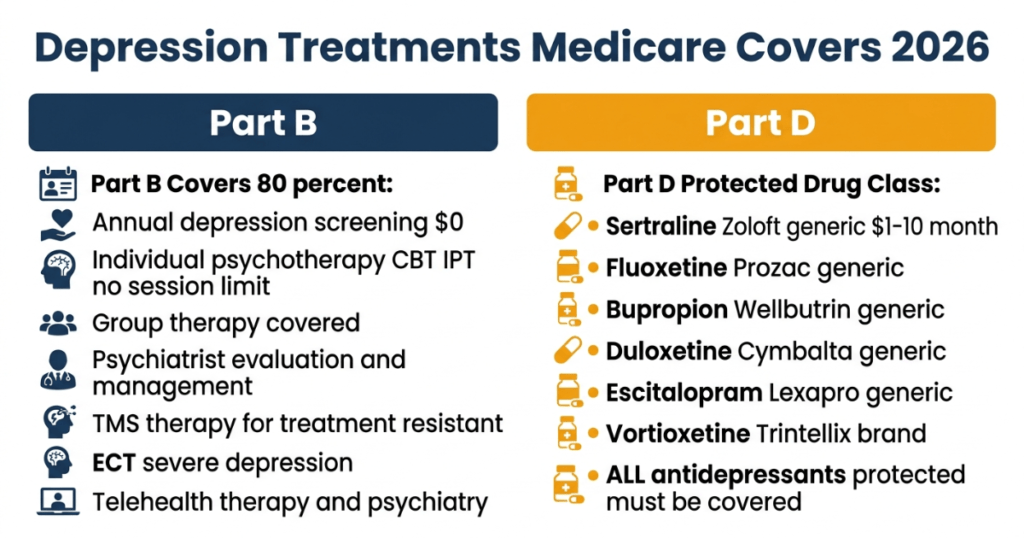
Does Medicare cover antidepressant medications in 2026? Yes — Medicare Part D covers antidepressant medications and antidepressants are a protected drug class under Medicare Part D.
Antidepressants as a Protected Drug Class
This is critically important — antidepressants are one of Medicare Part D’s six protected drug classes. This means:
- Medicare Part D plans must cover all or substantially all antidepressants on the market
- Plans cannot restrict antidepressant coverage through prior authorization or step therapy in ways that significantly limit access
- Formulary restrictions on antidepressants are strictly limited
This protected class status ensures that Medicare beneficiaries with depression can access the specific antidepressant their physician prescribes rather than being forced to switch to a cheaper formulary alternative.
Antidepressants Covered Under Medicare Part D
SSRIs — selective serotonin reuptake inhibitors:
- Sertraline (Zoloft) — generic available — typically Tier 1 — very affordable
- Fluoxetine (Prozac) — generic available — typically Tier 1
- Escitalopram (Lexapro) — generic available — typically Tier 1
- Citalopram (Celexa) — generic available — typically Tier 1
- Paroxetine (Paxil) — generic available
- Fluvoxamine (Luvox) — generic available
SNRIs — serotonin-norepinephrine reuptake inhibitors:
- Venlafaxine (Effexor) — generic available — typically Tier 2
- Desvenlafaxine (Pristiq) — generic available
- Duloxetine (Cymbalta) — generic available — very common
- Levomilnacipran (Fetzima) — covered under Part D
Atypical antidepressants:
- Bupropion (Wellbutrin) — generic available — very affordable
- Mirtazapine (Remeron) — generic available
- Trazodone — generic available
TCAs — tricyclic antidepressants:
- Amitriptyline — generic available — very affordable
- Nortriptyline — generic available
- Imipramine — generic available
MAOIs — monoamine oxidase inhibitors:
- Phenelzine (Nardil) — covered under Part D
- Tranylcypromine (Parnate) — covered under Part D
- Selegiline transdermal (Emsam) — covered under Part D
Newer antidepressants:
- Vilazodone (Viibryd) — covered under Part D
- Vortioxetine (Trintellix) — covered under Part D
- Brexpiprazole (Rexulti) — used as adjunct for depression — covered under Part D
Antidepressant Costs Under Medicare Part D
Generic antidepressants — sertraline, fluoxetine, bupropion — are typically Tier 1 drugs costing $1 to $10 per month under Part D — making them among the most affordable medications in the entire Medicare drug benefit.
Brand-name antidepressants — vortioxetine (Trintellix), brexpiprazole (Rexulti) — are more expensive. The $2,000 annual Part D out-of-pocket maximum protects patients taking multiple or expensive psychiatric medications.
Does Medicare Cover Therapy and Counseling for Depression?
Does Medicare cover therapy and counseling for depression in 2026? Yes — Medicare Part B covers outpatient mental health services including psychotherapy and counseling for depression.
Individual Psychotherapy — Covered
Medicare Part B covers individual psychotherapy for depression at 80% after the $257 annual Part B deductible. Covered psychotherapy modalities include:
- Cognitive behavioral therapy (CBT) — the most evidence-based psychotherapy for depression
- Psychoanalytic therapy
- Supportive psychotherapy
- Problem-solving therapy
- Behavioral activation therapy
- Interpersonal therapy (IPT)
Psychotherapy must be provided by a Medicare-enrolled mental health provider — psychiatrist, psychologist, licensed clinical social worker, licensed professional counselor, or marriage and family therapist.
Group Therapy — Covered
Medicare Part B covers group psychotherapy for depression at 80% after the annual deductible. Group therapy is often significantly less expensive per session than individual therapy and can be equally effective for mild to moderate depression.
No Session Limit for Depression Therapy
Medicare does not impose a predetermined session limit for mental health psychotherapy. Coverage continues as long as therapy is medically necessary. There is no annual cap on the number of covered therapy sessions for depression.
Therapy Cost with Medicare
With Original Medicare — 20% coinsurance approximately $30 to $50 per individual therapy session after the $257 annual deductible With Medigap Plan G — $0 per therapy session after the annual deductible With Medicare Advantage — $0 to $50 per session depending on plan
Does Medicare Cover Psychiatrist Visits for Depression?
Does Medicare cover psychiatrist visits for depression in 2026? Yes — Medicare Part B covers psychiatric evaluation and management visits for depression at 80% after the $257 annual Part B deductible.
Psychiatric Services Covered
Medicare covers all of the following psychiatric services for depression:
- Initial psychiatric evaluation and diagnostic assessment
- Medication management visits — reviewing antidepressant effectiveness, side effects, and dosing
- Combined medication management and psychotherapy visits
- Crisis intervention and stabilization
Important Mental Health Parity Provision
Psychiatric visits for depression are subject to the same cost-sharing as medical visits — Medicare cannot charge higher coinsurance for mental health visits than for comparable medical services. This mental health parity rule ensures that cost-sharing for depression treatment is the same as for any other medical condition.
Psychiatrist Visit Costs with Medicare
With Original Medicare — 20% coinsurance approximately $30 to $60 per visit after the $257 annual deductible With Medigap Plan G — $0 per visit after annual deductible
Does Medicare Cover TMS Therapy for Depression?
Does Medicare cover transcranial magnetic stimulation (TMS) therapy for depression in 2026? Yes — Medicare Part B covers TMS therapy for major depressive disorder (MDD) for patients who have not responded adequately to antidepressant medications.
What Is TMS Therapy?
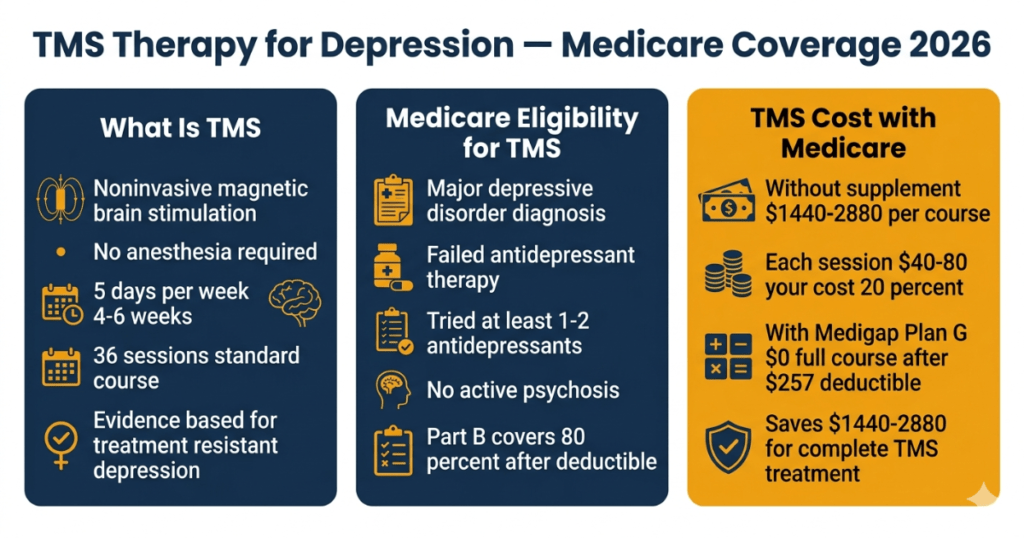
Transcranial magnetic stimulation is a noninvasive procedure that uses magnetic fields to stimulate nerve cells in the brain to improve symptoms of depression. TMS does not require anesthesia and is performed in an outpatient setting — typically in a series of sessions 5 days per week for 4 to 6 weeks.
Medicare TMS Coverage Criteria
Medicare covers TMS for depression when the patient meets specific criteria:
- Diagnosis of major depressive disorder (MDD)
- Failed to achieve satisfactory improvement from antidepressant therapy — typically after trying at least one or two antidepressants at adequate doses for adequate duration
- Not currently experiencing a psychotic disorder or other specified contraindications
TMS Treatment Schedule and Coverage
A standard TMS treatment course consists of 36 sessions. Medicare Part B covers TMS at 80% after the $257 annual Part B deductible for each session.
TMS costs with Medicare:
- Medicare-approved amount per TMS session — approximately $200 to $400
- Your 20% coinsurance per session — approximately $40 to $80
- Full 36-session course total coinsurance — approximately $1,440 to $2,880
With Medigap Plan G — TMS sessions cost $0 after the $257 annual Part B deductible — potentially saving $1,440 to $2,880 for a complete TMS course.
Does Medicare Cover ECT for Depression?
Does Medicare cover electroconvulsive therapy (ECT) for depression in 2026? Yes — Medicare covers ECT for treatment-resistant depression and other severe psychiatric conditions.
What Is ECT?
Electroconvulsive therapy is a medical procedure performed under general anesthesia in which small electric currents are passed through the brain to trigger a brief seizure. ECT is one of the most effective treatments available for severe treatment-resistant depression and is particularly valuable for older adults.
Medicare ECT Coverage
ECT is covered under Medicare Part B (outpatient) or Part A (inpatient) depending on where it is performed. ECT requires anesthesia and is typically performed in a hospital outpatient department or inpatient setting.
For inpatient ECT — Medicare Part A covers the hospitalization at standard Part A cost-sharing For outpatient ECT — Medicare Part B covers at 80% after the annual deductible
ECT for severe depression in older adults — including patients with suicidal depression, psychotic depression, or depression with severe weight loss — is one of the most important and evidence-based psychiatric treatments available and Medicare’s coverage ensures financial barriers do not prevent access.
Does Medicare Cover Telehealth Mental Health for Depression?
Does Medicare cover telehealth therapy and psychiatry for depression in 2026? Yes — Medicare covers telehealth mental health services for depression including:
- Individual psychotherapy via video telehealth
- Psychiatric evaluation and medication management via telehealth
- Group therapy via telehealth in some circumstances
Telehealth mental health services expanded significantly during the COVID-19 public health emergency and many of these expansions have been made permanent through legislation. Medicare beneficiaries can receive depression therapy and psychiatric care via video telehealth from the comfort of their homes — a significant advantage for seniors with mobility limitations, transportation challenges, or who live in areas with limited mental health providers.
Telehealth mental health services are covered at the same rate as in-person services — 80% after the Part B deductible.
Does Medicare Cover Inpatient Psychiatric Care for Depression?
Does Medicare cover inpatient psychiatric hospitalization for depression in 2026? Yes — Medicare Part A covers inpatient psychiatric hospitalization for severe depression requiring hospital-level care.
Medicare covers inpatient psychiatric hospitalization:
- In a general hospital psychiatric unit — covered under standard Part A benefits
- In a specialty psychiatric hospital — covered under Part A with specific limitations
190-Day Lifetime Limit for Freestanding Psychiatric Hospitals
Medicare Part A coverage for inpatient psychiatric care in a freestanding psychiatric hospital — not a general hospital with a psychiatric unit — is subject to a 190-day lifetime limit. This limitation does not apply to psychiatric care received in general hospitals with psychiatric units.
How Much Does Depression Treatment Cost with Medicare in 2026?
Depression Screening
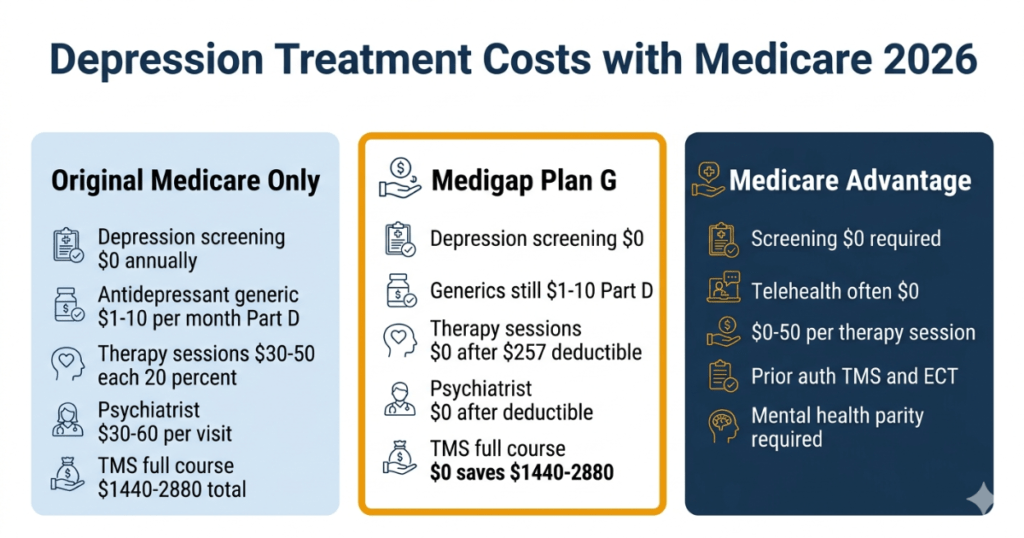
Annual depression screening — $0 under preventive benefit
Antidepressant Medications Under Part D
Generic antidepressants — $1 to $10 per month — extremely affordable Brand name antidepressants — subject to Part D tier cost-sharing — $2,000 annual cap applies
Individual Therapy
With Original Medicare — approximately $30 to $50 per session (20% coinsurance) after deductible With Medigap Plan G — $0 per session after annual deductible With Medicare Advantage — $0 to $50 per session
Psychiatrist Visits
With Original Medicare — approximately $30 to $60 per visit With Medigap Plan G — $0 per visit after annual deductible
TMS Therapy
With Original Medicare — approximately $1,440 to $2,880 for full 36-session course With Medigap Plan G — $0 for full course after annual deductible
ECT
Outpatient ECT with Original Medicare — 20% coinsurance per session With Medigap Plan G — $0 per session after annual deductible
Does Medicare Advantage Cover Depression Treatment?
Does Medicare Advantage cover depression treatment in 2026? Yes — all Medicare Advantage plans must cover depression treatment as a Medicare-required service. Mental health parity applies to Medicare Advantage plans — depression treatment cannot be subject to higher cost-sharing than comparable medical services.
Many Medicare Advantage plans offer enhanced depression treatment benefits including:
- $0 telehealth mental health visits
- Care management programs for depression
- Behavioral health integration with primary care
- 24/7 crisis line access
- Caregiver support programs
Prior authorization — some Medicare Advantage plans require prior authorization for TMS therapy and ECT. Ensure authorization is obtained before beginning these advanced treatments.
Frequently Asked Questions — Does Medicare Cover Depression Treatment
Does Medicare cover depression treatment in 2026?
Yes — Medicare covers comprehensive depression treatment including annual depression screening at $0, antidepressant medications under Part D (antidepressants are a protected drug class), individual and group psychotherapy under Part B, psychiatrist visits, TMS therapy for treatment-resistant depression, ECT for severe depression, and telehealth mental health services.
Does Medicare cover antidepressants?
Yes — antidepressants are a protected drug class under Medicare Part D — plans must cover all or substantially all antidepressants. Generic antidepressants like sertraline, fluoxetine, and bupropion typically cost $1 to $10 per month under Part D.
Does Medicare cover TMS therapy for depression?
Yes — Medicare Part B covers TMS (transcranial magnetic stimulation) for major depressive disorder that has not responded adequately to antidepressant medications. Coverage is at 80% after the $257 annual deductible. With Medigap Plan G a full 36-session TMS course costs $0 after the annual deductible.
How much does therapy for depression cost with Medicare?
With Original Medicare individual therapy sessions cost approximately $30 to $50 (20% coinsurance) after the $257 annual Part B deductible. There is no session limit. With Medigap Plan G therapy costs $0 per session after the annual deductible. Medicare Advantage typically charges $0 to $50 per session.
Does Medicare cover psychiatrist visits for depression?
Yes — Medicare Part B covers psychiatrist visits for depression evaluation and medication management at 80% after the $257 annual deductible. Mental health parity ensures the same cost-sharing as other medical specialist visits.
Summary — Does Medicare Cover Depression Treatment 2026
Does Medicare cover depression treatment in 2026? Yes — Medicare provides comprehensive depression treatment coverage including free annual screening, affordable antidepressant medications under Part D, psychotherapy with no session limit, psychiatrist visits, TMS for treatment-resistant cases, ECT for severe depression, and telehealth mental health services.
Depression is one of the most treatable conditions in medicine — and Medicare’s comprehensive coverage ensures that financial barriers never prevent Medicare beneficiaries from accessing effective depression treatment. If you or a loved one is experiencing symptoms of depression ask your primary care physician about Medicare’s depression screening and treatment benefits.
Medigap Plan G provides excellent financial protection for depression treatment — covering the 20% coinsurance for therapy sessions, psychiatrist visits, and TMS therapy — making ongoing mental health treatment effectively free after the annual deductible.
For free help understanding your Medicare depression treatment coverage contact your State Health Insurance Assistance Program (SHIP) at shiphelp.org or call Medicare free at 1-800-633-4227.
This guide is for informational purposes only and is not medical advice. If you are experiencing symptoms of depression please contact your physician. In a mental health crisis call or text 988 (Suicide and Crisis Lifeline) for immediate support.
Sources: Medicare.gov | CMS.gov | SSA.gov | AARP.org
Last updated: April 2026 | Author: James Carter, Independent Medicare Research Analyst