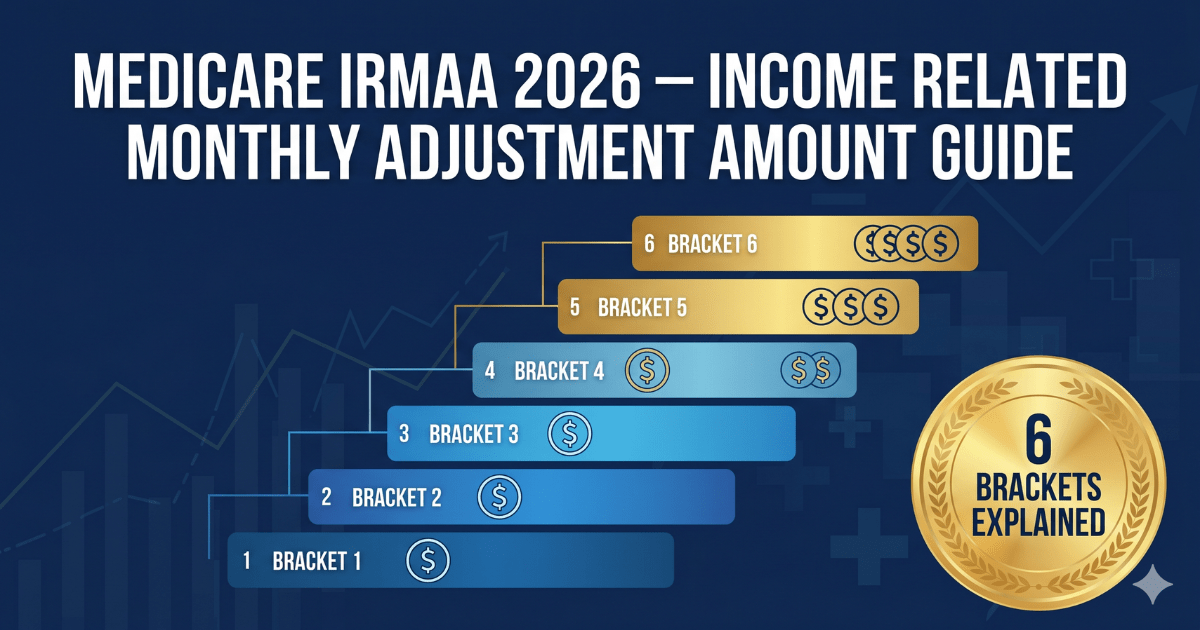
Medicare IRMAA 2026 — Income Related Monthly Adjustment Amount Guide
Medicare IRMAA in 2026 — the Income Related Monthly Adjustment Amount — is an additional premium surcharge paid by higher-income Medicare beneficiaries on top of the standard Part B and Part D premiums. If your income is above certain thresholds you pay more for Medicare than the standard $185.00 Part B premium. IRMAA affects approximately 7% of all Medicare beneficiaries but the financial impact can be significant — ranging from an additional $74 per month to over $400 per month above the standard premium. In this complete guide we explain everything about Medicare IRMAA in 2026 — what it is, how it is calculated, the 2026 IRMAA brackets, how to appeal IRMAA, and strategies to reduce or avoid IRMAA in 2026. All information is sourced from Medicare.gov and SSA.gov.
Also Read —
- Medicare Income Limits and IRMAA 2026
- Medicare Part B Premium 2026
- Medicare Plan Changes 2026
What You Will Learn — Medicare IRMAA 2026
- What is Medicare IRMAA in 2026
- How IRMAA is calculated and which income year is used
- The 2026 IRMAA brackets for Part B and Part D
- How much extra do you pay with IRMAA
- How to appeal a Medicare IRMAA determination
- Qualifying life changing events for IRMAA appeals
- Strategies to reduce or avoid Medicare IRMAA
- IRMAA and Medicare Advantage
- Frequently asked questions about Medicare IRMAA 2026
What Is Medicare IRMAA in 2026?
Medicare IRMAA — Income Related Monthly Adjustment Amount — is an additional premium surcharge added to the standard Medicare Part B and Medicare Part D premiums for higher-income Medicare beneficiaries. IRMAA is not a penalty — it is a graduated income-based adjustment to Medicare premiums designed so that higher-income beneficiaries contribute more to their Medicare costs.
IRMAA was created by the Medicare Modernization Act of 2003 and first implemented in 2007. The program was designed based on the principle that Medicare beneficiaries with higher incomes can afford to pay more for their coverage. The surcharge is structured in brackets — with higher income levels paying progressively higher IRMAA amounts.
In 2026 Medicare IRMAA affects approximately 7% of Medicare beneficiaries — those with Modified Adjusted Gross Income (MAGI) above the threshold for their filing status. While this represents a relatively small percentage of Medicare beneficiaries IRMAA is a significant financial consideration for affected seniors — potentially adding thousands of dollars to annual Medicare costs.
IRMAA applies to both Medicare Part B and Medicare Part D. Part B IRMAA adds to your monthly medical insurance premium while Part D IRMAA adds to your monthly prescription drug plan premium.
How Medicare IRMAA Is Calculated
Understanding how Medicare IRMAA is calculated in 2026 is essential for planning and potentially reducing your IRMAA liability.
Income Used for IRMAA — Two Years Prior
The income used to determine your 2026 IRMAA is your Modified Adjusted Gross Income (MAGI) from 2024 — two years prior. Social Security Administration receives income data from the IRS and uses your 2024 tax return information to set your 2026 IRMAA.
This two-year lookback is one of the most important IRMAA concepts to understand. Your 2026 Medicare premium is based on income you earned two years ago — not your current income. This means:
- A large income event in 2024 — such as a Roth conversion, property sale, or required minimum distribution — can trigger IRMAA in 2026 even if your current income is much lower
- If your income dropped significantly from 2024 you may be able to appeal your IRMAA using more recent income information
What Is Modified Adjusted Gross Income (MAGI)?
For Medicare IRMAA purposes MAGI equals:
- Adjusted Gross Income (AGI) from your tax return
- Plus tax-exempt interest income
- Plus any foreign income excluded from taxation
MAGI includes Social Security benefits that are subject to income tax — typically 50% to 85% of Social Security benefits for higher-income beneficiaries. This means Social Security income can push beneficiaries into higher IRMAA brackets.
How SSA Determines Your IRMAA
The Social Security Administration determines your 2026 IRMAA based on the 2024 tax return IRS provides. SSA sends Medicare beneficiaries an IRMAA determination letter — called a COLA notice or IRMAA determination — typically in November or December of the preceding year.
If SSA cannot access your 2024 tax return — for example if you had not yet filed — they use the most recent tax return available — potentially your 2023 return.
Medicare IRMAA Brackets 2026
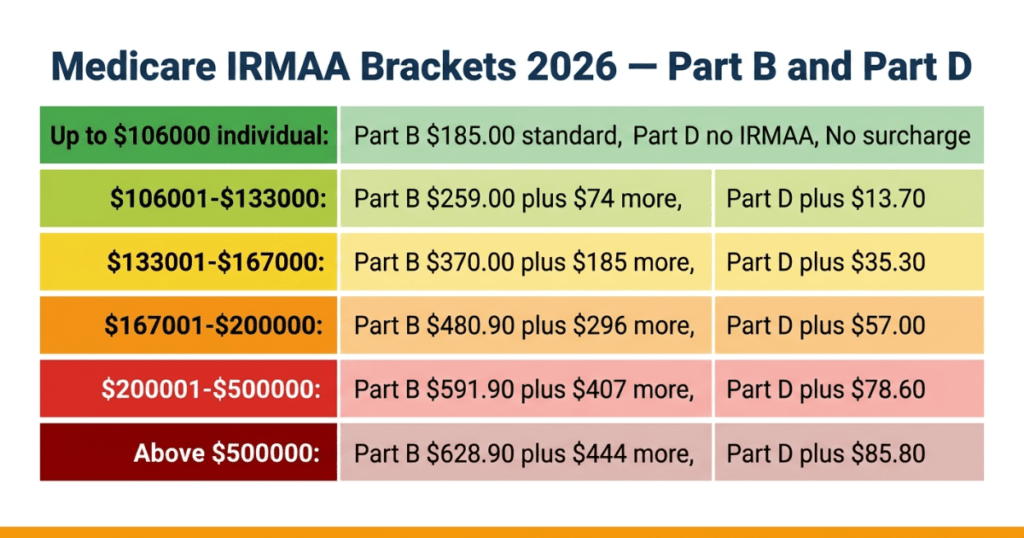
Here are the Medicare IRMAA brackets and associated premium amounts for 2026:
Medicare Part B IRMAA Brackets 2026
| Individual MAGI | Married Filing Jointly MAGI | Monthly Part B Premium 2026 |
|---|---|---|
| Up to $106,000 | Up to $212,000 | $185.00 (standard — no IRMAA) |
| $106,001 to $133,000 | $212,001 to $266,000 | $259.00 |
| $133,001 to $167,000 | $266,001 to $334,000 | $370.00 |
| $167,001 to $200,000 | $334,001 to $400,000 | $480.90 |
| $200,001 to $500,000 | $400,001 to $750,000 | $591.90 |
| Above $500,000 | Above $750,000 | $628.90 |
IRMAA Surcharge Amount Above Standard Premium:
- Bracket 1 — $74.00 per month above standard
- Bracket 2 — $185.00 per month above standard
- Bracket 3 — $295.90 per month above standard
- Bracket 4 — $406.90 per month above standard
- Bracket 5 — $443.90 per month above standard
Medicare Part D IRMAA Brackets 2026
In addition to the Part B IRMAA high-income Medicare beneficiaries pay an additional IRMAA surcharge on their Part D drug coverage — added on top of their plan’s monthly premium.
| Individual MAGI | Married Filing Jointly MAGI | Additional Monthly Part D IRMAA |
|---|---|---|
| Up to $106,000 | Up to $212,000 | $0 (no IRMAA) |
| $106,001 to $133,000 | $212,001 to $266,000 | $13.70 per month |
| $133,001 to $167,000 | $266,001 to $334,000 | $35.30 per month |
| $167,001 to $200,000 | $334,001 to $400,000 | $57.00 per month |
| $200,001 to $500,000 | $400,001 to $750,000 | $78.60 per month |
| Above $500,000 | Above $750,000 | $85.80 per month |
Married Filing Separately
Medicare beneficiaries who file taxes as Married Filing Separately face a compressed IRMAA bracket structure — the highest IRMAA brackets kick in at much lower income levels than for single or married filing jointly filers. For married filing separately:
- Income up to $106,000 — standard premium
- Income above $106,000 — the highest IRMAA bracket applies immediately
This compressed bracket structure makes the Married Filing Separately tax filing status very costly for Medicare beneficiaries in most situations.
How Much Extra Do You Pay with IRMAA?
The financial impact of Medicare IRMAA in 2026 can be substantial. Here is the annual impact of IRMAA at each bracket:
Bracket 1 IRMAA (Individual income $106,001 to $133,000):
- Additional Part B — $74.00 per month
- Additional Part D — $13.70 per month
- Combined monthly IRMAA — $87.70
- Annual IRMAA cost — $1,052.40
Bracket 2 IRMAA (Individual income $133,001 to $167,000):
- Additional Part B — $185.00 per month
- Additional Part D — $35.30 per month
- Combined monthly IRMAA — $220.30
- Annual IRMAA cost — $2,643.60
Bracket 3 IRMAA (Individual income $167,001 to $200,000):
- Additional Part B — $295.90 per month
- Additional Part D — $57.00 per month
- Combined monthly IRMAA — $352.90
- Annual IRMAA cost — $4,234.80
Bracket 4 IRMAA (Individual income $200,001 to $500,000):
- Additional Part B — $406.90 per month
- Additional Part D — $78.60 per month
- Combined monthly IRMAA — $485.50
- Annual IRMAA cost — $5,826.00
Bracket 5 IRMAA (Individual income above $500,000):
- Additional Part B — $443.90 per month
- Additional Part D — $85.80 per month
- Combined monthly IRMAA — $529.70
- Annual IRMAA cost — $6,356.40
For couples where both spouses are on Medicare these costs are doubled — a couple at Bracket 4 would pay nearly $12,000 per year in IRMAA surcharges combined.
How to Appeal Medicare IRMAA
If your income has changed significantly since the tax year used to calculate your IRMAA you may be able to appeal and have your IRMAA reduced or eliminated. Here is how the IRMAA appeal process works:
Qualifying Life Changing Events for IRMAA Appeals
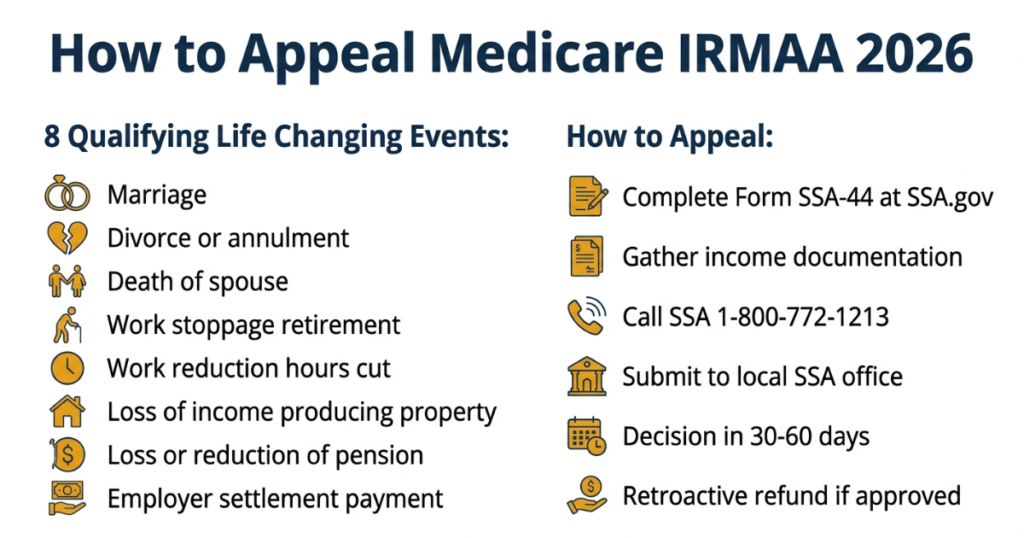
Medicare recognizes eight qualifying life changing events that allow you to appeal your IRMAA determination using more recent income information:
- Marriage
- Divorce or annulment
- Death of your spouse
- Work stoppage — you or your spouse stopped working
- Work reduction — you or your spouse reduced work hours significantly
- Loss of income-producing property — through disaster or other circumstances beyond your control
- Loss or reduction of pension income
- Receipt of employer settlement payment — certain legal settlements from former employers
How to File an IRMAA Appeal
To appeal your Medicare IRMAA determination:
Step 1 — Contact Social Security Administration at 1-800-772-1213 or visit your local SSA office.
Step 2 — Request a reconsideration of your IRMAA determination due to a life changing event.
Step 3 — Complete Form SSA-44 — Medicare Income-Related Monthly Adjustment Amount — Life-Changing Event form. This form is available at SSA.gov.
Step 4 — Provide documentation of your life changing event and more recent income information — tax return, W-2s, retirement account statements, or other income documentation.
Step 5 — SSA reviews your appeal and issues a new IRMAA determination based on your more recent income.
IRMAA Appeal for Incorrect Income Data
If SSA is using incorrect income data — for example if your 2024 return contains errors or has not been updated — you can also appeal by:
- Providing a corrected tax return
- Providing more recent income data through an amended return or employer documentation
- Requesting SSA use a different tax year if more appropriate
Appeal Timeline
SSA typically processes IRMAA appeals within 30 to 60 days. If your appeal is successful your IRMAA is reduced retroactively and you receive a refund for overpaid premiums.
Strategies to Reduce or Avoid Medicare IRMAA
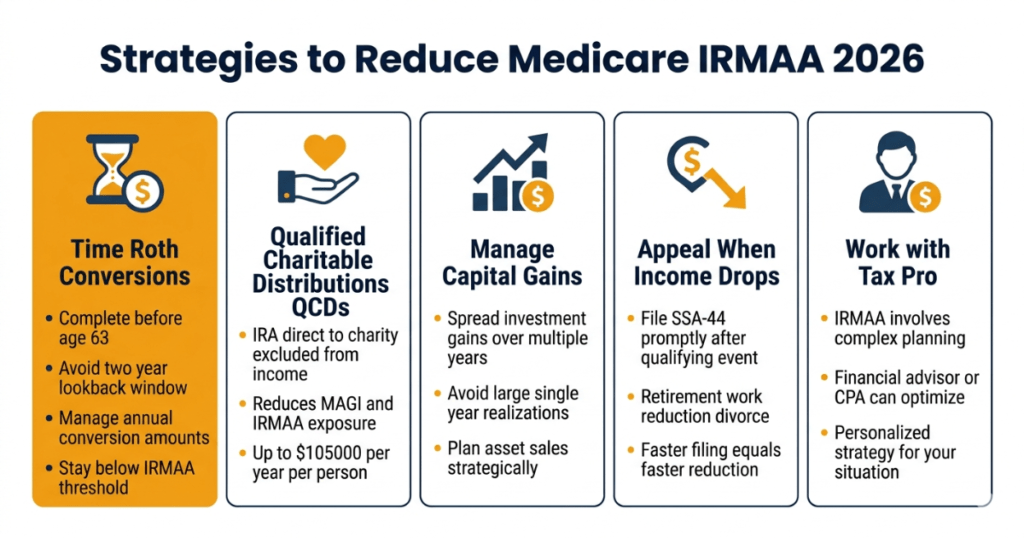
For higher-income Medicare beneficiaries IRMAA is a significant planning consideration. Here are strategies to reduce or avoid IRMAA in 2026:
Strategy 1 — Manage Roth Conversions Timing
Roth IRA conversions increase your MAGI in the year of conversion potentially pushing you into a higher IRMAA bracket two years later. If you are approaching Medicare eligibility plan Roth conversions carefully — either complete them before age 63 to avoid the two-year lookback window or manage the conversion amount to stay below IRMAA thresholds.
Strategy 2 — Control Required Minimum Distributions
Required minimum distributions from traditional IRAs and 401k accounts increase MAGI. Consider strategies to manage RMD income including qualified charitable distributions (QCDs) which allow IRA distributions paid directly to charity to be excluded from income — potentially reducing MAGI and avoiding IRMAA.
Strategy 3 — Manage Investment Income
Capital gains from investment sales increase MAGI and can trigger IRMAA. Plan investment realizations carefully — spreading gains over multiple years rather than realizing large gains in a single year can help manage IRMAA exposure.
Strategy 4 — File the IRMAA Appeal Promptly When Income Drops
If your income drops significantly due to retirement, reduced work hours, or other qualifying events do not wait — file your IRMAA appeal promptly using Form SSA-44. The sooner you appeal the sooner your IRMAA is reduced.
Strategy 5 — Work with a Tax Professional
IRMAA planning involves complex interactions between income sources, filing status, tax strategies, and Medicare premium calculations. Working with a tax professional or financial advisor who understands IRMAA can identify strategies specific to your situation that minimize your IRMAA liability.
IRMAA and Medicare Advantage
Does IRMAA apply to Medicare Advantage plans in 2026? Yes — IRMAA applies to Medicare beneficiaries enrolled in Medicare Advantage in the following ways:
Part B IRMAA — Part B IRMAA applies to all Medicare beneficiaries including those in Medicare Advantage. Even though Medicare Advantage replaces Original Medicare you still pay the Part B premium plus any IRMAA surcharge as a condition of Medicare Advantage enrollment.
Part D IRMAA — If your Medicare Advantage plan includes prescription drug coverage (MA-PD) the Part D IRMAA surcharge applies in addition to your plan’s premium.
Some Medicare Advantage plans offer a Part B premium reduction — called the giveback benefit — that credits back a portion of your Part B premium. However this credit applies to the standard $185.00 premium — IRMAA surcharges are not reduced by the giveback benefit.
Frequently Asked Questions — Medicare IRMAA 2026
What is Medicare IRMAA in 2026?
Medicare IRMAA — Income Related Monthly Adjustment Amount — is an additional premium surcharge paid by higher-income Medicare beneficiaries on top of the standard Part B and Part D premiums. In 2026 IRMAA begins at individual income above $106,000 (from the 2024 tax return) and ranges from $74 to $444 per month additional for Part B plus $14 to $86 per month additional for Part D.
Which income year does Medicare use for 2026 IRMAA?
Medicare uses income from 2024 — two years prior — to calculate 2026 IRMAA. This two-year lookback means income events in 2024 such as large Roth conversions, property sales, or high RMDs affect your 2026 Medicare premiums.
How do I appeal Medicare IRMAA?
If your income has dropped due to a qualifying life changing event — retirement, work reduction, divorce, death of spouse, or loss of income — you can appeal your IRMAA by completing Form SSA-44 and submitting it to SSA with documentation of your life changing event and more recent income information. Contact SSA at 1-800-772-1213.
Can I reduce my Medicare IRMAA?
Yes — IRMAA reduction strategies include timing Roth IRA conversions to avoid the two-year lookback window, using qualified charitable distributions to reduce IRA income, managing capital gain realizations, and appealing IRMAA when income drops due to qualifying life events.
Does IRMAA apply to Medicare Advantage?
Yes — IRMAA applies to all Medicare beneficiaries including those in Medicare Advantage. Part B IRMAA applies regardless of plan type. Part D IRMAA applies if your Medicare Advantage plan includes drug coverage. Part B premium reduction (giveback) benefits do not reduce IRMAA surcharges.
What is the IRMAA threshold for 2026?
The 2026 IRMAA threshold begins at individual Modified Adjusted Gross Income above $106,000 ($212,000 for married filing jointly) based on 2024 tax returns. Below this threshold you pay the standard Part B premium of $185.00 with no IRMAA surcharge.
Summary — Medicare IRMAA 2026
Medicare IRMAA in 2026 adds significant additional premium costs for higher-income Medicare beneficiaries — ranging from $88 per month combined for the lowest bracket to over $530 per month combined for the highest bracket. IRMAA is based on income from two years prior — your 2024 MAGI determines your 2026 IRMAA.
The most important IRMAA actions are understanding how the two-year lookback affects your premiums, planning income events carefully to manage IRMAA brackets, and filing appeals promptly when qualifying life changing events reduce your income.
For free help understanding Medicare IRMAA and how it affects your Medicare costs contact your State Health Insurance Assistance Program (SHIP) at shiphelp.org or call Medicare free at 1-800-633-4227. For IRMAA reduction strategies specific to your financial situation consult a qualified tax or financial advisor.
This guide is for informational purposes only and is not financial or tax advice. Always verify current IRMAA thresholds at Medicare.gov and SSA.gov before making financial decisions.
Sources: Medicare.gov | CMS.gov | SSA.gov | AARP.org
Last updated: April 2026 | Author: James Carter, Independent Medicare Research Analyst