
Does Medicare Cover Heart Surgery — Complete Guide 2026
Does Medicare cover heart surgery in 2026? Heart disease is the leading cause of death among Medicare beneficiaries — and heart surgery is one of the most commonly performed major procedures in the Medicare population. Whether you need bypass surgery, heart valve repair, angioplasty, or another cardiac procedure understanding your Medicare coverage is essential for making informed healthcare decisions. The good news is that yes — Medicare does cover heart surgery in 2026 and the coverage is comprehensive for medically necessary cardiac procedures. In this complete guide we explain exactly what Medicare covers for heart surgery in 2026 — what types of heart surgery are covered, who qualifies, how much heart surgery costs with Medicare, cardiac rehabilitation coverage, and how Medicare Advantage handles cardiac surgical procedures. All information is sourced from Medicare.gov and CMS.gov.
Also Read —
- Does Medicare Cover Cardiac Rehabilitation 2026
- Does Medicare Cover Physical Therapy 2026
- What Does Medicare Cover in 2026 — Complete Coverage Guide
What You Will Learn — Does Medicare Cover Heart Surgery
- Does Medicare cover heart surgery in 2026
- What types of heart surgery Medicare covers
- Does Medicare cover bypass surgery (CABG)
- Does Medicare cover heart valve surgery
- Does Medicare cover angioplasty and stenting
- Does Medicare cover pacemaker implantation
- How much does heart surgery cost with Medicare
- Does Medicare cover cardiac rehabilitation after surgery
- Does Medicare Advantage cover heart surgery
- Frequently asked questions about Medicare heart surgery coverage 2026
Does Medicare Cover Heart Surgery in 2026?
Yes — Medicare does cover heart surgery in 2026 when the procedure is medically necessary. Cardiac surgery is one of the most comprehensively covered categories of medical procedures under Medicare — reflecting the enormous burden that heart disease places on the Medicare population and the life-saving impact of cardiac surgical interventions.
Medicare heart surgery coverage in 2026 applies to a wide range of cardiac surgical procedures including coronary artery bypass grafting, heart valve repair and replacement, angioplasty and coronary stenting, pacemaker and defibrillator implantation, heart transplantation, and many other cardiac procedures.
Medical necessity is the central requirement for Medicare heart surgery coverage — your cardiologist and cardiac surgeon must document that the procedure is clinically indicated based on your specific cardiac condition, symptoms, and diagnostic findings. Medicare does not cover elective cardiac procedures performed without documented medical necessity.
What Types of Heart Surgery Does Medicare Cover?
Coronary Artery Bypass Grafting (CABG) — Covered
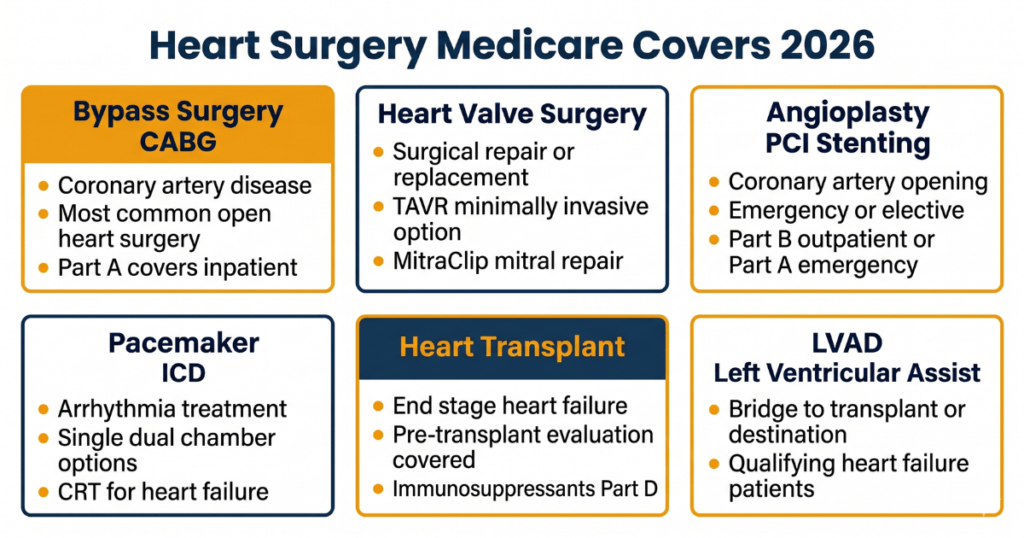
Does Medicare cover bypass surgery in 2026? Yes — coronary artery bypass grafting is one of the most commonly performed Medicare-covered cardiac surgeries. CABG surgery creates new routes for blood to flow around blocked coronary arteries — restoring blood flow to the heart muscle and relieving angina while reducing the risk of heart attack.
Medicare Part A covers CABG as an inpatient surgical procedure when medically necessary for:
- Significant coronary artery disease with symptoms not controlled by medications
- Left main coronary artery disease
- Three-vessel coronary artery disease with reduced heart function
- Failed percutaneous coronary intervention (angioplasty or stenting)
The $1,676 Part A deductible applies per benefit period. Days 1 to 60 are covered at $0 after the deductible. Medicare Part B covers the cardiac surgeon’s professional fee at 80% after the Part B deductible.
Heart Valve Surgery — Covered
Does Medicare cover heart valve surgery in 2026? Yes — Medicare covers both surgical and transcatheter heart valve procedures when medically necessary:
Surgical valve replacement — open-heart surgery to replace damaged heart valves with mechanical or biological prosthetic valves. Covered under Medicare Part A.
Surgical valve repair — procedures to repair rather than replace damaged heart valves — particularly mitral valve repair. Covered under Medicare Part A.
Transcatheter Aortic Valve Replacement (TAVR) — a minimally invasive procedure to replace the aortic valve without open-heart surgery. Medicare covers TAVR for patients with severe aortic stenosis who are at high or extreme risk for open-heart surgery.
Transcatheter Mitral Valve Repair (MitraClip) — a minimally invasive procedure to repair a leaking mitral valve. Medicare covers MitraClip for qualifying patients with significant mitral regurgitation.
Angioplasty and Coronary Artery Stenting — Covered
Does Medicare cover angioplasty in 2026? Yes — Medicare Part B covers percutaneous coronary intervention (PCI) — angioplasty with or without stenting — when medically necessary.
PCI can be performed:
- In an emergency for acute myocardial infarction (heart attack) — covered as emergency care
- Electively for stable coronary artery disease with documented ischemia — covered with appropriate documentation
Medicare covers PCI at 80% after the Part B deductible when performed in an outpatient catheterization laboratory. For emergency PCI performed during an inpatient hospitalization Medicare Part A covers the facility costs.
Pacemaker Implantation — Covered
Does Medicare cover pacemaker implantation in 2026? Yes — Medicare covers pacemaker implantation when medically necessary for qualifying cardiac arrhythmias including:
- Sick sinus syndrome
- High-degree atrioventricular (AV) block
- Bradycardia with symptoms
- Other qualifying arrhythmias requiring pacing
Medicare covers both single-chamber and dual-chamber pacemakers as well as cardiac resynchronization therapy (CRT) pacemakers for qualifying heart failure patients. The pacemaker device itself, the implantation procedure, and follow-up device checks are all covered.
Implantable Cardioverter-Defibrillator (ICD) — Covered
Medicare covers ICD implantation for patients at high risk for life-threatening ventricular arrhythmias. Medicare has specific coverage criteria including:
- Prior cardiac arrest due to ventricular fibrillation or ventricular tachycardia
- Documented sustained ventricular tachycardia
- Left ventricular ejection fraction of 35% or less with heart failure
Cardiac Catheterization — Covered
Medicare Part B covers diagnostic cardiac catheterization — a procedure that uses dye and X-rays to visualize coronary arteries and assess heart function — when ordered by a physician for medically necessary cardiac evaluation.
Heart Transplantation — Covered
Medicare covers heart transplantation for qualifying patients with end-stage heart failure who meet specific clinical criteria. Heart transplant coverage includes:
- Pre-transplant evaluation
- The transplant surgery itself
- Post-transplant immunosuppressive medications — covered under Part D
Left Ventricular Assist Device (LVAD) — Covered
Medicare covers LVAD implantation for qualifying heart failure patients — both as a bridge to heart transplantation and as destination therapy for patients who are not transplant candidates.
Who Qualifies for Medicare Heart Surgery Coverage?
For Medicare to cover heart surgery in 2026 you must meet specific medical necessity criteria:
Documented Cardiac Diagnosis
You must have a documented diagnosis of a cardiac condition that requires surgical intervention. Qualifying diagnoses include:
- Coronary artery disease with significant stenosis
- Heart valve disease with hemodynamic significance
- Heart failure with reduced ejection fraction
- Cardiac arrhythmias requiring device therapy
- Structural heart disease requiring correction
Failed or Inadequate Medical Therapy
For most elective cardiac procedures Medicare requires documentation that medical therapy — medications and lifestyle modifications — has been tried and is inadequate to control symptoms or prevent disease progression. Emergency procedures for acute conditions — heart attack, acute valve failure — do not require prior failed medical therapy.
Physician Documentation and Cardiac Workup
Your cardiologist and cardiac surgeon must provide comprehensive documentation including:
- Clinical symptoms and functional limitations
- Diagnostic test results — ECG, echocardiogram, stress tests, cardiac catheterization
- Evidence of medical necessity for the specific surgical procedure
- Discussion of risks and alternatives
How Much Does Heart Surgery Cost with Medicare in 2026?
CABG Bypass Surgery with Original Medicare
Part A costs:
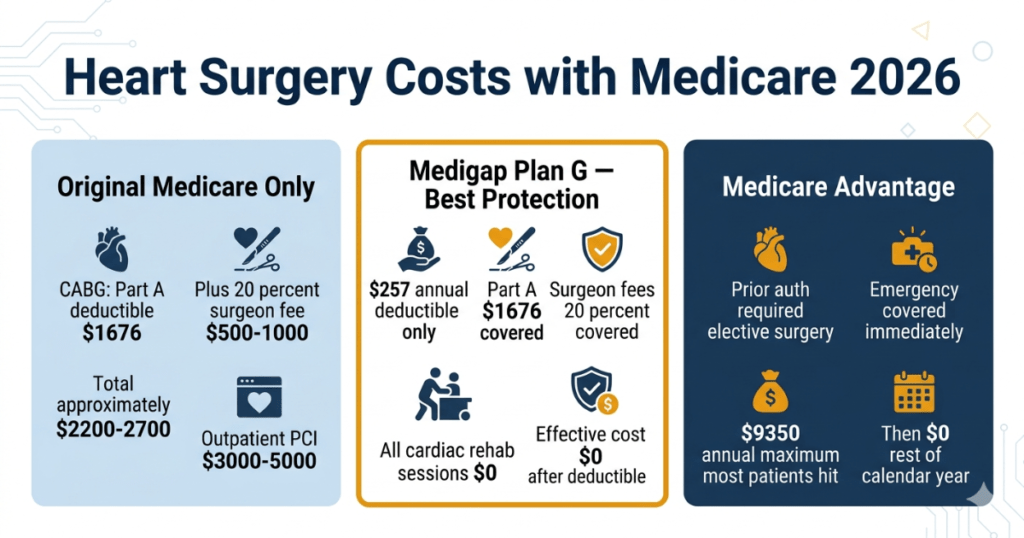
- Part A deductible — $1,676 per benefit period
- Hospital days 1 to 60 — $0 after deductible
- Most CABG patients are hospitalized 5 to 7 days — $0 facility cost after deductible
Part B costs:
- Cardiac surgeon fee — 20% of Medicare-approved amount
- Anesthesiologist fee — 20% coinsurance
- Cardiac surgeon fee Medicare-approved approximately $2,500 to $5,000
- Your 20% coinsurance for surgeon — approximately $500 to $1,000
Total approximate out-of-pocket for CABG with Original Medicare:
- Approximately $2,200 to $2,700 without a supplement
Heart Valve Surgery with Original Medicare
Similar cost structure to CABG — Part A deductible plus 20% coinsurance on physician fees. Total approximate out-of-pocket approximately $2,200 to $3,000.
PCI Angioplasty Outpatient with Original Medicare
Part B costs:
- $257 annual Part B deductible
- 20% coinsurance on total Medicare-approved outpatient amount
- Outpatient PCI Medicare-approved total — approximately $15,000 to $25,000
- Your 20% — approximately $3,000 to $5,000
With Medigap Plan G
Medigap Plan G provides exceptional financial protection for heart surgery. After the $257 annual Part B deductible Plan G covers:
- The $1,676 Part A deductible
- 100% of all coinsurance for inpatient cardiac surgery
- 20% coinsurance on all physician fees and outpatient procedures
With Plan G your effective out-of-pocket for heart surgery after the annual deductible is $0 — potentially saving $2,000 to $5,000+ compared to Original Medicare alone.
With Medicare Advantage
Medicare Advantage plans cover heart surgery with their own cost-sharing:
- Prior authorization required for elective procedures
- Emergency cardiac surgery — covered immediately
- Inpatient cardiac surgery — typically $250 to $500 per day for first few days
- Outpatient cardiac procedures — copay or coinsurance
- All costs count toward $9,350 annual maximum
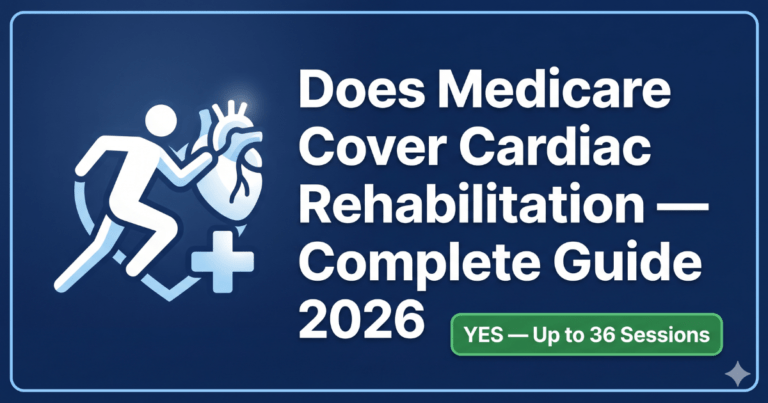
Does Medicare Cover Cardiac Rehabilitation After Heart Surgery?
Does Medicare cover cardiac rehabilitation after heart surgery in 2026? Yes — Medicare Part B covers cardiac rehabilitation following heart surgery for qualifying cardiac conditions.
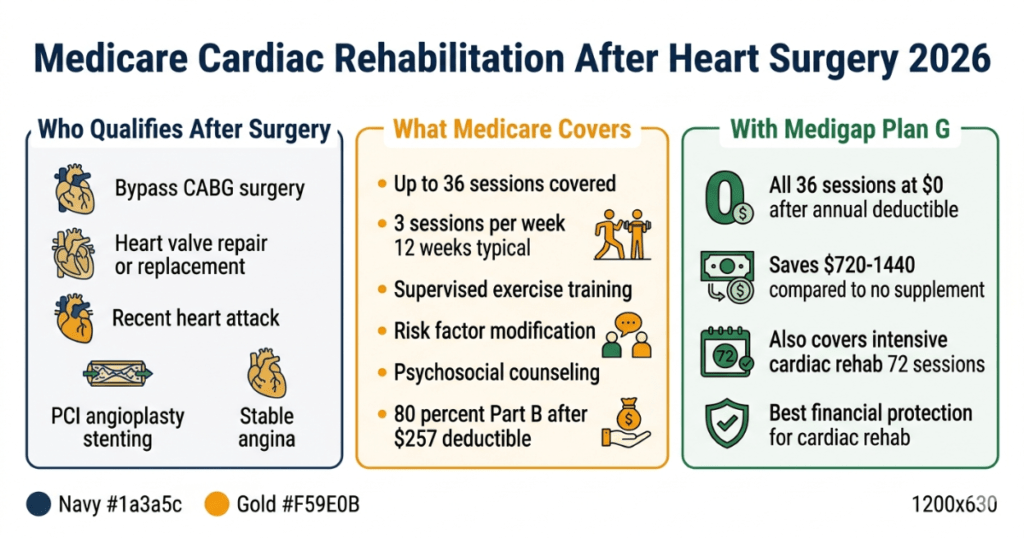
Qualifying conditions for Medicare cardiac rehabilitation coverage include:
- Coronary artery bypass surgery (CABG) — one of the primary qualifying conditions
- Heart valve repair or replacement surgery
- Recent heart attack (within past 12 months)
- Stable angina pectoris
- Percutaneous transluminal coronary intervention
Medicare covers up to 36 sessions of cardiac rehabilitation following heart surgery — typically 3 sessions per week for 12 weeks — at 80% after the Part B deductible. With Medigap Plan G all 36 sessions are covered at $0 after the annual deductible.
Cardiac rehabilitation after heart surgery significantly improves outcomes — reducing mortality, improving functional capacity, and reducing readmission rates. Medicare’s coverage of cardiac rehabilitation reflects the strong evidence base supporting this intervention.
Does Medicare Advantage Cover Heart Surgery?
Does Medicare Advantage cover heart surgery in 2026? Yes — all Medicare Advantage plans must cover heart surgery as a Medicare-required service. Important considerations:
Prior authorization for elective procedures — most Medicare Advantage plans require prior authorization for elective cardiac surgery including scheduled CABG and valve surgery. Your cardiologist and cardiac surgeon handle the authorization process but ensure this is completed before your surgery date.
Emergency cardiac procedures — Medicare law requires Medicare Advantage plans to cover emergency cardiac surgery without prior authorization at any facility nationwide. Heart attacks, acute valve failures, and other cardiac emergencies are covered immediately regardless of network status.
Network cardiac surgeons and hospitals — for elective procedures verify that your cardiac surgeon and the hospital are in your plan’s network. For complex cardiac surgery you may want access to a specialized cardiac surgery center — verify these are in-network before scheduling.
Out-of-pocket maximum — cardiac surgery costs count toward the $9,350 annual maximum. Most cardiac surgery patients reach this maximum during the initial hospitalization — after which Medicare Advantage covers 100% of all covered services for the rest of the year.
Frequently Asked Questions — Does Medicare Cover Heart Surgery
Does Medicare cover heart surgery in 2026?
Yes — Medicare covers a comprehensive range of heart surgeries when medically necessary including coronary artery bypass grafting, heart valve repair and replacement, TAVR, angioplasty and stenting, pacemaker and ICD implantation, and heart transplantation. Medicare Part A covers inpatient surgical facility costs and Part B covers surgeon fees and outpatient procedures.
Does Medicare cover bypass surgery?
Yes — Medicare covers coronary artery bypass grafting when medically necessary for significant coronary artery disease. Coverage includes the hospital stay under Part A with the $1,676 deductible and 20% coinsurance on cardiac surgeon fees under Part B. With Medigap Plan G your effective cost after the $257 annual deductible is $0.
How much does heart surgery cost with Medicare?
With Original Medicare inpatient heart surgery costs approximately $2,200 to $2,700 out of pocket — the Part A deductible plus 20% of surgeon and anesthesiologist fees. Outpatient cardiac procedures like angioplasty can cost $3,000 to $5,000 without a supplement. With Medigap Plan G your effective cost after the $257 annual deductible is $0.
Does Medicare cover TAVR heart valve replacement?
Yes — Medicare covers Transcatheter Aortic Valve Replacement (TAVR) for patients with severe aortic stenosis who are at high or extreme risk for open-heart surgery. Coverage is subject to specific eligibility criteria and must be performed at a Medicare-approved TAVR facility.
Does Medicare cover cardiac rehabilitation after heart surgery?
Yes — Medicare Part B covers up to 36 sessions of cardiac rehabilitation following heart surgery at 80% after the Part B deductible. Cardiac rehabilitation after bypass surgery and valve surgery is strongly associated with better outcomes and is a covered Medicare benefit.
Does Medicare cover pacemaker implantation?
Yes — Medicare covers pacemaker implantation for qualifying cardiac arrhythmias including sick sinus syndrome, high-degree AV block, and symptomatic bradycardia. Coverage includes the pacemaker device, the implantation procedure, and follow-up device monitoring.
Summary — Does Medicare Cover Heart Surgery 2026
Does Medicare cover heart surgery in 2026? Yes — Medicare provides comprehensive coverage for medically necessary cardiac surgical procedures including bypass surgery, valve surgery, angioplasty, pacemaker implantation, and heart transplantation. Medicare Part A covers inpatient cardiac surgery facility costs and Part B covers surgeon fees and outpatient cardiac procedures.
Medigap Plan G provides the most comprehensive financial protection for heart surgery — covering the Part A deductible, all coinsurance after the deductible, and all physician fee coinsurance — making your effective out-of-pocket cost $0 for all Medicare-approved cardiac surgical services. Medicare Advantage provides annual out-of-pocket maximum protection of $9,350.
For free help understanding your Medicare heart surgery coverage contact your State Health Insurance Assistance Program (SHIP) at shiphelp.org or call Medicare free at 1-800-633-4227.
This guide is for informational purposes only and is not medical advice. Always consult your cardiologist and cardiac surgeon and verify current Medicare coverage at Medicare.gov before making surgical decisions.
Sources: Medicare.gov | CMS.gov | SSA.gov | AARP.org
Last updated: April 2026 | Author: James Carter, Independent Medicare Research Analyst