
Medicare Part A vs Part B — What Is the Difference in 2026?
Medicare Part A vs Part B — what is the difference and why does it matter? If you are turning 65 or new to Medicare, understanding the difference between Medicare Part A vs Part B is the single most important first step in understanding how Medicare works. Medicare Part A and Medicare Part B together make up what is called Original Medicare — the federal health insurance program covering more than 65 million Americans. In this complete 2026 guide we explain exactly what Medicare Part A vs Part B covers, what each part costs, which one you need, and how they work together to give you complete health coverage.
What You Will Learn — Medicare Part A vs Part B
- The key difference between Medicare Part A vs Part B
- What Medicare Part A covers in 2026
- What Medicare Part B covers in 2026
- How much Medicare Part A costs in 2026
- How much Medicare Part B costs in 2026
- When to enroll in Medicare Part A vs Part B
- Whether you need both Part A and Part B
- How Medicare Part A and Part B work together
- What Medicare Part A and Part B do NOT cover
- Frequently asked questions about Medicare Part A vs Part B
Medicare Part A vs Part B — The Key Difference
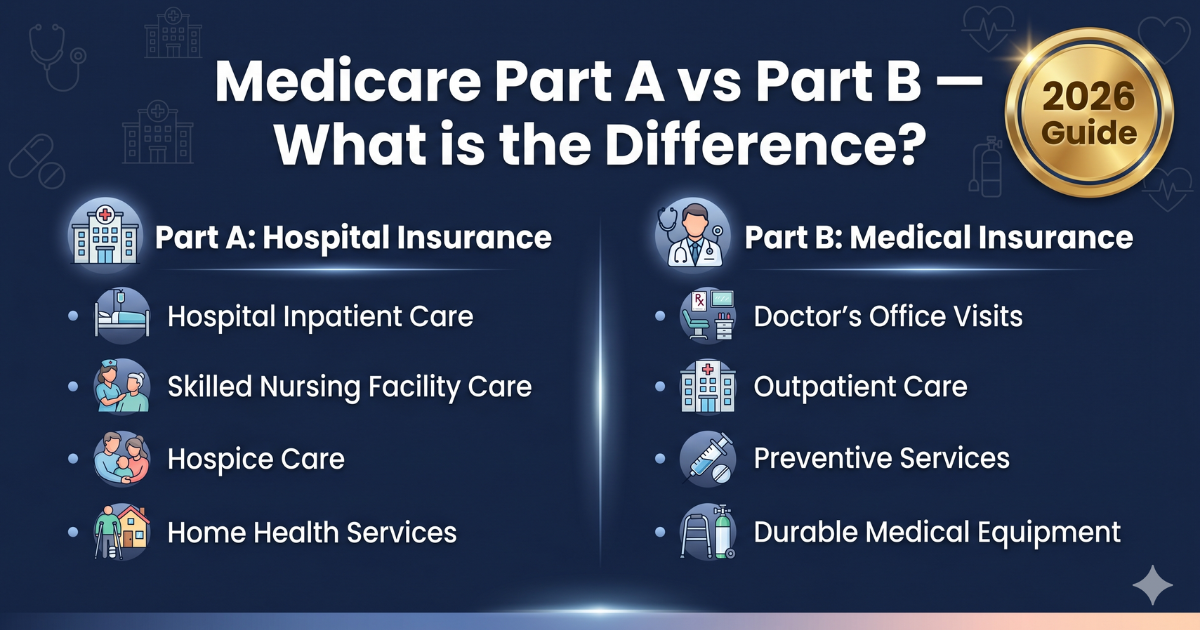
The most important thing to understand about Medicare Part A vs Part B is that they cover completely different types of healthcare services.
Medicare Part A is your hospital insurance. It covers the cost of services you receive when you are admitted to a hospital, skilled nursing facility, or hospice care program.
Medicare Part B is your medical insurance. It covers the cost of services you receive from doctors, outpatient facilities, and medical equipment suppliers.
Together Medicare Part A and Part B form Original Medicare — the foundation of your Medicare coverage. Most seniors need both Part A and Part B to have complete coverage for both hospital and medical services.
Here is the simplest way to remember the difference between Medicare Part A vs Part B:
- Part A — think A for Admission. It covers you when you are admitted to a hospital or facility.
- Part B — think B for Bills from your doctor. It covers your doctor visits and outpatient medical services.
What Does Medicare Part A Cover in 2026?
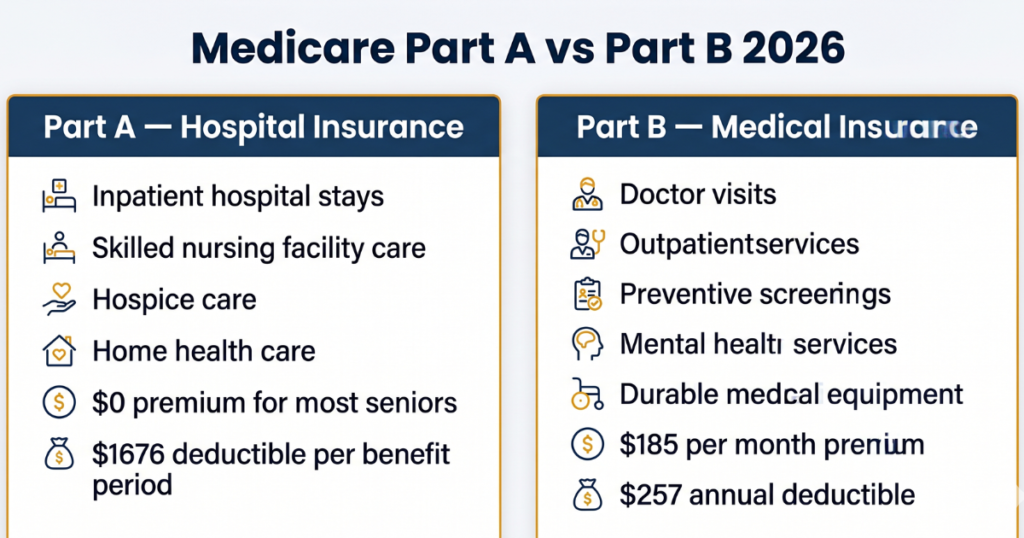
Medicare Part A covers four main categories of care. Understanding what Medicare Part A covers helps you understand when your Part A benefits will kick in and what you will pay.
Inpatient Hospital Care
Medicare Part A covers inpatient hospital care when you are formally admitted to a hospital. This includes your room, meals, nursing care, medications administered during your stay, and most other hospital services and supplies.
Part A does NOT cover your private duty nurse or a private hospital room unless medically necessary. It also does not cover personal convenience items like a telephone or television in your room.
Skilled Nursing Facility Care
Medicare Part A covers care in a skilled nursing facility (SNF) after a qualifying hospital stay. To qualify for SNF coverage under Part A you must have been admitted as a hospital inpatient for at least 3 consecutive days and require skilled nursing or rehabilitation services.
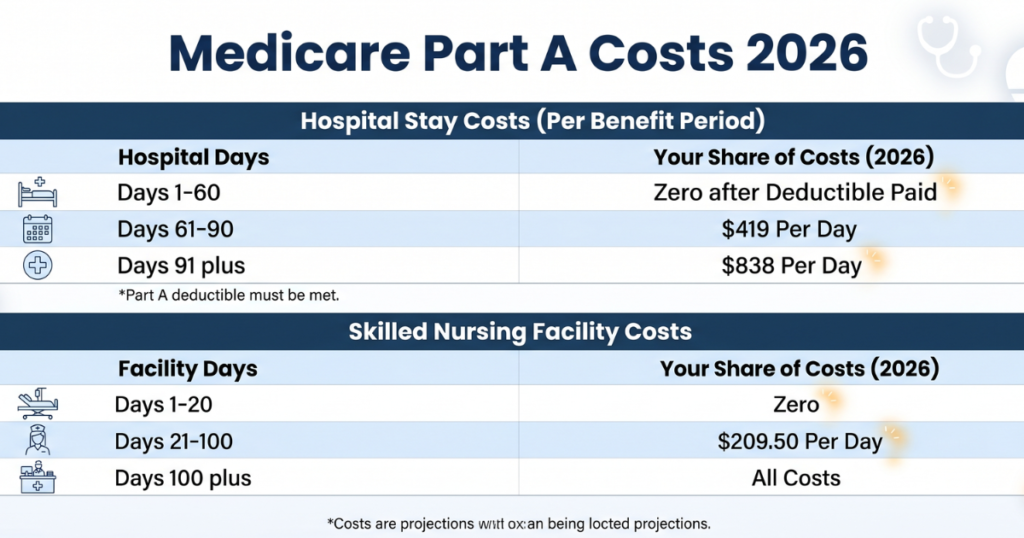
Part A covers the first 20 days of skilled nursing facility care at $0. From day 21 to day 100 you pay $209.50 per day in 2026. After 100 days Medicare Part A pays nothing and you pay 100% of costs.
Home Health Care
Medicare Part A covers home health care services if you are homebound and need skilled nursing care or therapy services. To qualify you must be confined to your home and have a doctor certify your need for home health services.
Covered home health services include skilled nursing care, physical therapy, occupational therapy, speech-language pathology, medical social services, and home health aide services.
Hospice Care
Medicare Part A covers hospice care for people with a terminal illness who are expected to live 6 months or less. Hospice care focuses on comfort and quality of life rather than curative treatment.
Part A covers hospice care including nursing services, medical social services, counseling, short-term inpatient care, and respite care for caregivers. You pay nothing for most hospice services.
Medicare Part A Costs in 2026
Understanding the cost difference between Medicare Part A vs Part B is just as important as understanding what each part covers. Here is the complete Medicare Part A cost breakdown for 2026:
Medicare Part A Premium
Most people pay $0 per month for Medicare Part A in 2026. You qualify for premium-free Part A if you or your spouse worked and paid Medicare taxes for at least 10 years (40 quarters).
If you did not work long enough for premium-free Part A the 2026 premiums are:
- $285 per month if you worked 30 to 39 quarters
- $518 per month if you worked fewer than 30 quarters
Medicare Part A Deductible and Coinsurance 2026
- Hospital inpatient deductible — $1,676 per benefit period
- Hospital days 1 to 60 — $0 coinsurance after deductible
- Hospital days 61 to 90 — $419 per day coinsurance
- Hospital days 91 and beyond — $838 per day lifetime reserve days
- Skilled nursing facility days 1 to 20 — $0
- Skilled nursing facility days 21 to 100 — $209.50 per day
- Skilled nursing facility beyond 100 days — 100% of costs
What is a Medicare Part A Benefit Period?
A benefit period begins the day you are admitted as an inpatient to a hospital or skilled nursing facility. It ends when you have not received inpatient hospital or skilled nursing care for 60 consecutive days. There is no limit to the number of benefit periods you can have — but you pay the $1,676 Part A deductible for each new benefit period.
What Does Medicare Part B Cover in 2026?
Medicare Part B covers a much wider range of services than Part A. While Medicare Part A vs Part B comparison often focuses on hospital vs doctor visits, Part B coverage is more comprehensive than most seniors realize.
Doctor Visits and Outpatient Services
Medicare Part B covers all medically necessary doctor visits including visits to your primary care physician, specialists, and other licensed healthcare providers. Part B covers both office visits and outpatient clinic visits.
Part B also covers outpatient hospital services — services you receive at a hospital without being formally admitted as an inpatient. This is an important distinction in the Medicare Part A vs Part B comparison because many hospital services are actually covered under Part B not Part A.
Preventive Care Services
One of the most valuable aspects of Medicare Part B coverage is its comprehensive preventive care benefits. Part B covers many preventive screenings at $0 cost to you including:
- Annual wellness visits with your doctor
- Mammograms for breast cancer screening
- Colonoscopies for colorectal cancer screening
- Bone density scans for osteoporosis
- Diabetes screenings and self-management training
- Cardiovascular disease screenings
- Depression screenings
- HIV screenings
- Lung cancer screenings for high-risk seniors
- Abdominal aortic aneurysm screenings
- Glaucoma screenings for high-risk patients
- Flu shots, pneumonia vaccines, and COVID-19 vaccines
Mental Health Services
Medicare Part B covers outpatient mental health services including visits to psychiatrists, psychologists, clinical social workers, clinical nurse specialists, and nurse practitioners for mental health conditions.
Part B pays 80% of the Medicare-approved amount for mental health services after your annual deductible. You pay the remaining 20%.
Durable Medical Equipment
Medicare Part B covers durable medical equipment (DME) that is medically necessary for use in your home. Covered equipment includes wheelchairs and scooters, walkers and canes, hospital beds, CPAP and BiPAP machines for sleep apnea, blood sugar monitors, oxygen equipment and supplies, and prosthetics and orthotics.
Other Services Covered by Medicare Part B
Beyond the categories above Medicare Part B also covers ambulance services when medically necessary, clinical research, second surgical opinions, outpatient physical therapy and occupational therapy, speech-language pathology services, cardiac rehabilitation programs, pulmonary rehabilitation programs, diabetes supplies and equipment, kidney disease education services, and some chiropractic services.
Medicare Part B Costs in 2026
The cost comparison between Medicare Part A vs Part B shows a significant difference. While most seniors pay nothing for Part A premiums, everyone pays a monthly premium for Part B.
Medicare Part B Premium 2026
The standard Medicare Part B premium in 2026 is $185.00 per month. This premium is the same for most seniors. However higher income seniors pay more through IRMAA (Income Related Monthly Adjustment Amount) surcharges.
The 2026 Part B IRMAA surcharges by income level are:
- Individual income up to $106,000 — standard $185.00 per month
- Individual $106,001 to $133,000 — $259.00 per month
- Individual $133,001 to $167,000 — $370.00 per month
- Individual $167,001 to $200,000 — $480.90 per month
- Individual $200,001 to $500,000 — $591.90 per month
- Individual above $500,000 — $628.90 per month
Medicare Part B Deductible and Coinsurance 2026
- Annual Part B deductible — $257 per year
- After deductible — Medicare pays 80%, you pay 20%
- Preventive services — $0 with no deductible required
The 20% coinsurance for Part B services has no annual out-of-pocket maximum under Original Medicare. This means if you have a major illness your 20% share could be very large. This is why most seniors add either a Medigap supplement or Medicare Advantage plan to limit their out-of-pocket exposure.
Medicare Part A vs Part B — Side by Side Comparison
Here is the complete Medicare Part A vs Part B comparison in one easy to read format for 2026:
What Each Part Covers:
Part A covers — inpatient hospital care, skilled nursing facility care, hospice care, home health care
Part B covers — doctor visits, outpatient services, preventive screenings, mental health services, durable medical equipment, ambulance services, physical therapy, lab tests, X-rays
Cost Comparison:
Part A monthly premium — $0 for most seniors, up to $518 if not enough work history
Part B monthly premium — $185.00 standard, up to $628.90 with IRMAA surcharge
Part A annual deductible — $1,676 per benefit period
Part B annual deductible — $257 per year
Part A coinsurance — $0 for first 60 hospital days after deductible, then $419 per day
Part B coinsurance — 20% of Medicare-approved amount after deductible
Enrollment:
Part A enrollment — automatic at 65 if receiving Social Security, otherwise must enroll
Part B enrollment — must actively choose to enroll, can delay if covered by employer insurance
Out of Pocket Maximum:
Part A — no annual out-of-pocket maximum
Part B — no annual out-of-pocket maximum
Do You Need Both Medicare Part A and Part B?
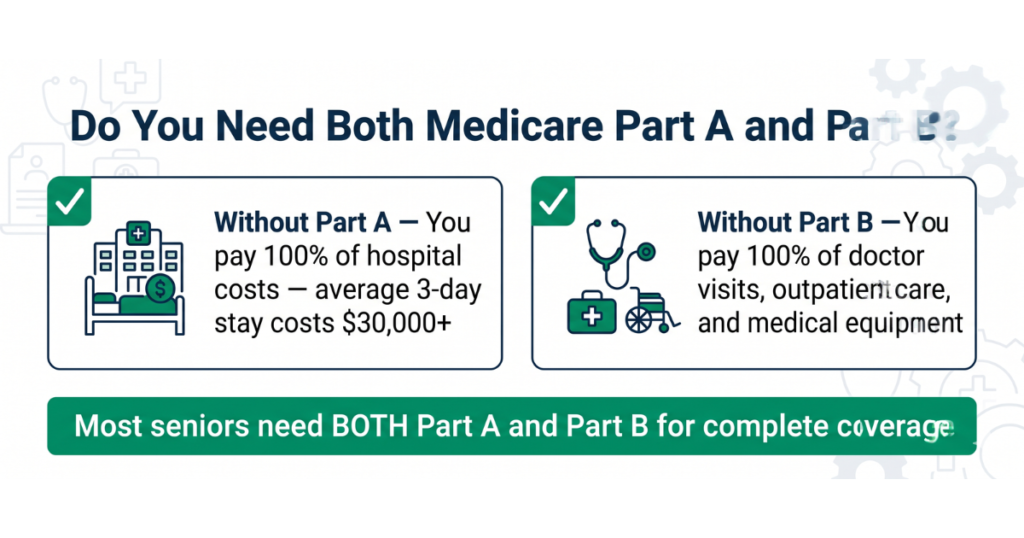
This is one of the most common questions in the Medicare Part A vs Part B discussion. The short answer for most seniors is yes — you need both.
Here is why most seniors need both Medicare Part A and Part B:
You need Part A because it covers your hospital stays. Without Part A you would pay the entire cost of any hospital admission out of pocket. The average cost of a 3-day hospital stay in the United States is over $30,000.
You need Part B because it covers your everyday medical care. Without Part B you would pay 100% of doctor visit costs, outpatient services, preventive screenings, and medical equipment out of pocket.
Together Medicare Part A and Part B cover the two most important categories of healthcare for seniors — hospital care and medical care. While they do not cover everything (dental, vision, hearing, and prescription drugs are notable gaps) they provide the essential foundation of Medicare coverage.
The only situation where you might delay enrolling in Part B is if you or your spouse are still actively working and covered by employer group health insurance. In that case you can delay Part B without penalty until the employer coverage ends. Always confirm this with your HR department and Medicare before delaying enrollment.
When to Enroll in Medicare Part A vs Part B
The enrollment timing for Medicare Part A vs Part B is the same — both are available during your Initial Enrollment Period which is a 7-month window:
- 3 months before the month you turn 65
- The month you turn 65
- 3 months after the month you turn 65
Most seniors who are not covered by employer insurance should enroll in both Part A and Part B during this Initial Enrollment Period. Missing this window can result in permanent late enrollment penalties.
Medicare Part B Late Enrollment Penalty
The Medicare Part B late enrollment penalty is 10% added to your monthly premium for every 12-month period you were eligible but did not enroll without qualifying coverage. This penalty is permanent — it stays with you for life.
For example if you delay enrolling in Part B for 2 years without qualifying employer coverage you will pay 20% more than the standard Part B premium every month for the rest of your life. At the 2026 standard premium of $185.00 that means paying $222.00 instead of $185.00 every single month forever.
Always enroll in Medicare Part A and Part B on time during your Initial Enrollment Period to avoid these permanent penalties.
What Medicare Part A and Part B Do NOT Cover
Understanding the coverage gaps is just as important as understanding what Medicare Part A vs Part B covers. Together Part A and Part B do NOT cover:
- Routine dental care — exams, cleanings, fillings, dentures
- Routine vision care — eye exams, glasses, contact lenses
- Hearing aids and routine hearing exams
- Long-term custodial care in nursing homes
- Most care outside the United States
- Cosmetic surgery
- Prescription drugs — you need Part D for drug coverage
- Private duty nursing
- Personal care services
These gaps — especially dental, vision, hearing, and prescription drugs — are why most seniors add additional coverage beyond Original Medicare Parts A and B.
How to Fill the Gaps in Medicare Part A and Part B
Once you understand Medicare Part A vs Part B you will immediately notice the coverage gaps. There are two main ways seniors fill these gaps:
Option 1 — Add a Medigap Supplement Plan
A Medigap plan supplements Original Medicare by covering your Part A and Part B out-of-pocket costs including deductibles, coinsurance, and copayments. Medigap Plan G is the most popular choice in 2026 because it covers nearly all out-of-pocket costs after the Part B deductible.
With Original Medicare plus Medigap Plan G and a Part D drug plan most seniors have near-complete coverage with very predictable out-of-pocket costs.
Option 2 — Switch to Medicare Advantage (Part C)
Medicare Advantage replaces your Original Medicare Parts A and B with an all-in-one plan from a private insurance company. Most Medicare Advantage plans include dental, vision, hearing, and prescription drug coverage — filling many of the gaps in Parts A and B.
The tradeoff is that Medicare Advantage plans restrict you to a network of local doctors and hospitals while Original Medicare lets you see any Medicare-accepting provider nationwide.
For more details on this choice see our complete guide to Medicare Advantage vs Medigap.
Frequently Asked Questions — Medicare Part A vs Part B
What is the main difference between Medicare Part A vs Part B?
The main difference between Medicare Part A vs Part B is what they cover. Medicare Part A is your hospital insurance — it covers inpatient hospital stays, skilled nursing facility care, hospice care, and home health care. Medicare Part B is your medical insurance — it covers doctor visits, outpatient services, preventive screenings, mental health care, and durable medical equipment. Together Part A and Part B form Original Medicare.
Do I automatically get Medicare Part A and Part B at 65?
If you are already receiving Social Security benefits you will automatically be enrolled in both Medicare Part A and Part B at age 65. If you are not receiving Social Security you must actively enroll in Medicare Part A and Part B during your Initial Enrollment Period. You can enroll at SSA.gov or by calling Social Security at 1-800-772-1213.
How much does Medicare Part A cost vs Part B in 2026?
In 2026 most seniors pay $0 per month for Medicare Part A and $185.00 per month for Medicare Part B. The Part A deductible is $1,676 per benefit period and the Part B deductible is $257 per year. After deductibles Part B charges 20% coinsurance on most services while Part A charges per-day coinsurance for longer hospital stays.
Can I have Medicare Part A without Part B?
Yes you can have Medicare Part A without Part B. Some seniors who are still working and covered by employer insurance choose to take Part A (which is free for most) and delay enrolling in Part B until their employer coverage ends. However you cannot have Medicare Part B without Part A.
Is Medicare Part A or Part B better?
Medicare Part A vs Part B is not a question of which is better — you need both for complete coverage. Part A covers your hospital care and Part B covers your everyday medical care. Skipping either part leaves you with major gaps in coverage that could result in very large out-of-pocket costs.
Does Medicare Part A or Part B cover prescription drugs?
Neither Medicare Part A nor Part B covers routine prescription drugs. You need Medicare Part D for outpatient prescription drug coverage. Part A does cover drugs administered during a hospital stay and Part B covers some drugs administered in a doctor’s office such as chemotherapy drugs and certain injectable medications.
What is the Medicare Part A deductible vs Part B deductible in 2026?
The Medicare Part A deductible in 2026 is $1,676 per benefit period. This resets each time you start a new benefit period which means you could pay it more than once per year if you have multiple hospital stays separated by more than 60 days. The Medicare Part B deductible in 2026 is $257 per year — you pay this once per calendar year.
Does Medicare Part A cover doctor visits?
No. Medicare Part A does not cover doctor visits. Doctor visits are covered by Medicare Part B. This is one of the key differences in the Medicare Part A vs Part B comparison. Part A covers you when you are admitted to a hospital and Part B covers your outpatient doctor visits.
Does Medicare Part B cover hospital stays?
Medicare Part B does not cover inpatient hospital stays — those are covered by Part A. However Part B does cover outpatient hospital services — services you receive at a hospital without being formally admitted as an inpatient. This is an important distinction because many hospital services including observation stays, outpatient surgery, and emergency department visits that do not result in an admission are billed under Part B.
Summary — Medicare Part A vs Part B
Understanding the difference between Medicare Part A vs Part B is the foundation of understanding your Medicare coverage. Medicare Part A is your hospital insurance covering inpatient care, skilled nursing, hospice, and home health. Medicare Part B is your medical insurance covering doctor visits, outpatient services, preventive care, and durable medical equipment.
Most seniors need both Medicare Part A and Part B for complete coverage. Together they form Original Medicare — but they still have significant gaps in dental, vision, hearing, and prescription drug coverage that most seniors fill with either a Medigap supplement plan or a Medicare Advantage plan.
The key cost difference between Medicare Part A vs Part B in 2026 is that most seniors pay $0 per month for Part A and $185.00 per month for Part B. Both parts have their own deductibles and coinsurance charges when you use services.
For personalised help understanding your Medicare Part A and Part B options contact your free State Health Insurance Assistance Program (SHIP) counselor at shiphelp.org or call Medicare free at 1-800-633-4227.
This guide is for informational purposes only and is not medical or financial advice. Always verify current Medicare costs at Medicare.gov before making enrollment decisions.
Sources: Medicare.gov | CMS.gov | SSA.gov | AARP.org
Last updated: April 2026 | Author: James Carter, Independent Medicare Research Analyst



10 Comments