
Does Medicare Cover Dental and Vision — Complete Guide 2026
- Routine dental covered: ❌ No — not under Original Medicare
- Routine vision covered: ❌ No — not under Original Medicare
- Hearing aids covered: ❌ No — not under Original Medicare
- Dental via Medicare Advantage: ✅ Yes — most plans include it
- Vision via Medicare Advantage: ✅ Yes — most plans include it
- Cataract surgery: ✅ Covered under Part B
- Glaucoma screening (high risk): ✅ Covered under Part B
Does Medicare cover dental and vision? This is one of the most common questions seniors ask when they first sign up for Medicare — and the answer surprises most people. If you have Original Medicare (Parts A and B) the short answer is no — Medicare does not cover routine dental care, routine vision care, or hearing aids. However there are ways to get dental and vision coverage through Medicare in 2026. This complete guide explains exactly what Medicare covers and does not cover for dental, vision and hearing — and what your options are.
ALSO READ-How Does Medicare Work for Seniors — Complete Guide 2026 ALSO READ- Best Humana Medicare Advantage Plans 2026 — Complete Review
What You Will Learn in This Guide
- Does Medicare cover dental care in 2026
- Does Medicare cover vision care and eye exams in 2026
- Does Medicare cover hearing aids in 2026
- Why Original Medicare does not cover dental and vision
- How Medicare Advantage covers dental and vision
- How to get dental and vision coverage as a Medicare beneficiary
- How much dental and vision coverage costs under Medicare Advantage
- Frequently asked questions about Medicare dental and vision coverage
| Service | Original Medicare | Medicare Advantage |
|---|---|---|
| Routine dental cleaning | ❌ Not covered | ✅ Most plans cover |
| Fillings / extractions | ❌ Not covered | ✅ Many plans cover |
| Dentures | ❌ Not covered | ⚠️ Some plans cover |
| Dental implants | ❌ Not covered | ⚠️ Select plans only |
| Routine eye exam | ❌ Not covered | ✅ Most plans cover |
| Eyeglasses / contacts | ❌ Not covered | ✅ Most plans include allowance |
| Cataract surgery | ✅ Covered (Part B) | ✅ Covered |
| Glaucoma screening | ✅ High risk only | ✅ Covered |
| Hearing aids | ❌ Not covered | ✅ Many plans cover |
Does Medicare Cover Dental and Vision — Quick Answer
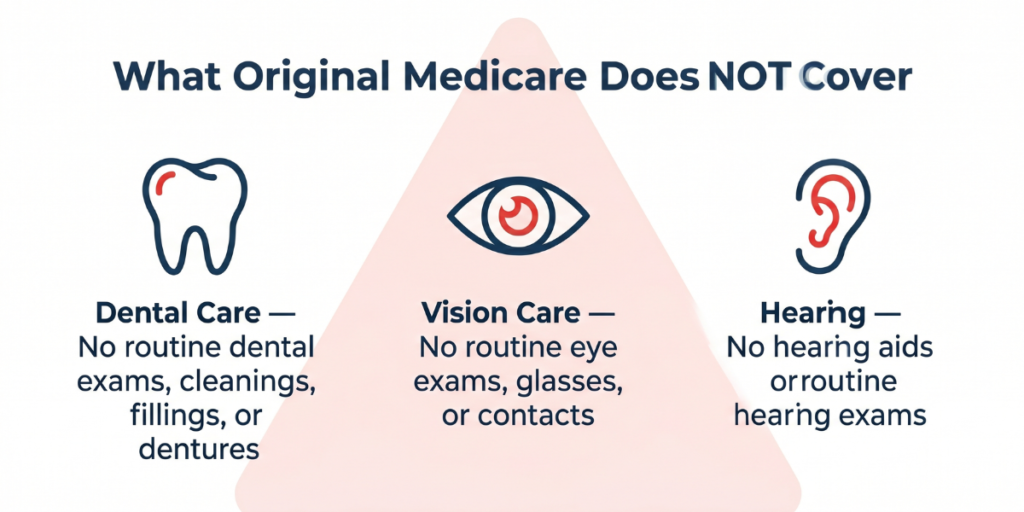
No — Original Medicare (Parts A and B) does not cover routine dental care, routine vision care, or hearing aids. These are three of the biggest coverage gaps in Original Medicare that shock most seniors turning 65.
However Medicare Advantage plans (Part C) frequently include dental, vision and hearing benefits as extra coverage beyond what Original Medicare provides. If dental and vision coverage is important to you Medicare Advantage is worth considering seriously.
Here is a quick summary before we dive into the full details:
- Original Medicare dental coverage — very limited emergency only
- Original Medicare vision coverage — very limited medically necessary only
- Original Medicare hearing coverage — none for hearing aids
- Medicare Advantage dental coverage — often included
- Medicare Advantage vision coverage — often included
- Medicare Advantage hearing coverage — often included
Does Medicare Cover Dental Care in 2026?
Original Medicare does NOT cover routine dental care. This is one of the most significant coverage gaps in the entire Medicare program and affects millions of seniors every year.
Routine dental services that Medicare does NOT cover include:
- Routine dental exams and cleanings
- Dental X-rays
- Fillings and cavity treatment
- Tooth extractions (unless medically necessary)
- Dentures and partial dentures
- Dental implants
- Crowns and bridges
- Gum disease treatment
- Root canals
- Orthodontic treatment
This means if you have Original Medicare and need a routine dental cleaning, filling, or crown — you pay 100% out of pocket. There is no Medicare coverage for these services.
However Original Medicare does cover certain dental services in very limited circumstances:
- Dental services that are an integral part of a covered medical procedure — for example tooth extraction before heart valve replacement surgery
- Dental examination before kidney transplant surgery
- Dental services required due to accidental injury to the mouth or jaw
These exceptions are narrow and do not cover routine dental maintenance. The vast majority of dental work seniors need is not covered by Original Medicare.
The cost of dental care without coverage can be significant. According to dental industry data a routine dental cleaning costs $75 to $200, a filling costs $150 to $300, a crown costs $1,000 to $1,500, and dental implants can cost $3,000 to $5,000 per tooth. Without dental coverage these costs come entirely out of pocket.
Does Medicare Cover Vision Care in 2026?
Original Medicare does NOT cover routine vision care. This is another major coverage gap that catches many seniors off guard when they turn 65.
Routine vision services that Medicare does NOT cover include:
- Routine eye exams for glasses or contact lens prescriptions
- Eyeglasses and contact lenses
- Contact lens fittings
- Refractive eye surgery like LASIK
However Original Medicare does cover certain vision services when they are medically necessary:
- Cataract surgery — Medicare Part B covers cataract surgery including one pair of standard eyeglasses or contact lenses after surgery
- Glaucoma testing — Medicare covers glaucoma screening once per year for high-risk patients including people with diabetes, family history of glaucoma, African Americans aged 50 and older, and Hispanic Americans aged 65 and older
- Diabetic retinopathy screening — Medicare covers annual eye exams for diabetic retinopathy for people with diabetes
- Macular degeneration treatment — Medicare covers diagnosis and treatment of age-related macular degeneration
- Treatment of eye diseases and injuries — Medicare covers medically necessary eye care for conditions like diabetic eye disease, glaucoma treatment, and eye injuries
The key distinction is that Medicare covers eye care that treats a medical condition but does not cover routine vision maintenance like annual eye exams for prescription updates or the cost of glasses.
A standard eye exam for glasses typically costs $100 to $200 out of pocket. Prescription glasses cost $200 to $600 or more. Without vision coverage these costs add up quickly for seniors who need annual prescription updates.
Does Medicare Cover Hearing Aids in 2026?
Original Medicare does NOT cover hearing aids or routine hearing exams for the purpose of fitting hearing aids. This is another significant gap in Medicare coverage that affects millions of seniors.
Hearing services that Medicare does NOT cover include:
- Routine hearing exams
- Hearing aids of any kind
- Hearing aid fittings and adjustments
- Hearing aid batteries and accessories
However Original Medicare does cover certain hearing-related services:
- Diagnostic hearing and balance exams — Medicare Part B covers these when ordered by a doctor to determine if you need medical treatment
- Treatment of hearing conditions — Medicare covers medically necessary treatment for conditions affecting hearing such as ear infections, cochlear implant surgery for severe hearing loss, and treatment of tinnitus
Hearing aids are one of the most expensive uncovered costs for Medicare beneficiaries. A pair of hearing aids can cost $2,000 to $7,000 or more. Without hearing coverage these costs are entirely out of pocket for Original Medicare beneficiaries.
In 2022 the FDA approved over-the-counter hearing aids for adults with mild to moderate hearing loss. These can be purchased without a prescription at stores like Walgreens, CVS, and Best Buy for $200 to $1,500 — a much more affordable option for seniors with mild hearing loss.
Why Does Original Medicare Not Cover Dental and Vision?
Many seniors are shocked that Medicare does not cover dental and vision. The reason is historical — when Medicare was created in 1965 dental and vision care were considered separate from medical care and were excluded from the program.
Several attempts have been made in Congress to add dental and vision coverage to Original Medicare but as of 2026 routine dental and vision remain excluded from the standard Medicare program.
This coverage gap affects approximately 65 million Medicare beneficiaries. According to the Kaiser Family Foundation nearly half of Medicare beneficiaries have no dental coverage at all — making dental care one of the leading out-of-pocket expenses for seniors.
How Medicare Advantage Covers Dental and Vision
Medicare Advantage plans (Part C) frequently include dental, vision and hearing benefits as extra coverage that goes beyond what Original Medicare provides. This is one of the main reasons many seniors choose Medicare Advantage over Original Medicare.
However the extent of dental and vision coverage varies significantly between plans. Not all Medicare Advantage plans include dental and vision coverage and those that do vary greatly in what they cover and how much they cover.
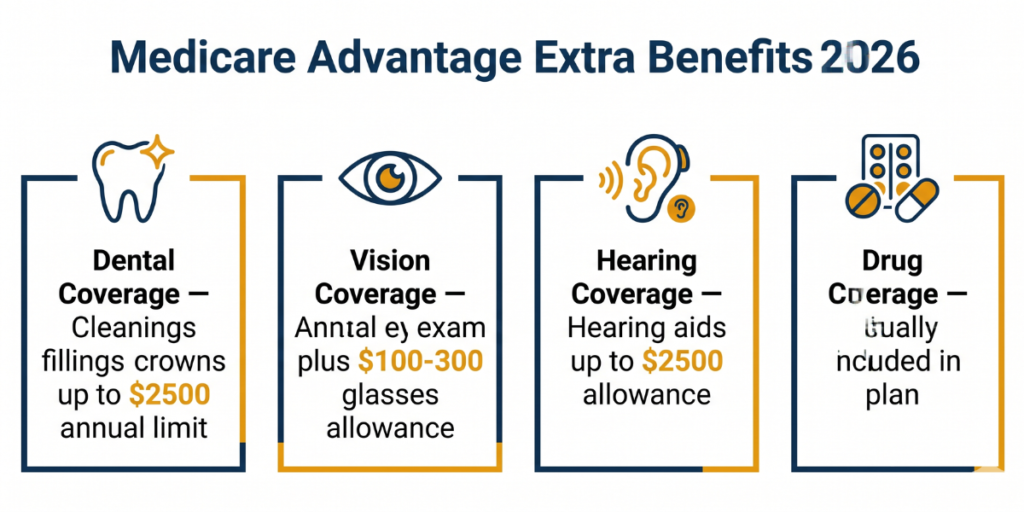
Typical Medicare Advantage dental coverage in 2026 includes:
- Preventive dental care — cleanings, X-rays, exams — usually fully covered
- Basic restorative care — fillings, simple extractions — usually 50% to 80% covered
- Major dental work — crowns, bridges, dentures — some plans cover 50% up to an annual limit
- Annual dental benefit limit — typically $1,000 to $2,500 per year
- Some premium plans offer $3,000 to $5,000 annual dental limits
Typical Medicare Advantage vision coverage in 2026 includes:
- Annual routine eye exam — usually fully covered once per year
- Prescription eyeglasses or contact lenses — usually $100 to $300 allowance per year
- Some plans offer coverage for contacts instead of glasses
- Some premium plans offer higher allowances of $200 to $500
Typical Medicare Advantage hearing coverage in 2026 includes:
- Annual hearing exam — usually covered
- Hearing aids — many plans offer $500 to $2,500 allowance per pair
- Some premium plans offer higher hearing aid allowances
- Coverage for hearing aid fittings and adjustments
To find Medicare Advantage plans with dental and vision coverage in your area use the free plan finder at Medicare.gov and filter by plans that include dental and vision benefits.
Other Ways to Get Dental and Vision Coverage with Medicare
If you have Original Medicare and want dental and vision coverage you have several options beyond Medicare Advantage:
Standalone dental insurance plans — you can buy a separate dental insurance plan from private insurers like Delta Dental, Humana, Cigna, and Aetna. These plans typically cost $20 to $50 per month and cover preventive care and some restorative work up to an annual maximum.
Dental discount plans — these are not insurance but membership programs that give you discounted rates at participating dentists. They typically cost $100 to $200 per year and provide 10% to 60% discounts on dental services. Popular options include Careington and Aetna Dental Access.
Standalone vision insurance — separate vision plans from providers like VSP, EyeMed, and Davis Vision typically cost $10 to $30 per month and cover annual eye exams and provide allowances for glasses or contacts.
Community health centers — federally qualified health centers (FQHCs) offer dental and vision services on a sliding fee scale based on income. Find your nearest FQHC at findahealthcenter.hrsa.gov.
Dental schools — dental schools offer significantly reduced cost dental care performed by supervised dental students. Treatment costs 50% to 80% less than private dental offices. Find accredited dental schools at the American Dental Association website.
Veterans benefits — if you are a veteran you may be eligible for VA dental and vision benefits. Contact your local VA facility or visit va.gov for details.
How to Choose Between Original Medicare and Medicare Advantage for Dental and Vision
If dental and vision coverage is a priority for you here is how to decide between Original Medicare and Medicare Advantage:
Choose Original Medicare plus standalone dental and vision plans if:
- You want complete freedom to see any doctor or specialist nationwide
- You travel frequently or split time between states
- You have complex medical needs requiring specialist access
- You are willing to pay separately for dental and vision coverage
- Dental and vision coverage is important to you
- You are comfortable using a network of local doctors
- You want lower monthly premiums
- You want dental, vision, hearing and drug coverage all in one plan
- You do not travel extensively
The best way to compare is to use the Medicare.gov plan finder during Open Enrollment (October 15 to December 7) to compare Medicare Advantage plans in your zip code and see exactly what dental and vision benefits each plan offers.
How Much Does Medicare Advantage Dental and Vision Coverage Cost?
Many Medicare Advantage plans with dental and vision benefits charge $0 additional premium — meaning you get dental and vision coverage at no extra monthly cost beyond your Part B premium of $185 per month in 2026.
However more comprehensive dental and vision benefits are sometimes available with plans that charge a small additional monthly premium of $20 to $100 per month.
When comparing plans consider not just the premium but also:
- Annual dental benefit maximum — higher is better
- Whether the plan covers major dental work like crowns and implants
- The vision allowance for glasses or contacts
- The hearing aid allowance
- Whether your preferred dentist and eye doctor are in the plan network
Frequently Asked Questions — Does Medicare Cover Dental and Vision?
Does Medicare cover dental implants?
No. Original Medicare does not cover dental implants. Medicare Advantage plans may offer partial coverage for implants but most plans have annual benefit limits that may not fully cover the cost of implants which can run $3,000 to $5,000 per tooth. Check your specific plan’s dental benefits for details.
Does Medicare cover eye exams?
Original Medicare covers eye exams only when medically necessary — such as for diagnosing and treating glaucoma, diabetic retinopathy, or macular degeneration. Routine eye exams for glasses or contact lens prescriptions are not covered. Medicare Advantage plans usually cover one routine eye exam per year.
Does Medicare cover glasses?
Original Medicare covers one pair of standard eyeglasses or contact lenses after cataract surgery. It does not cover routine glasses or contacts for vision correction. Medicare Advantage plans usually provide an annual allowance of $100 to $300 for glasses or contacts.
Does Medicare cover hearing aids?
No. Original Medicare does not cover hearing aids. Medicare Advantage plans often include hearing aid benefits with allowances of $500 to $2,500 per pair. Over-the-counter hearing aids approved by the FDA in 2022 are available without a prescription for $200 to $1,500 for those with mild to moderate hearing loss.
Does Medicare cover dental cleaning?
No. Original Medicare does not cover routine dental cleanings. A routine cleaning costs $75 to $200 out of pocket without coverage. Medicare Advantage plans usually cover preventive dental care including cleanings fully or at low cost.
Does Medicare cover dentures?
No. Original Medicare does not cover dentures. Medicare Advantage plans may offer partial coverage for dentures up to an annual benefit limit. Standalone dental insurance plans also sometimes cover dentures after a waiting period.
When does Medicare cover dental work?
Original Medicare covers dental work only when it is directly related to a covered medical procedure — such as tooth extraction before heart valve surgery or jaw reconstruction after an accident. Routine dental maintenance is never covered by Original Medicare.
How do I get dental coverage with Medicare?
The main options are enrolling in a Medicare Advantage plan that includes dental benefits, purchasing a standalone dental insurance plan, joining a dental discount membership plan, or using community health centers and dental schools for reduced cost care.
Q: Does Medicare cover dental in 2026?
No — Original Medicare does not cover routine dental care including cleanings, fillings, dentures, or implants. Medicare Advantage plans commonly include dental benefits. Standalone dental insurance is also an option.
Q: Does Medicare cover vision in 2026?
No — Original Medicare does not cover routine eye exams or eyeglasses. It does cover cataract surgery and glaucoma screenings for high-risk patients. Medicare Advantage plans typically include a vision benefit with an annual eyewear allowance.
Q: How do I get dental and vision coverage with Medicare?
The easiest way is to enroll in a Medicare Advantage plan that includes dental and vision benefits. Most $0 premium Medicare Advantage plans include at least preventive dental and basic vision coverage.
Q: Does Medigap cover dental and vision?
No — Medigap plans do not cover dental, vision, or hearing. They only cover gaps in Original Medicare costs like deductibles and coinsurance.
Summary — Does Medicare Cover Dental and Vision?
Does Medicare cover dental and vision? The bottom line is that Original Medicare does not cover routine dental care, routine vision care, or hearing aids. These are significant coverage gaps that affect millions of seniors every year.
If dental and vision coverage is important to you the best solution is to enroll in a Medicare Advantage plan that includes these benefits. Many Medicare Advantage plans offer dental, vision, and hearing coverage at $0 additional monthly premium.
Use the free plan finder at Medicare.gov during Open Enrollment (October 15 to December 7) to compare Medicare Advantage plans in your zip code. You can filter specifically for plans that include dental and vision benefits.
For free unbiased help comparing plans in your area contact your State Health Insurance Assistance Program (SHIP) counselor at shiphelp.org or call Medicare free at 1-800-633-4227.
This guide is for informational purposes only and is not medical or financial advice. Always verify current Medicare plan benefits at Medicare.gov before making enrollment decisions.
Sources: Medicare.gov | CMS.gov | SSA.gov | AARP.org | KFF.org
Last updated: April 2026 | Author: James Carter, Independent Medicare Research Analyst
ALSO READ -How Much Does Medicare Cost Per Month in 2026 — Complete Breakdownhttps://medicarebuddyy.com/how-much-does-medicare-cost-per-month-in-2026/
Also Read – Does Medicare Cover Cataract Surgery 2026 — Complete Guide




14 Comments